Picture: Twitter
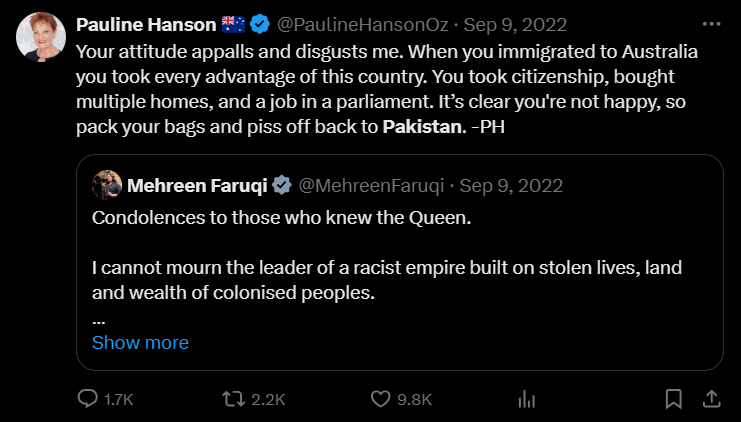
This vulgar remark was directed towards Australian Senator Mehreen Faruqi – not in a private space, but online.
In September 2022, the former Queen Elizabeth II passed away. Mehreen shared her perspective, expressing sympathy for the Queen as an individual, but stating, “I cannot mourn the leader of a racist empire built on the lives, land, and wealth of colonized peoples.”
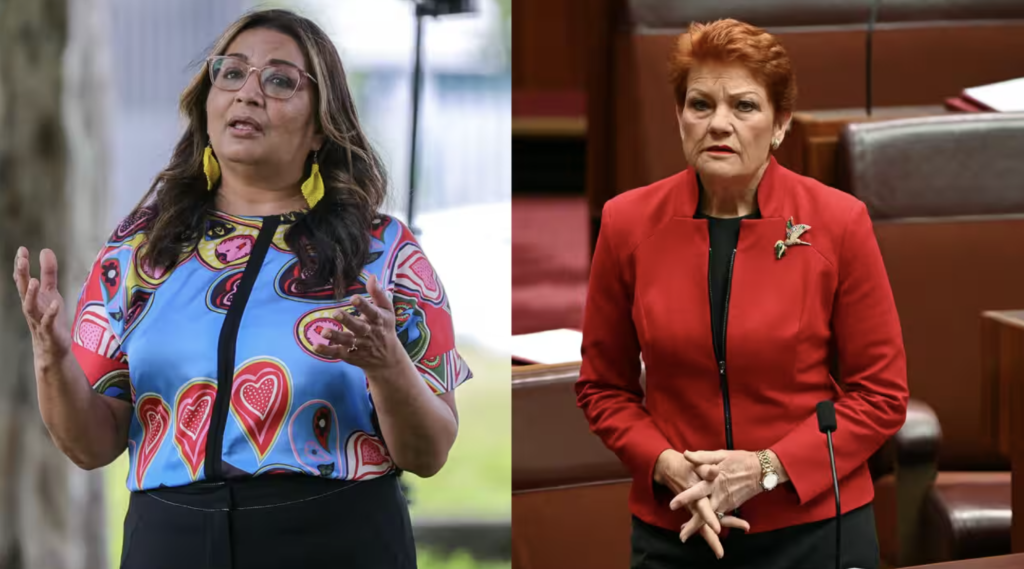
Mehreen Faruqi (left) and Hanson (right). (Picture:SBSNews)
This elicited a vicious response from One Nation Leader Pauline Hanson. Hanson claimed Faruqi has come to Australia to “take every advantage of the country” and shamed the Lahore-born Muslim politician to go back to Pakistan. Thus, in a sense, this response skips the content of what the senator said entirely. Instead, it becomes a question of where she is “allowed” to be.
At first glance, this seems to be just a separate incident of discrimination. But it is not. As a woman of color and a Muslim, Senator Faruqi experiences repeated online hate. Most of these hate speech goes beyond political disagreements, criticising her identity is “simply not allowed” to show in public spaces.
This blog discusses that such things don’t happen by chance, but are structurally shaped and amplified by platform algorithms.
Over the last couple of decades, the rise of social media has allowed the public to participate in political discussions. Previously, we could only passively recieve information through the newspaper, television, or radio, People’s comments on politics can only be exchanged in private or through formal channels, such as writing letters of suggestions or public opinion surveys. In recent years, platforms changed that. People can now respond to anything online publicly, and gain unprecedented direct access to political information and discussion. Not only that, but the models have fundamentally altered the character of political discourse.What we see is not only a broadening of discussion, but a change in which visibility and immediacy outweigh considered speech.
On the one hand, this leads to broader participation, which in itself is not negative. However, there is a catch: the barriers to participation are much lower. Flew (2021) argues that platforms are infrastructural elements that enable the flow of content and data. Thus, information can be uploaded, stored, and exchanged through social media. However, this access to platforms is neutral. It emphasises visibility and rapid dissemination, which makes emotional content easier to spread.
This is where the connection to power comes in. For figures like Mehreen, she is in an open political situation with the cross-identity of women and people of colour. Because of the inequality of the platform’s influence on users, she is more likely to be affected.
In the name of “freedom of speech”, satire, jokes and humour are often used as excuses to cover up racism and gender discrimination. Although these expressions do not look like direct hate speech, in actual dissemination, they get the same exposure and influence as those who openly express hatred. As Matamoros-Fernández (2017) argues, platforms are not passively facilitating or hosting discursive spaces. Rather, they play a significant role in shaping the boundaries of hatred. In other words, rather than hate speech being a passive occurrence, it is an active variable. Platforms exacerbate it.
In this sense, hate speech not only appears on social platforms, but is also amplified through these platforms.
How Platforms Amplify Hate: Understanding “Platformed Racism”
Picture:Adobe Stock
In a 2017 study, Matamoros Fernández introduced the idea of “Platformed Racism.” It is used to explain how technology and culture on social media shape racism. It shifts the focus from individuals to larger structural systems. Platforms are amplifying human hatred and prejudice, rather than the other way around. Fernández reiterated that we know these structures impact content, but they are not innocent. In other words, cyber racism is not brought to the platform by users, but the product of the active participation of the platform in shaping and dissemination.
More specifically, the functions of the platform, such as the algorithm recommendation system, interactive functions( such as likes and shares) and the lack of transparency of content review, have contributed to a system dominated by user participation. The platform will not display all content equally. In order to maintain user activity and participation, the platform will give priority to pushing emotional, extreme and even biased content. Moreover, it is often the most inflammatory content that spreads the farthest. In addition, platform culture and communication norms will also shape the expression of hate speech. As Matamoros-Fernández (2017) pointed out, racism on social media is not always obvious. It may be hidden in humour, memes or obscure language, making it more difficult to find and supervise. Content that triggers anger, indignation or shock tends to generate more interaction. It also signals to the algorithm that these contents should be further promoted.
Therefore, platform design is directly related to the dissemination of hate speech.This is the connection back to platforms. The more hate, the more response, and the more engagement, the quicker and further the tipping point towards exposure. This could continuously build on the hate. This highlights that hate is simply not an incidental occurrence. Rather, it is ingrained in the structure of digitally-induced “exposure,” artificially sown in the metasystem of platforms and algorithmically manipulated for views and clicks. Platforms are more than containers carrying harmful content. These contents are amplified via algorithms and interaction systems.
This helps explain why people like Mehreen Faruqi, who are at the intersection of gender and race, are more likely to be targeted and more aggressive. It is platform systems that decide which content gains attention.
Gender Dimension: Hate Speech Is Not Neutral

Picture:Adobe Stock
Online hatred is not neutral, it is also influenced by the existing gender power relations. More and more studies show that the cyber violence suffered by female politicians is clearly influenced by gender. Meriläinen (2024) acknowledges a significant amount of online attention for women politicians. Still, online harassment often involves hate and is significantly different from men (often implicitly sexual). That is something we care about—the type of hate matters.
Female politicians will encounter different attacks from men on the Internet. These attacks are often amplified through emotional expressions and specific ways of speech, with the aim of “suppressing their voices”. Rather than discussing policies, people are more inclined to question whether women are naturally suitable for politics, which is obvious gender discrimination. These stereotypes do not naturally appear. Rather, they stem from diverse cultural imperatives of female gender roles and the broader social norms surrounding female and male relations.
Again, platforms play a role with their tendency to implicitly overreact. As de Silva and Parker (2025) noted, polarization against women is dire and a bit scary. It complements the rise of platform feminism. While the abuse may be racially or politically motivated, it seems that a shared norm that platforms have allowed women or people of color in these public spaces resembles nothing but danger. It is incessant abuse based on gender.
As Senator Mehreen Faruqi said directly, “one of the main purposes of online hate speech seems to be to silence people, especially women. We receive a constant stream of sexist and racist abuse every day.”
All of this suggests that online hate is a means of upholding an established and familiar “hierarchy,” in that certain voices must not be allowed in at any cost.
Intersectionality: Where Gender and Race Collide

Picture:Adobe Stock
If we dig deeper, we can find that these attacks often revolve around stereotyped evaluations of women (such as emotional, unreasonable or irrational) and based on traditional gender and racial roles. To understand this, the “intersectionality” theory can be introduced, which highlights the interconnectedness of social and power structures that complements different areas of hate.
As speculated by Meriläinen (2024), female political leaders may have more chances of receiving attacks as they challenge borders. They may become more densely targeted. Because they are active voices and are likely presented with more exposure, potentially maligning effects on the leader’ s reputation. More importantly, these attacks often shift from political discussions to attacks based on gender or race.
But rather, female politicians have different burdens, triggering through potential policies. Visibility embodies similar exposure, but also potential fire. In this case, the effects will not evenly spread in other sheltered places. Lowers on the visible scale will culminate upon the intersectional identity between race and gender.
Through outside opportunities, they are more likely and intense, often drawing on heir visible identity characteristics (such as gender or race) . It invisibly reinforces existing social norms, stipulating what can be said and what cannot be said. Once they cross the line, it will be regarded as “wrong.”
These phenomena are actually maintaining a long-standing patriarchal power structure. This structure places different groups in specific social roles through gender and racial norms. In a mixed public space like social media, these “unspoken rules” continue to affect who can speak out and who should be silent. And these structural factors are more critical than individual speech itself.
This demonstrates the power of the platforms. Indeed, this kind of attack against someone of color—often female, but not feminine—on these visible spheres of race and gender can double its weight. An individual predicament with imminent assaults—about a race (bottom of the gender spectrum online) and gender-based norms on the upper region, affirmatively triggering a loss of control or respect on the lower end.
What is alarming is that platforms do not necessarily shift. Their mechanisms implicating male- or gendered-bias. Or rather: platforms can amplify their anti-systematic workings against these de-familiarized participants.
This comes to show that oppositional perspectives against predominant ideals that resemble “fear” of others’ voices, that is, “against” those individuals who need to go back and stay in this exact country, must be left out; injustice is part of their utopia. As multiple voices are replayed, it leads to clearly negative outcomes.
Limitations of Platform Governance

Picture:Adobe Stock
Although platforms readily oppose hate, there is a deep paradox in hate speech governance. On the surface, platforms are “good guys” or, rather, simply innocently axing baselines on every “cleared” hate speech. Some hatreds are often not expressed openly and directly, but spread in a more implicit way, so it is more difficult to be regulated.
Well, here lies the paradox. First, there is a low threshold depending on how deeply one settles one’ s own unhappiness, rather temporarily, at the risk of “freedom of speech.” Where could we draw the line in fastening such a rule? This leads to a higher incentive towards an ambiguous notion to judge by or appeal to certain, especially those promising gender, often seen in these favoring perspectives.
Moreover, the platform has obvious ambiguity in distinguishing and managing different types of speech. This unclear judgement standard makes the treatment of hate speech inconsistent. Especially when it comes to gender or racial harassment, the governance mechanism of the platform is flawed. It may not be handled properly, but it may also amplify certain attacks, thus failing to effectively reduce the damage.
As noted, it is a vicious cycle. This will lead to a higher bias in identifying several contents beyond sections, dependent on the algorithm outputs that people might take as apparent responsibility. Simply, they bring more false positives; subsequently, some core-risk believes these regularities disproportionately escalate some forms of pervasive threat.
What’ s more, platform supervision is not transparent. While some content is deleted, others are still visble. It leads users to be confused. Sinpeng (2021) points out, in different culture and contexts, platforms can’t capture all hate speech, especially remarks against special groups.
Fundamentally, user participation decides the platform’s dissemination of content. People are easily attracted to controversial content. Therefore, negative content is more likely to be spread. Even if the platform tries to regulate hate speech, it can’t change the underlying design to restrict the dissemination, which is chosen by users.
Finally, user participation determines most of the platform’s profitability. This logic is embedded in the system. It is hard to address the problem from the root. So only rely on personal behaviour is not enough, we need to realize that the structure of platforms( algorithm, management and profit model) contributes to hate speech.
Conclusion
It can be seen from the example of Mehreen Faruqi, hate speech becomes more intense whhile facing special identities, such as women and people of colour. Platform structure, social bias and deep-rooted power relations together cause this phenomenon.
Therefore, we need to take an in-depth look at the platform underlying logic and algorithms. Meanwhile, it is urgent to realize the hidden prejudices against women and people of colour, even in the cyber space. Only by paying attention to these existing problems, can we build a more equal and inclusive online environment.
Reference
Flew, Terry. (2022). Regulating platforms. Polity Press.
Matamoros-Fernández, A. (2017).Platformed racism: The mediation and circulation of an Australian race-based controversy on Twitter, Facebook and YouTube. Information, Communication & Society, 20(6), 930–946.
Meriläinen, J.-M. (2025).The role of gender in hate speech targeting politicians: Evidence from Finnish Twitter. International Journal of Politics, Culture, and Society, 38, 423–449.
de Silva, A., & Parker, C. (2025). Platformed hate speech against women: Beyond self-regulation. UNSW Law Journal, 48(2).
Sinpeng, A., Martin, F., Gelber, K., & Shields, K. (2021). Facebook: Regulating hate speech in the Asia Pacific. University of Sydney & University of Queensland.
Be the first to comment