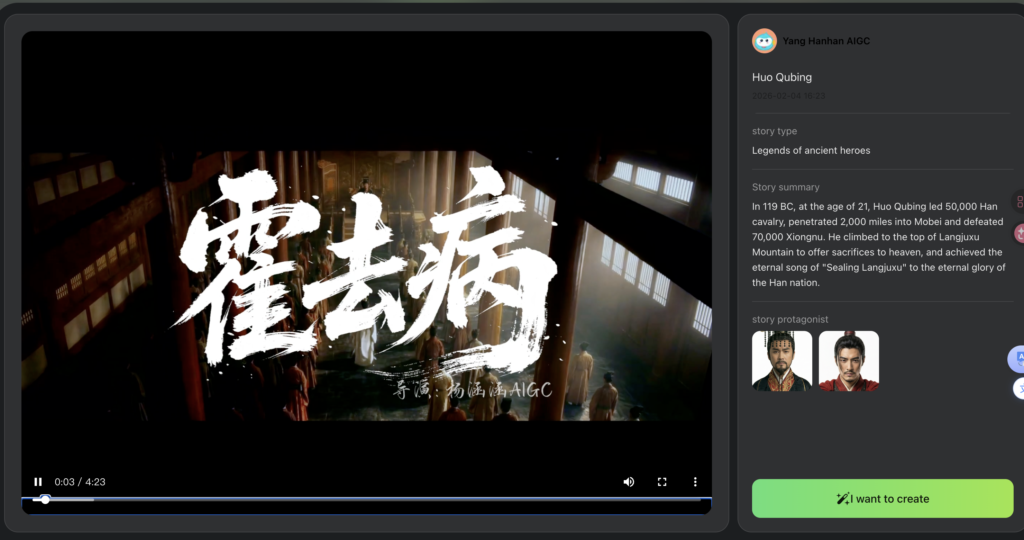
Figure 1. Screenshot of AI short drama Huo Qubing Note. From 霍去病 [AI short drama], by Namistory, 2026 (https://namistory.n.cn/).
The Story That Wouldn’t Die
In March 2026, Chinese social media was sparsely covered with shocking titles such as: A team of three spent less than 3,000 yuan (approximately 400 US dollars) in 48 hours it had become an AI-generated short drama about General Huo Qubing from ancient China. According to reports, it has attracted more than 500 million viewers on Douyin (Tiktok known in China). If such data is valid, then there has been a fundamental change to the model of the film economic systems – less than 0.001 cents per view, potentially democratizing content creation overnight.
The above numbers are quite remarkable: $400 per 500 million likes. Each View is less than 1 per thousand cents. If so, then the entire economic rationale for film production has been transformed into a different state overnight. Independent creators can resist studios autonomously. No more gatekeepers. The Future is Now.
Huo Qubing’s director Yang Hanhan issued a statement that garnered relatively lower public interest compared to the initial viral claims. Only 3 people were considered as the primary creators, and there were actually about 20 staff involved in reality. “48 h” only indicated that it would take 48 hours to complete; in fact, this process involved four consecutive days and nights of hard labour. Moreover, the 3,000 yuan was insufficient to cover all related costs such as labour and machinery fees. Yang explicitly stated that she cannot verify whether the 500 million views were confirmed by any other means or if they came solely from media reports.
However, this kind of creative myth has spread widely; therefore, a new type of story now exists that claims AI has reduced the entry barrier to creation. The birth of the artificial intelligence short drama suggests that platform power is shifting from direct management of content distribution to inducing ideas and producing works via technology. Also shows that the existing governance mechanism has not yet reflected this change, or that it still needs to be improved in terms of maturity under such circumstances.
The production schedule is distributed 48 hours, but there was no relaxation at all during this time period. The 3,000 yuan only covers the cost of AI computing power, excluding labor, equipment, or other expenses. And the fifty million views? Yang Hanhan is certain that the amount cannot be verified precisely because it was reported by the media and not an official tally.
Therefore, the platform imagination collapse occurred. People are not lacking in knowledge but have chosen a way that is incorrect for knowing this truth. Exploitation in the portrayal of artificial intelligence is seen as empowerment; exclusion has become efficient, and monopoly has been turned into democracy. The same thing when packaged with a new plot cannot be regulated by existing regulatory measures because there is no underlying issue. Hence, although Huo Qubing’s director provided an explanation for the veracity of the evidence at the time, people persisted in believing that AI short dramas had become more democratic.
What Actually Happened
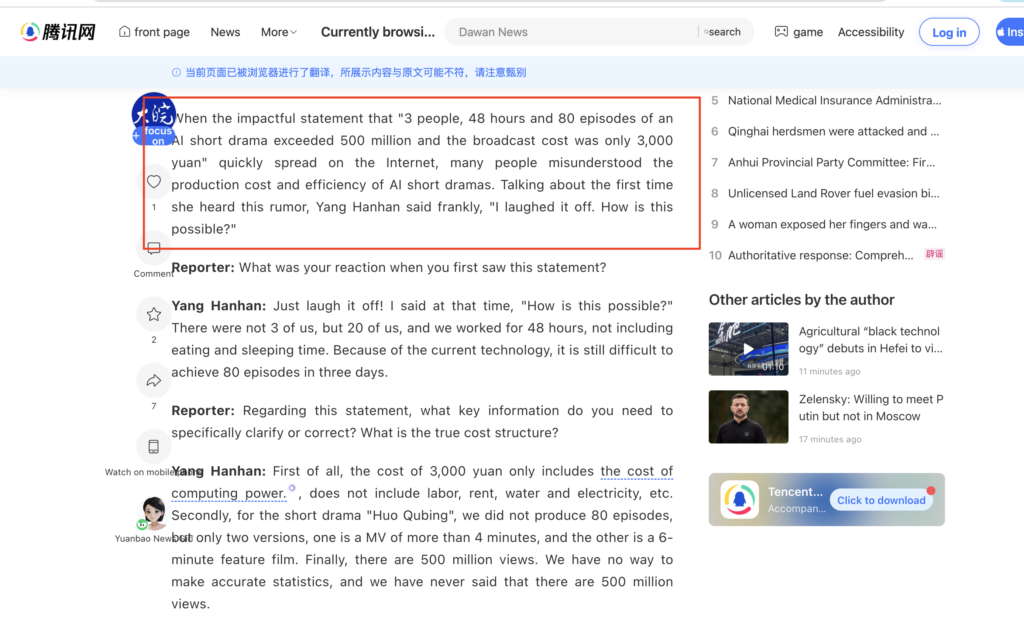
Figure 2. Screenshot of a Dawan News interview with director Yang Hanhan discussing AI-generated short drama production. Source: Tencent News.
Yang’s group did not press the switch to create a complete drama all at once. Generated 1,700 AI images and produced 90 workable storyboards through screening. They produced 500 videos from the above pictures. Tasks such as editing, composition, sound mixing and refinement cannot be completed by the algorithm yet. It indicates that almost all had been eliminated. It is still a non-frictionless creation. This is an industrial-scale trial of errors under a mask of “AI-generated”.
Contrary to the widespread notion of an “80-episode” production format, actually there were only two short films with a total length of about 4 to 6 minutes, which is less than one episode. However, it is much more difficult to spread widely compared with the sensationalist one. Unconfirmed indicators serve multiple interests: Investors’ Pursuit of Validation in AI Investments; Platforms to Promote Their Democratic Narrative; Technology Companies for Marketing Purposes.
According to Burroughs, the phenomenon taking place now should be called a streaming lore. Legends are not reports of reality; they are the framework through which we perceive reality. In the field of AI short dramas, the framework of “AI empowering creation” that is exaggerated is not explaining reality, but rather limiting the questions you can ask, such as “Where does the data come from?” “What should those deprived of labor, like scriptwriters and actors, do?” Wait a moment. In simple terms, the platform is not presenting reality; rather, it is teaching you how to understand reality. Therefore, in the “democratization” narrative, these issues have become those that should not be raised. Once these myths exist, raising these issues would be seen as opposing innovation, and thus would be placed on the opposite side of innovation.These are the platforms’ own story-telling about how they work; stories of friction-free creation and algorithmic success, democratising possibilities – repeating them so much that it feels like a commonplace (Burroughs, 2019). The myth of Huo Qubing was immediately transformed into a digital legend and has served as an interest in favour for those concerned or on particular websites.
The Shift Nobody’s Talking About
In fact, this platform has moved out of its control over sales and Distribution into self-governance within production technology.
Netflix and traditional streaming service providers who select the content displayed on their respective websites/apps for users. However, AI platforms utilise this authority for creation. Determine what tools creators can afford, which workflows technology is feasible for application, and decide on the form of “good” AI-generated works.
Short AI drama Huo Qubing was made by a tiny theatre workshop called “Namistory” under the control of the technology company 360 Group. Not only does the platform release the end products but it also creates a production environment through price-setting for computational resources, training of deep learning models and aesthetics settings for AI-generated short dramas.
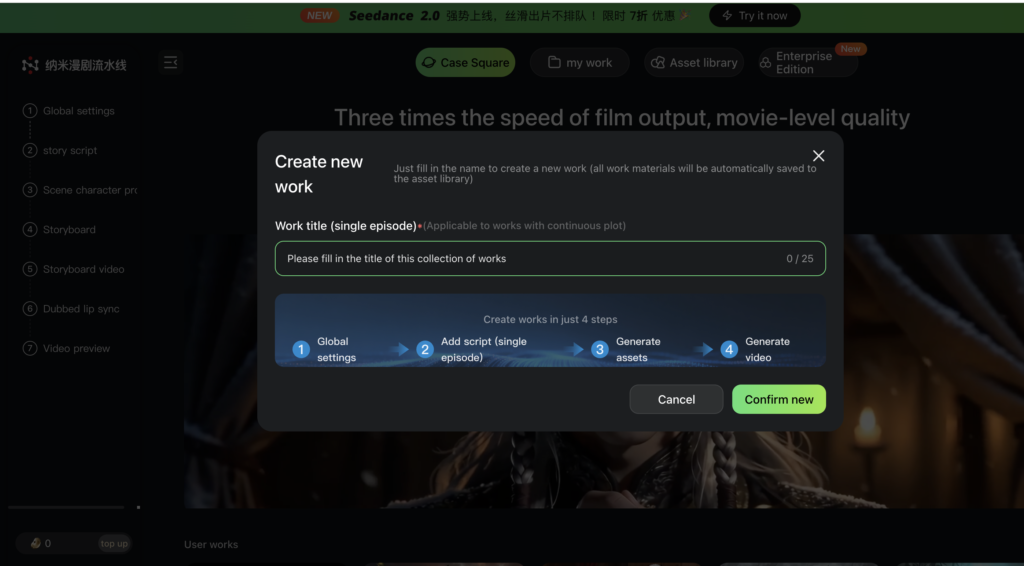
Figure 3. Screenshot of Namistory platform interface for creating AI-generated content Note. From Namistory [Software], by Namistory, 2026 (https://namistory.n.cn/).
Crawford has stated that AI is not artificial nor intelligent, but rather an extract of power ledger generated by extracted labour, resources and capital (Crawford, 2021). AI system encoding whose stories are true to its own sense of aesthetics and which kinds of stories deserve our admiration, whether such a face can conform to society’s norms for beauty, and then the biases in the training data will shape this generation culture. The Huo Qubing case offers a window on the ledger to see that there were originally 1,700 lost pictures that could have saved computers and energy resources; Invisible work of about twenty people was hidden behind “AI-generated” certificates.
Since there is no motivation for correction when myths disseminate; Myths are primary channels to promote the products.
Why Governance Keeps Missing This
Huo Qubing has sparked calls for sector regulation. Analysts recommend building a check function for playback Volume, establishing standards for cost disclosure, and making users clearly label AI-produced items. These are necessary countermeasures, yet they merely address the surface problems of the existing system.
Regulatory systems still face these three problems: copyright infringement and deepfaked content; Consumers’ rights protection. This is quite essential yet lacks the most fundamental change – production power has gathered in these artificial intelligence platforms; no longer just controlling what the audience sees, it can even influence how the content gets made.
Terry Flew believes that regulation failure generally begins with Words. Until then, it will have determined that an issue has been identified on the platform (Flew, 2021). Words such as “democratisation” and “empowering creators” have undoubtedly positive associations. No one desires regulation of democracy.
However, we can see what lies behind them now. The twenty-member group that was shrouded in the “AI-generated” stigma. 1700 invalid images, including unused calculations and environmental impacts. A small number of AI production tools are held by several technology giants; as a result, these companies have strengthened their public relationship.
Frank Pasquale objects to the “black-box society” with reduced accountability of each individual due to top-down decisions. The next generation of content generated by AI technology. The technology per se does not have mystery, but rather the underlying power relations that lie beneath its “democratisation” rhetoric.
In fact, the so-called “democracy” of artificial intelligence promises everyone to create freely; However, behind this promise lies a reality where it restricts who can produce based on certain criteria and keeps these standards hidden from people’s view. In other words, even though there may be fewer barriers to entering production now, in reality, the conditions under which creators produce are relatively tight.
After regulators establish the basic outline of old-type AIG applications, the platform will be upgraded to the next level.
The Asymmetry of Platform Imagination
So here we are. A short-six-minute AI-generated film of a general long-dead for over two millennia, which was seen by the audience as various images. Each person observed only that which was intended for observation: Investors verified their AI investments. The platform saw the proof of the democratisation mission. Creators see their future having higher accessibility. The regulators could not determine whether the phenomena met their criteria.
It was not because of the false spread by people; It is that the false story was more credible than the real one. We have mastered the platform language of platform discourse: exploiting as efficiency, monopoly as democratisation and surveillance as personalisation. What I refer to as the platform-imagination crisis hereafter. We have it now. There are specific data: less than twenty people, approximately; In reality, it was only 48 hours for work on this project, which included all non-working time as well; Unofficial views have been reported rather than the official fifty-million plus figure. What we are lacking in concept is how to describe what has been observed.
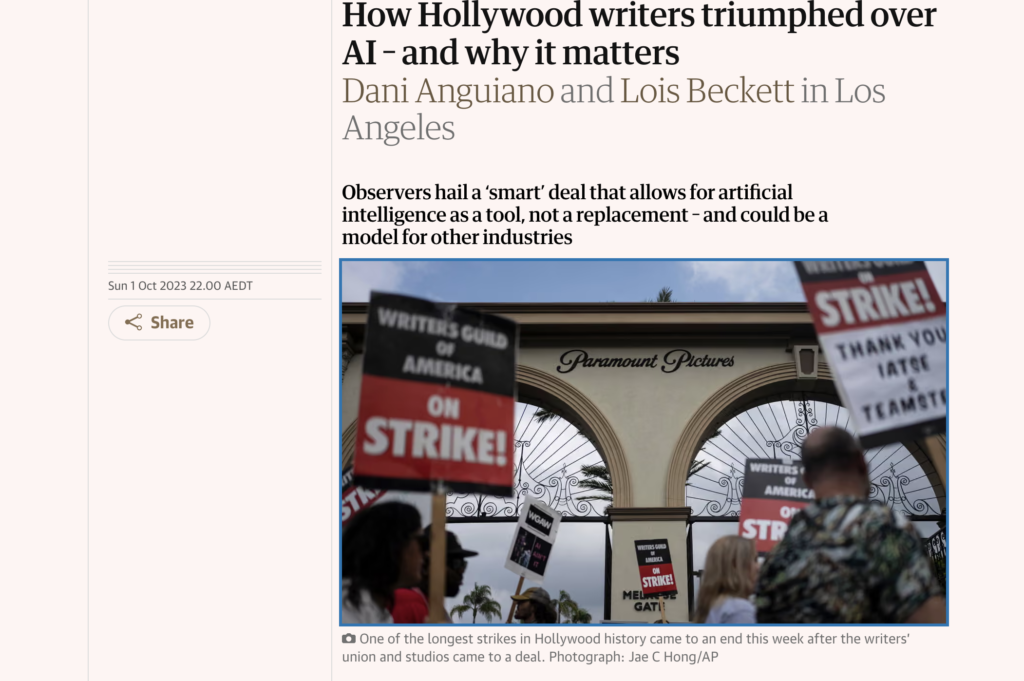
Figure 4. Screenshot of The Guardian article on Hollywood writers’ strike and AI
Note. From “How Hollywood writers triumphed over AI – and why it matters,” by
D. Anguiano & L. Beckett, 2023, October 1, The Guardian
(https://www.theguardian.com/culture/2023/oct/01/hollywood-writers-strike-artificial-intelligence).
See the following example of contrast. In 2023, the Writers Guild of America went on a one-year-long strike and the core issue at that time was an AI-generated script. Writers went out of the studios to give interviews and make their work visible in society. They won contract protection: AI cannot be credited as a writer, cannot write or rewrite literary materials without human involvement, and the studios must disclose AI-generated content to the writers. Annual verification of the latest progress in AI is required here.
About 20 people were involved in making Huo Qubing. They lacked the workers’ council, strike barriers or a press office. When Yang Hanhan released its own explanation, it should have terminated the legend. But it didn’t. The platform lacked motivation for amplification of the correction. The democratisation story also helps other groups. This problem of asymmetrical imagination on the platform. Some labour can be organised, self-recounted and need recognition. However, the labour that produced the “AI-generated” text has lost its ability to tell its own story. It can manage both the output of goods and who has spoken; it’s what we call “control”.
Who Writes the Story?
General Huo Qubing lived almost two millennia earlier. In March, 2026, he rose from the ashes of pixels to become an algorithmic myth about artificial intelligence creation.
The story being spread is not about history. It is the future platform hopes we can picture: A frictionless, algorithmically generated and more open society. There are about twenty members in reality, more than two thousand photographs, and a director attempting to control the runaway story line.
There are such logical connections expanding. AI-created music is rampant on streaming services; Algorithms shape what many people know; And AI-aided education determines what children learn. Each time, following a similar storyline pattern: empowerment; Democratise; Increase efficiency. The same reality: centralised power; Invisible labour; Lagging supervision.
It is not about whether the platforms need to be managed. Whether we will be able to cease using their vernacular and begin imagining governance of our own creation.
Huo Qubing’s soul has come back to life through pixels. It needs a more interesting or important event than what appears here. Therefore, so do I.
References:
Anguiano, D., & Beckett, L. (2023, October 1). How Hollywood writers triumphed over AI – and why it matters. The Guardian. https://www.theguardian.com/culture/2023/oct/01/hollywood-writers-strike-artificial-intelligence
Burroughs, B. (2019). House of Netflix: Streaming media and digital lore. Popular Communication, 17(1), 1–17. https://doi.org/10.1080/15405702.2017.1343948
Crawford, K. (2021). The atlas of AI: Power, politics, and the planetary costs of artificial intelligence. Yale University Press.
Flew, T. (2021). Regulating platforms. Polity Press.
Namistory. (2026). 霍去病 [AI short drama]. https://namistory.n.cn/
Namistory. (2026). Create new work [Software interface]. https://namistory.n.cn/
Pasquale, F. (2015). The black box society: The secret algorithms that control money and information. Harvard University Press. http://www.jstor.org/stable/j.ctt13x0hch
Tencent News. (2026, March 27). 3人48小时80集,成本仅3000元?AI短剧《霍去病》导演回应 [3 people, 48 hours, 80 episodes, cost only 3,000 yuan? AI short drama Huo Qubing director responds]. https://news.qq.com/rain/a/20260327A03O6H00
Xinhua. (2026, March 17). AI-generated short dramas surge in China, raising copyright concerns. Xinhua News Agency. https://english.news.cn/20260317/b03f83726e364660970072e9fe6c6bc0/c.html
澎湃新闻. (2026, March 13). 3000块钱做出5亿播放量?AI短剧《霍去病》引争议. https://www.thepaper.cn/newsDetail_forward_32754377
36氪. (2026, March 10). AI短剧《霍去病》爆火,但为何成了一场闹剧? https://www.36kr.com/p/3716954732311941
Be the first to comment