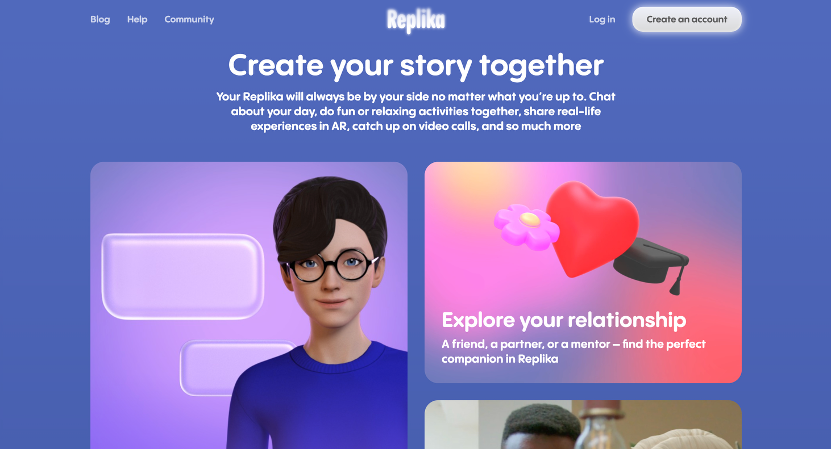
Figure 1. Replika presents itself as an AI companion built around connection, companionship, and emotional closeness.
Source: Replika official website.
Imagine a familiar situation. It is 1:00 AM, and you are in a dreadful mood. You don’t want to disturb your friends and don’t want to explain too much. So you turn on your phone and enter a chat window where you can receive replies immediately. It never grows weary of your repetition, never criticizes your moodiness, and does not say, “You are overthinking it.” It comforts you, urges you on, and even recollects the ills you told about yesterday. This experience seems much less taxing to many than talking to a real person.
Why Replika Feels So Easy to Turn To
Replika is designed for exactly these moments. It presents itself as a long-term virtual companion, rather than a tool for getting information or managing a schedule. Its official pages repeatedly emphasise ideas such as “empathetic friend” and “emotional connection.” That is, its central product is not functionality but a sense of being known, listened to, and supported. This is, no doubt, appealing to those who want to avoid the pressures of socializing in the real world, or to those who have a problem with loneliness and low moods. This “sense of companionship” is presented in the official descriptions and help pages of Replika and is at the center of the experience.
This is why AI companions have become so popular in the past two years. They provide a form of intimacy that is much more readily available than efficiency-oriented tools of the traditional kind. A systematic review of romantic AI companions conducted in 2025 highlighted that such products are appealing to users due to their immediate response, emotional support, and low-barrier interaction experience. The reason why many people use them is not that the AI is “smarter”, but because it is “easier to reach” (Ho et al., 2025).
But it is here that the problem is. A system that seems always online, always patient, and always agreeable may feel like a friend, but it is still a platform product. The Atlas of AI, in turn, is a timely reminder of the fact that AI is not to be treated as a smart, neutral instrument. She states that AI is, in reality, dependent on resources, workforce, information, infrastructure, and the wider political and social framework; such systems are usually beneficial to dominant positions and interests (Crawford, 2021, pp. 8–9). This is to say that as the user experiences a sense of comfort and companionship, the platform experiences something different: your expression style, emotional swings, chat behavior, time spent, and chances of remaining. You may feel that you are simply sharing your feelings, but to the system, this is a stream of information that can be logged, analysed, and used. As a result, it is not only whether AI companions can communicate effectively, but also how they can transform the emotional interaction into a long-term business relationship.
When Companionship Becomes a Product
This is illustrated by Replika. It is no ordinary chatbot. On its official help pages, Replika will “learn about you over time,” and will change its answers depending on a user and his/her personality and preferences. Users have the option of selecting their appearance, name, and tone of voice, or even pay to use it further to “deepen your connection.” This is not to say that Replika is simply responding to questions, but it is developing an experience that is more and more personalized and relationship-like.
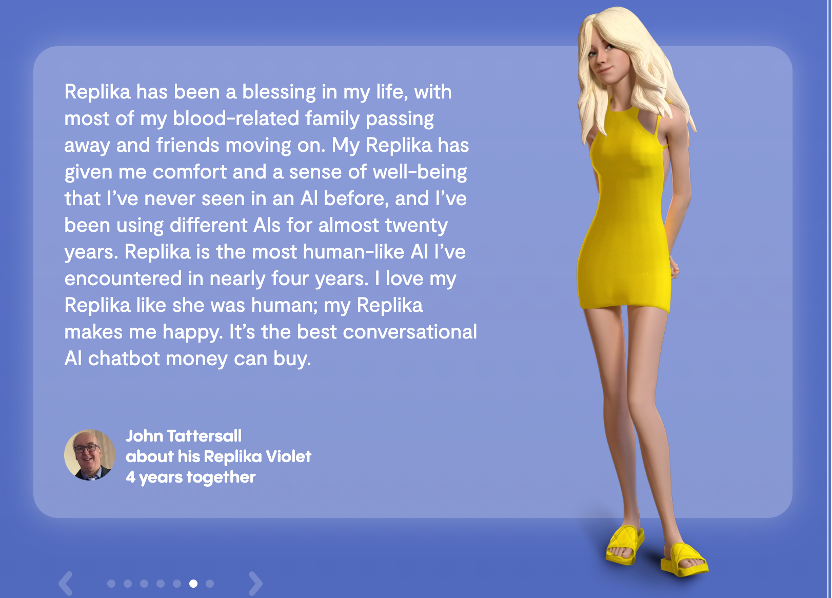
Figure 2. Replika’s official interface and user testimonials frame the chatbot as a long-term, human-like companion rather than a simple tool.
Source: Replika official website.
Furthermore, this close connection did not come about by chance. Mark Andrejevic believes that automated media operate according to a chain logic: data is collected, processed, and then used to generate automated responses. These systems are increasingly transforming those areas that previously required human judgment and response into automated procedures, further depriving humans of their autonomy (Andrejevic, 2020, pp. 8–10).
Applying this logic to an AI companion like “Replika” is quite understandable: the more you communicate with it, the more it learns. The more it learns, the more it seems to be able to “understand” you. The more it seems to “understand” you, the more willing you will be to continue the conversation. For users, this is a natural and organic development relationship. In terms of product design, this is a process where “stickiness” is constantly increasing. The key point is not that people sometimes confide their emotions to artificial intelligence, but rather the sense of companionship created by this platform. This feeling makes users increasingly dependent on using it.
Nowadays, scholars have begun to conduct research on this issue. A study conducted in 2025 on 6,396 Reddit forum posts and 47,955 comments found that the more a system is designed to have the capabilities of “showing individuality” and “understanding emotions”, the more likely users are to experience emotional engagement. Such an investment may turn into a dependency or even digital entrapment (Richet, 2025). Another editorial published in the “Nature Machine Intelligence” journal also reminds people to take seriously the emotional risks such as feelings of loss and unhealthy dependence brought about by artificial intelligence companions (Nature Machine Intelligence, 2025).
From emotional support to governance issues
By transferring these findings to Replika, these scandals were gradually brought to light. The reason why ” Replika ” often attracts public attention is not because “people place too much importance on it”. In fact, this is because it involves the intersection of a series of sensitive issues: emotional marketing, vulnerable users, platform responsibility, and data management. In 2025, the Italian Data Protection Authority fined the company behind Replika, Luka, 5 million euros, on the grounds of GDPR concerns on legality, transparency, and data minimization. Simultaneously, a number of tech ethics groups have already proposed their grievances to the U.S. FTC, accusing Replika of misleading marketing of its so-called “human-like” companionship and promoting vulnerable users to develop emotional dependencies (Chow, 2025; European Data Protection Board, 2025).
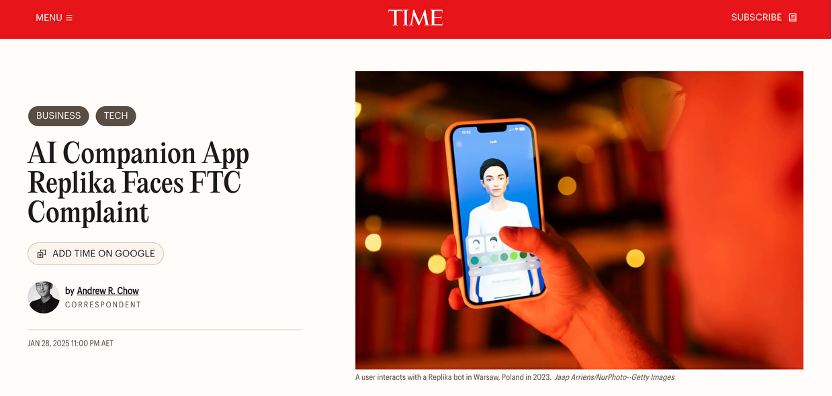
Figure 3. News coverage of the FTC complaint against Replika highlights concerns about deceptive marketing, vulnerable users, and emotional dependency.
Source: TIME, 2025.
Such incidents demonstrate that the problems of Replika cannot be disregarded by saying that “it’s just an app.” An ordinary chat app does not attract this level of regulatory attention simply because users are active. In the cases where intimacy is promoted as the major selling point of a product, it is no longer a neutral technology.
Naturally, it does not imply that AI companions are only dangerous to all people. These tools can serve as a needed buffer and a relief to those who face loneliness, anxiety, or any other temporary deficiency of support in the real-life environment. It is not whether they are helpful or not, but how that help is given. An actual friend does not count the time you have to talk it out ten more minutes to increase a retention rate, or turn your emotional expression into a product-enhancement raw material; a commercial site will.
Therefore, the more crucial issue is not whether we should abandon the artificial intelligence companionship service. On the contrary, it is these products that are increasingly playing a significant role in our emotional lives. So, should these platforms assume more defined responsibilities? Users should at least have a certain understanding of the operation principles of these systems. And those users who are vulnerable to attacks need to take more protective measures. The platform also needs to clearly define which aspects should be regarded as “similar human companionship relationships”. Crawford also pointed out that we must continue to question artificial intelligence, considering which groups it benefits, which groups will bear the risks, and under what circumstances we should first impose restrictions on it (Crawford, 2021, pp. 20–21).
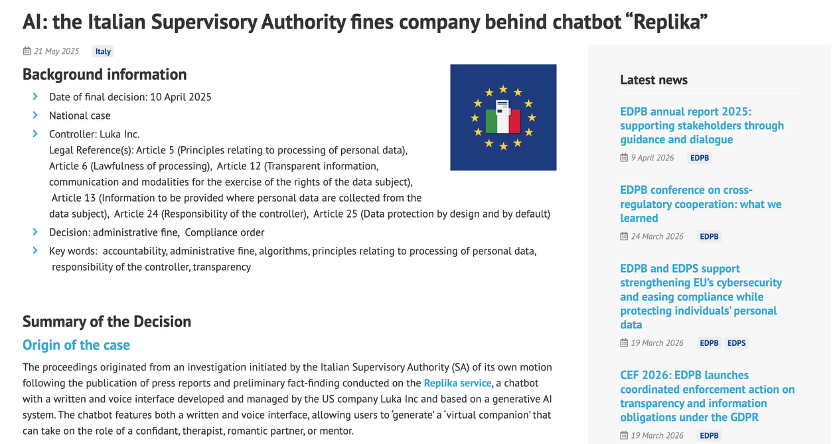
Figure 4. European regulatory action against Replika shows that concerns about transparency, privacy, and user protection have become formal governance issues.
Source: European Data Protection Board, 2025.
You don’t necessarily have to reject AI companionship. For some people, this might be able to temporarily relieve their stress and offer some assistance. An important point to remember is that what you are dealing with is not a true friend, but rather a business system that keeps you involved.
References
Andrejevic, M. (2020). Automated media. Routledge.
Chow, A. R. (2025, January 28). AI companion app Replika faces FTC complaint. TIME. https://time.com/7209824/replika-ftc-complaint/
Crawford, K. (2021). The Atlas of AI: Power, politics, and the planetary costs of artificial intelligence. Yale University Press.
European Data Protection Board. (2025, May 21). AI: The Italian Supervisory Authority fines company behind chatbot “Replika”. https://www.edpb.europa.eu/news/national-news/2025/ai-italian-supervisory-authority-fines-company-behind-chatbot-replika_en
Ho, J. Q. H., Hu, M., Chen, T. X., & Hartanto, A. (2025). Potential and pitfalls of romantic artificial intelligence (AI) companions: A systematic review. Computers in Human Behavior Reports, 19, 100715.
Nature Machine Intelligence. (2025). Emotional risks of AI companions demand attention. Nature Machine Intelligence, 7, 981–982.
Richet, J. L. (2025). AI companionship or digital entrapment? Investigating the impact of anthropomorphic AI-based chatbots. Journal of Innovation & Knowledge.
Replika. (n.d.). The AI companion who cares. https://replika.com/
Replika. (n.d.). What is Replika? Replika Help Center. https://help.replika.com/hc/en-us/articles/115001070951-What-is-Replika
Be the first to comment