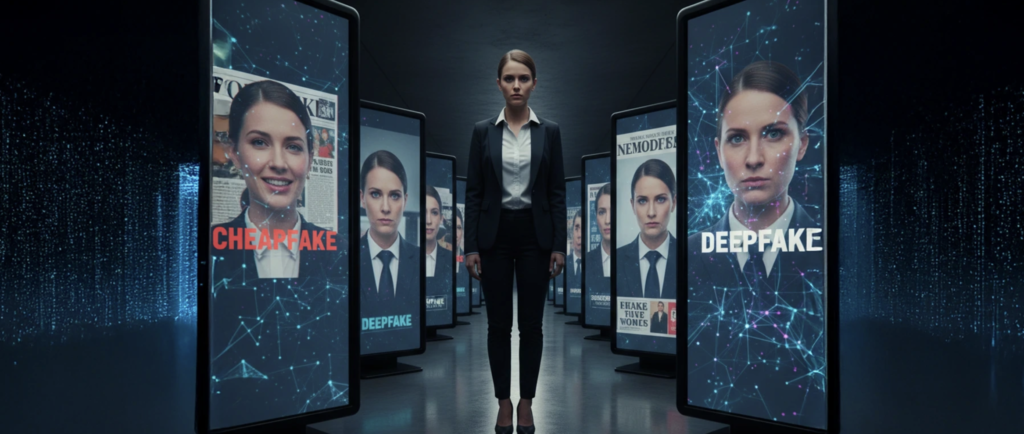
Imagine this: When you’re scrolling through social media, a video suddenly appears showing a well-known public person saying shocking statements. The video looks completely real—every detail, from facial expressions and voice to the background, feels perfectly believable. But what if it was all fake?
Picture Source: Copyleaks
What is ‘DEEPFAKE’?
This is the new reality of ‘deepfakes,’ a type of AI-generated media. It can edit or completely create images, videos, and even audio from nothing. It makes content look like someone truly said or did something, even though they never actually did. Unlike traditional editing methods that required professional skills and could be detected with careful observation, deepfakes are becoming increasingly subtle and easily accessible. Nowadays, with AI tools available everywhere, almost anyone can create highly realistic fake content in a short amount of time.
This technology’s rapid growth is closely tied to progress in machine learning, especially systems that train with large amounts of facial and voice data. These systems can learn different models and copy them with remarkable accuracy. The rise of this technology is not all negative. On the one hand, because of its realism and unique ability, many people who are suffering from emotional or psychological trauma caused by the death or separation of family members can use it to find some short-term healing or comfort. But we must admit that AI tools are not simply neutral, which means they will shape by human values, decisions and bias.
Big data, algorithms, these kinds of terms are often viewed as neutral, harmless, or objective, but they are not (Noble, 2018).
The dependence of people on social media and their use makes these kinds of content spread faster and more widely than any time before without getting checked.
Why problems appear and What we are concerning?
Based on this situation, the main problem is related to human beings. Deepfakes can spread quickly now days is because people are become more depend on the convenience of artificial intelligence, the brains are lazy sensory responses, lack of responsibility in online browsing, and a thirst of visual gratification. These reasons caused this content to spread rapidly. Therefore, provide a good opportunity to deepfake contents to distribute fake information, but also can challenge the concept of ‘truth’ in the online world. They emerge in a digital environment where the spread of information is fast and easy. Without careful attention, deepfakes might seem like just another form of online fake news, similar with photoshopped images or mislead headlines.
In the past, people trusted the truths presented in videos or images they saw online, especially videos recording specific moments were viewed as powerful evidence that something truly happened. However, deepfakes have overturned this belief. When video content can be created or edited with near-perfect realism, visual evidence can no longer guarantee authenticity. Crawford (2021) said, it is hard for people to confirm clearly what the models really learned from the data they received. This leads people to question everything they see, even if it is real. This is also the ‘crisis of truth’ theory advanced by some academic scholars. The problem is not only that trust in digital media begins to crack, if people keep watching contents with careless opinion, any video could be fake, then no video or image is worth trusting.
More concerning is a trend known as “the liar’s dividend,” which occurs when individuals, especially people in high positions, use the claim “this is a deepfake” to reject real evidence online (Grohmann et al., 2026). From social perspective, deepfakes not only empower acts of deception but also provide a convenient excuse to reject reality and facts. As Crawford (2021) said,
Actually AI completely depends on broader political and social frameworks.
This technology shifts and reinforce most power to people who can benefit from uncertainty, further reinforce the unequally in who decide what the truth is, complicating and making the process of accountability more difficult. The increasing level of uncertainty will bring broader social impacts, since the digital environment heavily relies on a shared foundation of ‘what is truth.’ When this shared foundation starts to shift and change, it becomes more difficult for people to engage in meaningful discussions, build strong opinions, or even ask someone to accountable for their behaviours. People might not discuss the issues themselves anymore but rather focus on whether the issues happened.
Furthermore, deepfakes point out a deeper issue within digital culture: we increasingly lean on digital platform as a source of truth. People depend more and more on search engines, using them instead of libraries, teachers, researchers or related knowledge keepers (Noble, 2021). Popular platforms tend to promote content that attracts attention and has strong visual effects, but these often lack fact-checking to ensure their authenticity. In this environment, deepfake content can spread quickly and widely, not only because people trust it, but also because it is attention attractive and easy to share. This spread is not a random event; it is related to the digital platform’s design. This suggests that the problem of deepfakes is not just about technology, but also about structure. From this perspective, the crisis of truth becomes more serious because of the platform’s logic. The platform’s logic focuses more on attention than correctness, which makes trustworthy information more difficult to compete on digital platforms.
The dangers of deepfakes are not limited to isolated cases of misinformation; in fact, its most significant impact is how it reshapes our relationship with the truth. Deepfakes make reality harder to confirm, causing a sense of doubt in our daily online experiences. This shift raises the question: How can we maintain trust in a digital environment when what we see may not be real?
Real Cases
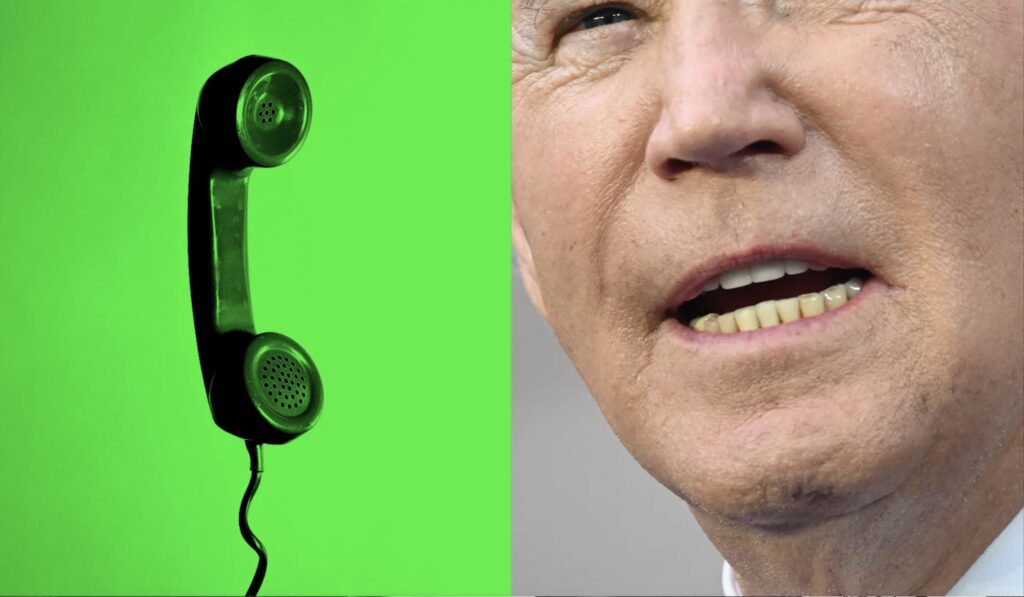
A real-world example of deepfake technology impacting real life is political content created by AI during election periods. During the 2024 U.S. presidential election, a large number of people received robocalls that sounded like Joe Biden, advising them not to vote in the primaries. The voice later was confirmed as deepfake audio created by artificial intelligence, but its realism was enough to mislead the receivers. This case shows that deepfake technology is no longer an experimental tool, it can be widely used to influence political behaviour.
Picture Source: Google
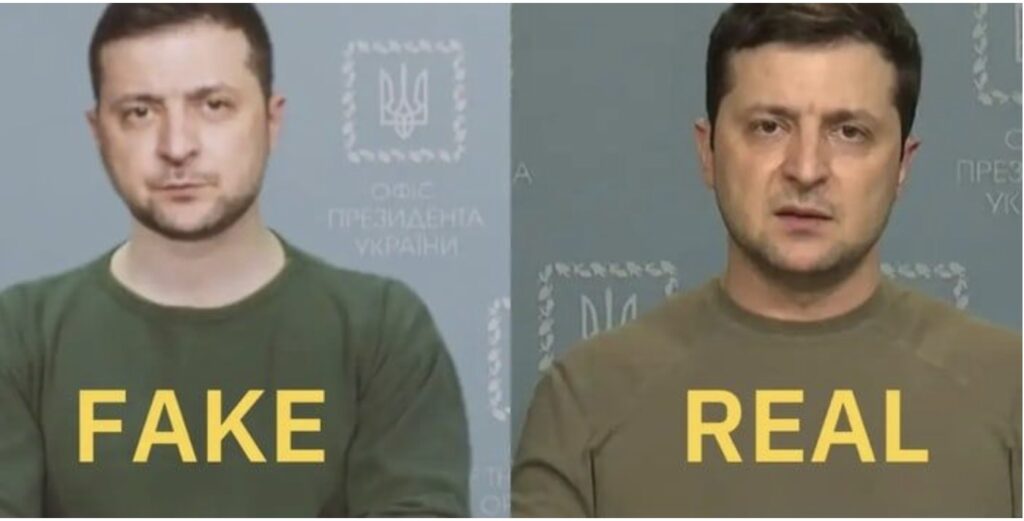
What’s more, edited video clips of political officials appeared online, making statements they never actually said. In March 2022, a video of Zelensky appeared on social media, in the video he asked Ukrainian soldiers to drop their weapons down. The video spread rapidly across Russia and Ukraine. Zelensky later posted a statement on his social media accounts clarify that the video was created by deepfake technology, saying he had never said those words and the only thing he would ever suggest is Russian armies drop their weapons, calling the video a “childish provocation”.
Picture Source: Bitdefender
These cases show that deepfake’s technical impact doesn’t fully depend on how perfect the technical is, it depends on the timing. During times of political tension or when the public is highly focused, even content that can only fool people for a short time, before any fact-checking, is enough to shape public opinion. This points out a problem: the speed of content spread on digital platforms is often faster than the process of fact-checking. Therefore, deepfakes exploit the gap between surface impressions and verification, pressuring people to make quick judgments with limited information. This further confirms that deepfakes not only twist reality but also shake the foundations of truth itself.
What makes this situation even more concern is not just the existence of fake content, but how real it has become. As technology improves, deepfakes can now copy face expressions, voices, tones, and movements with high quality. Due to the rise and popularity of this technology, the number of fake pornography products rapidly increased by 464%, rising from 3,725 to 21,019 in just one year. The Scammers mainly use Facebook and other social media platforms to promote various investments that use celebrities as attractive features, causing British victims to lose 9 million pounds. One of the victims fell for deepfake advertisements of Elon Musk and Martin Lewis promoting investments, leading him to borrow total of 76,000 pounds from four loan companies. Although he cancelled part of the loans, his debt still amounts to 27,000 pounds, which could push him into bankruptcy.

Picture Source: Money Saving Expert
For many people, especially those just randomly scrolling on social media, it is hard to know which is real and which is fake. This allows misinformation to spread rapidly, impacting public understanding before the truth gets clarified. This case shows how deepfakes transform the problem from simply identifying fake content to finding solutions and ways through increasingly uncertain environments. The challenge for people is not simply ‘what is fake,’ but if we can trust everything, we see at all. As deepfake technology becomes more common and popular, this erosion of trust could become a serious problem that affects how people receive and understand online content.
What impact deepfake will cause?
As deepfakes have changed how people engage with online information, their awareness of content manipulation might be improving, leading them to become more careful or perhaps more apathetic. Some users may stop carefully checking content, instead choosing a passive attitude to avoid questioning any content at all. Another group might choose to withdraw completely, because they feel identifying what is real and what is fake is too difficult and takes too much time. This creates ‘information fatigue,’ and under this situation, feeling uncertain does not encourage critical thinking but leads to escape. This change reflects the technology impact how information consumes. Noble (2021) state that
Algorithm-driven apps are almost everywhere, which requires people to more carefully examine what values and conditions these systems put first.
It means under the deepfake environment, people are not only need to question the contents themselves, but they also need to question the system they use.
Another significant impact is the unequal ability to respond to deepfakes. Public figures or large organizations might have the resources to dispute, investigate, or remove related deepfake content, but most ordinary people often lack these resources. It reflects the imbalance problem in digital systems. Artificial intelligence depends on broader political and social structures (Noble, 2021). If edited content spreads online, it could damage someone’s reputation or personal relationships before any correction or clarity measures occur. Bias can deeply affect systems through complex mechanisms (Crawford, 2021). Furthermore, as the technology becomes more widespread, users have a greater responsibility than before to engage in critical analysis and content evaluation. However, not everyone has the skills and knowledge to do this. This also creates a distance between those who can handle digital media uncertainty and those who are easily manipulated. All of this suggests how deepfakes are reinforcing existing power imbalances in the digital environment.
Any Solution?What we can do?
Although people are often encouraged to develop the ability to think critically about media, shift the responsibility completely onto users ignores the role of platforms and government regulate. Platforms and related companies have significant power to control the distribution of content, but they often respond to deepfakes passively without taking strong protective action. The most notable case was the deepfake images and videos of the famous singer Taylor Swift that spread across social media platform , the speed and severity of the spread caused the platform have to block Taylor Swift related searches for several days(CE Noticias Financieras, 2024). These videos often spread quickly across major social media platforms and reached a large audience in a short time before being discovered as fakes.This suggests that a stronger governance framework is needed, which should not only address the issue of deepfake identification but also regulate the systems that promote rapid dissemination. Without systemic change, management efforts to combat deepfakes might stop at enhance individual ability, without addressing the conditions that allow misinformation to be created and spread.
In the end, deepfake technology reflects a transformation in the digital environment. Nowadays, the challenge is no longer simply to identify fake content, but to keep people trusting in the concept of ‘evidence’ itself. As visual media becomes easier to exploit, the responsibility to address misinformation shifts toward to individuals. Solving this problem not only requires technical solutions but also enhanced platform governance and improved public understanding of how digital systems shape what we see and believe. Without these actions and efforts, the “crisis of truth” driven by deepfakes could continue to impact and erode the foundational trust that online communication has built.
References:
Briefing: Zelensky deepfake shared on social media. (2022). In BBC Monitoring Former Soviet
Union. BBC Worldwide Limited.
Crawford, K. (2021). The Atlas of AI: Power, Politics, and the Planetary Costs of Artificial
Intelligence (1st ed.). Yale University Press.
https://doi.org/10.2307/j.ctv1ghv45t
Grohmann, L., Halle, F. A., & Appel, M. (2026). Deepfake! A liar’s dividend for audiovisual
material. Psychology of Popular Media.
https://doi.org/10.1037/ppm0000665
“I was scammed out of £76,000 by Elon Musk deepfake -now I’m losing my home”; Ahead of tonight’s ITV documentary, Celebrity Scams: Are You At Risk?, the Mirror speaks with Derren “Des” Healey, a kitchen fitter who was plunged £76,000 into debt after cruel scammers tricked him with deepfake footage of Elon Musk and Martin Lewis. (2025, March 13). Daily Mirror (London, England).
Joe Biden impersonated in deepfake call to disrupt New Hampshire primary. (2024, January 23).
El Pais.
https://link.gale.com/apps/doc/A781055855/STND?u=usyd&sid=summon&xid=d57de93a
Just, N., & Latzer, M. (2017). Governance by algorithms: reality construction by algorithmic
selection on the Internet. Media, Culture & Society, 39(2), 238–258.
https://doi.org/10.1177/0163443716643157
Noble, S. U. (2019). Algorithms of oppression : how search engines reinforce racism. New York
University Press.
Pornography and ‘deepfakes’: should I be worried if I’m not Taylor Swift? (2024, Jan 31). CE
Noticias Financieras
Picture Reference
CLULEY, G. (2022). Deepfake President Zelensky calls on Ukraine to surrender, as TV station hacked. Hot for Security. https://www.bitdefender.com/en-gb/blog/hotforsecurity/deepfake-president-zelensky-calls-on-ukraine-to-surrender-as-tv-station-hacked
Elliott, V. (2024, January 23). The Biden Deepfake Robocall Is Only the Beginning. Wired. https://www.wired.com/story/biden-robocall-deepfake-danger/
McCann, L. (2026). What Is a Deepfake? Here’s What You Need to Know – Copyleaks. Copyleaks. https://copyleaks.com/blog/what-is-a-deepfake
Shaw, G. (2023, July 7). WARNING: Beware frightening new “deepfake” Martin Lewis video scam promoting a fake “Elon Musk investment” – it’s not real. MoneySavingExpert.com. https://www.moneysavingexpert.com/news/2023/07/beware-terrifying-new–deepfake–martin-lewis-video-scam-promoti/
Be the first to comment