Has this ever happened to you? Initially, you were planning on spending only ten minutes watching TikTok, but suddenly an hour has passed!
People often seem to think that it is because of their weak willpower.
However, the fact is that algorithms and website structure play an important role in it! The recent discussion about social media addiction is no longer about ourselves, but about them.
On February 6, 2026, the European Commission issued a preliminary ruling, pointing out that TikTok’s use of “addictive” elements such as “unlimited scrolling”, “autoplay” and “personalized recommendation” may violate the Digital Services Act (DSA) (European Commission, 2026).
What’s more interesting is that this represents a new trend in the field of social media platform regulation: from “content risk” to “platform’s design impact on behavior”.
This means that the real question is not “why do people get addicted”, but “how does the website make you keep returning?”
This is the focus of today’s regulators and researchers.
In addition, this eye-catching behaviour limits our choices and affects some people, especially teenagers.
Therefore, I believe the addictiveness of TikTok does not come from the content itself, but from the positive shaping of user behavior by its algorithms and platform design. This also reflects the need for digital governance to shift from content supervision to design-based supervision.
Algorithms shapes people’s behaviour
In our daily life, when we discuss about algorithms, we perceive them as a neutral recommendation system that only provides us with the content that we enjoy.
But actually, Just and Latzer (2017) note that the automated process of algorithms impacts not just the information available for users, but also their behaviour, and plays an important role in forming people’s perception of reality.
On digital platforms, we are not make decisions in a free space. Decisions are always made under conditions where the information we have access to has already been filtered out through algorithms.
This means that before the user really makes a choice, the range of information to choose from has been preset, which fundamentally affects the user’s “what they can choose”
The most important thing is that this impact first occurs at the “cognitive level”. The algorithm gradually affects the distribution of attention and interest formation of users by continuously changing the information structure that users come into contact with.
For example, when users continue to come into contact with filtered information, their behavior may gradually shift from the initial purposeful information search to relying on the information flow provided by the platform.
In other words, it means that although you believe you are selecting the content yourself, the decision pathway has already been determined beforehand.
Thus, the algorithm not only “recommend what you like,” but it also “defines what you will like.” It slowly modifies how the users allocate their attention and the habit of using.
Why does TikTok make you so addicted?

(TikTok shape users behaviour. Picture: Quitters, n.d.)
While algorithms have the power to influence behaviours according to theory.
So the case of TikTok shows how the platform can directly transform this impact into a continuous behavior pattern through specific design.
In contrast to the typical investigations on harmful contents, the investigation carried out by the EU’s investigation on TikTok mainly concerns the design aspect of TikTok rather than some particular types of harmful contents (European Commission, 2026).
On TikTok, users’ viewing behaviour is mostly guided by personalized recommendation system (Firth & Marinelli, 2025).
That is to say, the fundamental issue now has changed from “whether the contents of the platform is harmful” to “whether the platform itself can influence the users’ behaviours via the design”.
Among the mentioned problems are infinite scrolling (eliminating users’ natural opportunities to stop), autoplay (reducing users’ opportunities to make decisions), push notifications, and personalized recommendation systems (constantly optimizing the content according to users’ past behavioral data and thus making it increasingly appealing to their tastes).
These designs make the user’s viewing behavior continue unconsciously.
In this process, the interface design is not a simple auxiliary algorithm, but embeds algorithm logic into the user’s operation process, so that users can be continuously guided in the absence of conscious decision-making points.
Therefore, user behavior is no longer composed of independent decision-making, but is transformed into a continuous automated process with low decision-making costs.
A similar mechanism also shows up on Instagram’s Reels. But, there is a difference in the intensity of behavior guidance between the two.
However, the difference between them lies in the degree of reinforcement of “behavioral continuity”. Instagram still relies to some extent on users’ social relationships, like their follow lists.
TikTok’s recommendation system relies more on algorithmic drive than on users’ social networks. This allows the platform to adjust the content faster according to user behavior and further compress the space for users to make “stop” decisions.
Hence, it is not about the attractiveness of the content of TikTok.
In this sense, TikTok not only affects users’ cognition, but also directly reconstructs users’ behavioral processes through design, which makes it more difficult for users to interrupt this usage mode.
The disparity in effects on the algorithms: What makes teens more vulnerable to the effects of the algorithm?
If the discussion above was about how the platform influences user behaviour through algorithms and design, then the most important issue here would be: Is that influence equal to everyone?
The answer is actually no.
In the case of TikTok, the European Commission specifically pointed out that the platform failed to adequately assess the risks its design posed to teenage users, such as longer usage time, more frequent app openings, and the gradually developing pattern of dependent usage.
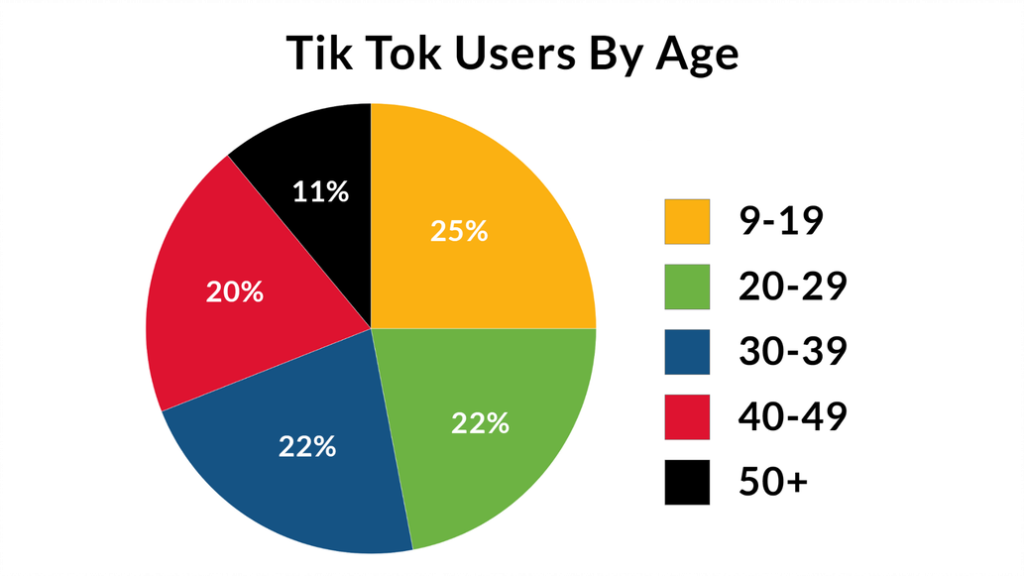
(TikTok users by age. Picture: Measure Marketing Result Inc., n.d.)
This age distribution chart of TikTok users can clearly show that the proportion of teenage users is the highest.
But the key problem is not only that “teenagers are more addictive”, but also that they are in a structurally unequal position in the face of algorithms.
Compared with adults, teenagers are in a stage of developing their cognitive and self-control abilities.
Yang (2023) explained that they are more likely to be attracted by immediate feedback mechanisms, like constantly updated new content, continuously emerging short-video stimuli, and quick emotional satisfaction.
Kshetri (2025) argues that to increase engagement, TikTok’s algorithm takes advantage of user weakness.
This means that these designs not only aim to improve user experience, but also take advantage of users’ psychological weaknesses to a certain extent to extend the usage time.
But, these designs are not random. By the contrary, they are highly consistent with the platform’s goal of optimizing user engagement time.
In other words, the design of the platform didn’t “differentiate user capabilities”, but its impact resulted in an uneven outcome among different groups of people.
The most important is that teenagers often have a harder time realizing that they are in an environment shaped by algorithms. For them, the content seems to “appear naturally” rather than being the result of filtering and calculation.
This lack of awareness makes them more likely to view continuous viewing as their own interest rather than a guided behavioural path.

(Teenagers are addicted to TikTok. Picture: Williams, 2023)
This implies that people blame “young people’s lack of self-discipline”, but we can’t see what kind of responsibility the platform itself should bear at the design level.
More specifically, it’s not about personal behavior, but about risk allocation.
This influence is more likely to be deeply rooted among teenage users, becoming a behavioral pattern, and may have a long-term impact on their attention, time allocation, and information perception.
In this context, taking teenagers as our central subjects is not done out of their perceived vulnerability, but rather reveals the platform gap unintentionally exacerbates this inequality.
This is the reason why the responsibility of the platform cannot be limited to “providing tools”, but it must consider how the design of the platform affects the actual capabilities of different users.
From platform design to algorithm governance: How regulation responds to platform power
For precisely this reason that the algorithm produces a disproportionate effect on users, the issue of platform responsibility has gradually transformed into a governance problem that requires institutional responses.
As opposed to previous platforms which operated as purely neutral information intermediaries, the present platforms are being understood as technology that can manipulate the behaviour of their users.
Regulation, therefore, needs to change from one where “controlling content” is central to “controlling design”.
Systemic risks such as how the platform’s operations might affect the users’ behaviours, as well as their mental and societal wellbeing must be considered by the platform according to the Digital Services Act (DSA) (European Commission, n.d. ).
Therefore, the platform should have more accountability in terms of the recommendation system, the interface design, as well as user guidance.
However, it is not only reflected in the European Union’s regulations but also emerging elsewhere.
For example, the Australian government proposed the social media age restriction policy, which requires the platforms to adopt measures ensuring that people below the age of 16 would not create their account (esafety Commissioner, 2025).
The objective of such a policy was to minimize the negative influence of platform designs on teenagers, including excessive use and exposure to harmful content.
In this particular case, we see that platform responsibility is not only related to the content management but also to the way the platform itself impacts users’ behaviour, especially regarding more vulnerable demographics like teenagers.
From the perspective of governance, the above method is a response to “algorithm power”.
As I pointed out before, algorithms not only affect what users see, but in fact, they also affect the way users behave.
When this method is continuously used in the platform environment, it will change from personal choice to a behaviour pattern determined by the platform architecture.
For this reason, we should focus on “Do users have self-control?” Move to “Is the platform responsible for its design method?”
However, this method also has its own shortcomings.
For example, the algorithm used by the platform may be very complex, making it difficult for regulators to understand how the system works.
On the other hand, too strict regulatory rules may have a negative impact on the innovation and usability of the platform.
This results in a big issue: how to improve the protection of users without restraining innovations within the platform?
Furthermore, another question that emerges for the regulator is whether the platform should be treated as just a tool or as infrastructure with some social obligations?
As long as the algorithm is able to consistently nudge users on a daily basis, the platform becomes much more than just an information-sharing service, it’s become an important participant in shaping social behaviour.
Thus, it is not just the case of TikTok coming under the investigation but rather shows a much larger problem in the digital age.
As soon as the algorithm begins directing the behaviour and actions of people, there must be certain obligations accompanying its influence.
Rethinking platform power
Therefore, TikTok’s case doesn’t just expose the issue of the platform’s “addictive” design.
It signifies an important shift: Regarding platform governance from focusing on individual responsibility and blaming the user’s inability to regulate his/her behaviour in the face of tempting opportunities to regulating platform design as an active regulator of users’ choices.
Given the increasingly prominent role played by the preset informational environment in influencing individuals’ decisions, it becomes difficult to solely hold individuals accountable for their lack of self-control.
By contrast, the attention architecture generated by the platform itself through design becomes the very tool which governs the activities of its users.
In other words, the platform stops being an impartial conduit for transferring information and becomes instead a technological system able to influence people’s behaviour.
It is precisely the new role played by a platform that renders the question of “how to govern platform design” one of the most prominent new issues discussed in digital governance studies.
In this regard, TikTok is not a special research case, but a good microcosm, reflecting the complexity of platform accountability.
References
European Commission. (2026). Commission preliminarily finds TikTok’s addictive design in breach of the Digital Services Act. Shaping Europe’s Digital Future. https://digital-strategy.ec.europa.eu/en/news/commission-preliminarily-finds-tiktoks-addictive-design-breach-digital-services-act
European Commission. (n.d.). The Digital Services Act. Shaping Europe’s Digital Future. https://digital-strategy.ec.europa.eu/en/policies/digital-services-act
esafety Commissioner. (2025, February 11). Social Media Age Restrictions. ESafety Commissioner. https://www.esafety.gov.au/about-us/industry-regulation/social-media-age-restrictions
Firth, E., & Marinelli, A. (2025). Datacasting: TikTok’s Algorithmic Flow as Televisual Experience. Media and Communication, 13. https://doi.org/10.17645/mac.9392
Just, N., & Latzer, M. (2016). Governance by algorithms: reality construction by algorithmic selection on the Internet. Media, Culture & Society, 39(2), 238–258.
Ksetri, N. (2025). Algorithmic Power and Responsibility: TikTok’s Transition to U.S. Oversight. IEEE, 58(12), 106-110. https://ieeexplore.ieee.org/document/11285913
Measure Marketing Result Inc. (n.d.). How to Use TikTok for B2B Excellence. https://measuremarketing.com/using-tiktok-for-b2b-excellence/
Quitters, G. (n.d.). How to Stop TikTok Addiction. Game Quitters. https://gamequitters.com/tiktok-addiction/
Williams, T. (2023b, April 13). Why is Tiktok So Addictive? Experts Weigh in Amid New Safety Feature. Digital Health Technology News. https://www.healthtechdigital.com/why-is-tiktok-so-addictive-experts-weigh-in-amid-new-safety-feature/
Yang, Y. (2023). Reasons for Teenagers’ Habitual Use of Social Media: A Case Study of TikTok. SHS Web of Conferences, 155, 02006. https://doi.org/10.1051/shsconf/202315502006
Be the first to comment