In your spare time, whilst lying in bed scrolling through Douyin (Tiktok in China), you may have come across videos like this:
Video source: Douyin influencer @Setherhh77
The creator spends the first three seconds showing themselves without make-up or looking dishevelled—perhaps with dull skin, dressed casually, or even deliberately using filters to make themselves look puffy or scruffy, in order to appear less attractive. Then, in perfect time with the music, the scene instantly shifts to an image of extreme refinement, slimness or handsomeness.
These videos often garner a huge number of likes and encourage viewers to emulate this filming technique. Next, you might see a make-up tutorial teaching you how to create a natural, beautiful look. Perhaps you’ll then watch a weight-loss plan video, in which the creator explains how long they’ve been sticking to their diet and presents data to prove its effectiveness, and so on.
You may have grown accustomed to these videos yet feel a sense of unease. This unease stems from the fact that you’ve begun to unconsciously compare yourself to the standards on screen whenever you stand in front of the mirror. You might even find yourself longing to emulate the lifestyle of these content creators.
So, even though we know these videos rely on filters, editing and carefully choreographed performances, why do they still make us feel anxious?
The answer may lie not in the videos themselves, but in the algorithmic logic behind them. These recommendation systems quietly define what is considered normal, beautiful and worth watching again and again.
Algorithm-based recommendation logic
Before discussing how algorithms shape our thinking, I would like to introduce the famous ‘Clever Hans’ case mentioned by Crawford (2021) in his book The Atlas of AI.
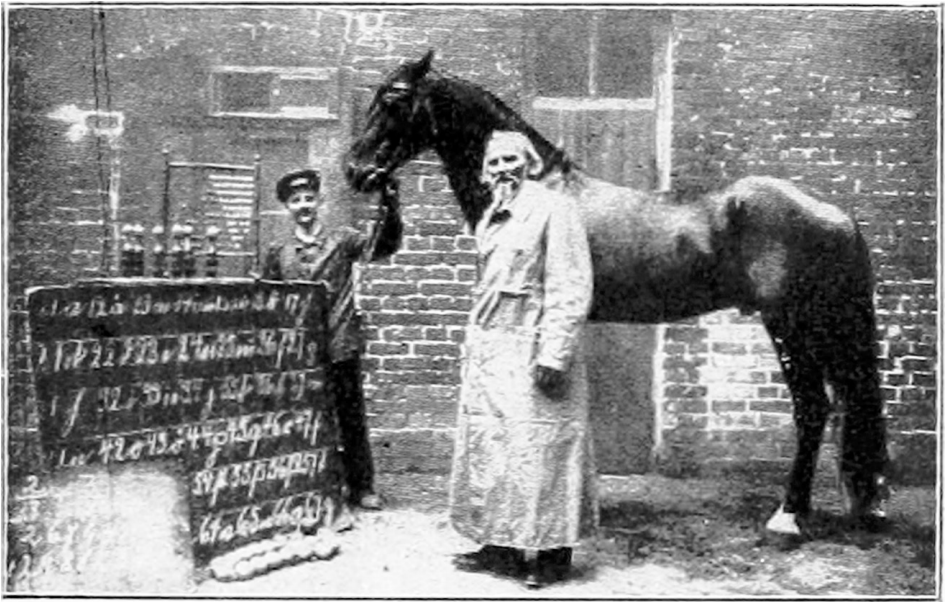
Hans was a horse that took Europe by storm in the late 19th century. He appeared to be capable of performing arithmetic and spelling, tapping out the correct answers with his hooves whenever his owner asked him a question.
However, subsequent research revealed that Hans could not actually perform arithmetic at all. Hans was simply exceptionally skilled at observing subtle changes in the questioner’s body language and facial expressions. He would stop tapping when the number of taps happened to be correct and those around him displayed expressions of relief or surprise.
In a sense, modern algorithms are like Hans the horse. They understand neither what beauty is nor the anxiety that videos can induce. They make judgements solely by capturing your feedback on the videos—your likes, watch time, and even related searches (such as ‘weight loss tutorials’ or ‘make-up tutorials’). When you watch these videos repeatedly due to aesthetic pressure, the algorithm misinterprets this interaction as ‘liking’, thereby creating an even more intense environment of anxiety for you.
Not only that, but the algorithm also uses collaborative filtering—as shown in the image—to predict what you might like next based on the behaviour of similar users. When the system detects that User 1 and User 2 exhibit highly similar behaviour regarding certain content, they are both shown similar content.
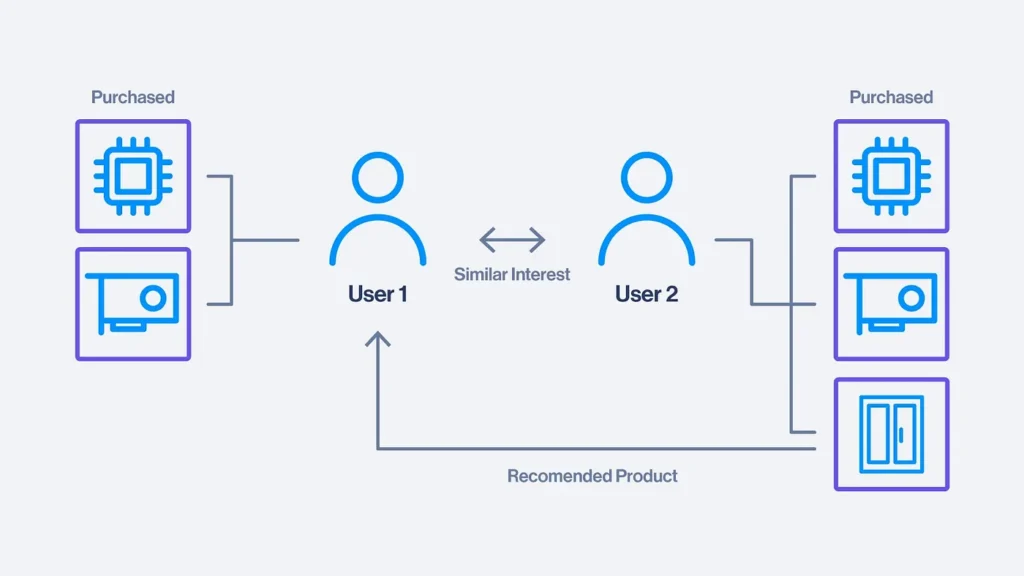
When you repeatedly watch videos such as ‘Makeover Success Stories’, the system not only records your viewing history but also categorises you into a group of users with similar preferences.
Consequently, what was originally a single moment of unease may, under the logic of collaborative filtering, be amplified into a group effect. Users no longer see merely ‘recommended content’, but an entire aesthetic worldview replicated from similar behaviours, whilst a collective aesthetic is simultaneously shaped.
A machine-generated aesthetic hierarchy
Based on this understanding of algorithms, we can see that social media platforms such as Douyin and Rednote do far more than simply guess your preferences. Algorithms construct a highly personalised environment for you based on your various behaviours. In this environment, the repeated appearance of certain information gradually leads you to perceive it as reality itself.
Over time, we not only encounter certain ideas more frequently, but are also subtly guided to accept them as self-evident, desirable or morally correct. The more frequently a particular worldview is presented, the more it comes to resemble the natural state of life. This leads us to question ourselves:
“Is there something wrong with me? Should I change myself to become like them?”
When a personalised algorithmic environment is formed, this aligns with Halinan and Striphas’ (2016) definition of algorithmic culture:
We refer to it as “algorithmic culture”: provisionally, the use of computational processes to sort, classify, and hierarchise people, places, objects, and ideas, and also the habits of thought, conduct, and expression that arise in relation to those processes (p. 119).
Hussain et al. (2025) also point out that algorithms are not merely vehicles for cultural transmission; they define standards of ‘beauty’ within online communities, thereby perpetuating the cycle of aesthetic standardisation.
Algorithms not only process data, but also make cultural decisions. Thus, on social media platforms, culture is largely determined by algorithms at a visible level, whilst at the same time being shaped by them. Every action we take as users is recorded by algorithms, which then calculate what content we should see and push it to us.
The Power Behind Visibility
A question arises: who exactly is deciding what content the algorithm recommends? Why has this particular aesthetic style become mainstream?
In the theory of “industry lore” mentioned in Burroughs (2019), a set of implicit common knowledge gradually takes shape within platforms and the industry: what kind of content is more “visible”, who is the target audiences, which cultural expressions are more likely to attract specific groups, and how this market must operate to achieve traffic and commercial success.
The reason certain content formats keep reappearing is not merely because users like them, but because they have long been regarded as ‘proven’ content templates within the ecosystem of platforms, creators and commercial partnerships.
In other words, although a platform’s recommendation system may appear automated and neutral, its underlying values are deeply influenced by the platform’s power dynamics and the logic of capital. What content is actually visible is never a matter of chance, but rather the result of the interplay between the platform’s algorithmic system, its commercial objectives and its cultural norms.
The power relations at play here are a politics of visibility essentially. Bucher (2018) points out, the core of algorithmic power lies not in directly dictating what users should believe, but in controlling which content remains visible and which is marginalised.
This industry wisdom is particularly evident in Douyin’s transformation or ‘glow-up’ videos.
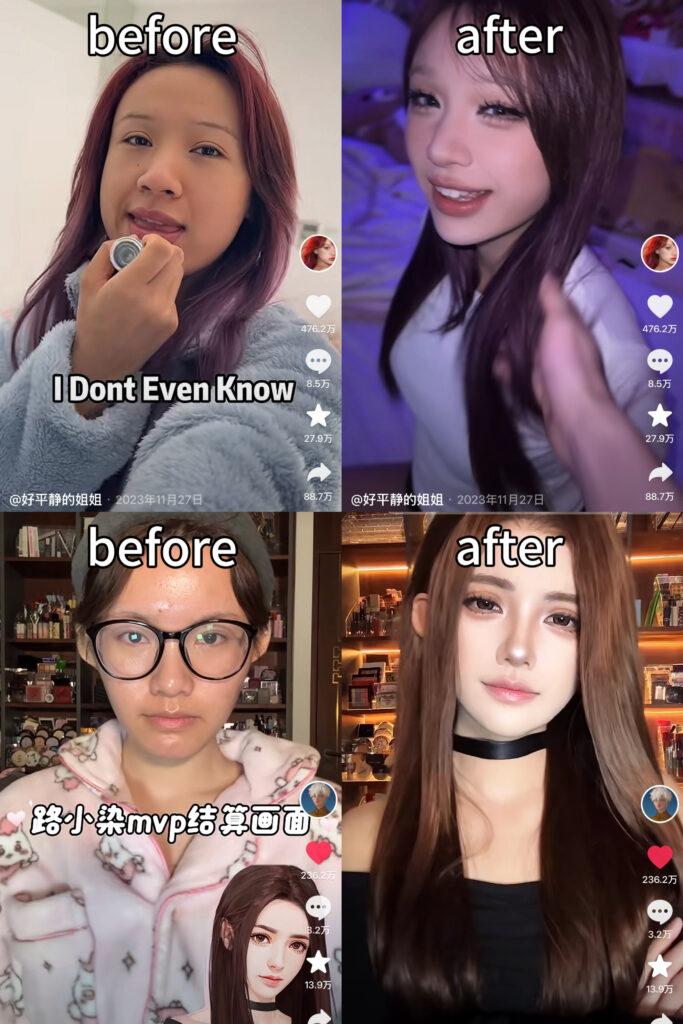
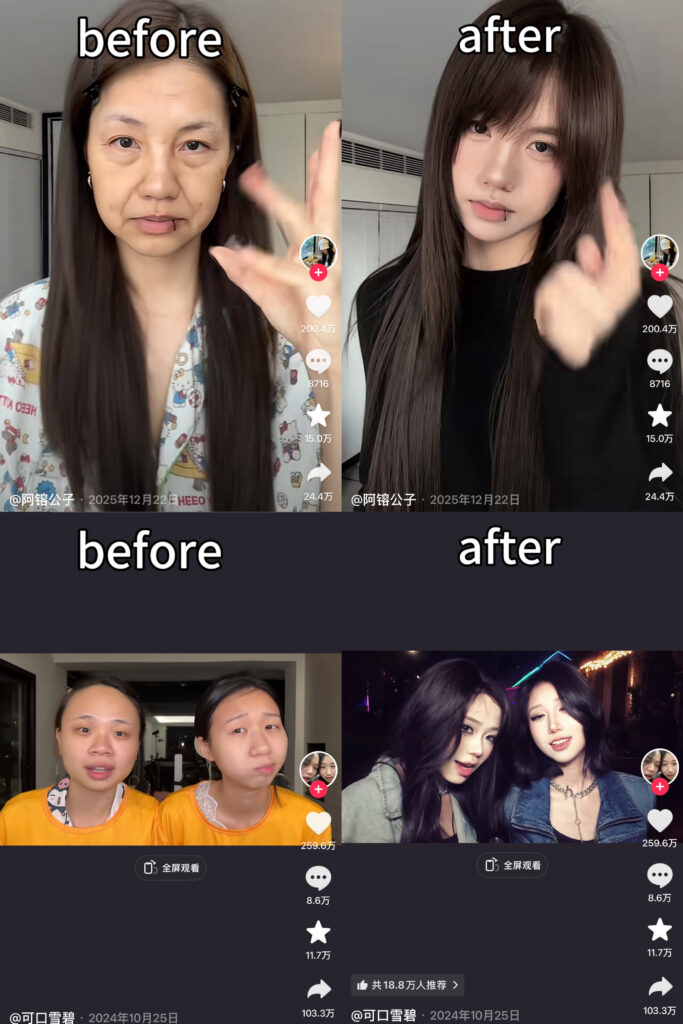
Image source: Douyin influencer: @520sister666, @Nishiba, @aronggongzi, @Setherhh77
Creators understand before-and-after sequences with striking visual contrasts, slender figures, meticulous make-up and fast-paced editing are more likely to achieve high completion rates and engagement. Brands also recognise that such content is naturally suited to promoting skincare, make-up, body-shaping and fashion products. From the link, we can see that in @Setherhh77’s video, the influencer first used the products recommended by the brand before the transformation, thereby achieving a flawless make-over.
At the same time, the comments section was full of posts extolling the benefits of make-up and looking attractive, with some audiences asking about make-up brands:
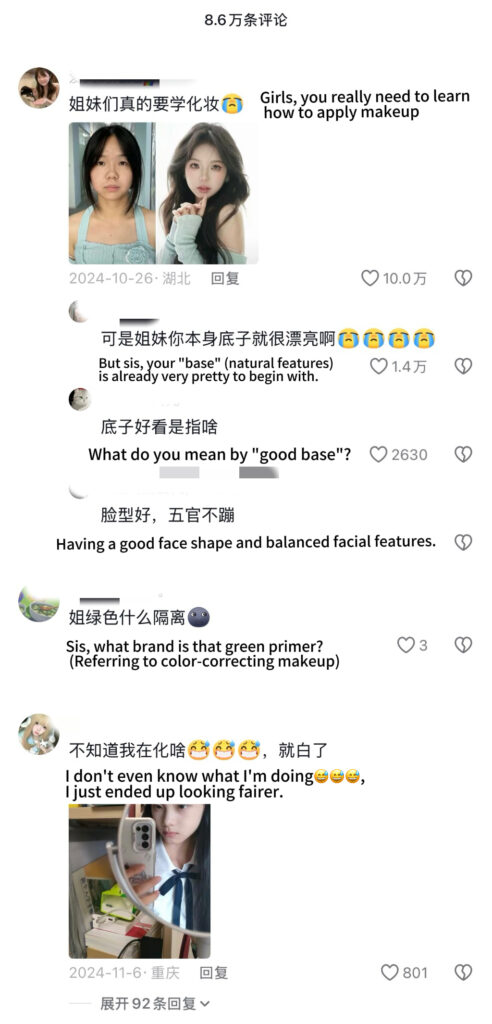
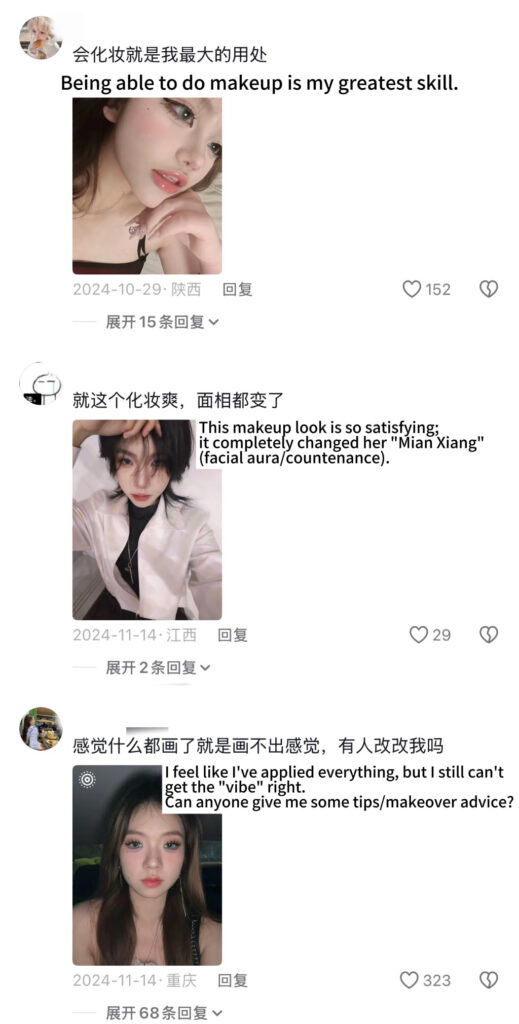
Image source: the comments section by @Setherhh77
This aesthetic aligns not only with the platform’s recommendation logic but also with the commercial logic of the entire content industry chain.
Apart from this, the reason this aesthetic has become mainstream is closely linked to existing gender cultural norms. Slender, youthful, refined and highly stylised female images have long occupied a privileged position in mainstream media, platform algorithms merely serve to further digitise, automate and scale this existing cultural power.
Consequently, aesthetic standards that were originally social and cultural constructs have, through repeated algorithmic recommendations, been repackaged as a form of ‘common sense’ that appears neutral, universal and worthy of pursuit.
Beauty Anxiety
How many young women have developed anxieties about their self-image and appearance as a result of videos of this kind recommended by algorithms on Douyin and other social media platforms? Perhaps we all understand that aesthetic standards are neither singular nor static. Yet, due to the aesthetic hierarchy shaped by algorithms, even those who understand this deep down still find themselves irresistibly drawn to the extreme aesthetic standards promoted online.
In this cultural climate, we can observe that people now routinely subject their photos to meticulous editing; beauty filters, face-slimming effects, nose-slimming and eye-enlarging techniques seem to have become standardised templates.People only post photos or videos to social media platforms after meticulous editing.
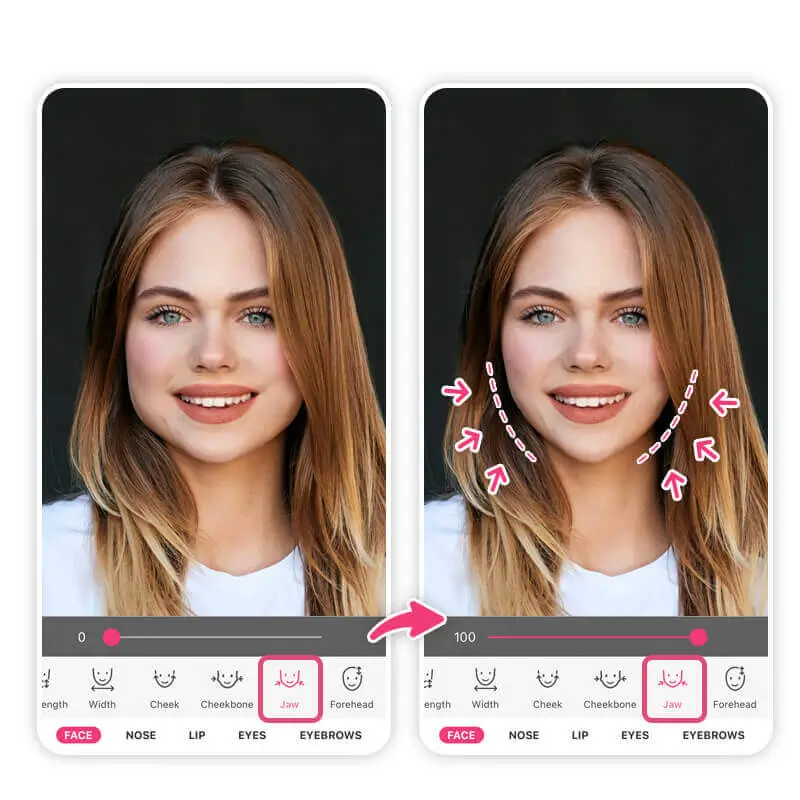
Research by Barnes (2025) found that users feel anxious about posting unedited, natural photos or videos, and attempt to gain confidence and social validation by posting retouched images.
This reliance on beauty-enhancing tools reflects a widespread shift in users’ perceptions, a shift that has been shaped to a large extent by the platform algorithms that determine aesthetic standards. Whilst such image editing may appear to conform to so-called ‘mainstream aesthetics’, over time, repeatedly retouched photographs are reshaping users’ perceptions of what constitutes a ‘normal’ face. Unretouched appearances are gradually being viewed as unacceptable, or even repulsive, thereby fuelling a surge in cosmetic surgery and weight-loss trends.
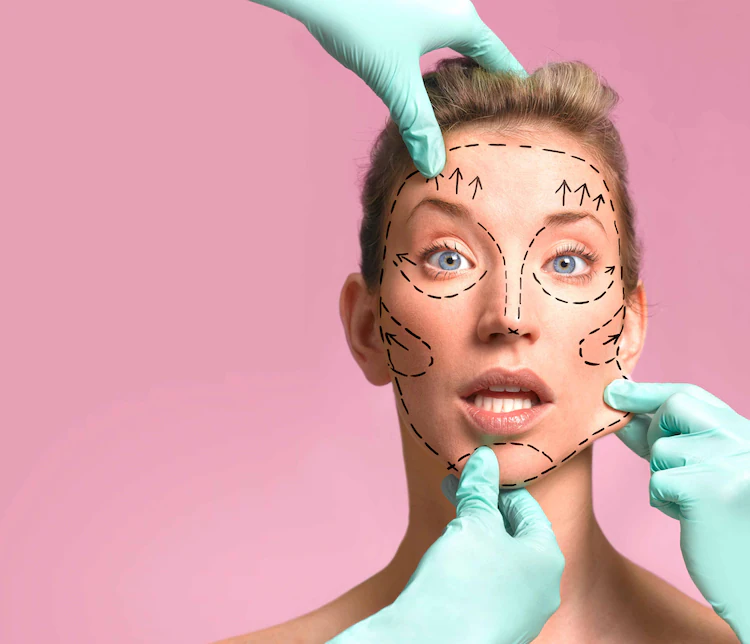
Much of this cosmetic surgery and weight-loss behaviour may, in fact, be entirely unnecessary. An obsessive focus on facial imperfections drives some women to undergo repeated cosmetic procedures, whilst extreme dieting leads others to develop anorexia and a range of other mental health issues. At this stage, can we still say with absolute certainty that these are entirely the users’ own choices?
Users’ sense of resistance is awakening
However, an increasing number of users are now realising that the aesthetic standards and consensus meticulously crafted by algorithms are, in fact, nothing more than a digital illusion. This growing awareness is evolving into a rebellion against algorithms.
For example, the subreddit r/InstagramReality, launched on Reddit, is a grassroots resistance community. Users post content here to expose the overuse of filters, showcase ‘before and after’ comparisons, and debunk photo-editing techniques such as slimming faces, enlarging eyes and smoothing skin, challenging the distorted aesthetic standards shaped by algorithms through collective exposure.
Some influencers also proactively share photos of themselves without make-up, conveying the message: ‘Look, even without retouching, I am beautiful because I am confident.’ When popular influencers do this, it can help shift the mindset of their followers.
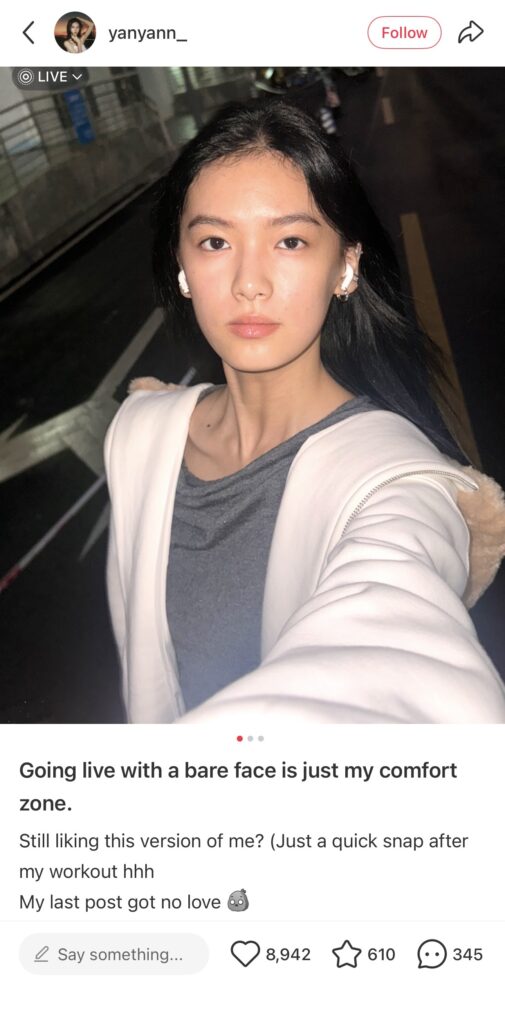
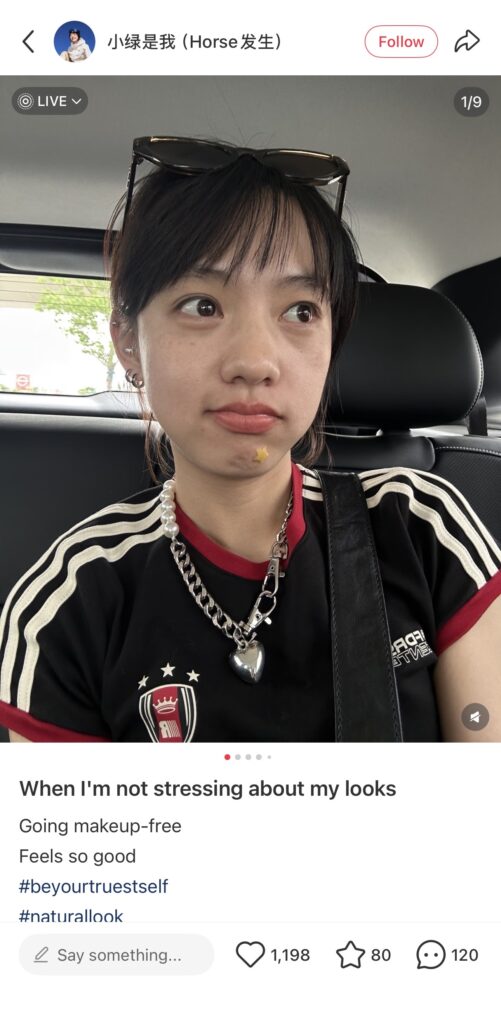
Image source: Rednote influencer: @yanyann_, @xiaolvshiwo (Horse fasheng)
Beyond Algorithm
In this age of AI, algorithms use their inherent rules and logic to shape an aesthetic hierarchy for us, and, aided by the illusory bubble of the internet, construct an idealised vision of life. The point is not to dismiss filters, make-up or self-expression. The deeper issue is to recognise that what appears to be a personal preference may, in fact, have been shaped within a platform environment optimised for repeatability, visibility and commercial value.
Beauty will not disappear because of algorithms; what is changing is the way we perceive our own capabilities. Next time you see a ‘before-and-after’ video, remember you can also choose to embrace your authentic, unquantifiable self.
Reference List
Aronggongzi. @aronggongzi. (2025). [Douyin video post] [Video]. Douyin. https://v.douyin.com/tr5PTXv3EN0/
Barnes, S. (2025). From Filters to Fillers: The Real-Life Instagram Face. In The Harms of Beauty (pp. 95-114). Bristol University Press.
Bucher, T. (2018). If…then : algorithmic power and politics. Oxford University Press.
Burroughs, B. (2019). House of Netflix: Streaming media and digital lore. Popular Communication, 17(1), 1–17. https://doi.org/10.1080/15405702.2017.1343948
Crawford, K. (2021). The Atlas of AI: Power, Politics, and the Planetary Costs of Artificial Intelligence (1st ed.). Yale University Press. https://doi.org/10.2307/j.ctv1ghv45t
Corp, P. (2025). YouCam Makeup: AI Selfie Editor. PERFECT. https://www.perfectcorp.com/consumer/blog/selfie-editing/best-face-reshaper
Hallinan, B., & Striphas, T. (2016). Recommended for you: The Netflix Prize and the production of algorithmic culture. New Media & Society, 18(1), 117–137. https://doi.org/10.1177/1461444814538646
Haopingjingdejiejie. @520sister666. (2023). [Douyin video post] [Video]. Douyin. https://v.douyin.com/_l7mnpj6Mf4/
Hussain, B., Aslam, S., & Imran, A. (2025). Manufacturing beauty: How AI and Social media are redefining aesthetic norms in emerging digital cultures. Acta Psychologica, 260, Article 105734. https://doi.org/10.1016/j.actpsy.2025.105734
Kelexuebi. @Setherhh77. (2026). [Douyin video post] [Video]. Douyin. https://v.douyin.com/MPX5TP0Wd_U/
Malhotra, M. (2025, October 16). Beauty anxiety is real. Know how you can save yourself from it. India Today. https://www.indiatoday.in/lifestyle/beauty/story/what-is-beauty-anxiety-and-this-is-how-you-can-save-yourself-from-it-2802321-2025-10-16
McComb, S. E., & Mills, J. S. (2022). The Effect of Physical Appearance Perfectionism and Social Comparison to thin-, slim-thick-, and fit-ideal Instagram Imagery on Young Women’s Body Image. Body Image, 40(40), 165–175. https://doi.org/10.1016/j.bodyim.2021.12.003
National Institute of Mental Health. (2024). Eating Disorders: What You Need to Know. National Institute of Mental Health. https://www.nimh.nih.gov/health/publications/eating-disorders
Nishiba. @Nishiba. (2025). [Douyin video post] [Video]. Douyin. https://v.douyin.com/yoO_-nGmAzo/
Pham, K. (2022, July 12). What are Recommendation Systems? Medium. https://medium.com/@khang.pham.exxact/what-are-recommendation-systems-6bb5036042db
pssadmin. (2016, July 29). Is Plastic Surgery Addiction Really a Thing? | Dr. Lee B. Daniel. Dr. Lee B. Daniel. https://aestheticplasticsurg.org/our-blog/plastic-surgery-addiction-really-thing/
Reddit – The heart of the internet. (2017). Reddit.com. https://www.reddit.com/r/Instagramreality/?solution=3c7564a8dad24c0d3c7564a8dad24c0d&js_challenge=1&token=bbbe4bf1c9a2b5160829c4be34da5861cc29d8b1b1113d48431974da03339985
Xiaolvshiwo (Horse fasheng). (2025). [Xiaohongshu post]. Xiaohongshu. http://xhslink.com/o/3ZgyVxZQVeW
Yanyann_ (2024). [Xiaohongshu post]. Xiaohongshu. http://xhslink.com/o/3p1ABshOeWo
Be the first to comment