Following the rapid growth of the internet, everyone has the right to express emotions and thoughts.
Cyberspace is often imagined as a space for connecting everyone and a place for people who come from different backgrounds to share ideas. What would you think of this wide range of digital pace? Some might believe it is a space to hear diverse voices from around the world; others would say it is the best way to get answers to questions we sometimes get confused about. And some people would say it is a place to meet others with the same thoughts.
However, this idealized vision does not reflect reality. In contrast, cyberspace has also become a space where people express their hatred. The distance created by devices and the real world allows people to speak more freely than they would offline. In other words, when people do not need to take any responsibility in real life, they give vent to their anger by sending online hate speech towards successful public figures.
Are those hate speeches being sent randomly? No, hate speeches are some users’ deeper emotions, expectations of the celebrities, and a chance to turn humans into labels rather than seeing them as individuals. Moreover, most cases that start with hate speech or criticism can quickly turn into online harm and become widespread public attacks.
And now, 19-year-old Olympic champion Quan Hongchan is facing something unexpected in her life. She should enjoy the praise that comes from her athletic achievements, but what she is trying to survive are waves of hate speech.
Who is Quan Hongchan?
Quan Hongchan is a Chinese diver, born in 2007. She is from a village in Guangdong, coming from a modest background to become an Olympic champion through years of intense training. She won her first Olympic gold medal in 2020, when she was only 13 years old. Since then, she has won three Olympic gold medals in total.
At such a young age, her journey is often celebrated as one’s hard work and success. However, she has already experienced the pressure of being constantly judged in the public eye and hate speech in the online space.
What Happened?
According to the South China Morning Post, Quan Hongchan has recently found herself at the centre of widespread online hate and cyberbullying, leading authorities to open a formal investigation. Quan Hongchan, who has impressively won three Olympic gold medals, shared during an interview that she has faced a constant stream of negative comments from people online about how she looks.
Many of these hurtful comments focus especially on her weight. Also, these criticisms have been so common and personal that it has been hard for Quan to ignore the large amount of hate comments or not feel affected by what others say about her appearance, because some criticisms are directed at her family members directly. Quan feels very speechless and stressed about these comments, which are flying all over the internet on different platforms. She started to hate her own body because of what people kept saying about it.
In the interview, she said she no longer has the confidence to wear shorts or skirts, so she keeps wearing long, wide pants to hide her size. All the online judgments about her body made her feel ashamed. In her case, we can see how strangers’ negative words can take away someone’s confidence. And could impact how they live their everyday life. Quan is an example. All the pressures from the hate speeches were already hurting her self-esteem then she even thought about quitting the sport she enjoys much earlier than she planned. We should reconsider how deeply online hate speech can hurt someone’s feelings and change the way they see themselves.
Quan Hongchan’s Recent Interview. (Video: Youtube)
Earlier this month, a WeChat group named Diving Together image started spreading online. The screenshot quickly attracted public attention. It is not surprising to see athletes having a group chat to communicate, but the group’s rules are targeted to someone. There were statements such as “no personal attacks — except on Quan Hongchan” and even “feel free to say the worst things you want about Quan Hongchan, even wishing harm on her to death.” There are 282 people in the group chat. However, they were not just strangers hiding behind fake names. The group chat includes athletes, judges, and even reporters.
It is hard to tell where harmless online comments ended, and there is real hatred within the sport. The situation is truly widespread and dangerous among respected members of the sport.
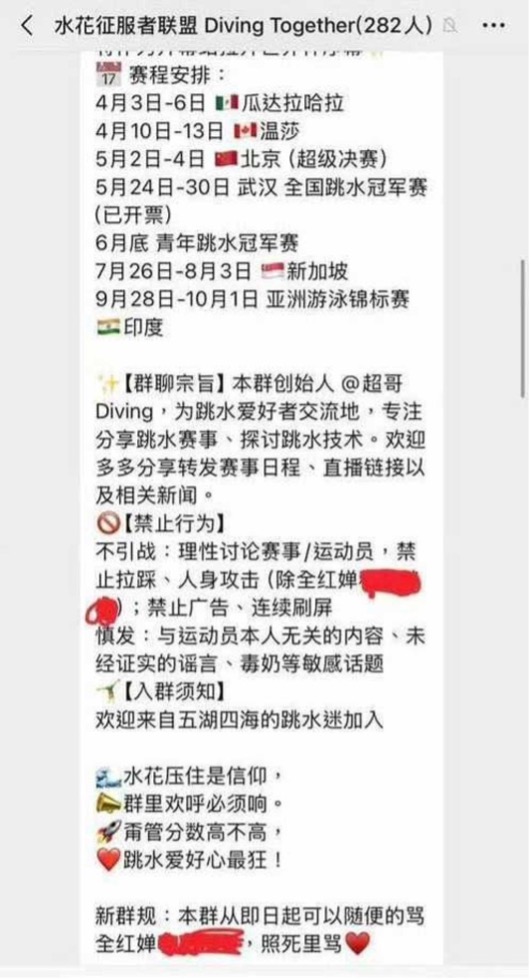
One online group even had a rule like: “No personal attacks — unless it’s Quan Hongchan.” (Picture: Wechat Screenshot)
The screenshot was shared quickly, and people in China who reacted were shocked and angry. Social media platforms were full of conversations about this incident. You couldn’t open any Chinese social media app without seeing people talk about it. For many of us, it was a sign of how real and damaging digital hate can be.
How can a person who made the country proud experience cyberbullying?
Things netizens should be mindful of are how and to what extent it can become normalized.
How Envy Drives into Hate Speech?
Why do successful figures like Quan Hongchan become targets of online hate? It is envy. Success is often celebrated on the surface. Also, it can create a sense of distance between individuals and the audience. Smith (2007) explains that envy grows when people compare themselves to others. When they feel they cannot reach the same level, they see it as better or even the best. In cyberspace environments, users are always exposed to others’ achievements. And these comparisons leave users feeling unsatisfied with their current lives. More importantly, users start complaining about the differences. Festinger (1954) mentions that people judge themselves by comparing themselves to others, an action called social comparison.
Quan Hongchan’s rapid rise from a rural background to becoming an Olympic champion at 13. These early achievements make her success even more striking. Her achievements were admired by different age groups, but there is a group of people who feel frustrated when faced with such an exceptional story. Online haters not only express emotions directly but may also redirect them into criticism or negative comments. People often focus on things that don’t really matter. For example, her appearance or personal life, rather than what she has achieved. Also, these negative reactions spread more easily through online platforms.
Individuals see others criticizing in a nonsensical way, they are more likely to join in together. A little bit of emotion adding together will evolve into public expressions of hate. And there is a distance created between admiration and resentment when someone becomes successful.
How Platforms Shape Hate?
Not only individual emotions. Platforms can decide what to spread quickly. The bandwagon effect is happening.
People like to follow the trends. When they see others attacking something, they most of the time follow, sometimes without even realizing it. At the same time, platform algorithms play the “game”. Things do not get common with no reasons. The platform tends to push emotional content, especially when users spend lots of time on the content. Posts that make people feel angry or emotional are shared widely and seen by more people easily. Flew (2021) explains that digital platforms make it easier for harmful content to spread quickly. Negative comments do not just exist; they are made to be more visible.
Sometimes, turning into public shaming and ongoing attacks only takes a few critical comments. In today’s environment, the impact goes far beyond words. Every word matters and can hurt people. Online hate is not just about what is said. It reflects how platforms allow it to grow, spread, and cause real harm is more important.
How Fame Makes Entitlement?
The online freedom of speech is somehow making the audiences feel they have the right to judge at any time in every aspect of those public figures’ lives. The entitlement audiences have does not make it ethical. When someone becomes successful and visible, they are often treated as if they belong to the public. Comments are made based on all the achievements, appearance, personality, and even their personal lives. The more visible someone is, the more people feel they can judge their life. What happened to society? Flew (2021) describes hate speech that often focuses on specific individuals. It starts to feel acceptable to target them. When someone is no longer valued as a private person, but as a public figure. The line between sharing an opinion and judging it gets unclear.
As a highly visible public figure, Quan’s smallest details, like body shape, can be picked apart and become the online target. Comments often turn small issues to big discussions. What makes this even more questionable is how young she is. She has grown up under constant public attention. Instead of having space for her to develop as an individual, she is expected to always meet all the public’s expectations. At this point, the problem is no longer her performance, the problem becomes people deciding how she should behave in her life.
How Success Demands Perfection?
People may be expected to keep being perfect all the time after they achieve success. Once they fail or make a small mistake, they attract criticism quickly. In the public’s eyes, even minor issues can feel unacceptable. Quan Hongchan’s achievements are widely celebrated, but they also have with expectations that are difficult to meet. And Quan does not have the responsibility to meet public expectations. Gaining weight has been an issue for most women. It may keep giving females anxiety, especially when we cannot control it, but it just happens. Maybe due to hormones, aging or even adolescence. Quan is expected to live up to a fixed image of excellence instead of being allowed to grow and make mistakes like anyone else.
Conclusion
The growth of cyberspace was never meant to create a space where people can attack others freely. And today, it is the opposite. There are more similar things happening in the world, like Quan Hongchan’s case. Sadly, this is the kind of online culture we are in now. If hate continues to be seen as normal, online spaces will only become more harmful. Recognizing this is the first step towards creating a healthier and more responsible digital environment.
References:
Smith, Richard H., editor. Envy: Theory and Research. Oxford University Press, 2008. https://academic.oup.com/book/10741
Leon Festinger. “A Theory of Social Comparison Processes.” Human Relations, vol. 7, no. 2, 1954, pp. 117–140. SAGE Journals, https://journals.sagepub.com/doi/abs/10.1177/001872675400700202.
Flew, Terry. Regulating Platforms. Polity Press, 2021.
“Quan Hongchan Opens Up: Her Real Weight Struggles” YouTube, uploaded by ShanghaiDaily1999, 30 March 2026, https://www.youtube.com/shorts/nWB06pjBAGo.
Li, Ada. “Chinese Authorities Investigating ‘Malicious’ Cyberbullying of Diving Star Quan Hongchan.” South China Morning Post, 9 Apr. 2026, https://www.scmp.com/sport/other-sport/article/3349419/chinese-authorities-investigating-malicious-cyberbullying-diving-star-quan-hongchan.
Very well presented. Every quote was awesome and thanks for sharing the content. Keep sharing and keep motivating others.
Why does the layout on this website look so weird?!!
Hmm it looks like your website ate my first comment (it was extremely long) so I guess I’ll just sum…
You really make it seem so easy with your presentation but I find this matter to be really something which…


- The Secret Truth About Privacy Revealed
- When Your DNA Becomes Someone Else’s Business: Biocapitalism, Data Privacy, and 23andMe
- Why Australia’s fight with X shows platform neutrality is a myth
- Did A ‘Rape Academy Site’ Just Receive 62 Million Monthly Visits?
- Algorithmic Amplification of Hate: Why Online Harms Are a Platform Design Problem
- #DigitalGovernance #DigitalRights #Datafication #Algorithms #SurveillanceCapitalism
- Age Verification
- agent
- AI
- AI Actors
- AI and Pornography
- AI Companions
- AI Content Creation
- AI glasses
- AI Limitations
- AI Overviews
- AI privacy
- algorithm
- Algorithmic Goverance
- Algorithmic Governance
- Algorithmic Harm
- algorithms
- Algorithms control
- anti muslim hate
- Artificial Intelligence
- Artistic Value
- Attention Economy
- Australia Social Media Ban
- automation
- big data
- Big Tech
- Black Box
- Black Snape
- BlackBoxSociety
- ChatGPT
- Consent
- content moderation
- Content Regulation
- Creative work
- Dark Patterns
- data scraping
- Datafication
- DataPrivacy
- Deepfakes
- Digital Addiction
- Digital Culture
- Digital Economy
- Digital Intimacy
- Digital legal responsibility
- digital platforms
- digital policy
- Digital Privacy
- Digital Relationships
- digital rights
- Digital security
- DigitalPolicy
- disinformation
- Doubao
- Douyin
- Doxxing
- Duty of Care
- Ethical Ai
- EU Digital Policy
- facial recognition
- Filter Bubble
- GDPR
- Generative AI
- Global Tech Policy
- Google Search
- Greece Social Media Ban
- hate speech
- Human Rights
- Human-Machine Relationships
- Industry Transformation
- internetban
- islamophobia
- Law
- layoffs
- Meta
- mob justice
- online abuse
- online behaviour
- Online harm
- Online Safety
- OpenAI
- Parenting in the Digital Age
- personal data
- Platform
- Platform Design
- platform governance
- PLATFORM MODERATION
- platform responsibility
- privacy
- privacy devide
- privacy policy
- public knowledge
- Racist
- Recommendation Systems
- red fort blast
- Rednote
- Regulation
- reporting
- reporting misinformation
- Search Engines
- Security
- sexism
- Short Drama
- social identity
- social media
- Social Media Addiction
- Social Media Ban
- Social media platform mechanisms
- Social media platforms
- Social Media Regulation
- Surveillance
- SurveillancePricing
- Tech and Society
- terms of service
- The Guardian
- Tiktok
- Transparency
- unemployment
- User Dependency
- Youth and Social Media
- Youtube
Be the first to comment