What if hate speech isn’t a failure — but a feature?
In the weeks following Elon Musk’s takeover of X (formerly Twitter) in late 2022, researchers observed a sharp rise in hate speech on the platform. A report by the Center for Countering Digital Hate found a surge in racist, anti-LGBTQ+, and other harmful content after changes to moderation policies.
Academic studies have supported this trend, showing that hate speech increased significantly in the months after the acquisition, with some analyses estimating rises of around 50%(Hickey et al., 2023).
Many users described a similar experience. They hadn’t posted anything provocative. They were simply visible — because of who they were. Within hours, their inboxes filled with abuse, including slurs, death threats, and harassment.
Just months earlier, Twitter had laid off about half of its workforce, with further cuts affecting trust, safety, and moderation teams.
These incidents were not isolated. They were the system at work.
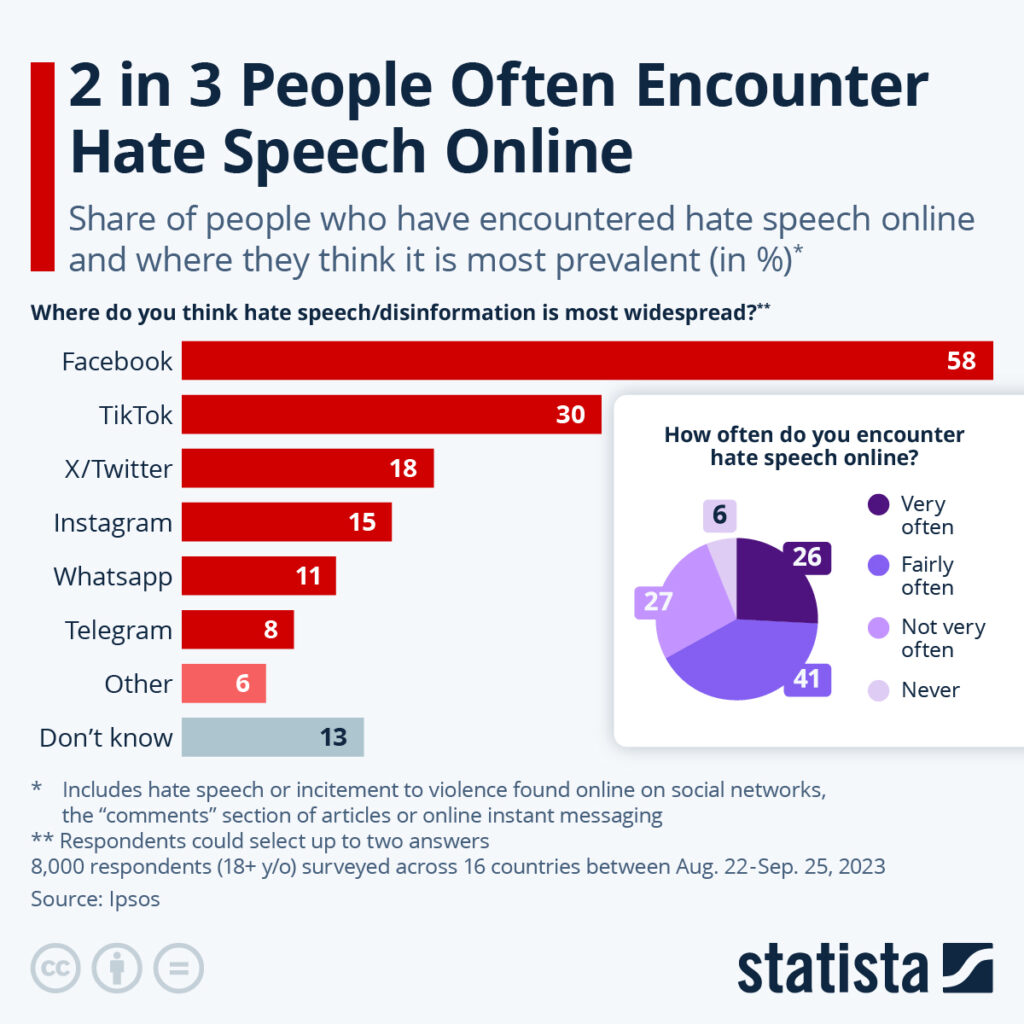
“The issue of hate speech online does not fall under a moderation failure. It is an aspect of platform construction, its revenue generation, and their failure to regulate by governments.”
Algorithms Don’t Just Recommend Content. They Recommend Outrage.
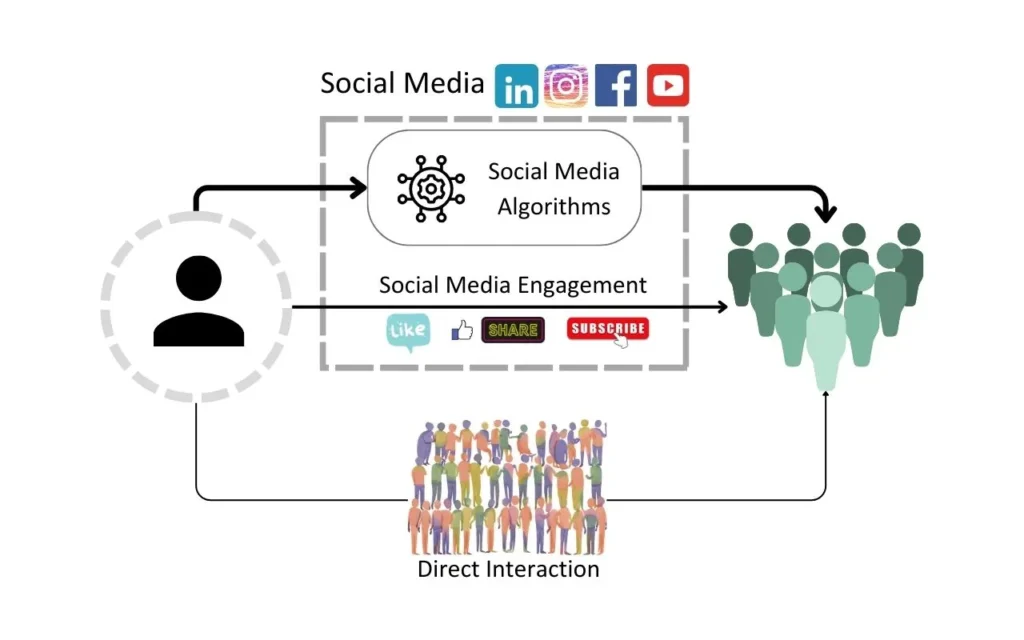
Whenever you open Facebook, TikTok, Youtube or X, you are not free to browse the internet. What you are viewing is a curated version – filtered, ranked, and fed into your screen by an algorithm which has a single objective; one objective – keep you scrolling.
What keeps people scrolling? Emotion. In particular, negative emotion of high arousal: outrage, fear, disgust.
Research shows that any content that arouses these emotions will produce significantly more clicks, shares, and comments compared to neutral or informative content.
“The algorithm isn’t neutral. It is prejudiced in intention – and the prejudice rewards insubordination.”
Researchers Just and Latzer (2016) refer to this type of reality construction as algorithmic: automatic selection systems do not passively represent the reality but actively construct it, make visible and exalted that which provokes us, and obscures that which enlightens us.
The real-world result? A post that provokes outrage or hostility can generate thousands of reactions. The system reads that as engagement — and amplifies it further.
This isn’t a bug. It’s a business model.
Platforms Were Built to Grow, Not to Be Safe.
To comprehend the reasons behind online hate speech proliferation, you must first learn about the actual objectives of online platforms. The platforms function as commercial enterprises which design their systems to maximize user engagement time on their websites. The 2017 study by researcher Adrienne Massanari on Reddit’s toxic communities which included the notorious #Gamergate harassment campaign showed that the upvote and downvote system together with community moderation did not produce an unbiased environment for idea exchange.
Instead, it spawned what she called techno cultures of cruelty: communities that were structurally encouraged by the platform’s own design to target women, journalists, and minorities.
The internal Facebook documents leaked by whistleblower Frances Haugen in 2021 confirmed the same pattern at a much larger scale: Facebook’s own researchers found its algorithms were fuelling political polarisation and, in some regions, real-world violence.
The company’s response? Delay fixes that might hurt engagement metrics.
The platform knew. It chose growth.
Hate Speech Crosses Borders. Regulation Doesn’t.
Online hate speech is transnational in nature, it is the area where responsibility is lost most of all.
All the nations that attempt to control hate speech on the Internet hit the same stumbling block: national legislation, international ones.
It is possible to pass the Digital Services Act in the EU. Online Safety Act can be updated in Australia. However, when the harmful information against a minority population get hosted on the US servers, edited (or not) by a company deeply embedded in the culture of the first amendment, and consumed by the users ten other countries, whose law holds?
“Platformed racism does not merely put up with racist content. It mediates it, gives it structure, disseminates it.”
This has been demonstrated with forensic accuracy by a 2017 research by Ariadna Matamoros-Fernández on a race-based controversy against Indigenous Australian AFL player Adam Goodes. The harassment was diffused differently on Twitter, Facebook and YouTube – influenced by the unique moderation culture of each platform and the type of algorithm used.
The retweet feature in twitter increased its exposure. The organising infrastructure was in facebook groups. The recommendation engine in YouTube ensured that the audience was entertained.
Matamoros-Fernández (2017) describes this as “platformed racism” — the idea that platforms do not merely host racist content, but actively shape how it circulates and spreads.
Case Study: X Under Musk and the Collapse of Content Moderation.
No example better illustrates this structural problem than the transformation of Twitter into X under Elon Musk in late 2022.
Within weeks of the takeover, Musk dissolved the Trust and Safety Council, reinstated previously banned accounts, and significantly reduced moderation teams — all framed as a defence of free speech.
The effects were immediate.
Multiple studies and reports have documented a rise in hate speech on the platform following the acquisition. For example, early analyses found that the use of certain racial slurs surged dramatically in the days after Musk took control, reaching levels far above the 2022 average.
As shown in this figure, spikes in hate speech closely follow platform design changes, suggesting that these outcomes are structurally driven rather than accidental.
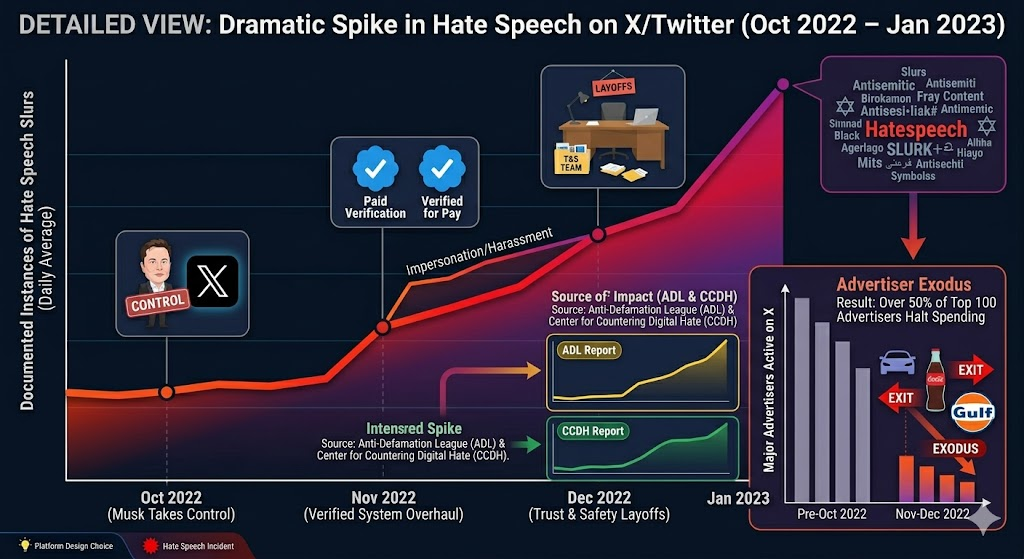
The data was damning. The center to countering digital hate reported an extended and steep increase in slurt and targeted harassment in the months after the ownership transfer.
Nevertheless, it is here where this case is truly educative with regards to digital policy: Musk did not construct the problem. He removed the patch.
What the X experiment showed is that former moderation was a veneer of control that had always been structurally constructed such that it always rewarded outrage and anger. Self-regulation that is not backed by the structure and also lacks external accountability is reversible by whoever is the owner of the business this quarter.
Regulation: Too Little, Too Late, Too Easy to Game.
This is not necessarily the fault of governments. Over the last 20 years (in the majority of the democratic countries of the West), the Western democracies worked on the principle that platforms were inert pipes and not publishers and, as such, did not bear any material legal responsibility when it came to the content generated by its users.
Section 230 of the Communications Decency Act in the United States, written in 1996, when the internet was almost non-existent, gave sites virtually complete immunity against the content posted on them. This was to be expected.
Europe moved faster. Introduced as Digital Services Act (DSA), which will be fully effective in 2024, will direct the giant platforms to recognize and handle systemic self-danger, such as with harmful material that was amplified through an algorithm, and will code to independent audit.
But even the DSA has limits. It deals with outlawed material. Even the worst hate speech on the internet is technically free to air, dehumanising but not threatening in and of itself, doing harm in large scale but can be denied at an individual level.
Under the DSA platforms are not forced to redesign their algorithmic reward system. It does not limit the amplification of engagement. It does not require that safety be incorporated in the architecture during its design.
And cross-contextually? Research by Guan and Chen (2026) on hate speech in China’s digital environment shows that structural conditions — whether algorithmic or political — shape online speech regardless of geography. The problem has not been solved in any jurisdiction. That is not a coincidence.
The Fix Isn’t More Moderators. It’s Different Machines.
So what do we actually do?
First, we retire the idea that better moderation is the answer. Meta already employs tens of thousands of content moderators — most of them contractors in the Global South, paid poverty wages to watch the most violent content on the internet.
This system is not just inadequate. It is inhumane. It treats hate speech as a content problem to be cleaned up after the fact, rather than a design problem to be prevented at the source.
What structural solutions actually look like:
- Algorithmic impact assessments — required before deployment, like environmental impact assessments for infrastructure
- Independent audits of recommendation systems — giving external researchers access to how content is amplified
- Banning specific amplification pipelines — such as autoplay recommendation chains that researchers have shown drive radicalisation
- Legal liability for algorithmic amplification — not just content hosting, but the decisions platforms make about what gets spread
None of this is technically impossible. The most politically challenging situation arises because the companies facing the highest financial risks lead the funding activities that support their lobbying efforts to create regulations which would limit their operations.
Conclusion: The Platform Problem Is Still the Problem.
Hate speech on the internet is not a given. Neither is it the evil side of free speech – a obligatory tax on free discourse.
It is the result of certain choices of the design, certain business interests, and certain administrative malfunctions. All of which are changeable.
None of this is a revelation to the people who are victims of hate speech on a daily basis women of colour, LGBTQ+ communities, religious minorities, journalists, activists. What the study is now affirming and what policy makers will, as it all ultimately comes down to, is that the internet, as is now, is not a level playing field.
“It is a machine,–and just now it is tuned so as to increase the bad in us. It is possible to construct various machines. It is not a matter of whether we can and will demand them politically.”
References
Bolsover, G., & Howard, P. (2019). Chinese computational propaganda: automation, algorithms and the manipulation of information about Chinese politics on Twitter and Weibo. Information, Communication & Society, 22(14), 2063–2080. https://doi.org/10.1080/1369118X.2018.1476576
Hickey, D., Schmitz, M., Fessler, D., Smaldino, P., Muric, G., & Burghardt, K. (2023). Auditing Elon Musk’s impact on hate speech and bots. arXiv. https://arxiv.org/abs/2304.04129
European Commission. (2022). Digital Services Act (EU) 2022/2065. eur-lex.europa.eu
Guan, T., & Chen, X. (2025). Threat Perception, Otherness and Hate Speech in China’s Cyberspace. The Journal of Contemporary China, 1–16. https://doi.org/10.1080/10670564.2025.2475051
Just, N., & Latzer, M. (2017). Governance by algorithms: reality construction by algorithmic selection on the Internet. Media, Culture & Society, 39(2), 238–258. https://doi.org/10.1177/0163443716643157
Massanari, A. (2017). #Gamergate and the Fappening: How Reddit’s algorithm, governance, and culture support toxic technocultures. New Media & Society, 19(3), 329–346. https://doi.org/10.1177/1461444815608807
Matamoros-Fernández, A. (2017). Platformed racism: the mediation and circulation of an Australian race-based controversy on Twitter, Facebook and YouTube. Information, Communication & Society, 20(6), 930–946. https://doi.org/10.1080/1369118X.2017.1293130
Be the first to comment