
If you’ ve ever opened TikTok just for five minutes and somehow lost an hour, you’ re not alone!
The app seems to know exactly what you want to watch. One video leads to another, and before you realise it, you’ re deep into a stream of content that feels strangely personal, almost as if it was made just for you.
But here’ s the uncomfortable question:
Who decided you should see those videos?
It’ s easy to think of social media as a neutral space, a place where people simply post content and others choose what they want to engage with. But that’ s not really how it works anymore. What we see online is heavily shaped by systems we don’ t control and rarely understand.
Behind every scroll, like, and share is a set of rules. These rules decide what content gets promoted, what gets hidden, and even what gets removed altogether. And importantly, these rules are not created by governments or public institutions. They are written and enforced by private companies.
As legal scholar Nicolas Suzor argues, platforms like TikTok, Instagram, and YouTube now function as “governors” of online life (Suzor, 2019). They don’ t just host conversations, they shape them.
This blog post argues that social media platforms have quietly become one of the most powerful forms of governance in modern society. Using TikTok as a case study, it explores how platform rules, algorithms, and data practices influence what we see online, and why this matters for our digital rights.
Social Media Isn‘ t as “Open“ as It Seems
At first glance, social media appears to be an open environment where anyone can share their ideas. Platforms often present themselves as neutral tools that simply host content created by users.
In reality, every platform is built on a carefully designed system that controls how content flows. These systems include algorithms, moderation policies, and data tracking mechanisms, all of which influence what users experience.
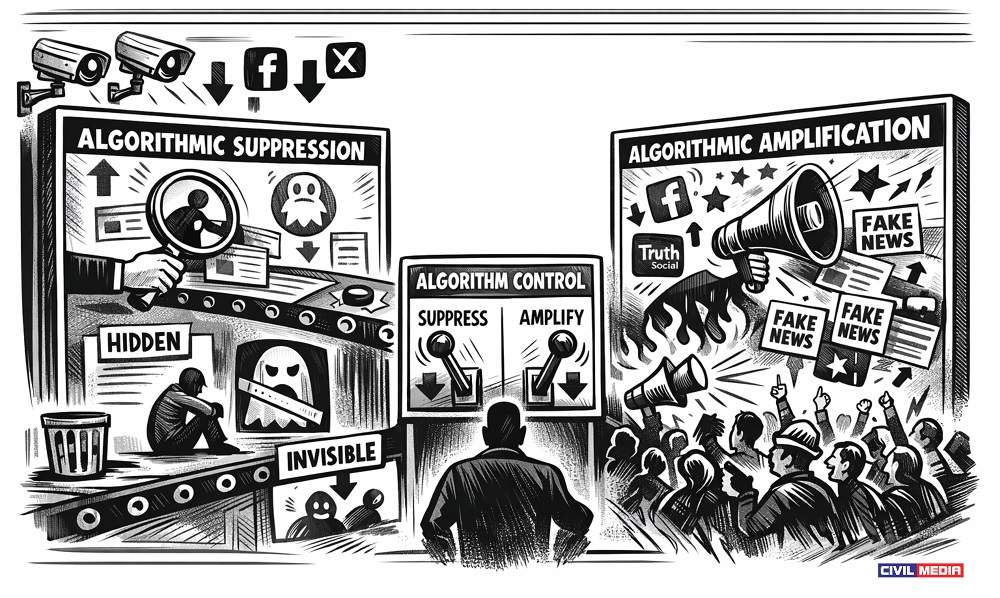
These include things like:
- – community guidelines that define acceptable behaviour
- – algorithms that determine which posts get promoted
- – moderation systems that remove or limit certain content
- – data collection practices that track user behaviour
When you scroll through your feed, you’re not seeing a random selection of posts. You’re seeing content that has been filtered, ranked, and prioritised based on criteria set by the platform. Most of these systems operate quietly in the background, which is why users rarely think about them. Yet they play a huge role in shaping online experiences.
Nicolas Suzor (2019) describes platforms as “private governors” of digital spaces. Instead of governments setting the rules for public communication, social media companies increasingly make these decisions themselves. Their policies determine what kinds of speech are allowed, how disputes between users are handled, and what consequences people face if they break the rules.
The scale of this influence is enormous. Billions of people now rely on digital platforms to communicate, access news, and participate in public discussions. This means that decisions made by a small number of technology companies can have global consequences.
For example, when a platform changes its algorithm, it can dramatically alter which types of content gain visibility. A creator who once reached thousands of viewers might suddenly find their posts barely appearing in anyone’ s feed. News organisations may struggle to reach audiences if the platform prioritises entertainment content instead.
These decisions are rarely visible to users, but they shape what we see online every day.
Why Digital Rights Matter Online
As platforms have gained more influence over communication and information, concerns about digital rights have become increasingly important.
Digital rights refer to the idea that fundamental human rights, such as privacy, freedom of expression, and access to information should also apply in digital environments (Goggin et al., 2017). As more of our social lives, work, and political discussions move online, protecting these rights has become a major challenge.
One of the biggest issues is the way platforms collect and use personal data.
Social media companies rely heavily on data to power their business models.E very interaction online generates information: what you watch, how long you watch it, what you click, what you ignore. Over time, this data builds a detailed profile of your preferences, habits, and even personality traits. This data helps companies build detailed profiles of users’ interests, preferences, and habits.
These profiles are extremely valuable because they allow platforms to deliver highly targeted advertising. In fact, personalised advertising is one of the main ways social media companies generate revenue.
From a business perspective, this system makes sense. But from a user perspective, it raises questions about how much control people actually have over their personal information.
Helen Nissenbaum (2018) offers a useful way to think about this issue through the concept of “contextual integrity.” According to this idea, privacy is not just about keeping information secret. Instead, it depends on whether information flows in ways that match social expectations.
For example, you might be comfortable liking videos on TikTok because you assume that action stays within the platform. What you might not expect is how that behaviour is analysed, stored, and used to shape future recommendations or advertising.
Digital platforms often blur these boundaries. Information shared casually in one context can quickly become part of large data systems used for marketing, recommendation algorithms, or behavioural analysis.
Because these processes are largely invisible, users rarely have a clear understanding of how their data is being used.
TikTok: Entertainment or Algorithmic Control?
To see how platform governance works in practice, it is helpful to look at a specific example. TikTok provides a particularly interesting case because of its powerful recommendation system.
What makes TikTok unique is its For You Page, a highly personalised feed driven almost entirely by an algorithm. Unlike older platforms that rely on social networks (friends or followers), TikTok’s system focuses on predicting what will keep you watching.
The algorithm considers factors like:
- – watch time (how long you stay on a video)
- – engagement (likes, comments, shares)
- – interaction patterns (what types of content you return to)
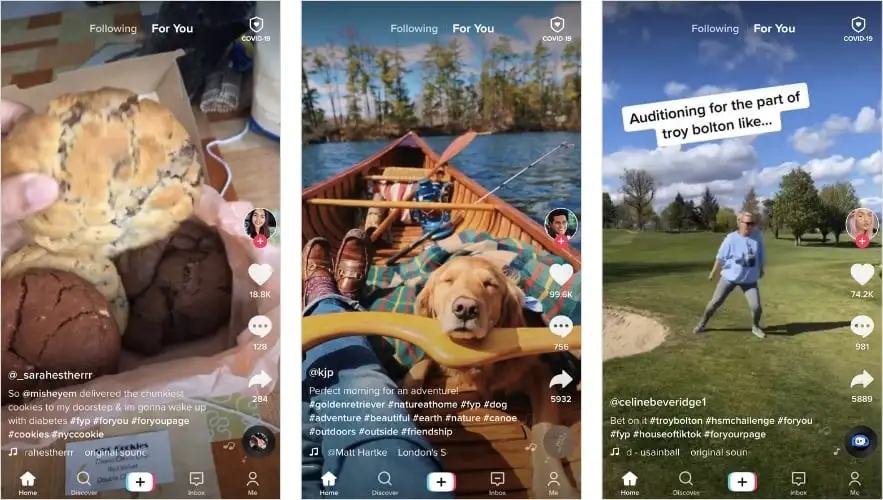
Using this data, the algorithm predicts which videos a user is most likely to enjoy and promotes those clips on the For You Page. From this, it builds a constantly evolving model of your interests. At first glance, this seems harmless, even helpful. After all, the platform is simply showing users content they are likely to enjoy.
But this is where things get more complicated.
Because the algorithm determines visibility, it effectively decides which voices are amplified and which are ignored. A creator might produce high-quality content, but if the algorithm doesn’ t promote it, that content may never reach an audience. This is a form of power that operates quietly but significantly.
As Flew (2021) suggests, platform algorithms are not neutral tools. They are designed with specific goals in mind, usually maximising engagement and profit. This means the system prioritises content that keeps users watching, which can sometimes favour sensational, emotional, or highly repetitive material.
There have also been ongoing concerns about content moderation on TikTok.
Reports and user experiences have raised questions about:
- – inconsistent enforcement of community guidelines
- – potential suppression of certain political or social topics
- – lack of transparency in moderation decisions
Some creators believe their content has been “shadow banned,” where posts receive dramatically reduced visibility without explanation. While platforms often deny intentional bias, the lack of transparency makes it difficult for users to understand or challenge these decisions. This connects directly to Suzor’ s (2019) argument, platforms act as governors, but without the accountability mechanisms we expect from traditional governance systems.
TikTok is not just showing content, it is shaping culture, influencing trends, and structuring online visibility.
Digital Rights in a Platform Dominated World
As platforms take on a greater role in organising communication, the question of digital rights becomes more urgent.
Digital rights extend traditional human rights into online environments, such as freedom of expression and privacy (Goggin et al., 2017). But enforcing these rights is much more complicated when the spaces where communication happens are privately owned.
For example:
If a platform removes content, is that censorship or moderation?
If an algorithm promotes certain viewpoints, does that influence public opinion?
If user data is collected and analysed, where should the line be drawn?
These are not easy questions. Scholars like Karppinen (2017) argue that digital rights should be understood as part of broader human rights frameworks. However, applying these principles in practice is challenging because platforms operate globally, while laws are usually national.
This creates gaps in accountability. Governments have started to respond. In Australia, for instance, debates around digital regulation have intensified, particularly in relation to online safety and platform responsibility. Similar discussions are happening globally, with policies aimed at increasing transparency and protecting user data.
However, as Flew (2021) points out, regulation is a balancing act. Too little oversight allows platforms to operate without accountability. Too much control risks limiting innovation or restricting free expression.
Why Platform Governance Matters
The growing power of digital platforms raises important questions about accountability. When a small number of companies control the infrastructure of online communication, they gain significant influence over how information circulates in society. Decisions about algorithms, moderation policies, and data practices can shape public discourse in ways that affect politics, culture, and everyday social interactions.
This is why governments around the world have begun exploring ways to regulate digital platforms more effectively. Terry Flew (2021) argues that the challenge for policymakers is finding ways to ensure greater transparency and accountability without undermining the benefits that digital platforms provide. Social media has created new opportunities for creativity, activism, and global communication. At the same time, the concentration of power in a few technology companies raises concerns about democratic oversight.
Finding the right balance between innovation and regulation will likely remain one of the central debates in digital policy over the coming years. For everyday users, understanding how platform governance works is also important. The more people recognise the role algorithms and policies play in shaping online spaces, the better equipped they are to think critically about what they see online.
The Internet Was Never Completely Free

When the internet first became widely accessible, it was often described as a space of freedom where people could communicate without traditional gatekeepers. Social media platforms seemed to reinforce this idea by allowing anyone to publish content and reach global audiences.
But as platforms have grown, it has become clear that online spaces are far from unregulated. Instead, they are governed by complex systems of algorithms, policies, and data practices designed by private companies. These systems influence what we see online, how our information is used, and what kinds of conversations take place in digital environments.
Recognising this reality does not mean rejecting social media altogether. Platforms have created remarkable opportunities for creativity, learning, and connection. However, it does mean acknowledging that these spaces are shaped by powerful institutions whose decisions affect millions, sometimes billions of people.
As debates about digital rights and platform regulation continue, one thing is becoming increasingly clear: the rules of the internet matter. And understanding who makes those rules may be one of the most important challenges of the digital age.
Reference list
Chen, Z. T., & Cheung, M. (2018). Privacy perception and protection on Chinese social media: a case study of WeChat. Ethics and Information Technology, 20(4), 279–289. https://doi.org/10.1007/s10676-018-9480-6
Flew, T. (2021). Regulating Platforms (pp. 72–79). John Wiley & Sons.
Goggin, G., Vromen, A., Weatherall, K., Martin, F., Adele, W., Sunman, L., & Bailo, F. (2017). Digital Rights in Australia. In ses.library.usyd.edu.au. University of Sydney. http://hdl.handle.net/2123/17587
Karppinen, K. (2017). Human rights and the digital. The Routledge Companion to Media and Human Rights. https://doi.org/10.4324/9781315619835-9
Marwick, A. E., & Boyd, D. (2019). Understanding Privacy at the Margins: Introduction. International Journal of Communication, 12(0), 1157–1165. https://ijoc.org/index.php/ijoc/article/view/7053
Nissenbaum, H. (2019). Respecting Context to Protect Privacy: Why Meaning Matters. Science and Engineering Ethics, 24(3), 831–852. https://doi.org/10.1007/s11948-015-9674-9
Suzor, N. P. (2019). Lawless: The secret rules that govern our digital lives. Cambridge University Press. https://doi.org/10.1017/9781108666428
Be the first to comment