
Hate speech has become an everyday phenomenon in modern society. As we are inundated with hostile comments, ridicule and public abuse from people over their appearance, identity or lifestyle on social media, it has become a very common problem for celebrities and ordinary people. The internet should not be viewed as a problem but part of how the world works today.
For one reason, online hatred is the product of a few “harmful individuals.” This may be true, but it is too narrow, as if online hate speech did not exist in the digital world, without first understanding why it is so pervasive and difficult to eradicate. Research has indicated that online communities are often hostile and marginalized populations frequently suffer from ongoing abuse, discrimination, and exclusion (Carlson & Frazer, 2018). This suggests we cannot blame online hatred on someone else. Online hate speech is not the product of a few “harmful individuals.” Though it may be relevant, it is wrong…
This article proposes that online hate speech is influenced by the structure of digital platforms. In particular, algorithms, platforms, and attention-grabbing media economy will further encourage the creation of harmful content and develop an individual hostility into a larger social problem. The article provides a short explanation of the mechanisms at work and combines it with the recent cases of online harassment of the Olympic diver Quan Hongchan to suggest that online hate speech is not only created by users, but encouraged, organized, and amplified by the communication platform.
Algorithmic Amplification and the Visibility of Hate
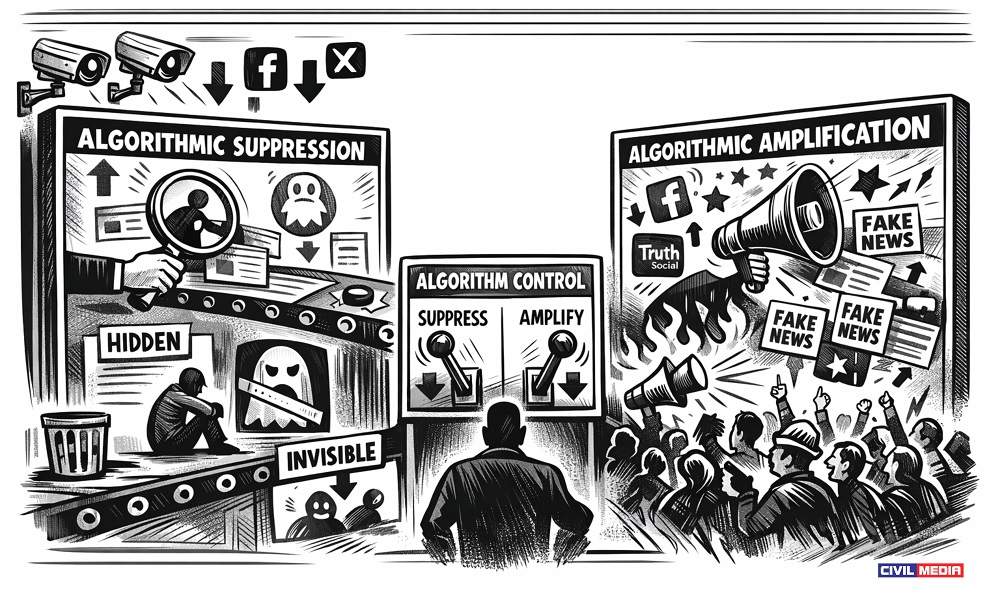
One of the reasons why hate speech gets spread across the Internet is algorithm amplification. On social media, the content is sorted according to the number of likes, shares, comments, forwards, and views. The users want content they are interested in or valuable, but in practice, they prefer content that triggers strong emotions, such as anger, ridicule or shame.
I think this changes the nature of online hate. Harmful words will not only be seen as part of the platform, they will be promoted by the platform’s tools. As Matamoros-Fernández (2017) describes, platforms are not just a place where bad remarks can be said but where they encourage it to be made through the platform’s tools and algorithms. I believe that Matamoros-Fernández’s work is important because it shifts the focus away from what the platform should do from the platform, but how users perceive it.
Harmful content triggers interactions. Provocative posts will draw attention, which increases the chances of exposure and engagement. It works like this. At the end of the day, no matter how harmful it is, the most eye-catching content is the offensive or provocative content. Since that time, cyber violence has not only been allowed but made worse by the extent of its spread.
This is important because it makes the individual hatefulness into a collective attack. An angry comment that may be considered rude can be detected by the algorithm for high interaction and become part of a huge cyber attack. Today, the problem with online hate speech is not the user’s intentions, but the platform itself. If the platform allows anyone to post insulting remarks, then they also support cyber violence.
Platform Design and the Production of Toxic Environments
The platform design influences the evolution and dissemination of hate speech online. While algorithms have gotten better, the site design has been crucial in influencing how hate speech emerges. Social media sites are not an inherently neutral medium. The purposes of social media websites determine how users interact and contribute to the network. Features like liking, sharing, quoting posts, popular lists and content ranking systems have become tools in which users compete for attention. Attention is now a measurable and competitive resource.
Massanari (2017) is particularly relevant here because she argues that the characteristics of Reddit, such as voting, anonymity, easy account creation and lack of audit, constitutes a harmful technological culture. Here, harassment and exclusion are not only tolerated, but even part of the ecosystem formed by platforms, users and managers. Massanari’s arguments are important here, as they show that harmful cultures do not come from outside the platform, rather, they are the product of the platform and supported by the platform.
Anonymity and low access levels make users not feel like they have to take any responsibility, and they may make more offensive and abusive remarks without any consequences from the society. High ranking of comments and easy to identify interactive elements make conflict easier to see. Out-of-the-box or aggressive content is easier to publish and more likely to be uncovered. A design choice that seemed minor or designed for functional reasons may have an impact on society. It can not only lower the cost of abuse but also expand its reach.
Content review is also important. The platform claims to be an open space for expression but this is not always the case. Weak, inconsistent or passive inspection mechanisms will allow malicious behavior to spread before any intervention is taken (if any). Many times, reporting tools will require victims to shoulder additional burdens. It appears that the main purpose of the platform is to promote activity, not protect those who are hurt.
Also, online hate speech must not be viewed only as a content problem, but also as a platform design problem. As the platform design will influence what content is easy to share, easy to see, and difficult to question, online hate speech can also be cultivated in the environment that the platform creates and maintains.
The Attention Economy and Platform Incentives
To understand why, we need to look at the economics of social media. Social media operates in the attention economy, and the activity of its users reveals a direct relationship to their potential income (through advertising, data collection and platform growth): the longer that a user stays on the website, the more interaction and content they consume, and the higher their value.
In these systems, content with inflammatory content can win more often. Anger, conflict and controversy can be a potent combination to draw users in and induce participation, thus winning them. Business analysts understand the value of content that will make users want to go back over and over again on the platform—whether it is in the public interest or not—which creates a conflict between user security and the platform profitability.
Importantly, this does not mean that the platform endorses hate speech. Rather, their business model is designed to profit from the spreading of harmful content. Community and audit policies may exist, but they might only work once the harmful content is spread. If this structure continues to reward incitement and exposure, harmful content will always be a profit center.
This is also why it is so difficult for one person to solve online hatred. Even if we say, be friendly, it is hard to shake the environment that profites off of conflict. To stop cyber damage, we must not just improve the audit mechanism, but look at the economy and technology that profit off violence.
Case Study: The Online Harassment of Quan Hongchan

The above structural dynamics are also observed in the online harassment incident of Olympic diving champion Quan Hongchan. In April 2026, Reuters reported that the sport department of China was investigating the case of cyberbullying against Quan Hongchan. Prior to this, she had been ridiculed on the internet over her size, figure, and her private life, and had even considered quitting after the Paris Olympics (Reuters, 2026). This case has attracted attention because it shows how intrusive cyber censorship can be for an accomplished young athlete.
This is personal abuse as the user posted derogatory, abusive and harassing comments about Quan Hongchan himself. But, it is just the beginning of the discussion. The volume and duration of this cyber violence shows how these platforms promote and circulate such content. Emotional comments are more prominent on these platforms, and if they are distributed widely, they will attract more people, more attention and more hostility.
To paraphrase Matamoros-Fernández (2017), the platform facilitates the dissemination of negative speech through its visibility and communication. Massanari (2017) also argues that the platform’s design (public participation indicators, participation, and inadequate audit) may have played a role in the dissemination of cyber harassment. Quan’s case shows how personal attacks can take the form of collective cyber violence when the platform focuses on traffic.
The significance of this case is to show the nature of cyberharm. Quan not only was criticized by a few users, she was also the victim of the network attention model, in which abuse was amplified, repeated, and acknowledged by society. This case demonstrates how the platform enhances the vulnerability of users and normalizes harassment when the victim is visible and frequently commented by the public.
Why This Matters: From Individual Harm to Social Consequences
Online hate speech may have consequences beyond eliciting feelings of anger. For the individual, it may be a source of stress, fatigue, fear, and depression. Carlson and Frazer (2018) noted that online hostility may make someone feel excluded and vulnerable online, especially when the user is in a vulnerable social situation. Cyber hatred is not just a short-term and symbolic problem but has emotional and social implications as well.
Public figures suffer the most from cyber violence because of their popularity. Because their lives are always in the public mind, angry comments are easy to make and hard to contain. Initial criticisms may become a source of constant surveillance, humiliation and damage to reputation. Therefore, we should understand online hate speech as a form of power, which is not only a means of communication but also a power to control or constrain its users.
Similarly, online hostility has been imposed as a way to normalize and increase public discourse. Having such malicious content on the rise will affect how we talk and who we can talk to. Some voices will be louder because they are provoked, and others will be muted because it is expensive to speak. This will have a tremendous impact on digital citizenship, public debate, and inclusion.
Hate speech online, therefore, is more than a pejorative comment. It is a social and political issue of who can be out in public and who can be the target of hatred, and which platforms allow it to flourish.
Conclusion
Hate speech on the internet is often seen as an isolated case of responsibility, but this misreading leaves out one of the main reasons it occurs. As I’ve explained in this article, algorithmic amplification, platform and attention economics play key roles in the dissemination and visibility of potentially harmful content. The digital platform is not only a place where hatred flourishes, but also a breeding ground for it.
The solution to online hate speech is not to change the way people use technology or make themselves better off, but to pay attention to how they choose to participate, prod and promote hatred. Unless the problem of online hate speech is resolved, online hate speech will no longer be a feature of digital platforms but a product of them.
References
Carlson, B., & Frazer, R. (2018). Social media mob: Being Indigenous online. Macquarie University.
Massanari, A. (2017). #Gamergate and the Fappening: How Reddit’s algorithm, governance, and culture support toxic technocultures. New Media & Society, 19(3), 329–346. https://doi.org/10.1177/1461444815608807
Matamoros-Fernández, A. (2017). Platformed racism: The mediation and circulation of an Australian race-based controversy on Twitter, Facebook and YouTube. Information, Communication & Society, 20(6), 930–946. https://doi.org/10.1080/1369118X.2017.1293130
Reuters. (2026, April 8). Chinese sports authorities crack down on cyberbullying of diving prodigy Quan. Reuters.
Be the first to comment