In 2025, 19-year-old cosplayer Ashley Gail Paxton died by suicide after sustained online racial harassment. All she did was just wear costumes, take photos, and share them. But some people repeatedly targeted her with hate speech over her skin colour. Such incidents are not isolated cases. These events have made people realise that the online harms can extend beyond the digital world.
On March 5, the Queensland Parliament passed new hate speech laws. The laws prohibit certain forms of expression that could make a member of the public feel threatened, harassed, or offended, with specific phrases explicitly restricted.
Before these laws, Australia had set up eSafety Commissioner to protect its citizens’ online safety, including mechanisms for reporting and managing online harms. The United Kingdom also enacted the Online Safety Act. These developments reflect growing global concern over the damage caused by hate speech.
But laws alone are not enough. So, beyond government regulations, platforms also need to take action. It is crucial that platforms learn how to manage hate speech, distinguish it from free speech, and create a healthy and safe online space.
Free speech is a fundamental right, but it is not absolute. Under international human rights law, it does not protect speech that incites hatred, discrimination, or violence against vulnerable groups.
We may all have heard of “hate speech”, but what exactly is it? Under international law, hate speech is treated as a serious human rights violation. As Sinpeng et al. (2021) define: hate speech is not merely offensive or hurtful, it is discriminatory speech targeting people based on their perceived membership in a marginalised group, causing harm both immediately and over time in the context where it is uttered (p.6).
Why platforms are responsible for hate speech?
John Perry Barlow, in A Declaration of the Independence of Cyberspace (1996) , stated that “we are creating a world that all may enter without privilege or prejudice accorded by race, economic power, military force, or station of birth. But the vision has backfired. Some platforms act as vehicles for hate, turning one group against another. They should not become tools for spreading hate speech or breeding grounds for it. Platforms, as the gateways to this world, have a duty to do their part.
It should be noted that platforms are not neutral. Many people may mistakenly believe platforms are neutral simply because they don’t produce content. But they are not. The algorithms, business models and other factors shape users’ content and influence their behaviour.
ABC has reported on Mr. Mejia-Canales’s idea of “going all the way upstream”.
Without appropriate commercial need (such as the threat of a fine or hurt to stakeholders), there’s no push for digital platforms such as X to regulate issues like hate speech because it doesn’t affect their bottom dollar. And in many cases, increases it as people engage more heavily with inflammatory content.
Platforms usually operate across multiple legal jurisdictions. For example, X operates in over 180 countries. This responsibility becomes even more complex, but also more necessary. Different countries have different laws governing hate speech. From the EU’s Digital Services Act to Australia’s Online Safety Act, platforms face a patchwork of obligations. But the fact that laws differ does not give platforms an excuse to do nothing. Platforms must meet their duty of care to users worldwide.
In sum, the platforms which affect user behaviour reflect choices made by the people who create and manage them and those who make choices should be responsible for, at least, the reasonably foreseeable risks of those choices (Woods et al, 2021, p.95).
What should platforms do: the case of X
In 2022, when Elon Musk acquired Twitter (now X), he promised to reduce restriction to promote free speech. “Free speech is the bedrock of a functioning democracy,” he said, “and Twitter is the digital town square where matters vital to the future of humanity are debated.”
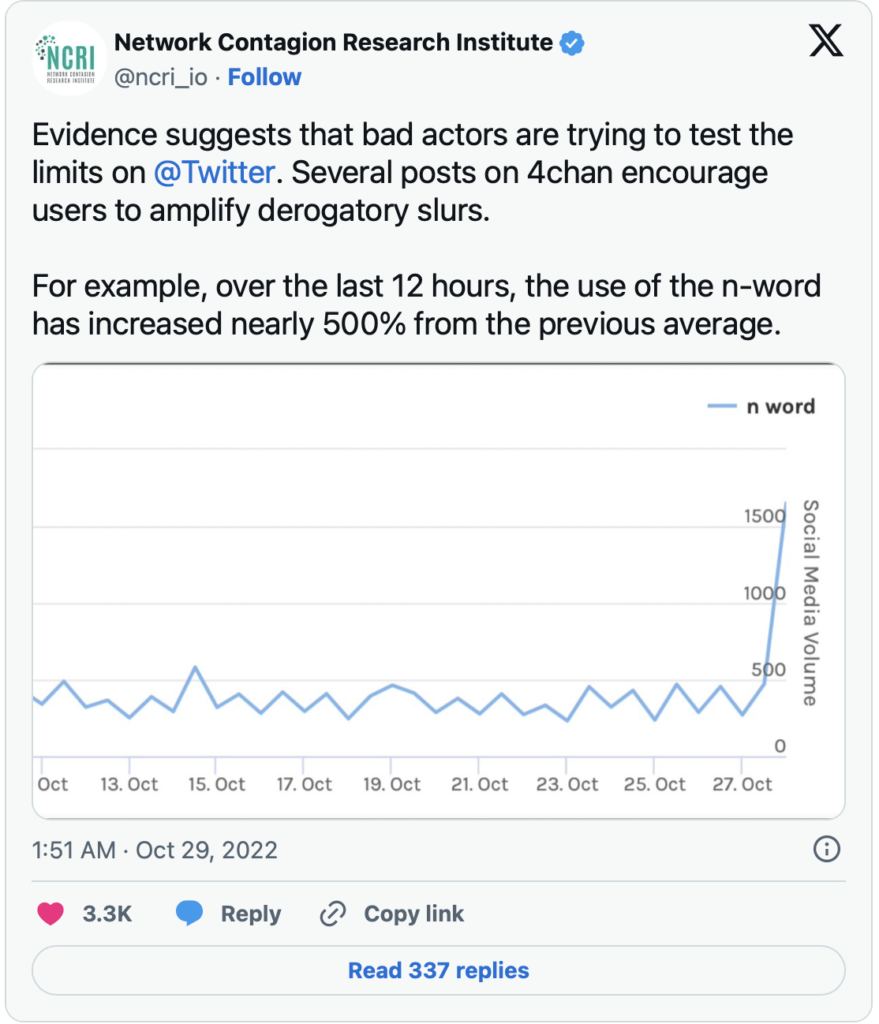
However, the data suggests otherwise. Within 12 hours of the acquisition, use of the n-word increased nearly 500% compared to average levels. Research shows that for at least eight months after the takeover, hate speech on X rose by 50%.
Moderation breaks down
Some of those laid off were responsible for online safety. According to the report, after the acquisition, the company’s Trust and Safety staff dropped by 30% globally and engineers focused on trust and safety issues fell by 80%. Moreover, the Trust & Safety Council as an advisory group of nearly 100 independent civil and human rights organisations addressing hate speech and other online harm issues, was disbanded. These moves led to a loss of key personnel and left the platform understaffed.
With fewer staff, X’s hate speech moderation system broke down. It became unable to detect hate speech and deal with it in a timely manner. When it slowed down its response to user reports of hate speech, users then developed “reporting fatigue”. They feel that reporting has little impact on hate speech on the platform and so stop reporting the abusive content (Sinpeng et al, 2021). This also explains why hate speech on X surged in such a short time.
To fix this, platforms need to ensure they have enough staff and all employees receive adequate and appropriate training. This enables them to handle hate speech quickly and effectively and avoid reporting fatigue. Handling of complaints is also an important part of harm reduction – a company’s complaints process should function as an early warning of systemic problems (Woods et al, 2021, p.96). At the same time, platforms should actively cooperate with third-party moderation companies to avoid efficiency problems caused by understaffing. They should also work with protected groups such as LGBTQ+ communities to better define what content should be moderated.
Transparency is the foundation of accountability
X reinstated more than 6,100 previously banned accounts, 194 of which had been suspended for hate conduct violations (Region, 2024). For those who spread hate online, such a response is like an open invitation: post freely, no real consequences.
Why did X reinstate accounts that had been suspended for hate speech? Is that a form of privilege? This raises a set of questions that every platform needs to answer: What is the platform’s definition of hate speech and its approach to handling it? Do influential accounts enjoy a privilege that allows them to face lighter penalties when they post hate speech?
These are not small questions. They will encourage more people to post hate speech. When platforms bend the rules for some, the rules mean nothing.
Every platform must understand that free speech does not mean the freedom to attack others without responsibility. Platforms have a duty to tell users what counts as hate speech and what the penalties are. More importantly, platforms must enforce those rules consistently. Otherwise, policies are just empty words on a screen.
A regulatory framework that includes transparency and accountability measures can more effectively address online harm. Many platforms lack transparency in their moderation systems. Although many of them have dedicated pages explaining how they handle hate speech, the actual process and the factors behind their decisions remain largely hidden from the public. As Matamoros (2017) notes: “platforms afford users with different technological mechanisms to manage and report controversial content but these are limited. Since they leave little room for transparent and public discussion about why something is considered offensive (p.936)”.
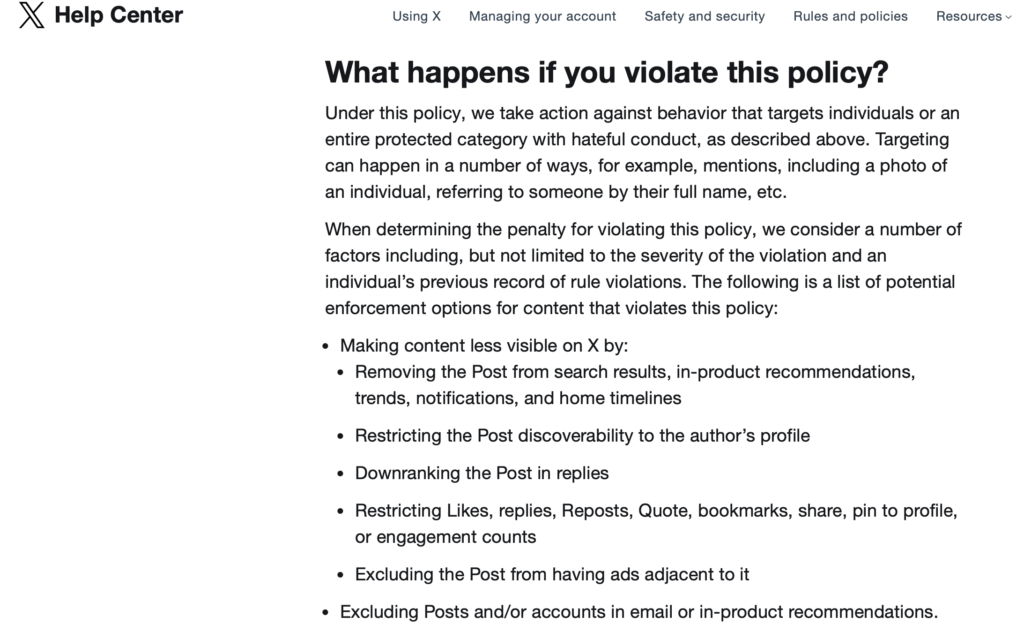
More transparency will increase users’ trust and help combat hate speech. Platforms can publish detailed reports about how many posts were removed, why they were removed and what penalties were given. Some people may worry this could be exploited. But that does not mean platforms should stay opaque. Lack of transparency will not stop abuse. Transparency is the foundation of enforcement. Rules must be updated as hate speech changes its form. That is not an excuse for platforms to do nothing.
The outrage economy: When hate becomes a business
The business model of X also plays a role in the clear increase in hate speech. Its algorithm unintentionally promotes hate speech to users who engage with such content.
We all know that social media platforms are essentially businesses that exist to make money. But how do they earn that money? Most of these platforms’ revenue comes from advertising. And its prices depend on user engagement: views, time spent and more. So algorithms are designed to push the most engaging content, of which hate speech is one example. That also explains why some users post so much hate speech.
The focus of regulation should not target content directly but focus on the design of the service, its business model, the tools the platform provides for users, and the resources it devotes to user complaints and user safety, as each of these aspects influences information flows across the platform (Woods et al, 2021, p.94).
Asking platforms to take actions is not asking them to stop earning money. It means asking them not to profit from hate speech. Profit is no excuse to pass responsibility to governments or users. Platforms have the power to choose what they profit from.
Platforms need to redesign their business models. For example, changing the algorithms that amplify hate content, adjusting advertising revenue sharing to reduce or cut off earnings for those who post hate speech. If platforms are willing, there are many better ways to make money.
Conclusion
By examining the sharp rise in hate speech on X after Elon Musk’s 2022 takeover, three broad measures emerge that could apply to most platforms. Internally, platforms need a stable and effective moderation system. That means enough staff and proper training to monitor posts and handle user reports in a timely manner. Platforms should cooperate with third-party online safety organisations and protected groups to improve their policies and moderation mechanisms. Second, the mechanisms need to be transparent that clearly define hate speech, enforce rules consistently. Third, platforms should not pursue profit at any cost. Redesign business models and algorithms to reduce the amplification of hate speech.
One day soon
For users, platforms, and governments alike, free speech cannot be an excuse to spread hate speech and cause online harm. Platforms must not fuel this behaviour or become accomplices to it.
For platforms like X and Facebook, which set the tone for the industry, their actions have a guiding effect on smaller platforms. How they handle hate speech influence broader moderation practices. If these platforms succeed in reducing online harm effectively, it could significantly improve safety across the wider digital ecosystem.
There is still a long way to go in tackling online harm and protecting online safety. It requires joint efforts from all of us: governments, platforms and users. I believe that one day, every platform will take real responsibility for online harm – and do it well. And with all of us working together, that day won’t be far away.
Reference list
ABC. (2024, October 8). How getting big tech platforms to care for their users could mean a better online experience for everyone. https://www.abc.net.au/news/2024-10-08/regulating-big-tech-in-australia-duty-of-care/104399160
Barlow, J.P. (1996). A declaration of the independence of cyberspace.
Domino, F. (2025). A nineteen-year-old Black girl is dead because she tried to enjoy anime. https://medium.com/@fazer4541/a-nineteen-year-old-black-girl-is-dead-because-she-tried-to-enjoy-anime-1a76ce4223cb
eSafety Commissioner. (2024, November 1). Report reveals the extent of deep cuts to safety staff and gaps in Twitter/X’s measures to tackle online hate. https://www.esafety.gov.au/newsroom/media-releases/report-reveals-the-extent-of-deep-cuts-to-safety-staff-and-gaps-in-twitter/xs-measures-to-tackle-online-hate
Matamoros-Fernández, A. (2017). Platformed racism: The mediation and circulation of an Australian race-based controversy on Twitter, Facebook and YouTube. Information, Communication & Society, 20(6), 930–946.
Region. (2024, January 17). Australian Government pursues X/Twitter over online hate ‘perfect storm’. https://region.com.au/australian-government-pursues-twitter-x-over-online-hate-perfect-storm/736284/
Sinpeng, A., Martin, F., Gelber, K., & Shields, K. (2021). Facebook: Regulating hate speech in the Asia Pacific. University of Sydney & University of Queensland.
Woods, L., & Perrin, W. (2021). Obliging platforms to accept a duty of care. In M. Moore & D. Tambini (Eds.), Regulating big tech: Policy responses to digital dominance (pp. 93–109). Oxford University Press.
Be the first to comment