Image from RECHARGUE(2023)
Convenience comes at a price
You post something on Threads, sharing your current mood and thoughts. A few minutes later, you suddenly have second thoughts, so you immediately hit ‘delete’. The content vanishes from the screen, but has it really disappeared from the internet?
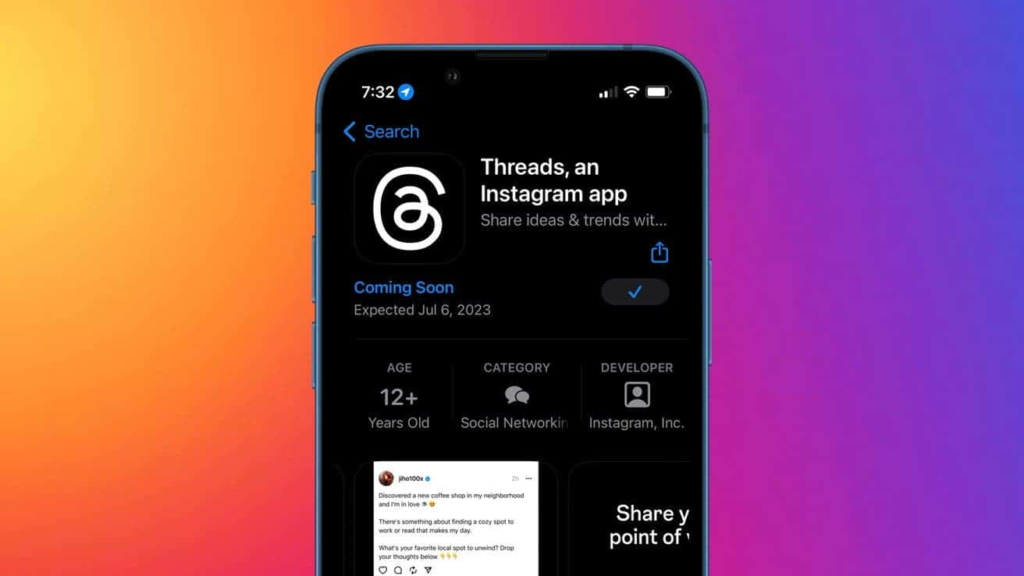
Regular Instagram users will easily notice that the app frequently pushes Threads notifications to their home feeds. As the content is usually tailored to individual interests, Threads is highly effective at capturing the recipient’s attention. One day last year, like many others, I saw a topic that caught my interest and downloaded Threads on a whim. I must say, the sign-up process was incredibly smooth—it pulled my Instagram credentials directly, requiring almost no additional information from me, to the point where I wondered if I’d actually signed up before. This seamless sign-up experience felt incredibly convenient, until I later realised: this ‘convenience’ comes at a price.
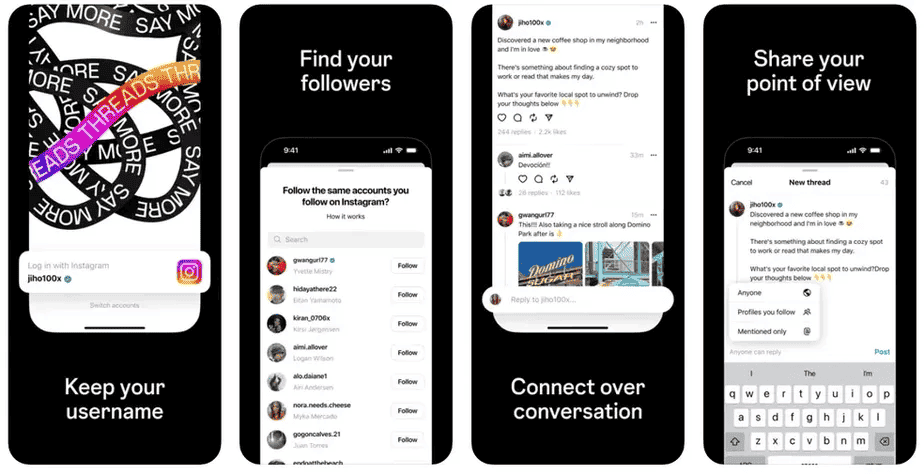
Image from RECHARGUE(2023)
A ‘gift’ that can be taken back at any time
Initially, Threads was eagerly anticipated as a competitor to Twitter, but many users discovered a troubling detail during the beta testing phase: to delete a Threads account, one had to simultaneously delete the linked Instagram account. It was not until the update to the Threads Privacy Supplementary Policy on 3 June 2025 that users were officially permitted to delete their Threads profile independently.
However, this amendment speaks volumes in itself. It did not stem from any legal obligation, but rather represented a voluntary concession by Meta in the face of public and regulatory pressure—it is worth noting that Threads has been slow to launch in the EU, partly because its data policies conflict with EU privacy regulations. In other words, it was public pressure, not the platform’s goodwill, that drove these changes.
As Nicolas Suzor noted in *Lawless*, social media platforms legally belong to the companies that created them and possess “near-absolute power” over their own operations; terms of service almost never impose any rules or restrictions on the behaviour of those in power, offering users only a final ultimatum: If you do not agree with the rules or the way they are enforced, you are free to leave at any time (Suzor, 2019, pp. 19, 22).
Within this framework, users have never truly possessed the right to demand that platforms change their rules; all they can do is wait for the platform to make concessions. It is as if you believe you have been granted a right, but it is more like a gift: one that can be taken back, whose terms can be rewritten, and you are unlikely to notice the moment it quietly disappears.
Image from RECHARGUE(2023)
So, what exactly does ‘deletion’ mean in the context of Threads?
The standard procedure is as follows: go to settings, tap ‘Delete’, confirm, and the content disappears. Most people assume that this is the end of the ‘deletion’ process. However, Threads’ own supplementary privacy policy (effective 3 June 2025) offers a more complex answer. There is a sentence in the policy that is worth pausing to read: once content flows to third-party services, “information sent to third-party services is no longer under Meta’s control”. In other words, your deletion request only takes effect within Meta’s systems – yet your content has long since ceased to exist solely within Meta’s systems. Content you post on Threads may already have been copied onto other servers. When you choose to delete it, all Meta can do is send a deletion request to those servers; whether they comply, and how they do so, falls outside Meta’s remit.
Threads’ policy states this clearly: “Interoperability protocols allow third-party services to automatically send requests to Threads to delete these posts. Upon receiving such requests, we will use reasonable efforts to comply with them.” Note the phrasing: “use reasonable efforts”. Is this a commitment, or a disclaimer? If it is a commitment, why does the platform not simply state, “We will delete it”? If it is a disclaimer, then what exactly is the right that users believe they are exercising when they press that button?
How many users actually understood these terms the moment they signed up for Threads? Probably not many—and they should not be blamed for that. Flew (2021) observed that privacy policies and terms of service of this kind are inherently written in a complex and vague manner. The logic of the terms is simple: either accept them in their entirety or stop using the service; there is no third option. Under these conditions, so-called ‘consent’ can hardly be considered a truly free and informed choice. And it is precisely through this set of agreements—which almost no one will read in full—that the mass processing of personal data is quietly normalised.
You may think you are managing your own data, but in reality, you are merely pressing a button—one you do not fully understand—within a set of rules you cannot comprehend or alter.
Consequently, the act of ‘deleting’ on Threads is more of a performance—giving users a sense of control. Yet the true fate of that data was, in fact, determined the moment you first clicked ‘Agree’.
Deletion: Whose Cheese Has Been Moved?
But the issue goes beyond the technical level. Even if Meta were to carry out the deletion on its own servers, there remains a more fundamental question worth asking: does the platform really have any incentive to delete your data completely?
The answer is most likely no—because deletion threatens the platform’s business model itself.
In examining the developmental logic of digital platforms, Flew (2021) cited the analysis of scholar Shoshana Zuboff. Zuboff points out that the rise of social media platforms, epitomised by Facebook and Twitter, has given rise to an entirely new business logic: ‘surveillance capitalism’. Under this logic, every action you take on the platform—such as posting, liking, lingering or swiping—is converted into data. This data is collected and analysed by the platform, ultimately becoming a product: a prediction of your future behaviour. The key point is that this system is not merely observing you; it is also quietly influencing you—guiding your next move by deciding what to push and what to block. (Flew, 2021, p. 79)
In other words, what the platform is truly interested in is not what posts you make, but all the behavioural traces you leave behind on the platform—such as what you viewed, how long you stayed, what you skipped, and when you chose to delete something. As Flew points out, even the act of clicking ‘Like’ ‘reveals more about who you are than the content you actually liked’ (Flew, 2021, p. 78) .
Within this framework, your data has never been limited to the content you actively post. It is a record to which you continually contribute, yet from which you cannot retrieve anything. Demanding that the platform delete it entirely is, to some extent, like asking a factory to return the raw materials after they have been turned into finished products; it is not that it cannot be done, but doing so would render the entire production line meaningless. This is why the ‘deletion’ offered by the platform is more akin to a clear-out on the interface than a genuine erasure at the data level. You may think you are managing your data, but what you encounter is merely the surface layer that the platform chooses to reveal. Beneath it, from the moment you click ‘Agree’, your data has become the platform’s raw material. And this fact has never been explicitly communicated to you.
Imagine you post a message on Threads about a bout of low spirits, then immediately delete it after realising it was inappropriate. But Meta’s system has already recorded it: that you posted the content, what you did during the few minutes it existed, and then that you chose to delete it. This act of ‘deletion’ itself may actually reveal more than the post’s content, because it tells the algorithm that you have some hesitation regarding a particular topic, or at what time and in what context your self-censorship occurred. You think you’ve wiped away the traces, but that moment of hesitation has long since been written into your data profile.
Is the law on your side?
As an international student studying in Australia, I knew virtually nothing about Australian privacy laws before writing this article. But as this issue affects me directly—I’m using Threads in Australia right now—I decided to look into it: if I really wanted to ask Meta to permanently delete my data, would the law be on my side?
After doing some research, the answer is straightforward: at present, it largely isn’t.
Under Australian Privacy Principle 11 (APP 11), organisations must destroy or de-identify personal information once it is no longer needed for its original purpose. The catch is that ‘no longer needed’ is for the organisation itself to decide (OAIC, 2024). If Meta considers your data to still be useful, then this provision does not apply. Users have no explicit legal basis to support them in proactively requesting deletion.
Of course, Australia hasn’t done nothing. In November 2024, it passed the most extensive privacy law reform in decades, introducing new civil remedies for privacy breaches and granting regulators stronger enforcement powers. However, the right to erasure is not included; it has been placed on the agenda for a ‘second round of reforms’ that has yet to be legislated, and there is currently no clear timeline for its implementation (Norton Rose Fulbright, 2024).
The contrast with the EU makes this even clearer. EU law directly grants users a right: you can request that a platform delete your data, and the platform must comply, or face a fine of up to €20 million (European Parliament and Council, 2016). This is why Threads has still not been able to launch normally in the EU. Meta knows that its data logic would not hold up in that legal environment. In Australia, however, it does.
In other words, whilst both involve pressing the ‘delete’ button, EU users have a legal framework underpinning that action. As an Australian user, I can still rely primarily on the platform’s self-regulation – that is, the aforementioned ‘reasonable efforts’.
And Threads isn’t alone here. It has been widely reported that deleted tweets on Twitter/X can remain accessible through third-party archiving services long after removal. This suggests the gap between ‘deleted’ and ‘gone’ is not unique to Meta, but a structural feature of how social media platforms work.
The same button, two different weights. The only difference lies in where you live.
After deletion
So, back to the original question: when you press ‘Delete’, does the content really disappear?
Having written this article, my answer is: not necessarily, and most likely not.
To a certain extent, your post may well have already been synchronised beyond Meta’s systems; even the platform itself cannot say for certain whether that deletion request will be carried out. Meanwhile, the platform’s backend can see more directly how long you stayed and at what precise moment you chose to delete it – these are data points in themselves, and whilst the post may be gone, they remain. As for the law, in Australia, there is currently no explicit right that allows you to approach Meta and demand: ‘Wipe my data clean.’
I’m not saying you shouldn’t use Threads or any other social media platform, nor am I suggesting that Meta is necessarily the villain. It’s just that this ‘illusion of deletion’ is worth highlighting, because it’s all too easily overlooked. We can’t immediately resolve the issues posed by a system, but at the very least, the next time you press that delete button, you can be aware of what you’re giving up.
References:
Flew, T. (2021). Regulating platforms. Polity Press.
Meta. (2025, June 3). Threads supplemental privacy policy.
https://help.instagram.com/515230437301944
Norton Rose Fulbright. (2024, December). Australian privacy alert:
Parliament passes major and meaningful privacy law reform.
Office of the Australian Information Commissioner. (2024). Privacy
and Other Legislation Amendment Act 2024. Australian Government.
Regulation (EU) 2016/679 of the European Parliament and of the
Council of 27 April 2016 (General Data Protection Regulation).
(2016). Official Journal of the European Union, L 119, 1–88.
Suzor, N. P. (2019). Lawless: The secret rules that govern our
digital lives. Cambridge University Press.
Be the first to comment