Source: https://au.pinterest.com/pin/1104156033659319157/
- THE SAME WEEK THAT SAID IT ALL
In January 2025, Mark Zuckerberg, the CEO of Meta, announced a decision that shocked the world — Facebook would significantly relax restrictions on hate speech, allowing users to post discriminatory content that was previously strictly prohibited. Meanwhile, on the other side of the world, multiple LGBTQ+ community accounts on the Chinese social media platform Weibo were systematically banned, due to the reason of “disseminating harmful information”.
Two events. One week. Two platforms that could not appear more different from each other. One is a Western platform that holds “freedom of speech” as its flag, while the other is a Chinese platform that follows the principle of “social stability”. But if you are an ordinary user who suffers from online hate attacks, you will notice an unsettling commonality: neither of them is truly there to protect you.
Facebook and Weibo seemingly represent two completely opposite models of internet governance. However, they share an astonishing similarity: the content review system of these two platforms always prioritizes the interests of power, whether that power is commercial or political. The truly vulnerable groups that suffer from hatred and discrimination, whether in the East or the West, are always the last ones to be protected.
- MORE THAN JUST “SAYING SOMETHING MEAN”
Before comparing these two platforms in detail, we need to first clarify one question: What exactly constitutes hate speech? Many people tend to think that hate speech simply about “insulting others” or “saying something offensive”. However, things are not as simple as that.
As media scholar Terry Flew (2021) argues, hate speech is not merely speech that offends — it is a systematic attack on a person’s identity, targeting characteristics such as race, religion, gender, or sexual orientation that cannot easily be changed. And the damage it causes does not fade after the comment section closes. It compounds. It layers onto discrimination that already exists in society, making it worse, making it feel more normal, making entire groups of people feel like they do not belong.
When we put these expressions in a specific context, the difference will become clearer. If someone says “you’re so stupid”, it’s certainly an offense, even an insult, but it’s aimed at you as a specific person. But statements like “all Muslims are terrorists” or “homosexuals should not be allowed to work” are completely different. This goes far beyond a simple insult. These statements target everyone who shares that identity. Those statements are not about one person. Moreover, they will further reinforce the existing prejudices, exclusions and discriminations in society.
- WHEN HATE SPEECH IS GOOD FOR BUSINESS
Mark Zuckerberg announces Meta’s content moderation policy changes, January 7, 2025. Source: Meta.
Facebook is not only one of the world’s largest social media platforms committed to connecting people, but it also consistently claims to be dedicated to combating hate speech. The platform has detailed community guidelines, a dedicated content moderation team, and a sophisticated AI detection system. It sounds comprehensive, does it not? But the reality is quite different.
A research team from the University of Sydney and the University of Queensland (Sinpeng et al., 2021) conducted an in-depth study of Facebook LGBTQ+ community pages in five Asia-Pacific countries across the Asia- Pacific region — India, Indonesia, Myanmar, the Philippines, and Australia. They found that a significant amount of hate speech on these pages managed to bypass Facebook’s automatic filtering system. Even more frustrating was that when page administrators reported hateful content to Facebook, they almost always received automated replies, yet the content was never removed. Over time, these administrators began to stop reporting violations- this phenomenon researchers refer to as “reporting fatigue.” The situation on the “Mindanao Pride” page in the Philippines is the most severe: 27% of the comments were identified as hate speech, and the page administrator even received death threats, yet Facebook has consistently failed to take effective action.
Why is it like this? Why can’t a company with a market value of hundreds of billions even handle such a small thing? Honestly? The answer is pretty straightforward: because it was not good for it if it was done. Facebook sells advertising, and advertising sells your attention, and nothing can capture attention more than anger. Hate speech makes people stop, comment, and share – the algorithm sees “high-participation content”, not “harmful content”. It’s not that the platform doesn’t know, but doesn’t care.
In January 2025, this logic reached its conclusion. Meta officially announced it was backing off its hate speech policy, allowing previously banned discriminatory content to return to the platform. Amnesty International did not mince words, warning this decision would put vulnerable communities across Asia-Pacific at even greater risk. Make no mistake: this was not a technical glitch. It was a business decision.

Source: Photo by Joshua Reddekopp on Unsplash
If you think it’s just a problem of Facebook’s “not working hard enough”, you may not have seen a deeper place. Let’s look at this number first: by the end of 2019, Facebook’s hate speech detection system supported about 40 languages. Looking at this number alone, it seems to be not bad? But when I first saw it, I was thinking – does my own Mandarin count? What about the dialect of my hometown? There are more than 2,300 languages in the entire Asia-Pacific region, and 40 covers a tiny fraction of that. This gap is not a technical problem, but a choice problem. Facebook knew about this gap, and it just decided not to spend money on it.
As Sinpeng et al. (2021) pointed out, hate speech published in a few languages is not only more difficult to be reviewed, but also not even recognized by the system in many cases.
In practice, hate speech in these languages simply does not exist as far as Facebook is concerned — invisible, unreported, unremoved. And then look at Europe. Tighter laws arrived. Market value rose. And suddenly Facebook found the resources to build significantly more robust moderation. The difference is not accidental. It tells you exactly where Facebook’s priorities lie.
- TOO MUCH MODERATION, ALL THE WRONG THINGS
If Facebook’s problem is that “it doesn’t regulate enough,” then Weibo’s problem appears to be the exact opposite — “it regulates too much.” Unlike Facebook, Weibo operates under a different governance model and has extremely strict content moderation mechanisms. As one of China’s leading social media platforms, Weibo needs to maintain so-called “social stability.” When I was growing up in China, I witnessed many accounts disappearing overnight. Gradually, I realized that it was because some topics simply couldn’t be discussed. As a result, the platform proactively removes “harmful content,” filters out sensitive terms, and suspends accounts that violate its policies. The Chinese government requires platforms to assume “primary responsibility” for content moderation, and Weibo has indeed fulfilled this duty — but the problem is that its moderation efforts have never focused on protecting users from hate speech, but rather on maintaining political stability.
What Li and Zhou (2024) found when studying Weibo’s moderation mechanism was deeply unsetting. The question Weibo is asking is not “is this content hurting someone?” Political dissent? Gone. Government criticism? Deleted. Discussions of socially sensitive issues? Wiped clean. However, discriminatory comments targeting women, the LGBTQ+ community, or ethnic minorities? Those somehow manage to stick around. For days. Some times much longer.
2021 was when things got impossible to ignore. Then something else was happening on Weibo. LGBTQ+ accounts began disappearing- not all at once, but gradually — along with the hashtags people used to find them. The explanation was that this content was “spreading harmful information.” But the reality looked quite different. If you look at the comment sections before those posts were taken down, you would see that the hate was already there — insults, threats, and the kind of everyday abuse that LGBTQ+ users faced again and again. Much of it was never seriously addressed. What actually changed was not the presence of hate, but who was allowed to remain. Those who were targeted were suspended or disappeared, while many of the voices attacking them stayed. In other words, the platform was not just dealing with hate speech itself, but quietly shaping who could continue to speak — and who could not.
And in April 2025, that pattern had a name and a face. On April 22, 2025, a Weibo account called “Voice of Comrade” — which had been active for 16 years and had 2 million followers — suddenly lost its account name, which was replaced by a string of numbers. Here is the context you need. The term “tongzhi” is often used by China’s Communist Party to refer to its members. However, over the decades, China’s LGBTQ+ community has quietly ‘ borrowed’ this term, transforming a party — specific word into their own, using it to replace the discriminatory labels of the past. Therefore, when Weibo deleted this account name, it was not addressing a technical issue, but rather reaching out to a community and taking away what they had built with their own hands. Under pressure from internet regulations, the account was eventually renamed “Voices of Pride” on April 23. In contrast, accounts on Weibo with hundreds of thousands of followers that regularly post extreme anti- LGBTQ+ content face no warnings and no penalties. The platform’s fundamental logic has never changed: “communities built to combat hate are erased, while the hate itself remains.”
- SAME VICTIMS, DIFFERENT EXCUSES
Wang (2022) cuts through the surface difference: Chinese and Western platforms look nothing alike, but they share the same blind spot — the users who most need protection are never the priority.
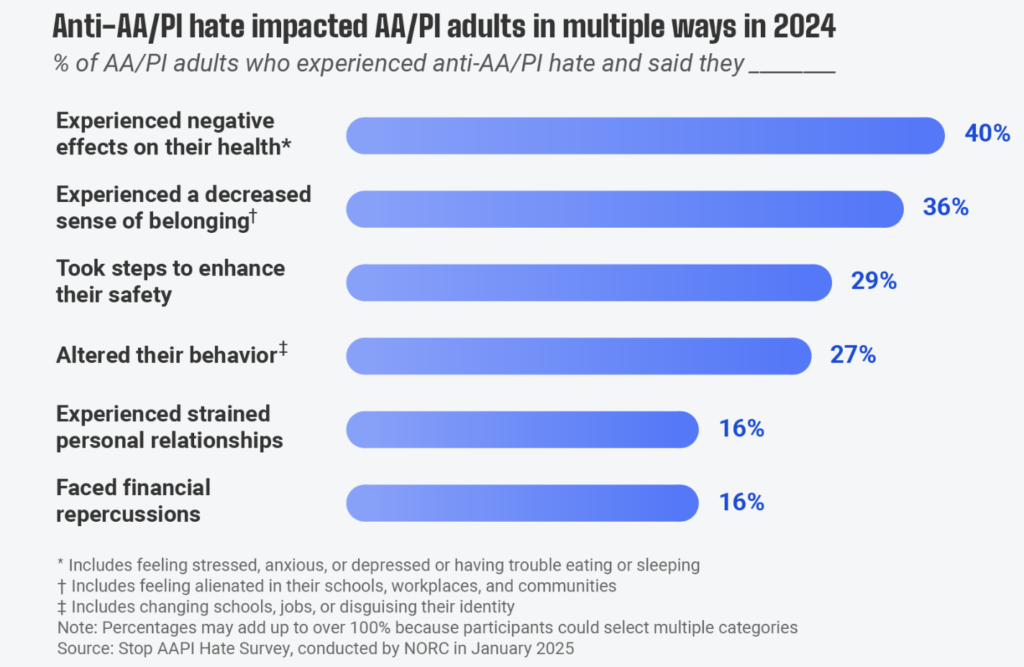
Numbers make this real. During the 2024 U.S. presidential election, anti-Asian hate speech didn’t just grow — it surged. According to Stop AAPI Hate, 53% of Asian American adults experienced some form of hate-motivated attack in 2024, with a significant number of these incidents occurring on social media platforms such as Facebook. Then came January 2025, when Meta officially relaxed its hate speech policies. Online hate speech targeting Asian Americans rose by 66%, and the platform became flooded with discriminatory content that had previously been banned. Amnesty International wasted no time in warning that vulnerable groups across the Asia-Pacific — groups already operating without adequate legal and technical protections- were now facing even greater danger (Amnesty International, 2025).
Source: https://stopaapihate.org/2025/06/02/state-of-hate-june25/
On the other side of the world, in China, a different but equally frustrating wall is being built. Asian users on Weibo who tried to speak about anti-Asian hate or share their painful experiences, to find some sense of community — they hit a massive roadblock. Posts throttled. Content hidden. Discussions quietly buried under the excuse of being “politically sensitive.” The platform did not remove the hate itself, but rather the discussions about it. Victims found their voices cut off while the content targeting them stayed exactly where it was. As Sinpeng et al. (2021) pointed out, when platform rules do not take user security as the core, the cost will not be shared equally, but often fall on those who are more vulnerable.
This pattern does not stop at Facebook and Weibo either. TikTok has come under heavy fire in Western markets for letting hateful content run wild. Its counterpart Douyin, meanwhile, is busy removing political dissent back in China under the guise of “maintaining harmony.” Same company. Same underlying system. But in each market, it bends to whoever holds the power — not to the people actually using it.
THE MASKS WON’T COME OFF ON THEIR OWN
At this point, you might be wondering: Since both systems have failed, what is the way forward? The answer may not lie in the platform itself.
As Flew (2021) points out, when platforms act as both rule — makers and enforcers, while also being commercial entities that profit from user behavior, it is unrealistic to expect them to exercise self-restraint. Furthermore, research by Sinpeng et al.(2021) also shows that relying solely on user reports is ineffective — when reports result in nothing more than automated responses, users eventually stop trying.
So by now, it should already be clear: platforms are not going to fix this by themselves. Change tends to happen only when pressure comes from outside — through laws that actually matter, through public pressure that holds platform accountable, and through cooperation across countries rather than isolated efforts. The Europe’s Digital Services Act proves this. When regulators forced Facebook’s hand in Europe, platforms like Facebook were forced to respond.
But even then, the effects are not felt equally. If you look closely, the cost is rarely shared equally. It tends to fall on the same people. The ones with the least power. The ones who were never really the priority.
“Different masks. Same face. And nobody wearing a mask takes it off voluntarily. ”
- Reference list
- Amnesty International. (2025, February 19). Meta’s new content policies risk fueling more mass violence and genocide. https://www.amnesty.org/en/latest/news/2025/02/meta-new-policy-changes/
- Flew, T. (2021). Hate speech and online abuse. In Regulating platforms (pp.91-96). Cambridge: Polity
- Li L.,& Zhou K. (2024). When content moderation is not about content: How Chinese social media platforms moderate content and why it matters. New Media & Society. https://doi.org/10.1177/14614448241263933
- Sinpeng, A., Martin, F., Gelber, K., & Shields, K. (2021). Facebook: Regulating hate speech in the Asia Pacific. Department of Media and Communications, University of Sydney & School of Political Science and International Studies, University of Queensland.
- Stop AAPI Hate. (2025). The state of anti-AA/PI hate in 2024. https://stopaapihate.org/2025/06/02/state-of-hate-june25/
- The Tribune India. (2025, April 27). Chinese authorities force Weibo account to change name, spark outrage over LGBTQ censorship. The Tribune. https://www.tribuneindia.com/news/china/chinese-authorities-force-weibo-account-to-change-name-spark-outrage-over-lgbtq-censorship
- Wang, J. (2022). Platform responsibility for content moderation: China vs liberal democracies. Digital Planet, Tufts University. https://digitalplanet.tufts.edu/wp-content/uploads/2023/02/DD-Report_1-Jufang-Wang-11.30.22.pdf
- Zuckerberg, M. (2025, January 7). More speech and fewer mistakes [Video]. Meta. https://about.fb.com/news/2025/01/meta-more-speech-fewer-mistakes/
Be the first to comment