
“I have nothing to hide, so I don’t care about privacy.”
It’s something we say casually, when apps ask for permissions, when cookie banners pop up, when another “Agree to Terms” button appears and we click it without thinking twice. But what if privacy was never about hiding anything? What if it was actually about who has control over your life in a world where every click, search, and swipe is quietly being recorded?
Because here’s the uncomfortable truth: We trade privacy for convenience every single day, without really understanding the consequences.
More importantly, this trade is not entirely voluntary, it is shaped by systems designed to make data sharing feel unavoidable.
What We Don’t Think About
Let me paint you a familiar situation. You’re scrolling online and suddenly you see a lucky draw: win the latest iPhone, an iPad, maybe even a car. All you have to do is complete a short survey. It sounds harmless, even exciting. You enter your name, email, phone number, maybe your age and interests, and just like that, you’re in. The younger version of me would have done it instantly without hesitation. Now, I pause.
That shift comes from realising something simple but unsettling: nothing online is truly free. We don’t pay for most digital services with money, we pay with data. Even something as small as a $30 Starbucks gift card in exchange for “just a quick survey” is actually a transaction. You are not the customer; you are the product. And the most concerning part is that most of us don’t consciously recognise that we’re making this trade at all.
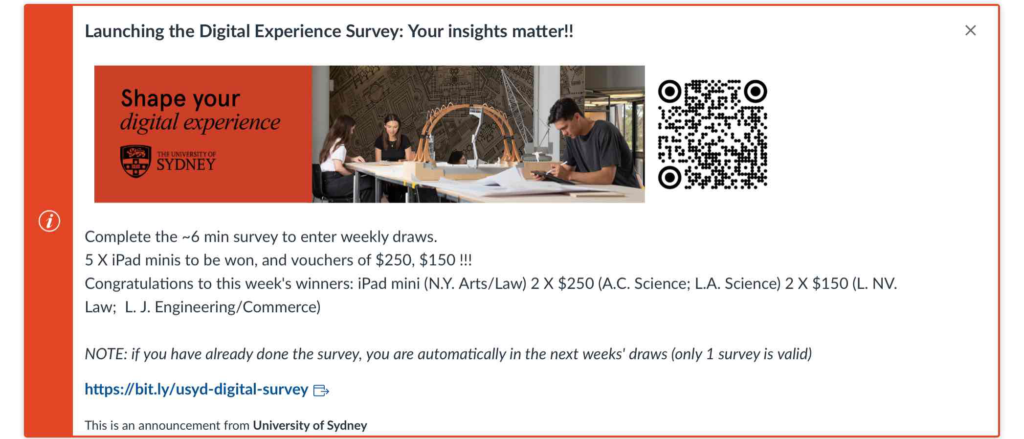
University of Sydney Digital Experience Survey giving out 5x iPad Minis and vouchers of $250, $150 (Canvas)
Even university-led surveys, such as the University of Sydney Digital Experience Survey offering prizes, demonstrate how easily users exchange personal data for incentives.
Convenience Is the New Currency
Convenience is one of the most powerful forces shaping our online behaviour. We love how easy everything has become: one-click logins, personalised recommendations, apps that seem to anticipate what we want before we even search for it. These features make our lives smoother and more efficient, and naturally, we gravitate towards them.
But that convenience is built on constant data collection. Every time you accept cookies, allow location tracking, or connect an app to your social media account, you are contributing to a system designed to learn more about you. What makes this more complex is that people do care about privacy, at least in theory. Research by Goggin et al. (2017) shows that many Australians are concerned about their online privacy and even take steps to protect it, such as adjusting settings or limiting what they share. Yet only a minority feel that they actually have control over their privacy.
This disconnect is revealing. It suggests that while awareness exists, understanding and control do not. As a result, we continue choosing convenience, often underestimating the scale of what we are giving away in return.
Privacy Is About Control, Not Secrecy
The idea that privacy only matters if you have something to hide is one of the most common misconceptions in digital culture. On the surface, it seems reasonable if you are not doing anything wrong, why worry? However, this way of thinking fundamentally misunderstands what privacy is about.
Rather than being about secrecy, privacy is about control, having a say over what information is collected about you, how it is used, and who has access to it. When privacy is reduced, what is lost is not just personal information, but autonomy. Algorithms begin to shape what you see, advertisements target your specific vulnerabilities, and platforms subtly influence your behaviour. These processes often happen invisibly, without your awareness.
So the real question is not whether you have something to hide, but whether you are comfortable with others having the power to define and influence your digital experience.
The Invisible Rules That Govern Us
One of the least visible but most significant aspects of the digital world is that it is governed by rules, just not the kind we usually think about. As Suzor (2019) explains, platforms like social media companies operate as private systems of governance. They create the rules, enforce them, and determine the consequences for breaking them.
These rules are embedded in Terms of Service agreements and community guidelines, documents that most users accept without reading. Yet they function much like laws, shaping what users can say, do, and access online. Unlike traditional legal systems, however, these rules are not created through democratic processes, nor are they easily challenged.
This means that when you use a platform, you are participating in an environment governed by a set of invisible rules that you did not help create and likely do not fully understand. The simple act of clicking “Agree” places you within this system.
Platforms, Power and the Data Economy
The reason these systems matter is because of the immense power they hold. As Flew (2021) highlights how digital platforms have become central players in modern society, largely due to their control over data and communication networks.
Data has become one of the most valuable resources in the digital age. Platforms collect vast amounts of it, analyse it, and use it to generate profit and influence. This creates a significant imbalance of power between users and platforms. While individuals contribute small pieces of data through everyday interactions, platforms aggregate and leverage this data on a massive scale.
The result is an ecosystem where a handful of companies hold disproportionate control over information flows, user behaviour, and even public discourse. This raises important questions about accountability and whether existing forms of regulation are sufficient to address these imbalances.
This growing concentration of power has led to increasing calls for stronger regulation of digital platforms. Governments around the world are beginning to question whether existing legal frameworks are sufficient to protect users’ rights in the digital age. However, regulating platforms is complex, as these companies operate across borders and often set their own rules. As Flew (2021) suggests, the challenge lies in balancing innovation and economic growth with the need to ensure accountability and protect fundamental rights such as privacy. Without effective regulation, the gap between platform power and user control is likely to continue widening.
This growing concern is already shaping policy responses. In Australia, the government has proposed banning social media access for users under the age of 16 as a way to protect children from data exploitation and online harms (Livingstone, 2026). The policy reflects increasing recognition that younger users are particularly vulnerable in data-driven environments, where platforms collect behavioural information from an early age. However, it also raises important questions about how digital rights should be balanced between protection, access, and autonomy. While such measures aim to reduce harm, they also highlight a broader issue: the need for stronger, more transparent systems of platform governance that apply not only to children, but to all users navigating the digital landscape.
When Privacy Becomes a Transaction
Returning to everyday experiences, it becomes clear how easily privacy is turned into a transaction. Small actions such as filling out a survey, signing up for a discount, or downloading an app may seem trivial in isolation. However, each interaction contributes to a larger data profile that becomes increasingly detailed over time. This data can reveal patterns about your preferences, habits, and even emotional states. Once collected, it may be shared, sold, or used to refine algorithms that predict and influence your future behaviour. What initially appears as a simple exchange of data for convenience or reward carries implications that extend far beyond the moment of interaction.

While these everyday exchanges may seem harmless, large-scale cases reveal just how significant the consequences can be. One of the most well-known examples is the Facebook–Cambridge Analytica data scandal, where the personal data of millions of Facebook users was collected without explicit consent and used for political advertising. What made this case particularly alarming was not just the scale of the data breach, but how that data was used to influence behaviour. Users who had simply interacted with quizzes or apps, often without fully understanding the permissions they had granted unknowingly contributed to a system that profiled their personalities and targeted them with highly tailored political messages.
The scale of the scandal is further illustrated in the video below:
This case highlights a key issue in the digital economy: users are often aware that their data is being collected, but they do not fully understand how it can be used. What begins as a seemingly small trade such as sharing information for entertainment or convenience, can evolve into something far more powerful. In this sense, privacy is not just about protecting personal information, but about preventing the misuse of that information in ways that shape decisions, opinions, and even democratic processes.
More importantly, it demonstrates how personal data is not only collected, but can be weaponised to influence behaviour at scale, raising serious concerns about the lack of accountability in platform governance.
A more recent example of this pattern can be seen in the migration of users between platforms, often described as “digital refugees.” As reported by The Guardian, many “TikTok refugees” have moved to platforms such as Xiaohongshu (RedNote) in search of alternative digital spaces. This shift is often driven by dissatisfaction with content, algorithms, or platform culture, with users believing that new platforms offer a better or safer experience. However, this movement raises important questions about privacy and digital rights. While users may feel they are escaping one platform’s issues, they are often entering another system with different and sometimes less transparent data governance practices. The underlying model remains the same: platforms collect, analyse, and monetise user data. In this sense, users are not escaping the system, but simply trading one version of it for another, often without fully understanding the implications.
Ultimately, privacy is not lost in one dramatic event, but gradually through a series of small, seemingly insignificant decisions that accumulate over time. In a world increasingly shaped by data, the question is no longer whether we value convenience, but whether we are willing to question the systems that demand our data in return.
This raises another important question: if we are increasingly aware of these risks, why do we still feel in control?
The Illusion of Control
Despite growing awareness, many users still feel a sense of control over their digital privacy. They adjust settings, limit what they post, and try to be more cautious online. However, this sense of control is often misleading.
The digital environment is complex and interconnected, making it difficult for individuals to fully manage how their data is collected and used. Turning off one setting does not necessarily prevent data collection elsewhere. Declining cookies on one website does not eliminate tracking across others.
This creates the illusion that users have agency, while in reality, they are navigating a system designed to prioritise data collection. The result is a persistent gap between perceived control and actual control.
So, What Are We Really Giving Up?
The consequences of trading privacy for convenience are not always immediate or visible. Instead, they accumulate over time, shaping the way individuals interact with digital environments.
Loss of privacy can lead to reduced autonomy, as algorithmic systems begin to influence choices and behaviours. It can also affect fairness, as data-driven profiling may reinforce biases or limit opportunities. More broadly, it contributes to a cultural shift where constant surveillance becomes normalised and expected.
These outcomes highlight that privacy is not just an individual concern, but a broader societal issue with implications for power, governance, and rights in the digital age.
A Trade Worth Rethinking
The next time you are prompted to accept cookies, sign in through a platform, or exchange your data for a reward, it is worth pausing to consider what you are agreeing to. These moments may seem minor, but they are part of a larger system in which personal data is continuously collected and utilised.
Privacy is not about hiding information; it is about maintaining control over how that information shapes your life. As digital platforms continue to expand their influence, understanding this trade-off becomes increasingly important.
Because in the end, the question is not whether convenience is valuable, it is whether it is worth the cost.
Reference
Flew, T. (2021). Regulating platforms. Polity Press.
Suzor, N. P. (2019). Lawless: The secret rules that govern our lives. Cambridge University Press.
Goggin, G., Vromen, A., Weatherall, K., Martin, F., Webb, A., Sunman, L., Bailo, F. (2017) Executive Summary and Digital Rights: What are they and why do they matter now? In Digital Rights in Australia. Sydney: University of Sydney. https://ses.library.usyd.edu.au/handle/2123/17587
Guardian News and Media. (2018, March 17). Revealed: 50 million facebook profiles harvested for Cambridge Analytica in major data breach. The Guardian. https://www.theguardian.com/news/2018/mar/17/cambridge-analytica-facebook-influence-us-election
Guardian News and Media. (2025, January 14). More than half a million “tiktok refugees” flock to China’s rednote as ban looms. The Guardian. https://www.theguardian.com/technology/2025/jan/14/tiktok-ban-rednote-app
Livingstone, H. (2026, January 23). How does Australia’s Under-16 Social Media Ban Work? BBC News. https://www.bbc.com/news/articles/cwyp9d3ddqyo
Kleinman, Z. (2026, March 5). We have more privacy controls yet less privacy than ever. BBC News. https://www.bbc.com/news/articles/c4gj39zk1k0o
Be the first to comment