
Figure 1 Image from Pinterest (HawkCaden, n.d.)
Introduction: The most pale and powerless justification
In the comment area of competitive game voice channels or social media, we can often hear or see abusive words, and the weakest sentence at this time is often: “Brother, it’s just a game.”
People who say this are usually good-hearted, but to be honest, this sentence is basically useless. Because for bystanders, winning or losing in the game is of course irrelevant, but for players who are angry, this is not “just a game” at all. That star, that segment, and the half-hour investment are all real things. To put it bluntly, this is not just a pastime, but a high-pressure social battlefield.
So here’s the question: why do we curse at the strangers on the other end of the screen for a few minutes of winning or losing?
More importantly, what does this kind of “spraying” behavior have to do with the “online hate speech” we usually talk about? Combined with the research on cyberspace threat perception and some reports of online hate speech, you will find that “spraying people” is not just a bad temper, but also a clear set of psychological logic behind it.
Why do we “break the defense”? – Two threats are making a strange role.
Have you noticed that you don’t swear every time you lose? What really makes you explode is often a kind of “offended” feeling. The online hate speech often stems from two deep-seated threats: the realistic threat and the symbolic threat(Guan & Chen, 2026, p. 1343).
Reality threat: He really touched my “cake”.
What is the threat of reality? To put it bluntly, you really made me lose something. In the game, this is easy to understand – teammates send people’s heads crazily at the beginning of 0-8, the stage you have worked hard to play is lost, and the precious rest time is wasted. This feeling of damage to interests will directly trigger people’s defensive attack instinct. In Tap Tap, the King’s Camp and Billbill, there are a lot of posts like “Teammates send heads at the beginning 0-8, and the whole team begins to spray each other”. The threat of reality is the most direct trigger.
Symbolic threat: He blasphemed my “faith”.
There is another situation that even if you don’t lose points, you may explode. For example, you are a person who considers yourself a “hardcore player”, attaches importance to competitive spirit and pays attention to rules. At this time, a teammate came, randomly choosing heroes, hanging up, and deliberately sending them – you will think: “This kind of person is not worthy of playing this game at all.”
This is a symbolic threat – it challenges your values, beliefs, and perception of “right and wrong”. The comments made by Billbill and those commonly seen on the game forums really illustrate the point: “Don’t play ranked if you don’t want to win. It’s disgusting.” This kind of person doesn’t respect the game at all. I suggest banning their account.” You’re not losing points; you’re angry that “this world can be so unregulated and unreasonable.
In February 2021, during the “Dream Season” update of “Light on Way”, an item inspired by a large hat from the Ming Dynasty of China was launched on the international version of the game. However, due to disputes over its cultural origin among some players, the operator replaced it with a straw hat on the Chinese version of the game, which caused strong dissatisfaction among the players. Subsequently, the producer Chen Xinghan and the official confirmed that the design prototype was indeed a large hat from the Ming Dynasty of China, and issued an apology statement, promising to distribute the item as compensation throughout the server. This incident was called the “Light on Way Ming Hat Incident” or the “Dream Season Hat Incident” and quickly escalated into a public opinion conflict between Chinese and Korean players over the issue of cultural origin. Both sides engaged in intense debates on social media for several weeks (Chen, 2021).
Figure 2 Screenshot from a video published by The Paper (The Paper, 2021).
From a psychological perspective, this phenomenon can be regarded as a typical “symbolic threat”, where when an individual perceives their cultural identity, including beliefs and values, as being challenged or disrespected, they will experience an emotional reaction far beyond the outcome of the game (Guan & Chen, 2026, p. 1343). In this situation, this virtual item is no longer just a game item; it is regarded as an offense to the real cultural ownership.
Hidden Wounds:Why is it so hurtful to call someone a “pig” or a “dog”?
Many people will say, “I didn’t hit him. Why don’t I just scold him?” But things are not that simple.
Facebook: Regulating Hate Speech in the Asia Pacific mentions a very important concept called “consequential harm” (Sinpeng et al., 2021, p. 6). What do you mean? That is to say: the moment of scolding, the injury has already been caused. There is no need to wait until the other party is really beaten, has lost his job, and is depressed by the Internet – the moment the sentence “you are a pig” is said, the other party has been degraded by you as a “lowly person”. That’s why it will be very uncomfortable when you are called a “dog” in the game. Because the other party is not just venting his emotions, he is doing something crueler: to cut you out of the category of “people”.

This step is called “Otherness” (Guan & Chen, 2026, p. 1349). Once you don’t treat the other person in your heart, there is no psychological burden to scold – who will feel guilty for scolding pigs and dogs? Therefore, the abuse on the Internet seems to be “just a few words”, but in fact, its cruelest thing is that it deprives the other party of the qualification to be treated as a human being.
Figure 3 Image from Pinterest (image, n.d.).
Why “Reporting” Always Seems Useless? – Three Desperate Reasons
As verbal abuse becomes increasingly common in games, many people will ask: “Why don’t the platforms deal with these behaviors and take no action against them?” In fact, it’s not that the platforms don’t want to manage this, but there are several difficult obstacles that they can’t overcome.
The damage is irreversible.
Many offensive remarks do not simply “disappear after being said”. For instance, when someone tells you, “You are just a loser”, that sentence has already caused psychological harm to you know it is uttered. You might repeatedly think to yourself in the following minutes, hours, or even days: “Am I really a loser? Why does he say such things about me?” Such emotions may affect your subsequent actions, make you lose confidence in the game, and even make you not want to open this game again. Even more seriously, this sentence might become the final straw that breaks your spirit. Even if the platform later blocks that account, the account suspension can only temporarily stop this current situation and prevent him from continuing to insult you, but the discomfort, resentment, and pain brought by those words have remained in your heart and will not disappear just because the account is blocked.
If there are too many reports, people will become sprayers.
Many players have experienced this: after being insulted, they quickly click on the “report” button, and the platform promptly replies with “We will conduct an investigation”, but then there is no further response. Once or twice, one can still tolerate it. But after ten or eight times, one will gradually feel: “Reporting is useless. Then I won’t bother anymore. I’ll just reply back with insults myself, which is more satisfying.”
This feeling is called “learned helplessness” in psychology – when you realize that no matter how hard you try, it doesn’t work, you will give up following the rules and choose a more direct way to vent(Wikipedia contributors, n.d.). As a result, the originally victimized party eventually becomes the one who insults others. The entire gaming environment thus deteriorates further, with fewer good people and more people who insult others, forming a vicious cycle that no one can escape.
From the perspective of research on hate speech, this involves a core concept: dehumanization(Haslam, 2006, pp. 252–260). When we strip away the human characteristics of others, such as treating them as machines or animals, our moral regulatory mechanisms fail. In online games, this phenomenon of dehumanization is exacerbated by deindividualization, as the person behind the screen is merely a virtual character or a string of characters. When you cannot see their expressions or hear their breathing sounds, the threshold for hate speech drops to the lowest level(Haslam, 2006, pp. 252–260).
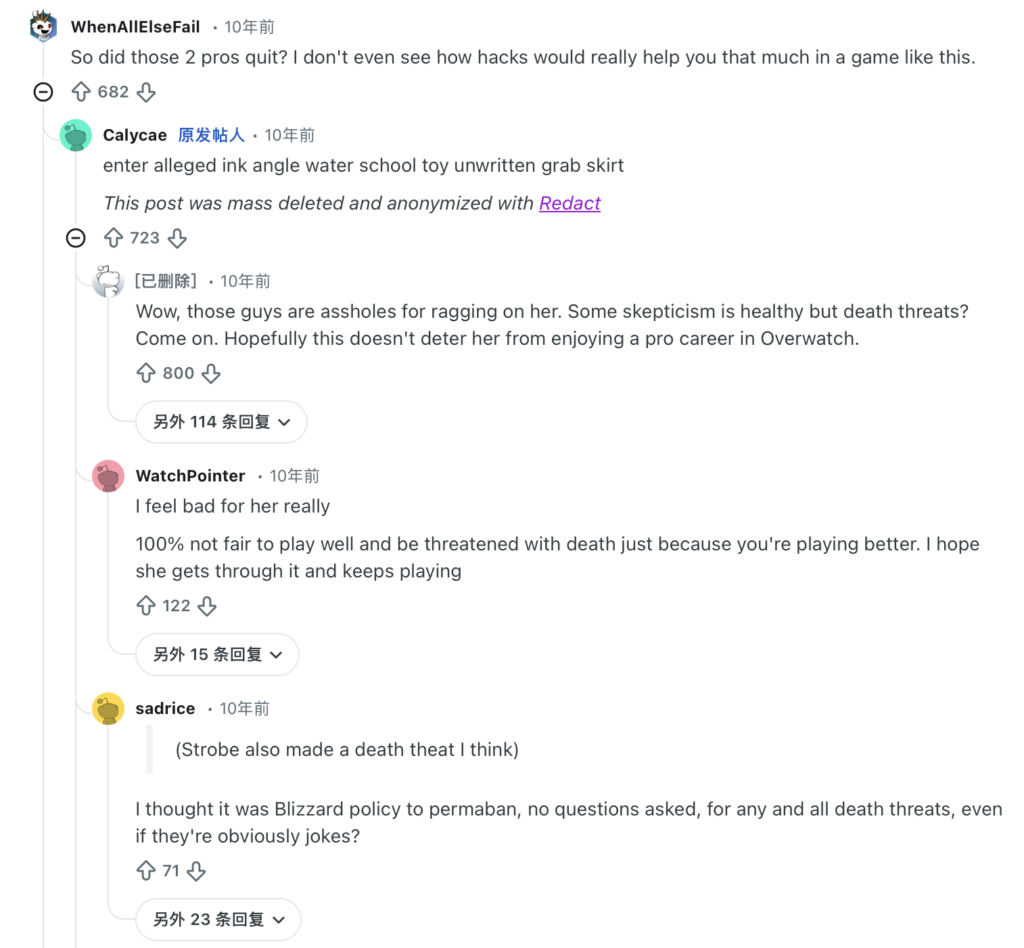
The anonymity of the digital environment provides cover for racial discrimination and misogynistic speech, and this toxicity is especially noticeable in team competition games. Team competition pressure often induces extreme negative behavior. When players think that their teammates’ performance affects the improvement of rankings, fierce verbal attacks often break out (University of California, 2025). This phenomenon is concentrated in the experience of Geguri, a Korean female professional player: in the competitive environment of Overwatch, the 17-year-old Geguri was not only publicly questioned by opponents for cheating because of her extraordinary Zarya operation skills, but also deeply immersed in the whirlpool of gender bias. Even if she proved her strength through live offline tests, there were still male opponents who made death threats because they could not accept being defeated by women. This case perfectly proves how competitive ranking pressure is intertwined with gender stereotypes, eventually evolving into cyber violence against specific groups (Chalk, 2016).
The system cannot understand “sardonic remarks”.
The language and culture are extremely rich and profound, especially in the Chinese context, where expressions such as satire, irony, and insinuation are extremely diverse and subtle. These expressions often rely on context, tone, punctuation, and even the tacit understanding between the speaker and the listener to be accurately understood. For instance, someone might say “You’re playing so well” in a game – it could be sincere praise or a sarcastic remark after a teammate’s consecutive mistakes.
This linguistic ambiguity and context-dependency pose a significant challenge to the current content moderation mechanisms based on keyword filtering or sentiment analysis. Algorithms tend to understand words literally and struggle to detect hostility and attacks hidden beneath “polite language”. As a result, malicious remarks that are truly harmful can evade regulation using these “safe words”, while victims, lacking explicit evidence of abuse, have difficulty receiving timely handling and support from the platform, thus feeling abandoned by the system.
In addition, this dilemma stems from the proliferation of Echo Chambers(Flaxman et al., 2016, pp. 311–312) within player communities. Research by Flaxman et al. (2016) shows that social networks tend to reinforce users’ existing biases. When a platform’s algorithm continuously pushes content complaining about “bad teammates,” users develop an illusion: they believe that “verbal abuse” is the only consensus for solving problems, or even a form of “community culture.” This sense of cultural identity offsets the deterrent effect of the reporting system. Unless platforms change the “traffic-first” mechanism in their governance logic, simple keyword filtering will never eradicate hidden hate speech.
So what can we do?
Before getting angry, ask yourself: Did he really touch my “real” cake?
Teammates send people’s heads, drop the stage, and waste half an hour of your time – these are annoying. But calm down and think about it for a second: they don’t threaten your salary, health and family relationship. You are angrier that your “game self-esteem” has been touched, not that you have been substantially hurt in real life.
Don’t call people “pig” or “dog”.
The moment you scolded the other party as a “beast”, you were mentally expelled from the “human”. Once the label is attached, you will not feel guilty when you scold, and the other party completely does not want to communicate with you well. Conversely, if you insist on using the “human” logic in your communication, the situation is unlikely to spiral into a vicious cycle of mutual criticism.
Learning to report correctly is much more useful than swearing.
Many people have tried to give feedback several times but received no response. They then felt that “this platform is completely useless, so I need to vent my anger as well.” Instead of expecting a perfect algorithm to relieve your anger for you, it would be better for everyone to do more “citizen morality” related things. For instance, report malicious remarks seriously instead of joining this verbal battle. The improvement of a community’s communication environment cannot be achieved by more intelligent robots, but rather by more calm ordinary people.
Conclusion
Finally, we should realize that fighting hate speech is not only a platform responsibility but also a form of digital citizenship. When we refuse to join in the abuse, we are actually cutting off the chain of hatred. Even in a high-pressure competitive environment, maintaining the basic bottom line of civilization is also maintaining our own dignity as “civilized people”.
References
Guan, T., & Chen, X. (2026). Threat perception, otherness and hate speech in China’s cyberspace. Journal of Contemporary China, 35(158), 1337–1352.https://www.researchgate.net/publication/389631498_Threat_Perception_Otherness_and_Hate_Speech_in_China’s_Cyberspace
Chen, C. (2021, February 4). After the Shining Nikki controversy, has Sky: Children of the Light also crossed the line? Jenova Chen apologizes and promises compensation. Guancha.cn.https://user.guancha.cn/main/content?id=459182
Sinpeng, A., Martin, F., Gelber, K., & Shields, K. (2021, July 5). Facebook: Regulating hate speech in the Asia Pacific. Department of Media and Communications, The University of Sydney.https://ses.library.usyd.edu.au/bitstream/handle/2123/25116.3/Facebook_hate_speech_Asia_report_final_5July2021.pdf?sequence=3&isAllowed=y
Wikipedia contributors. (n.d.). Learned helplessness. In Wikipedia.https://en.wikipedia.org/wiki/Learned_helplessness
Haslam, N. (2006). Dehumanization: An integrative review. Personality and Social Psychology Review, 10(3), 252–264.https://www.researchgate.net/publication/6927454_Dehumanization_An_Integrative_Review
University of California. (2025, December 4). From toxicity to healing: Changing the culture of online gaming.https://www.universityofcalifornia.edu/news/toxicity-healing-changing-culture-online-gaming
Chalk, A. (2016, June 21). Teenage Overwatch player accused of cheating proves she’s just that good with Zarya. PC Gamer. https://www.pcgamer.com/teenage-overwatch-player-accused-of-cheating-proves-shes-just-that-good-with-zarya
Flaxman, S., Goel, S., & Rao, J. M. (2016). Filter bubbles, echo chambers, and online news consumption. Public Opinion Quarterly, 80(S1), 298–320. https://academic.oup.com/poq/article/80/S1/298/2223402?login=false
Image reference
HawkCaden. (n.d.). [Image]. Pinterest.https://pin.it/3XV62DqsU
The Paper. (2021, February 4). After the Shining Nikki controversy, Sky: Children of the Light also crossed the line? Jenova Chen apologizes, saying there are hidden reasons; large hat to be distributed to all players [Video]. The Paper.https://m.thepaper.cn/newsDetail_forward_11137806?from=sohu
[Image]. (n.d.). Pinterest. https://pin.it/5sOAojS9G
Reddit user u/Unknown. (2016, July 12). 1 Zarya player “hackusation” cleared by Blizzard [Online forum post].Reddit.https://www.reddit.com/r/Overwatch/comments/4ozx0o/1_zariya_player_hackusation_cleared_by_blizzard/
Be the first to comment