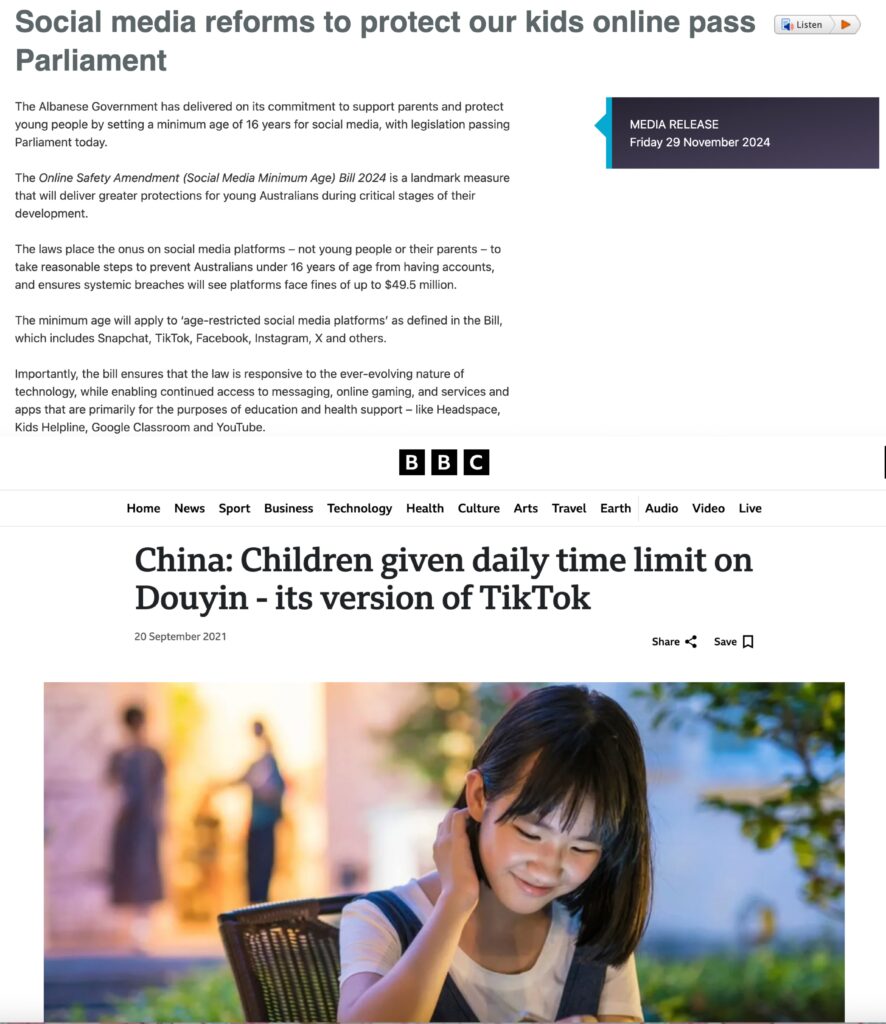
The popularity and frequency of use of TikTok has spread like wildfire, penetrating into all aspects of users’ lives. Let’s imagine two 16-year-old teenagers: one in Sydney and the other in Shanghai. On December 10, 2025, Australia officially imposed a social media ban on minors under the age of 16. A teenager in Sydney woke up and found that no matter how he tried, he couldn’t open TikTok to watch videos. He was very angry, but his mother breathed a sigh of relief: “Finally, I don’t have to worry about you developing bad online habits.” At the same time, teenagers in Shanghai opened TikTok to bass time. After watching it for 40 minutes, a notification popped up on the screen: “Today’s usage time has reached the limit.” This is the function of China’s “minor mode”. The teenager’s father glanced at the notification and thought to himself, “Whether it’s the time limit, at least my son won’t use his mobile phone all night.” This shows that the two countries have adopted different approaches in regulating teenagers’ use of social media applications. But if you ask them, “What are you looking at?” How long are you going to watch it?” They may not be able to give an exact answer.
The daily experience of these two teenagers actually reflects the completely different digital governance concepts of the two countries. According to a study by the Australian Government Cyber Security Commissioner, 96% of Australian teenagers aged 10 to 15 were already using social media before the ban was implemented, and 70% of them had been exposed to harmful content (Xinhuanet, 2025). In China, the “2024 Internet Usage Report of Minors” jointly released by the Central Committee of the Communist Youth League and the China Internet Information Centre shows that the number of Internet users of minors in China has exceeded 196 million, and the Internet penetration rate of minors is as high as 97.3% (Central Committee of the Communist Youth League, 2025). It is against the background of this difference that the two countries have chosen different paths of intervention.
Digital rights and responsibilities of the platform
Perhaps none of us has really thought seriously about what the guidelines of TikTok are. Even now, these guidelines are still difficult to define. Technology companies are like the “monarchs” of the digital world (Suzor, 2019). They formulate community guidelines, enforce laws, use algorithms to delete posts and block accounts, and preside over judicial procedures. But in the real world, the legislative, executive and judicial departments check and balance each other while maintaining their independence. In contrast, in the digital world, these three powers are concentrated in the hands of one entity. In fact, what people are worried about is not the “over-supervision” of the platform, but the “unsupervised platform”. If the government law violates your rights, you can sue the government; if the school’s disciplinary action is unreasonable, you can complain to the education department. But if TikTok deletes your post or video, who can you ask for help? If you send an email to TikTok, you may only receive an automatic reply without getting an effective solution.
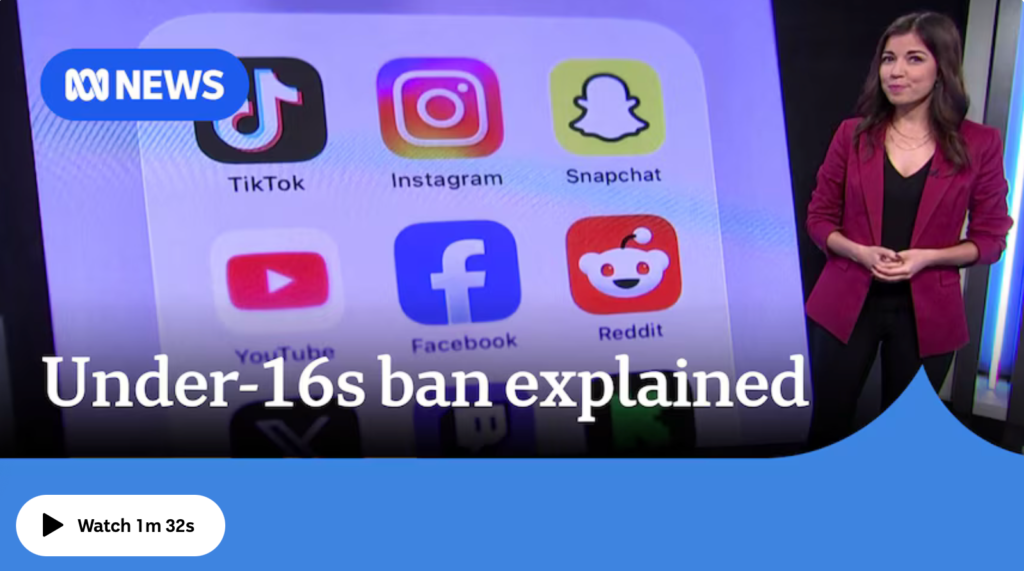
As mentioned at the beginning of the article, on December 10, 2025, an Australian law officially took effect, requiring the top ten platforms, including TikTok, Instagram, Facebook and X, to take “reasonable measures” to prevent minors under the age of 16 (Dick, 2025). Isn’t such a huge fine chilling? On the surface, this is indeed a serious illegal act, but in fact, the implementation of this law faces many challenges. For example, verifying the actual age of users has become a technical problem, because the Australian government clearly prohibits platforms from using identity documents as the only means of age verification to protect user privacy. More ironically, some teenagers have begun to turn to alternative platforms that are not bound by the new regulations, which confirms many people’s concerns that when the government intervenes in the digital field by “tough” means, there may be unexpected “unexpected consequences”. Scholar Suzor believes that this is like a sudden announcement in parliament: “Your Majesty, your power is too great; now let’s draw a red line to divide it.” This shows that the Australian government is ordering the platform to comply with the regulations, not negotiating with them; the authority of the platform cannot prevail over the government. The platform is no longer a rule-makers, but an implementer of national policies (Yu & Li, 2022).
However, China’s model is quite different. It is worth noting that this is not a simple one-way “government order-platform execution” relationship. TikTok is known as TikTok in China, and it strictly implements the following rules: “Users under the age of 14 who have verified their true identity will be automatically placed in ‘minor mode’ and cannot opt out; the daily usage time is limited to 40 minutes; from 10 p.m. to 6 a.m. the next day. Visit.” In addition, TikTok launched the “Building a Civilised Live Broadcast Environment: Special Activities for Minors in the Summer of 2025”, which clearly prohibits minors under the age of 16 from appearing in the live broadcast, and requires minors aged 16 to 18 to obtain the written consent of their parents or guardians before the live broadcast. Although the State Internet Information Office of China issued the Guidance on the Development of Mobile Internet Minors Model, it does not constitute a government-level ban. The release of the guidance requires the platform to embed a protection mechanism at the product design level (eastmoney, 2025). It is this model of “technology embedding + platform self-discipline” that enables the government’s intention to penetrate into the system, not just relying on external enforcement.
By comparing the two methods, we can clearly see that although both are aimed at limiting the power of the platform, Australia chooses a “tough” legal ban, while China chooses a relatively moderate way to achieve its goals through technological change. The differences between China and Australia essentially represent two completely different practises. The road to “power rebalancing”. If Suzor saw TikTok today, he might be confused: which of the different practises in these two countries can really give ordinary users real “digital rights”? Obviously, this problem is much more complicated than we thought.
Algorithms in artificial intelligence are not neutral
For all TikTok users, there is a saying worth remembering: artificial intelligence is neither “artificial” nor “intelligent”. It is a power structure – starting from mining rare earth mineral manufacturing servers, extending to hiring low-paid data annotators to annotate videos, and even further involving extracting data from every like (Crawford, 2021). To put it bluntly, artificial intelligence is driven by money, power and resources. A study in Australia last year found that when searching for keywords related to racism and gender discrimination on TikTok, nearly two-thirds of the search results showed stereotypes about marginalised groups (ISD, 2025). For example, when searching for insulting words against black people, most of the videos that appear are about black women; when searching for anti-Semitic words, the search results are full of conspiracy theories. Obviously, algorithms not only reflect social biases; they amplify these biases in a large-scale and automated way. Australia is a multicultural country, which means that some ethnic groups that should be protected are discriminated against by algorithms behind the scenes. What’s more worrying is that although TikTok’s community guidelines clearly stipulate that “discrimination or hate speech based on protected attributes such as race, ethnicity or nationality is prohibited” (TikTok For Business, 2025), the actual algorithm operation of the platform is cut off from these public commitments. But on the contrary.
In China, the role of algorithms is quite different. The audit logic of TikTok is quite strict because it follows local standards; when sensitive topics such as politics, religion or gender are involved, the algorithm will automatically block or delete the relevant content. There was a case showing that thousands of sensitive illegal posts were reported and dealt with on the same day, and the platform maintained a high degree of cooperation with the government and strictly followed the government’s guidelines (Yu & Li, 2022).
Therefore, when discussing algorithms, we must realise that artificial intelligence is not only the embodiment of platform power, but also an extension of national governance. In Australia, algorithms amplify social bias and reveal how business platforms prevail over social responsibility in pursuit of profits; in China, algorithms follow local standards, reflecting the penetration of national will into the digital field. This confirms Crawford’s assertion that artificial intelligence has never been neutral; it serves a specific power structure.
The failure of platform supervision leads to hate speech
In addition to the aforementioned racial and gender discrimination, refugee and immigrant groups are also often the targets of hate speech. Imagine how these refugees and immigrants who have just arrived in Australia and are still studying languages should deal with social media. Simpson’s research reveals a painful discovery: the groups most in need of protection – such as refugees and immigrants – are often the most easily ignored by platform auditors. It is precisely because of their limited language ability that they cannot understand the rules of the platform; and because of cultural differences, it is difficult for them to distinguish between positive remarks and hate speech. In addition, they are in a vulnerable position and lack the ability to deal with these problems directly (Xinpeng et al., 2021). Marginalised groups are essentially “low-value users”: their data contribution is limited, their purchasing power is insufficient, and their self-maintenance ability is also weak. The platform lacks enough economic motivation to invest resources to protect them; if they file a complaint, they will only receive an automatic reply – which is fundamentally futile.
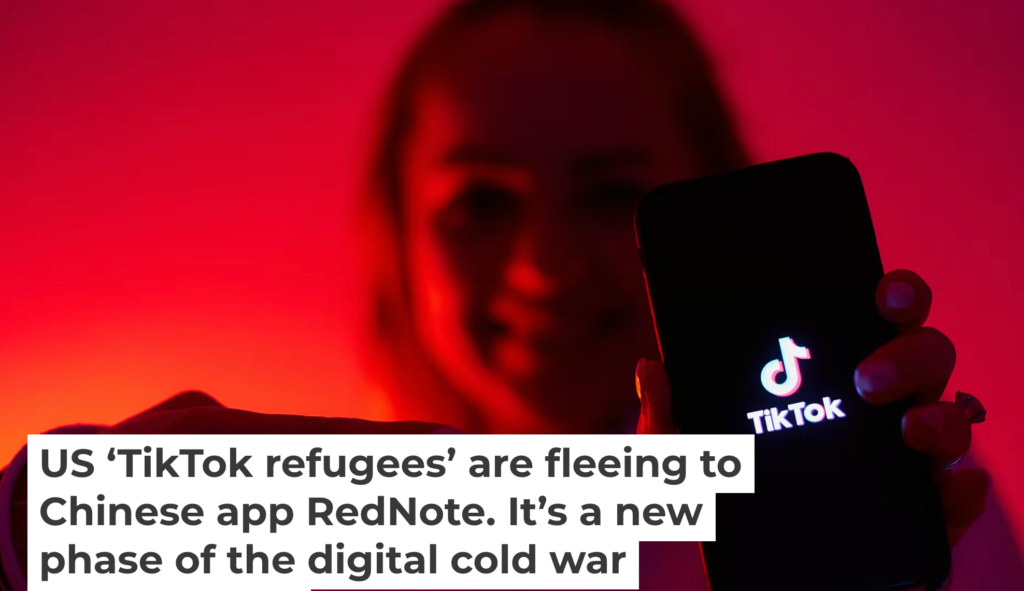
Although China is not a party to the Refugee Convention and does not have a refugee resettlement system, these groups may include foreign workers, “stateless persons” or “netizens”. In early 2025, after the ban on TikTok in the United States, a large number of overseas users poured into TikTok and Red Notes; at that time, such groups were called “TT refugees” in China (Reilly, 2025). After entering Chinese social media platforms, these “TT refugees” observed a strange phenomenon: although they use the same application as local Chinese users, they can often see English posts replying in Chinese, and vice versa. Compared with real refugees, these people are much less well-known; most of their posts are ignored or deleted by moderators – not because the posts contain hate speech, but because they do not know “what to say”. This leads to a deeper question: When the government strengthens the supervision of the platform in the name of “protection”, will the truly vulnerable groups really benefit? Australia’s ban aims to protect minors, but refugees and immigrants who do not speak the local language are still struggling under the interference of algorithms; China’s “minor model” limits the screen time of teenagers, but foreign “TT refugees” are silent because they do not understand the rules.
Conclusion
In contrast, the governance of TikTok in China and Australia shows a distinct “two-sidedness”. Australia has adopted a “positive” ban, trying to put the “digital monarch” power of the platform under democratic procedures through external constraints; while China internalises the national will into the daily operation of algorithms through technological integration and platform self-discipline. Although the two methods seem to be completely different, they both aim to solve the core question raised by Suzor (2019): how to protect the rights of ordinary users in a digital world without “laws”? Even if these two interventions can effectively achieve the governance goals expected by the country to a certain extent, they are far from perfect and there are still blind spots in governance. For example, Australia’s ban regards the platform as an implementer of national policies, but ignores the bias of the algorithm and its amplification effect. China’s “micro-mode” has implemented fine time control, but due to cultural differences, foreign “TikTok refugees” remain silent.
As ordinary users, we may not be able to change these huge institutional differences, but we can do one thing: keep asking questions. For example, when you see a deleted video, ask yourself: “Why was it deleted?” Or when you notice that the content recommended by the algorithm suddenly changes, ask yourself: “Who is behind the scenes to make these adjustments?” Or when you see friends from different countries discussing the same topic but saying different things, you should realise that it is not their fault – this is the information gap caused by the operation of the algorithm. Maybe there are no standard answers to these questions, but it is because there are no standard answers that we should keep asking questions. Only by constantly asking questions and being vigilant can we make progress through comparison.
Reference
Crawford, K. (2021). The Atlas of AI: Power, politics, and the planetary costs of artificial intelligence. Yale University Press.
Communist Youth League Central Committee. (2025). 2024 National report on internet use among minors in China. China Internet Network Information Center.
Institute for Strategic Dialogue. (2025). Recommending hate: How TikTok’s search engine algorithms reproduce societal bias. https://www.isdglobal.org/wp-content/uploads/2025/02/How-TikToks-Search-Engine-Algorithms-Reproduce-Societal-Bias.pdf
Dick, S. (2025, December 9). Australia’s social media ban for under-16s starts today. Here is what you should know. Abc.net.au; ABC News. https://www.abc.net.au/news/2025-12-10/australias-social-media-ban-for-under-16s-starts-today/106119800
Reilly, T. (2025, November 2). When TikTok in the U.S. sneezes, creators in Sydney catch a cold. LinkedIn. https://www.linkedin.com/pulse/when-tiktok-us-sneezes-creators-sydney-catch-cold-taylor-reilly-plvzc
Sinpeng, A., Martin, F. R., Gelber, K., & Shields, K. (2021). Facebook: Regulating hate speech in the Asia Pacific. Department of Media and Communications, The University of Sydney.
Suzor, N. P. (2019). Lawless: The secret rules that govern our digital lives. Cambridge University Press.
TikTok For Business. (2025). Discrimination, harassment, and bullying. https://ads.tiktok.com/help/article/discrimination-harassment-bullying?lang=en
Xinhua News Agency. (2025, December 10). Q&A: How Australia implements the social media ban for under-16s. Xinhuanet. https://www.xinhuanet.com/20251210/759e6540f476474688813d3f6331346f/c.html
Yu, J., & Li, Y. (2022). Regulating TikTok: The emergence of data nationalism in China and the United States. International Journal of Communication, 16, 3160-3179.
Be the first to comment