
“Don’t insult my family.”
The person who said this sentence is China’s Olympic diving champion Quan Hongchan, a little girl who has just turned 19 this year. In March 2026, Quan Hongchan affirmed netizens not to scold her and her family in an exclusive interview with the media, which attracted widespread attention. But in this continuous brewing online siege, she has to speak out again for the most basic respect for herself and her family.
At the end of March 2026, the network attack surrounding Quan Hongchan continued to ferment. There are a lot of ridicules about her appearance, figure, diet and weight on the Internet. Some of the content is like a joke on the surface, but in fact it is difficult to evaluate it as an ordinary opinion. The sports system then intervened, the training unit called the police, and the police also reported that the relevant personnel had been dealt with. Things have developed to this point, and it is no longer as simple as quarreling in a comment area. It shows that the siege has changed from scattered abuse to a public problem that needs to be dealt with by external forces.
In reality, what an athlete has accumulated over the years of training and competition is often easily covered up by a few bad comments. What this article wants to express is that it is not as simple as someone on the Internet is too mean. It was no coincidence that Quan Hongchan encountered online violence, nor was it just a few people who started it for a moment. It is more like a concentrated outbreak after the fan culture entered sports. The fan circle turns support into loyalty, discussion into camp confrontation, and emotions into the easiest thing to circulate. The popularity mechanism and recommendation logic of the platform push these things forward, making the attack easier to see and copy. (Massanari, 2017; Matamoros-Fernández, 2017) When things get big and external forces deal with it, it can indeed help, but that’s more like a remedy, not prevention.
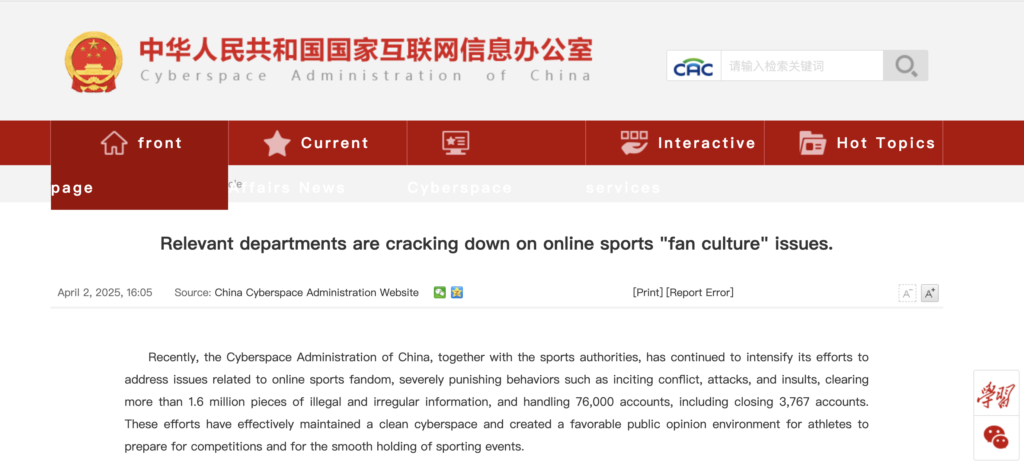
Image 2: Screenshot from Central Cyberspace Affairs Commission
As early as 2021, when the Central Cyberspace Information Office of China launched the special action of “Qinglang · ‘Fan Circle’ Chaos Remediation”, it has listed fans’ mutual abuse, trampling and provoking war, insulting and slandering, spreading rumors and attacking, searching for human flesh, violating privacy, and hiring online sailors, brushing and controlling comments and other acts as key targets for rectification. In the same year, the Internet information department further required the cancellation of all individual or group lists of star-related artists, standardize fan groups and support club accounts, and continue to clean up fan groups with the theme of casting, support, comment control and breaking news. (Central Cyberspace Affairs Commission, 2021)
By 2025, in response to the problem of online sports “fan circle”, the figure given by the official circular is more direct: the network information department, together with the sports department, has cleaned up more than 1.6 million illegal information and disposed of 76,000 accounts, of which 3,767 accounts have been closed. Only for the “fan” accounts that provoke each other and provoke war, 1,376 illegal accounts were closed, and 5,803 relevant illegal groups were disbanded at the same time. (Central Cyberspace Affairs Commission, 2025) Sports fan circle is not a sudden new problem, but the entertainment fan circle’s practice of trampling, controlling evaluation, inciting opposition and organizing siege, which has been changed to a target to continue operation.
Looking at the Quan Hongchan incident itself, the first thing that emerged was not professional criticism, but targeted humiliation. Some people stare at her appearance, some people stare at her figure, and some people focus on diet and weight. On the surface, this kind of content seems to be just a “comment”. In fact, it is no longer about discussing the performance of the competition, but turning an athlete into an object that can be looked at and belittled at will. Especially when it comes to female athletes, such words often have obvious gender connotations. It is not for communication, but to embarrass the parties (Massanari, 2017).
Going further down, it is to step on and stand on the team. The most common set of logic in the fan circle is not to make things clear, but to stand on the side first. Whoever you support means who you want to defend; if you question who, it is easy to be seen as handing over a knife to the other side. In this way, the discussion that could have been about the game will soon deteriorate.

Image 3: Times Now
Then what appeared was the amplification of the siege. In many cases, it is difficult for us to say whether it is organized or not, because there may not be public instructions, and it may not be possible to find a clear initiator directly. But you can see it clearly: similar rhetorics appear repeatedly, similar mockery moves back and forth on different platforms, and the comment area quickly forms a follow-up attack rhythm. One person says that ten people receive it and one hundred people forward it, which will soon give people an illusion, as if the whole network is thinking so. But in many cases, what is really amplified is not the mainstream opinion, but the part of the content that is most likely to stimulate emotions (Matamoros-Fernández, 2017).
Moreover, online injury will not be honestly stopped at “online”. Quan Hongchan’s sentence “Stop insulting my family” in the interview has made the problem very clear. What was involved was not only her online name, but also the boundaries of her life in reality. Once online emotions are continuously incited, they are easy to spread offline. Some people are watching, some are disturbing, some are trying to get close to the private space that should not have been disturbed. Even if not all onlookers will reach the most serious level, as long as this threat is real, it has already constituted harm (Carlson & Frazer, 2018).

But just the fan circle is not enough to make one thing burn into a whole network conflict every time. What really spread the fire is the distribution logic of the platform. The platform does not push the content according to whether this sentence makes sense, but whether this sentence can bring a reaction. Whoever is easier to make people stop, who is easier to trigger comments, retweets, quarrels and stays, and who is easier to be seen. Anger, mockery, hunting, and opposition are more likely to stimulate reactions than calm analysis, so they are naturally more suitable for running on the platform (Massanari, 2017).
Under this logic, offensive content is inherently an advantage. It is short, fast, fierce, and the copying cost is very low. You don’t even need to write a large paragraph. As long as you follow your emotions and a sentence, you will already participate in the dissemination. Someone started the head, and the people behind it was easy to answer. Then the comment area became hot, the popularity went up, and the platform pushed the content to more people. The platform mechanism may not actively support the damage, but it does reward the expression that is most likely to create emotions. What the platform wants is activity, stay time and participation, not the quality of public discussion. These two things are often not in the same direction. The more content can make people excited, the more likely it is to bring data to the platform; but the more such content is, the easier it is to push the discussion out of control.
What’s more complicated is that platform governance itself is usually not transparent. In many cases, the platform does not simply delete posts, but downgrade, limit the flow, suppress the popularity, and hide comments. Ordinary users can’t see how these actions are done. They only feel that some content is suddenly gone, and some content is still appearing. It is difficult for victims to judge whether the platform is protecting themselves, and it is difficult for onlookers to know what the rules of the platform are. On the other hand, it is easy for attackers to learn to bypass: change words, stalks, expressions, and continue to do the same thing. As a result, the governance seems to be being done, but the effect may not be convincing. The research of Sinpeng and others also pointed out that the platform relies heavily on context and local knowledge in the identification and handling of hate speech, which is precisely the most vulnerable part of globalization and standardized governance (Sinpeng et al., 2021).
Many daily injuries will not be dealt with immediately. Until the media begins to report, the public begins to question, the competent authorities take a stand, and the police intervene, the action of the platform will be significantly accelerated.

Image 5: Stock.adobeGolden Sikorka
Why is it always like this?
The reason is not difficult to guess. The platform is first of all a business organization, and it needs to consider cost, risk and external pressure. For the platform, a bad comment itself does not necessarily constitute the most urgent problem; what is more urgent is whether this matter will often evolve into a public relations crisis, regulatory risk and brand risk. In other words, platforms often do not respond to the victim’s situation first, but to external pressure first.
This is also why in many cases, the platform does not become the first line of defense, but more like the remedy of the last ring. The competent sports department investigates, the training unit calls the police, and the police punishes. Of course, these are important and can indeed play a role in stopping the bleeding. But it also shows that the previous protection did not take effect in time. If governance always relies on the big deal to appear, then it is more about cleaning up the scene than blocking the damage in advance.
Does that mean you can’t even criticize in the future? Is it possible to be regarded as online violence as long as you say it more seriously?
This question must be made clear. Of course, sports need to be criticized. You can criticize movement mistakes, discuss the ups and downs of the state, question the training arrangement, or disagree with an athlete’s public expression. Normal sports discussions should exist and should be preserved. The question is not whether it can be criticized, but what the criticism points to. If the discussion is about the performance of the competition, the facts and the professional judgment, then it is part of the public discussion. But if the language has left the competition itself and begins to point to appearance, figure, private life, and even family, the purpose is not to communicate but to embarrass the other party, shut up, and withdraw from the public space, then it is no longer an ordinary criticism. It’s a kind of injury. Many people like to package this kind of content as “I’m just expressing my opinion”, but the harm will not disappear just by putting this layer of statement on it (Sinpeng et al., 2021).
When Woods and Perrin discussed the platform duty of care, they emphasized that instead of doing fragmentary remediation around a single piece of content, it is better to turn governance into a risk-oriented system prevention and put the responsibility back on the design and security mechanism of the platform (Woods & Perrin , 2021). To reduce this kind of siege, the most important thing to change is not the slogan of netizens, but the timing of the platform to deal with the problem. Many injuries are not because of how complicated the content is, but because they run too fast. Once a similar humiliation begins to swipe the screen, the platform should not continue to let it rush forward by the heat. Limit the flow when it’s time to limit the flow, and reduce the heat when it’s time to reduce the heat. Don’t wait for things to be on the hot search and call the police before starting to delete posts and block the account. Another thing is that the rules can’t always be vague. What is normal criticism and what is cross-border attack? The platform and relevant institutions should make it clear and take action as soon as possible. For athletes, the most difficult thing is often not a certain sentence, but that no one is in front of them for a long time. If governance always appears at the end, it is more like an end than protection.
Hateful expression and continuous online injury are never just emotional problems. It will leave real consequences: put the parties under additional pressure, let the bystanders slowly get used to this environment, and also make the public discussion narrower and narrower. Sports should have been connected by the game itself, not because the siege and the team were pushed to the opposite side. With true respect and understanding of sports, we can no longer regard online violence as online noise. It is a kind of injury that can be organized, amplified, and should be managed in front. More importantly, governance should not always come after something big happens.

Image 6: Xinhua
Reference List
Carlson, B., & Frazer, R. (2018). Social media mob: Being Indigenous online. Macquarie University.
Central Cyberspace Affairs Commission. (2021, August 27). Notice on further strengthening the governance of “fan circle” chaos. CAC.gov.cn.
Central Cyberspace Affairs Commission. (2025, April 2). Relevant authorities crack down hard on online sports “fan circle” issues. CAC.gov.cn.
Massanari, A. (2017). #Gamergate and The Fappening: How Reddit’s algorithm, governance, and culture support toxic technocultures. New Media & Society, 19(3), 329–346. https://doi.org/10.1177/1461444815608807
Matamoros-Fernández, A. (2017). Platformed racism: The mediation and circulation of an Australian race-based controversy on Twitter, Facebook and YouTube. Information, Communication & Society, 20(6), 930–946. https://doi.org/10.1080/1369118X.2017.1293130
Sinpeng, A., Martin, F. R., Gelber, K., & Shields, K. (2021). Facebook: Regulating hate speech in the Asia Pacific. Department of Media and Communications, The University of Sydney, and School of Political Science and International Studies, The University of Queensland.
Woods, L., & Perrin, W. (2021). Obliging platforms to accept a duty of care. In M. Moore & D. Tambini (Eds.), Regulating Big Tech: Policy responses to digital dominance (pp. 93–109). Oxford University Press.
Be the first to comment