
Have you ever experienced and wondered that whenever you discuss about something, its advertisement will quickly appear on different platforms of your phone. Maybe you talked with your families after dinner about buying a new vacuum for cleaning, and the next day you see online ads for vacuums from vacuum brand official accounts on social media.
Why is this feeling so common? Is the platform really “listening” to us? Or there are still other ways operating.
Surprisingly, the ads you saw depend on factors such as searching history, browsing history, current locations, website cookies, etc. Even when platforms are not literally recording conversation for ads, the opaque systems of tracking and targeted advertising are invasive enough to create a real sense of being tracked by online platforms.
Why people feel like they are being listened to?
For many people, the idea of their phone is “Listening” does not come out without any evidences: you mentioned a product, a place, or even a celebrity personal problems in conversation, and later an ad related to that exact topic appears on Instagram, TikTok, Youtube or Facebook. Is it a coincidence? But the timing of the ads came out could be too precise. When privacy policies comes to social media platforms registration, most users even do not review them. Most just click “agree” button to accept the terms without fully examining them. Because most of them cannot see how advertising systems work behind the smartphone, so the most immediate explanation becomes the simplest one: My phone must have heard me.
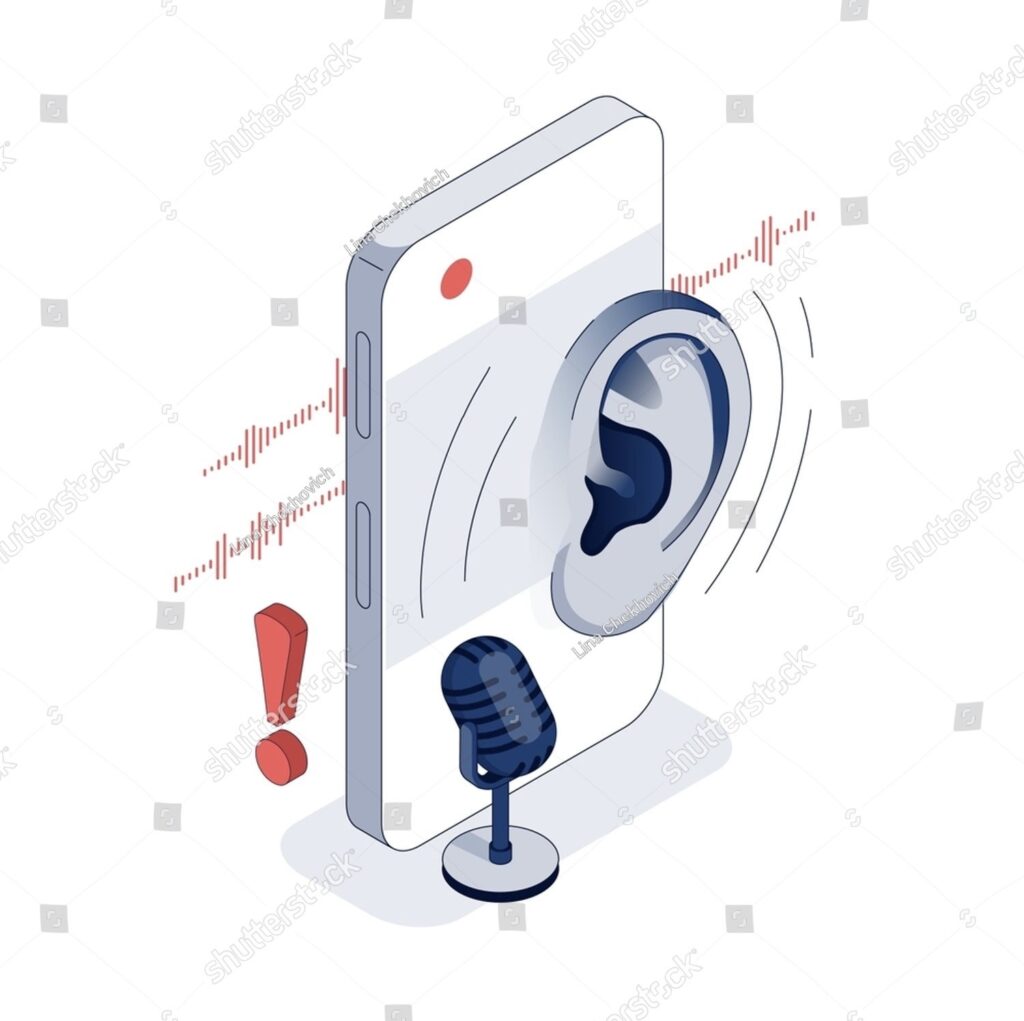
Nissenbaum (2018) argues that privacy is not simply about keeping data secret, but about ensuring that personal information is used in ways appropriate to the context in which it was originally provided. Most of people only see the outcome of the online advertising, not the background process. They do not see platforms collecting data from webs, cookies, apps and online activities of users. What they see is the final result: an ad appears on my phone at that precise moment and feels uncomfortable about their private information. The idea of “monitoring” becomes reliable even if users do not fully understand the terms of the process of collecting information, they can still feel a sense of disturbing and uncomfortable.
In fact, the fear of being listened to reflects a deeper problem of trust. Users know that platforms collect massive data from them, but they do not know what exactly is and what will they use for, even how those data used to predict interests and behaviours. When the system is invisible, people will fill that uncertainty with the direct explanation, which is a sense of being “watched”.
What is actually happening: tracking, analysing and targeted advertising
If the main reason is not simply that platforms are listening through user’s microphones, then what is actually happening? One of convincible answer is that digital advertising systems already collect enough information to make the “listening” unnecessary. Platforms can use searching history, browsing history and behaviour, cookies, current location, pattern of engagement to predict what users may be interested in.
This helps explain why advertisements can be feel like so personal. A user may believe that an ad appeared because of a private conversation, when in fact the platform may have used other factors: a recent product search history, a visit to a shopping website, previous interactions with similar content, even data shared by advertisers themselves. Form that point of view, system does not need to “hear” everything in order to know lots of information about the user. It only needs to track enough behaviour to make highly accurate ad push.
Instagram head Adam Mosseri made a video on his Instagram account to clarify that Meta did not use the phone’s microphone, to deny that Meta uses the microphone to eavesdrop on users for ad targeting.
Adam also gives a few possible explanations of why users “might see an ad for something that you recently talked to somebody about.”:
One, maybe you actually tapped on something that was related or even searched for that product online on a website, maybe before you had that conversation. We actually do work with advertisers who share information with us about who is on their website to try to target those people with ads. So if you were looking at a product on a website, then that advertiser might have paid us to reach you with an ad.
Two, we show people ads that we think that they’re interested in, or products we think they’re interested in, in part based on what their friends are interested in and what similar people with similar interests are interested in. So it could be that you were talking to someone about a product, and they, before, had to actually looked for or searched for that product, or that, in general, people with similar interests were doing the exact same thing.
Three, you might have actually seen that ad before you had a conversation and not realized it. We scroll quickly, we scroll by ads quickly, and sometimes you internalize some of that, and that actually affects what you talk about later.
Four, random chance, coincidence, it happens.
Suzor (2019) argues that social media platforms are not neutral spaces but privately governed environments shaped by rules, moderation systems and technical design. Although users may experience platforms as personal or communal spaces, these environments are ultimately controlled by companies whose terms of service function as “governing documents” (Suzor, 2019). That’s why the feeling of being watched can persist even when users are not being directly monitored. This experience still reflects a real form of digital surveillance —— continually collect data and information of users instead of microphone monitoring.
The Right to Object: Meta, Personalised Ads, and User Control
The issue of privacy has already moved beyond everyday suspicion and become a real dispute over privacy rights and platform governance.

A clear example is the 2025 case of O’carroll vs Meta in the United Kingdom. Tanya O’carroll challenged Meta over its continued use of her personal data for personalised advertising, arguing that she had the right to object to this kind of processing. The case ended in a settlement in which Meta agreed to stop targeting her with personalised ads, a result that was widely report as a significant precedent for other UK users by The Guardian and TechCrunch.
The UK Information Commissioner’s Office (ICO) also publicly stated that:
People have the right to object to their personal information being used for direct marketing, and that online targeted advertising should be considered a form of direct marketing.
The significance of this case shows not only in one user’s dispute with Meta, but it raises broader issues about how digital platforms govern personal data. At the heart of the issue are three factors: permission, transparency and control.
The importance of this case is that it shifts the debate from suspicion to governance. The question is no longer whether users are simply mistaken about being “listened to”, but whether platforms should be allowed to process personal data for advertising by default. O’Carroll’s challenge shows that users may accept a platform’s service without accepting every form of data-driven targeting attached to it. From that view, the case highlights a broader tension in platform governance: companies often treat personalised advertising as a normal part of digital participation, while users may see it as an intrusive use of their personal information. This helps explain why targeted advertising is not just a technical issue, but also a question of rights, accountability and meaningful user control.
Privacy, Rights, and the Loss of User Control
Even if social media platforms are not listening to every private conversation, the advertising systems behind platforms can still raise serious privacy concerns from users. The problem is not only that platform collect data, but they also collect so many information with combining and inferring that users always have no idea about how they are being understood and targeted.
To maintain traditional advertising ways, Google introduced the Federated Learning of Cohorts (FLoC) system, aiming to offer better privacy for users while still giving interest-based ads. With FloC, people with similar browsing histories are grouped together, allowing ads to be aimed at the whole group instead of targeting individuals (Kruminis et al., 2025).
Research on targeted advertising has shown that these systems rely on extensive tracking technologies, data sharing, advertising networks and analysing in apps and browsers. So when user feels like a suspicious ad is often the visible result of a much larger infrastructure working quietly in the backside.
This also weakens the idea of meaningful consent. Platforms may claim that users have agreed to data collection through privacy policies and terms of service, but that agreement is rarely fully informed. Most people do not know exactly what data are being collected, how those data are combined, or how they are later used to predict interests and shape behaviour.
Even when users adjust privacy settings, they cannot fully control how the platform itself or its advertising partners use the information collected about them (Goggin et al., 2017). If users cannot see how the system works clearly, then it is hard to say that their consent is fully informed or having exactly works.
More importantly, this affects people’s digital rights and their sense of control. Turning personal data into profit had become a more and more common business practice (Esayas, 2025). Digital privacy is not just hiding their secrets. It is also about being able to search and communicate without awareness that everything you do is being monitored, recorded, and turned into for commercial using.
When advertising becomes this personal and it is difficult for users to understand, users can begin to feel that they have lost control over their own information. So the problem is not simply whether platforms are “monitoring”. The deeper problem is that the business of the platforms depends on collecting so much personal information and data that surveillance starts to feel normal to the user.
Therefore, even if platforms are not listening through a phone’s microphone, the privacy concern will not disappear. The real issue is that platforms can still build detailed profiles of users by combining browsing history, search activity, app behaviour, current location signals, and data shared by other companies. To users, this can feel just as intrusive as direct surveillance because the result is the same: the personalised advertising that seems to know what they have been thinking or discussing. The problem is not only misunderstanding, but also transparency and opacity. When users cannot clearly see how data is collected, analysed, and turned into predictions about their interests, doubts about the platforms will rise. This also reduces users’ sense of control over their digital lives, because they may formally agree to platform terms without fully understanding the scale of tracking behind them.
The Real Problem Behind Targeted Ads
So, are our phones really listening to us? Well, in many cases, probably not in the literal way people imagine. Platforms do not always need to hear our private conversations to have a lot of informations about us. It also can be achieved through tracking, profiling, and targeted advertising, they can already collect enough information to make surveillance feel real.
That’s why the issue goes beyond a simple misunderstanding about technology. The deeper problem is that these systems are often opaque, difficult to refuse, and deeply tied to business models to build personal data extraction. When users do not have clear knowledge or awareness control, their privacy becomes weaker and feel easy to have from their opinion, and surveillance starts to feel like a normal part of our everyday life on digital platforms. So the real question is not only whether platforms are listening, but whether we have accepted a digital environment in which being constantly tracked has become normal.
Reference lists:
Chekhovich, L. (2025, September 21). Phone with giant ear symbolizes spying and surveillance. Microphone and sound waves highlight voice recording risk [Illustration]. shutterstock. https://www.shutterstock.com/zh/image-vector/phone-giant-ear-symbolizes-spying-surveillance-2680687483?dd_referrer=https%3A%2F%2Fwww.google.com%2F
Emiroğlu, A. (2025, March 14).Close-up of Mobile Phone Home Screen with Apps [Illustration]. pexels. https://www.pexels.com/photo/close-up-of-mobile-phone-home-screen-with-apps-31148083/
Esayas, S. Y. (2025). Data privacy and competition law in the age of big data : unpacking the interface through complexity science. Oxford University Press.https://doi.org/10.1093/oso/9780198891420.001.0001
Goggin, G., Vromen, A., Weatherall, K., Martin, F., Adele, W., Sunman, L., & Bailo, F. (2017). Digital Rights in Australia. Faculty of Arts and Social Sciences. https://ses.library.usyd.edu.au/bitstream/handle/2123/17587/USYDDigitalRightsAustraliareport.pdf?sequence=7&isAllowed=y
Information Commissioner’s Office. (2025, March 22). Statement on O’Carroll vs Meta. https://ico.org.uk/about-the-ico/media-centre/news-and-blogs/2025/03/statement-on-ocarroll-vs-meta
Kumer, E. (2025, January 7). Ads accurately predict people’s preferences [Illustration]. The Washington Post. https://www.washingtonpost.com/technology/2025/01/07/phone-listening-target-ads-iphone-siri/
Kruminis, E., Navaie, K., & Ascigil, O. (2025). BB-FLoC: A Blockchain-Based Targeted Advertisement Scheme with k-Anonymity. Distributed Ledger Technologies (Online), 4(3), Article 19. https://doi.org/10.1145/3672404
Lomas, N. (2025, March 21). Meta settles UK ‘right to object to ad-tracking’ lawsuit by agreeing not to track plaintiff. TechCrunch. https://techcrunch.com/2025/03/21/meta-settles-u-k-right-to-object-to-ad-tracking-lawsuit-by-agreeing-not-to-track-plaintiff/
Milmo, D. (2025, March 22). Meta to stop targeting UK citizen with personalised ads after settling privacy case. The Guardian. https://www.theguardian.com/technology/2025/mar/22/meta-confirms-it-is-considering-charging-uk-users-for-ad-free-version.
Nissenbaum, H. (2018). Respecting context to protect privacy: Why meaning matters. Science and Engineering Ethics, 24(3), 831–852. https://www.proquest.com/docview/2045936826?_oafollow=false&accountid=14757&pq-origsite=primo&sourcetype=Scholarly%20Journals
NOVA PBS Official. (2024, May 17). Is Your Phone Listening to You? | NOVA | PBS [Youtube video]. Youtube. https://www.youtube.com/watch?v=xtfU9AsUmc4
Mosseri, A. (2025, October 1). Myth busting: I swear, we do not listen to your microphone. [Instagram video]. Instagram. https://www.instagram.com/p/DPRA3qyEgWw/
Suzor, N. P. (2019). Who makes the rules? In Lawless: The secret rules that govern our digital lives (pp. 10–24). Cambridge University Press. https://www.cambridge.org/core/books/lawless/who-makes-the-rules/6688999078ABFE0821E84D76A055BE70



Be the first to comment