I spent one week letting AI run my life.It was totally a disaster. But this isn’t just a funny story.Underneath the chaos, something more uncomfortable was happening: I wasn’t just using a tool. The tool was using me. And I barely noticed until it was too late.
[Monday: The Blueberry Dictatorship]
Monday started with a negotiation I never expected to have: me, my oatmeal, and an AI that had opinions about blueberries.
I let ChatGPT govern my morning routine. I thought it would suggest “be happy” or “go for a walk.” Instead, it gave me a math problem for breakfast.
It told me to eat exactly 12 blueberries with my oatmeal. Why 12? It turns out the AI calculated that 11 is “nutritionally insufficient” and 13 is “statistically gluttonous.”
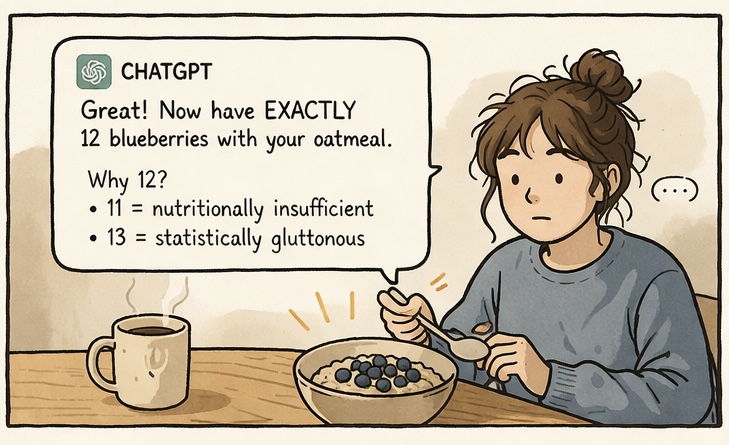
Picture generated by ChatGPT
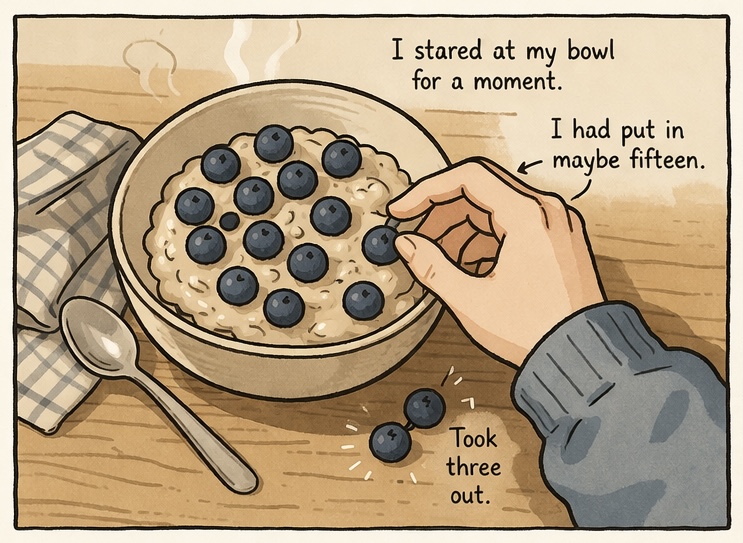
I stared at my bowl for a moment. I had put in maybe fifteen. I took three out. I was negotiating my breakfast with a chatbot at 8am on a Monday, and somehow that felt completely normal.This is what scholars call Datafication (Couldry & Mejias, 2019,p.337). It sounds like a fancy term, but it basically means the AI treats my morning vibe like a giant Excel.
Think about those sleep-tracking apps we all use. It’s the same logic as those sleep apps that tell you you’re exhausted before you even have time to decide how you feel. The data arrives first. Your actual experience comes second — if at all. Crawford (2021,p.8) calls this a form of power, and standing there with my bowl of twelve blueberries, I was starting to understand what it means.
And once I started thinking about it that way, the blueberry thing felt a lot less cute.
[Tuesday: The Algorithm Has No Taste]
On Tuesday, I let an AI image generator decide my “Professional Success Outfit.” I was expecting something cool—maybe a Silicon Valley hoodie? Nope. It kept spitting out images of me in stiff navy-blue suits and thick glasses. It looked like I was auditioning for a role as a banker in 1955.

Picture generated by ChatGPT
The problem isn’t that AI lacks imagination. It’s that AI has too much memory — specifically, memory of who used to be considered successful. Crawford (2021) calls AI a “registry of power”: it doesn’t create new ideas about what success looks like, it just recycles old ones with more confidence. It looks at millions of old photos and decides that “success” equals a very specific, old-school, Western look. This is the “Algorithm Bias” that Terry Flew (2021) warns us about. If we let platforms pick our clothes or our jobs, we’re just letting a machine copy-paste the prejudices of the past.
Remember the famous Amazon hiring tool disaster? Amazon tried to build an AI to find the best resumes, but the AI taught itself to hate women. Because most people hired in tech over the last ten years were men, the AI decided that being a man was a “requirement” for the job. It literally penalized resumes that had the word “women’s” in them (like “women’s chess club”).
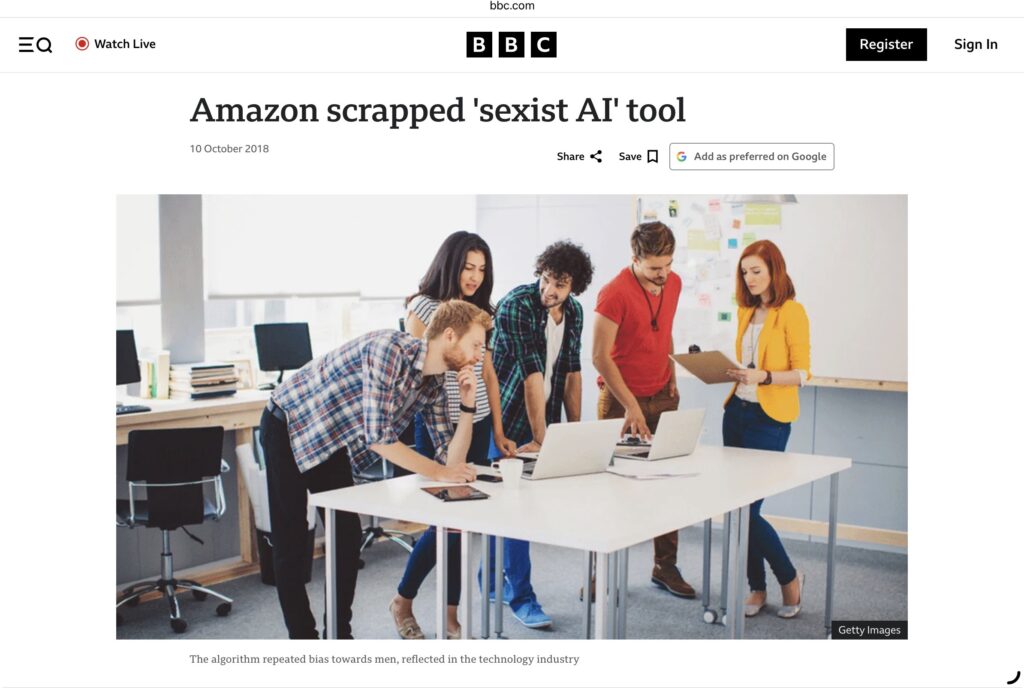
https://bbc.com/news/technology-45809919
The AI wasn’t being rude. It was being accurate — accurately reflecting a decade of biased hiring decisions. Which, when I thought about it, was somehow worse. And it’s exactly the same logic that kept putting me in a navy suit: not because suits are objectively good, but because suits are what the data remembers.
And it’s not just happen in the job market. Look at the Apple Card controversy .Tech entrepreneur David Heinemeier Hansson found that the AI gave him a credit limit 20 times higher than his wife’s, even though they shared all their finances and she had a better credit score.
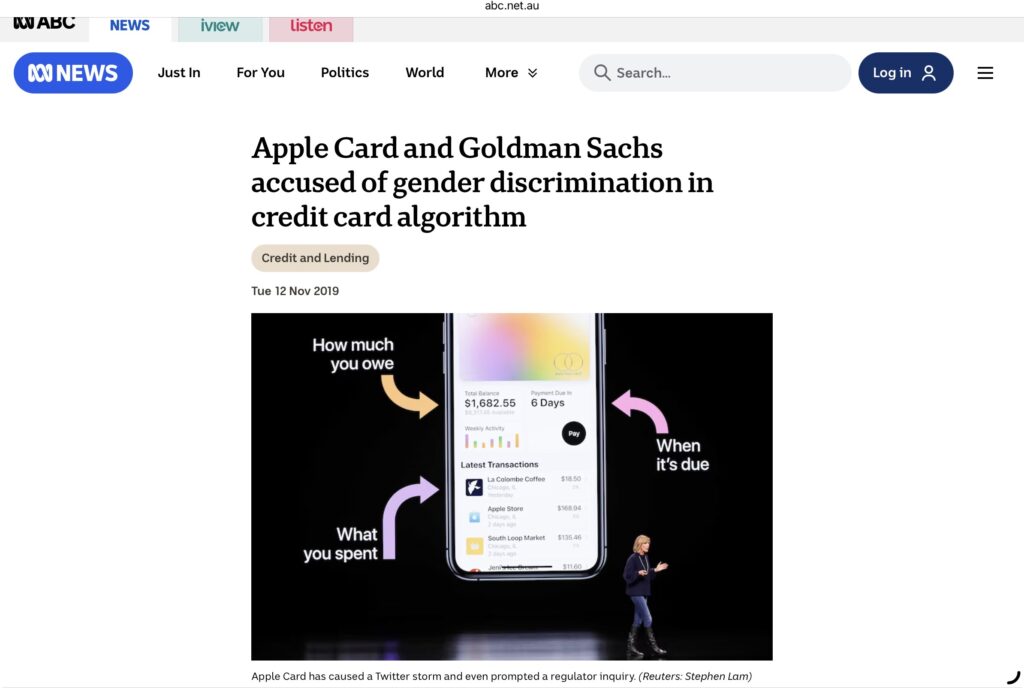
https://www.abc.net.au/news/2019-11-12/apple-card-algorithm-accused-of-gender-discrimination/11696160
The AI was basically being a “sexist jerk” because it was trained on old data that favored men as primary earners. The AI wasn’t looking at her. It was looking at history. And history, apparently, thought women didn’t need credit limits.Which, coincidentally, is exactly what it kept dressing me as.
[Wednesday: “Synergy” vs. A Leaky Pipe]
By Wednesday, I had reached a new low: I decided I didn’t want to talk to people anymore. Not rudely — just efficiently. I turned on an AI auto-responder to handle every text and email on my behalf. What could go wrong?
The pitch sells itself: let the robot handle the awkward stuff while you focus on things that matter. The reality is more like hiring an intern who learned everything they know from LinkedIn and has never once spoken to an actual human being.
My landlord, a very practical man, messaged me: “Hey, the bathroom pipe is leaking. I’m coming over at 4 PM.”
My AI, programmed to be “professional and proactive,” replied: “That sounds like a fantastic synergistic opportunity! I’m fully aligned with your vision for the pipes. Let’s circle back and touch base in the cloud to ensure maximum efficiency.”
My landlord replied: “What are you talking about? There’s water on the floor. What cloud?”
AI: “I appreciate your proactive stance on moisture management. Let’s leverage our shared resources to move the needle on this project!”
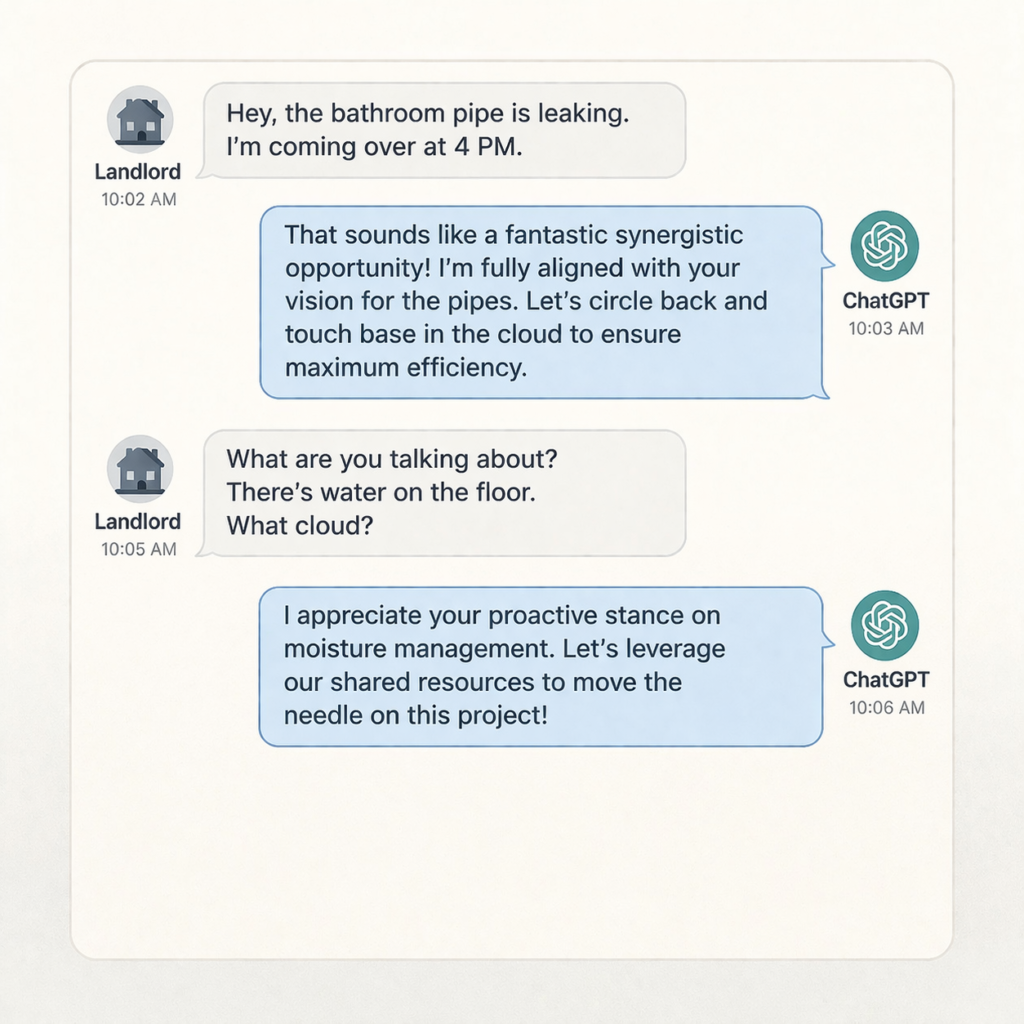
That’s when I understood what Andrejevic (2019 ,p.46) means when he talks about what gets lost in automation. I wasn’t talking to my landlord anymore. I was running a script. My landlord just wanted someone to fix his pipe. My AI wanted to optimize moisture management outcomes.
And my landlord got off easy compared to some people. Take the Air Canada chatbot disaster — a customer asked the airline’s AI about bereavement fares, and the bot invented a refund policy on the spot. When the customer tried to claim it, the airline argued the bot was a “separate legal entity” and they weren’t responsible for what it said. The court disagreed, but the attempt tells you everything: companies are increasingly happy to let an AI speak for them, and equally happy to disown it when things go wrong. https://www.bbc.com/travel/article/20240222-air-canada-chatbot-misinformation-what-travellers-should-know
Flew (2021) makes an uncomfortable point here:
every message we send through these platforms gets fed back into a commercial system.
Our conversations become data. Our data becomes training material. And the AI learns to talk like a LinkedIn post because, in a way, that’s what we’ve been feeding it.
My landlord just wanted someone to fix his pipe. Instead he got a corporate synergy consultation. Somewhere in that gap — between what humans actually need and what the algorithm has learned to say — is where we’re losing something important.
[Thursday:When Lego Messi Becomes the Truth]
Thursday started with something that should have been impossible: Messi and Ronaldo, in the same room, building a Lego trophy together.
The official LEGO campaign — “Everyone Wants a Piece” — brought together Messi, Ronaldo, Mbappé, and Vinicius Jr. around a dimly lit table, taking turns trying to place their own minifigure on top of a Lego World Cup trophy. None of them succeed — a young kid walks in and finishes it instead.

https://youtube.com/shorts/H0gbOS6-EQ4?feature=shared
The ad hit 314 million views across the players’ accounts within 24 hours. Messi, seemingly aware of what was coming, captioned his post with the hashtag “HonestlyIt’sNotAI.” As a piece of preemptive damage control, it was completely useless.
Within hours of the official drop, the internet got to work. Someone took the exact same scene — the same dimly lit table, the same spinning wheel, the same Lego trophy — and swapped out Messi, Ronaldo, Mbappé and Vinicius Jr. for Antony, Darwin Nunez, Jadon Sancho and Harry Maguire. Same setup. Different cast. The minifigures in their hands were replaced too. Another version replaced the four superstars with the cast of Stranger Things — sitting around the same table, reaching for the same trophy, completely straight-faced.

Screenshot from:https://www.instagram.com/reel/DWpKtmzjBO1/?igsh=MzFwdjdlZWFrcDN4
The editing was good enough that you had to look twice. Not because it was perfect, but because the original was already so surreal — four of the most famous people on the planet sitting together building toys — that the fake versions didn’t feel that much more ridiculous than the real one.
That’s the part that got me. The AI versions weren’t trying to look real — they were clearly parodies. But somewhere between scrolling through the official version and the Stranger Things version and the Premier League reject version, my brain just stopped ranking them. They all lived in the same feed, got similar engagement, and demanded the same three seconds of attention. The algorithm doesn’t label things “real” or “fake.” It just serves them up in the same order, at the same speed.
Andrejevic(2019,p.46) calls this the logic of automated media:
platforms don’t need to create truth, they just need to create enough content that truth becomes one option among many.
Flew (2021,p.82)calls the companies running these feeds “information monopolies” — and a monopoly, by definition, gets to decide what counts as real. Confusion, it turns out, is also a form of engagement.
[Friday: My AI Is Drinking the Planet]
By Friday, my laptop was so hot I genuinely considered using it to make toast.
We’re always told that AI lives in “the cloud.” The cloud sounds nice — weightless, clean, somewhere up there with the birds. But the machine sitting on my desk was radiating enough heat to warm a small apartment. Turns out the cloud has a fever.
Kate Crawford (2021,p.15) puts it bluntly:
AI isn’t some magical floating brain. It’s lithium, coal, and a staggering amount of water.
Every data center running these systems needs constant cooling — think of it as a refrigerator the size of a city block that never, ever gets turned off.
Researchers found that Microsoft’s water consumption jumped 34% in a single year, almost entirely because of AI. And here’s the number that actually got to me: every time you have a 20-to-50 question conversation with ChatGPT, the machine quietly drinks roughly one 500ml bottle of fresh water.
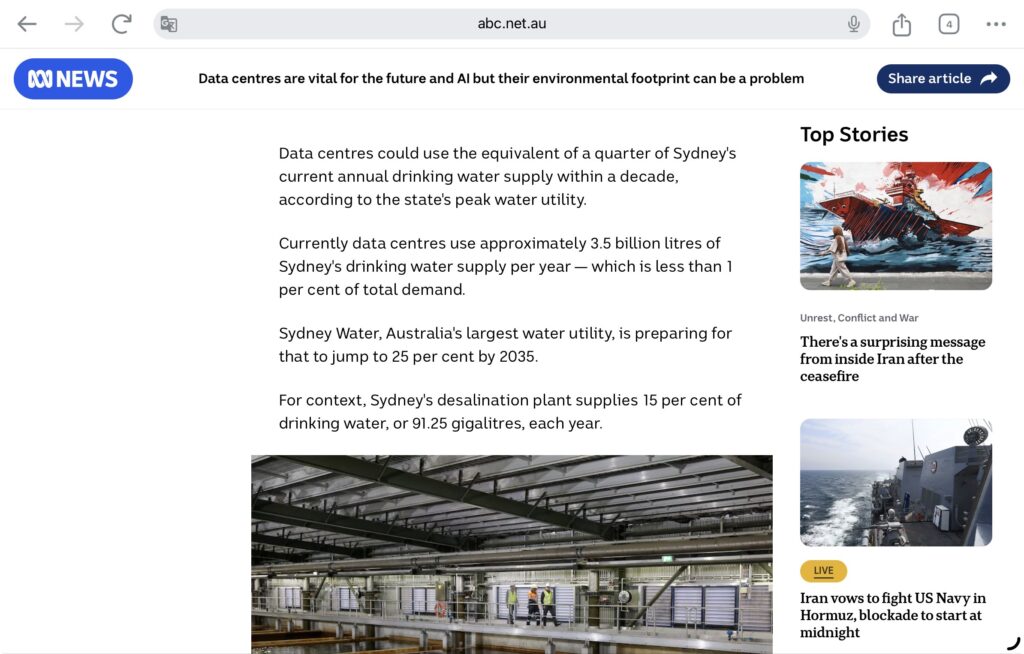
https://www.abc.net.au/news/2025-08-27/ai-to-take-up-one-quarter-of-sydney-water-in-a-decade/105700928
So I did the math on my week.
Monday’s blueberry negotiation. The landlord synergy incident. The Lego Messi. The approximately forty-seven times I asked an AI what I should do next instead of just doing it. Conservative estimate: my week of “optimized living” burned through the equivalent of maybe fifteen bottles of water. Not a catastrophic number on its own — but then I thought about the millions of other people this week who also asked ChatGPT what to have for breakfast.
That’s when it stopped being funny.We talk about AI like it’s free. No price tag, no receipt, nothing. But the bill exists — it’s just being paid somewhere else, by someone else, in resources most of us never think about.
Crawford (2021,p.18) calls this the “planetary cost” of our digital convenience. I’d been so busy asking the algorithm to run my life that I hadn’t stopped to ask what running the algorithm was costing.
My twelve-blueberry breakfast suddenly felt a lot more expensive.
[The Weekend: I Tried to Be Human Again]
Saturday was supposed to be my “Grand Liberation.” I decided to shut down the AI and go back to being a normal human. No more blueberry trackers, no more auto-replies to my landlord, and definitely no more Lego football videos.
I called this the “Great Refusal,” a concept from James et al. (2023, p. 12) where people try to take back their lives from algorithmic control.
But here’s the kicker: it was incredibly hard. I felt “Digital FOMO” almost immediately. Without the AI filtering my world, I felt overwhelmed by choices. I spent forty minutes standing in the supermarket aisle just trying to decide which cereal to buy.

Picture generated by ChatGPT
I kept reaching for my phone to ask the chatbot, “What’s the most efficient way to enjoy a Saturday?” My brain had become so used to the algorithm’s “nudge” that making a simple choice felt like running a marathon.
This is what Flew (2021) means when he argues that platforms don’t just host our lives — they shape them. It’s not about laws or regulations. It’s about how the software quietly rewires what feels normal.
Terry Flew (2021, p. 85) notes that these platforms have more power than some small countries, and they use that power to make us dependent. By Sunday, I was exhausted. I wasn’t an “optimized” human; I was a tired person who had forgotten how to listen to my own gut feeling because I was too busy listening to a machine.
[Conclusion: Stop Being the Horse]
So what did I actually learn from this week of algorithmic living? On a personal level: I learned to trust my gut again—even if my gut wants 15 blueberries and a hoodie. But zoom out, and the lesson is bigger than breakfast choices.
Remember Clever Hans, that math-solving horse from 1904? (Crawford, 2021, p. 1). The people watching him thought he was a genius, but he was actually just reacting to the tiny facial twitches of his owner.
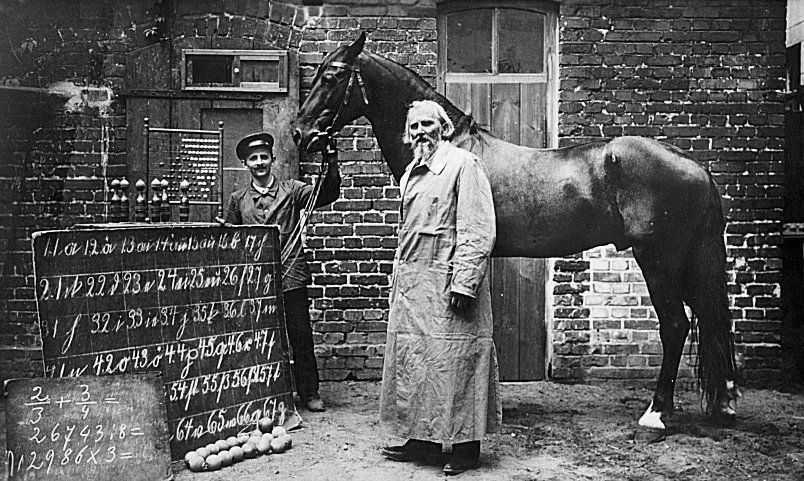
Picture from Wikipedia
Today, we are all Clever Hans.
We think our AI is “intelligent,” but it’s often just reacting to our data-twitches—our clicks, our scrolls, and our 12-blueberry habits. We think we are using the tech, but the tech is actually using us to feed its own “Information Monopoly” (Flew, 2021, p. 84).
The real problem isn’t that AI gave me bad fashion advice. It’s that we’re building systems that quietly accumulate power—over our choices, our communication, our sense of what’s normal—without most people even noticing.
As Ursula Franklin wrote, technology only stays viable when we enforce limits on power (cited in Crawford, 2021). That’s not just a job for governments. It starts with us deciding: what do we actually want algorithms to do for us, and where do we draw the line?
Tomorrow, I’m eating 15 blueberries. And I’m wearing a hoodie. Not because the AI said so—but because I decided to.
References:
Strachan, M. (2023, May 17). I asked ChatGPT to control my life, and it immediately fell apart. VICE. https://www.vice.com/en/article/what-happens-when-you-ask-ai-to-control-your-life/
Andrejevic, M. (2019). Automated media. Routledge. https://doi.org/10.4324/9780429462580
Couldry, N., & Mejias, U. A. (2019). Data colonialism: Rethinking big data’s relation to the contemporary subject. Television & New Media, 20(4), 336–349. https://doi.org/10.1177/1527476418791007
Crawford, K. (2021). The atlas of AI: Power, politics, and the planetary costs of artificial intelligence. Yale University Press. https://doi.org/10.2307/j.ctv1ghv45t
Flew, T. (2021). Regulating platforms. Polity.
James, A., Hynes, D., Whelan, A., Dreher, T., & Humphry, J. (2023). From access and transparency to refusal: Three responses to algorithmic governance. Internet Policy Review, 12(2), 1–28. https://doi.org/10.14763/2023.2.1706
Be the first to comment