Opening hook: This is not just about rude people online
We think that when we are confronted with cruel, discriminatory, or provocative content on social media, we often console ourselves by thinking that this is merely the behaviour of a few bad people, and the solution is simply to block or report it. But such an approach is too one-sided.
The content that is visualised on the screen is not the simple outcome of the actions of humans but is actually built carefully by processes such as platform filtering, ranking, and recommendation. Although the social media companies state they are neutral, they set the rules, do not enforce them very well, and build the participation models according to a commercial interest (Suzor, 2019; Roberts, 2019). The distribution of online harms is not equal, and the more vulnerable groups are the ones that are more likely to be harmed (Marwick & Boyd, 2018). The platform algorithm system decides what is visible of the content and what is the social reality, but it is rarely noticed or questioned by the user (Just & Latzer, 2017). The objective language of the technology hides human values and power relations inside digital systems (Noble, 2018). Therefore, the online hate is not only a problem of personal offence but also a problem of governance, of the formulation of the rules of digital life, of the prioritizing of the guarantees of security, and of how the platform design is amplifying the biases. We have to ask: Why is the digital system so good at spreading harm?
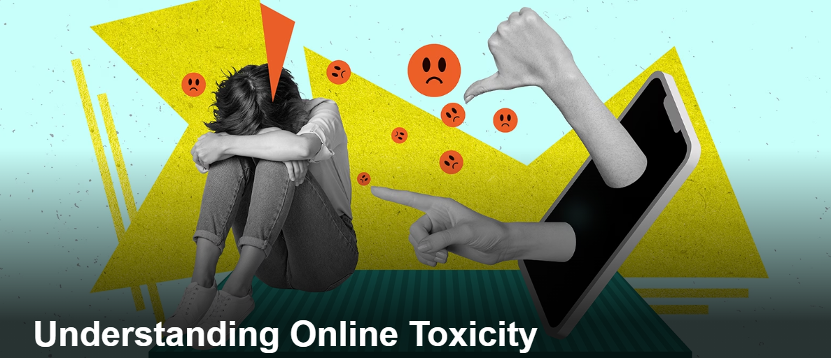
Understanding Online Toxicity
The key idea: platforms govern public life without acting like public institutions
If one talks about social media and if one regards the platforms as just like a digital bulletin board, that will be a major mistake. The platforms organize conversations, set the rules, and control the information dissemination system, which they can change at any time based on their business models. They do not use the word “control” very much, but they do control public life. As Nicolas Suzor (2019) has been saying, the power of the rule-making that is exercised by the platforms has a strong impact on the public culture, but it is in private contracts and is not democratic (Suzor, 2019).
The core of the contradiction of digital governance is that although the platforms are private entities, they impact public life: they are unelected, opaque, and not required to explain their decisions to users. The service terms, the community guidelines, and other technical systems are the charter of the platforms, but few people are reading or negotiating them. The companies say they empower users, but they actually hold the power. Sarah T. Roberts (2019) researched the fact that commercial content moderation is an operation of the platform; it is about the protection of the brand, the atmosphere of the advertising, the legal risks, and the participation of the user. Effectively, this refers to commercial governance (Roberts, 2019). Platforms are not neutral mediators; they are creators of the dialogue. Shared obligations. Once we recognized this, network harms are no longer the failure of the behaviour of the individual, but they are the consequence of the private power that is working in the public domain.
Why “neutral algorithms” are a myth
If we say that the platform sets the rules for online life, then algorithms are the means to make these rules happen. Algorithms decide the search result, the way to present the information flow, the content recommended, etc. It is fair and seems natural in what is said, but of course, it is packaged in the language of the technical; in fact, the illusion that the algorithm is neutral is very misleading. Just and Latzer (2017) have pointed out that the selection of the algorithm has become an important source of the social order. It not only organizes the information, but it also takes part in the construction of reality, of the way people cognise, of the way they know what is normal, what the standard is. It is the result of the junction of culture and politics.
The algorithm is not a neutral tool; it sees, it classifies, and it structures the way in which the user is behaving. Even if the recommendation system learns the user’s behaviour, when it is interested in promoting the content, it directs the user’s attention. In the digital environment, it is important because the popular discussion on the internet is made by systems that are oriented to reward exposure, repetition, and engagement. Neutrality, then, is a way to escape the responsibility. Scholar Safiya Umoja Noble (2018) has fought this logic, showing that the search system is driven by commercial interest and can be a repeat of inequality (Noble, 2018). The algorithmic systems shape the trust and the visibility; the systems can have bias, but they are not errors; they are structural problems that can increase the inequality and the lack of accountability.
The reality constructed by algorithms is also different from that of the traditional media. It is more personalized, commercialized, opaque, and difficult to predict. Users encounter an increasing number of highly customized versions of reality, exacerbating inequality and undermining accountability. Online harms spread not just because haters are present, but also because the platform rewards inflammatory content. The amplification effect of the algorithms has become a political issue. Note that, even if the platform system does not need to recognise the bad content, it is designed to promote the participation of the users, which helps the spread of such content. Then, when the platform says that the system is neutral, we should ask, “Who is neutral?” Algorithms do not make an impartial judgment but are constructed in a dialogue structure. The system itself is to blame for the spread of online harms.
Harm is uneven: digital rights and privacy look different at the margins
In most discussions of digital life, it is often assumed that everyone is in the same situation on the Internet, and treating privacy as a matter of choice for each individual is overly simplistic. Marwick and Boyd (2018) point out that privacy varies significantly among so-called “marginalised groups.” Vulnerable groups lack protection and face greater losses because they do not cope equally with cyber risks. Privacy serves as a guarantee of security, and exposing oneself online is not a joke; it has serious consequences. The recommendations to “opt out” or “strengthen protection” fail to consider the importance of digital participation. Nissenbaum’s (2018) concept of “contextual integrity” also shows that online platforms consistently violate expectations of information dissemination, leading to different consequences for content diffusion. Thus, digital rights are vital; privacy and security are about dignity in online participation, and the digital system’s imbalance causes uneven harm, which is not just about content but also about rights.
Current case study: Meta’s 2025 policy shift and the politics of “more speech”
In 2025, Meta changed its policy in which it treats online harm as a policy of governance, not a matter of mere speech: it banned third-party fact-checking, it adopted a model of community notes, it made the scope of law enforcement a little narrower, and it took the restriction about some controversial topics off, and it said that it would “promote more speech and fewer mistakes” (Paul, 2025). At first glance, it seems reasonable. However, “more speech” is not neutral, and ABC reports that the revised policy may allow discriminatory content, which might weaken the protection of the vulnerable group(Jetson, 2025).

Meta logo is seen in this illustration taken, August 22, 2022.
The platform rules are not isolated. The speech will be ranked, recommended, and amplified. Meta’s relaxation of the protections and its eye-catching content-boosting system may increase the risk of vulnerable online violence. The international response showed that it was not an internal update of the platform. Brazil questioned whether it was in respect of human rights requirements, and Meta’s oversight board criticized its reforms for not having any evidence of human rights due diligence (Reuters, 2025). In this case, it indicates that Meta has redistributed risk, and the platform’s free speech debate is about the sacrifice of power, exposure, and security interests for the platform.

LGBTQI+ advocacy groups say Meta’s changes are shocking.
Why moderation alone will not solve the problem
It is easy to think of online hate as a matter of personal behaviour: rude people, incorrect opinions, harmful comments. This is an explanation that is too narrow for the world that we actually live in. Platforms are not simply vehicles for public conversation. They organise, rank, and amplify the conversations, and they manage them through rules set and enforced by private companies rather than public bodies. Once we see the truth, cyber harm is less like random bad behaviour and more like a product of a digital system built around visibility, engagement, and unfair protection(Matamoros-Fernández, 2017).
This is also why the debate about free speech online can be misleading if it does not consider the power factor. The question is not only who is allowed to speak, but whose speech is amplified, whose privacy is protected, and whose safety is seen as sacrificable, as it shows in the case of Meta, which says that policy shifts can be described as supporting “more speech,” but in reality it puts at larger risk digital engagement for those that are already the most.
For the average reader, the main thing is simple: cyber harm involves governance, not just content moderation or technology. Because platforms shape public life today, they should be accountable, transparent, and respectful of digital rights. The fairness of the Internet is not just that we allow more speech; it is the fact that the people who depend on the Internet can participate with dignity and safety, and with a real chance that their voices will be heard.
What better digital governance could look like
When the content moderation cannot eradicate the cyber harm, improving the digital governance cannot stop at deleting posts after the fact. What is the point of the distribution of power, that is, who decides what the rules are, how the visibility of information is controlled, and whose rights are protected? The platform is not, then, a neutral host, but a private steward of the public life. As Suzor (2019) pointed out, the platforms set and enforce the rules that change the way public participation is, and they have weak transparency and accountability mechanisms. If this power is exercised, then the platform needs to explain how the decisions are made more clearly, and the user needs such effective channels for questioning.
Governance should go beyond content moderation, and it should pay attention to the amplification effect of the algorithms. As Just and Latzer (2017) argue, the influence of the harmful comes from the ranking, recommendations, and the way we disseminate the platform. The algorithm system is increasingly influencing the content that is to be exposed; in this way, the digital policy needs to pay attention to whether the content is actively promoted. At the same time, security should be build on the design, not be remediated, for example, to protect the user at the edge of the cyber harm. And, in addition, governance should be based on the digital rights, privacy, dignity and fair participation cannot be ignored. For Karppinen (2017), digital rights are central to the power struggles and democratic participation. In short, better digital governance also needs to shift from platform convenience to public accountability, paying attention to the digital environment created by the platform and the audience that they serve.
Conclusion: the takeaway for the reader
It is too narrow to simply classify the online hate as a matter of personal behaviour, because the platforms are organising, ranking, amplifying conversations, and managing with private rules, and the online harm is more like a product of the digital systems (e.g. built around visibility, etc.). Therefore, the online freedom of speech debate that ignores the power is misleading, and the key is who is amplified, the privacy is protected, and the security can be sacrificed, as shown in the case of Meta. For ordinary readers, the online harm is a matter of governance; the platforms should take responsibility for the way that they are shaping public life, should promote transparency, respect digital rights, and the Internet’s fairness lies in the people being able to have a voice with their dignity and safety (Karppinen, 2017).
Reference
Just, N., & Latzer, M. (2017). Governance by algorithms: Reality construction by algorithmic selection on the internet. Media, Culture & Society, 39(2), 238–258. https://doi.org/10.1177/0163443716643157
Karppinen, K. (2017). Human rights and the digital. In H. Tumber & S. Waisbord (Eds.), The Routledge companion to media and human rights (pp. 95–103). Routledge.
Marwick, A. E., & boyd, d. (2018). Understanding privacy at the margins. International Journal of Communication, 12, 1157–1165.
Massanari, A. (2017). #Gamergate and The Fappening: How Reddit’s algorithm, governance, and culture support toxic technocultures. New Media & Society, 19(3), 329–346. https://doi.org/10.1177/1461444815608807
Matamoros-Fernández, A. (2017). Platformed racism: The mediation and circulation of an Australian race-based controversy on Twitter, Facebook and YouTube. Information, Communication & Society, 20(6), 930–946. https://doi.org/10.1080/1369118X.2017.1293130
Nissenbaum, H. (2018). Respecting context to protect privacy: Why meaning matters. Science and Engineering Ethics, 24(3), 831–852. https://doi.org/10.1007/s11948-015-9674-9
Noble, S. U. (2018). Algorithms of oppression: How search engines reinforce racism. NYU Press.
Roberts, S. T. (2019). Behind the screen: Content moderation in the shadows of social media. Yale University Press.
Suzor, N. P. (2019). Lawless: The secret rules that govern our digital lives. Cambridge University Press.
Jetson, F. (2025, January 10). LGBTQ+ advocates alarmed by Meta’s hateful conduct policy changes. ABC News. https://www.abc.net.au/news/2025-01-10/meta-hateful-conduct-policy-changes-alarm-lgbtq-advocates/104800042
Kaplan, J. (2025, January 7). More speech and fewer mistakes. About Meta. https://about.fb.com/news/2025/01/meta-more-speech-fewer-mistakes/
Paul, K., & Wang, E. (2025, April 23). Meta’s oversight board rebukes company over policy overhaul. Reuters. https://www.reuters.com/sustainability/boards-policy-regulation/metas-oversight-board-rebukes-company-over-policy-overhaul-2025-04-23/
Reuters. (2025, January 14). Brazil says Meta hate speech policy changes do not fit with local law. Reuters. https://www.reuters.com/world/americas/brazil-seriously-concerned-about-meta-changes-hate-speech-policy-2025-01-14/
Paul, K., & Wang, E. (2025, April 23). Meta company logo[Illustration]. Reuters. https://www.reuters.com/resizer/v2/ZY3JDXTU7VIM7I5MWYZVLCIYFA.jpg?auth=435de0d4491f83dd17a9485c283f6f8eb00a55d0f8296b83ee59f2df1f842774&width=480&quality=80

Jetson, F. (2025, January 10). LGBTQ+ advocates reacting to Meta policy changes[Photograph]. ABC News. https://caltech-prod.resources.caltech.edu/main/images/Mobbs_Dean-Onli.2e16d0ba.fill-1600×810-c100.format-avif.avif

ABC News. (2025). LGBTQI+ advocacy groups expressing concern over Meta’s policy changes[Digital image]. Retrieved April 13, 2026, from https://live-production.wcms.abc-cdn.net.au/e5ddeb202853fc5e7341299814be7484?impolicy=wcms_crop_resize&cropH=1600&cropW=2400&xPos=0&yPos=0&width=862&height=575
Be the first to comment