When Opinions Go Unfiltered
Have you ever been honked at or honked at someone else while driving? Would you ever yell at someone for walking too slowly or taking the wrong path? Have you ever stopped to think about the difference?
The truth is, people are more likely to get angry when staying in a car, which is an enclosed space where anonymity allows them to avoid direct conflict even when showing their unsatisfactory to others. They will not see other people’s emotion through their facial expressions or tone of voice, which reduce the emotional burden to be “rude”. The difference here is not personality, but context.

Figure 1. What’s driving road rage. Note. From NRMA (2021).
Online interaction works in a similar way. When people feel less identifiable, they tend to say more extreme things or act more aggressively. Psychologists call this the online disinhibition effect (Suler, 2004). Online spaces also make it easier to lose empathy. You can’t see other people’s facial expressions or hear their tone, just like when you’re driving. As a result, using anonymous or semi-anonymous identities online makes it easier for people to speak harshly to others or express extreme opinions with less psychological cost.
A Viral Post That Sparked a Gender Debate on RedNote, 2026
Misogyny and gender conflict are among the most controversial topics on RedNote, one of the most widely used social media platforms in China. A recent example can be seen in a viral post on the Chinese platform RedNote. A user asked how much it would cost for a man with seemingly “ideal” traits to marry into a woman’s family as a live-in son-in-law. The post was later revealed to be a gender-reversal experiment: the described traits actually referred to the author herself.
The post quickly gained widespread attention, attracting large numbers of comments and intense debate. Many users reacted emotionally, reinforcing existing gender stereotypes rather than reflecting on them.
The Original Post
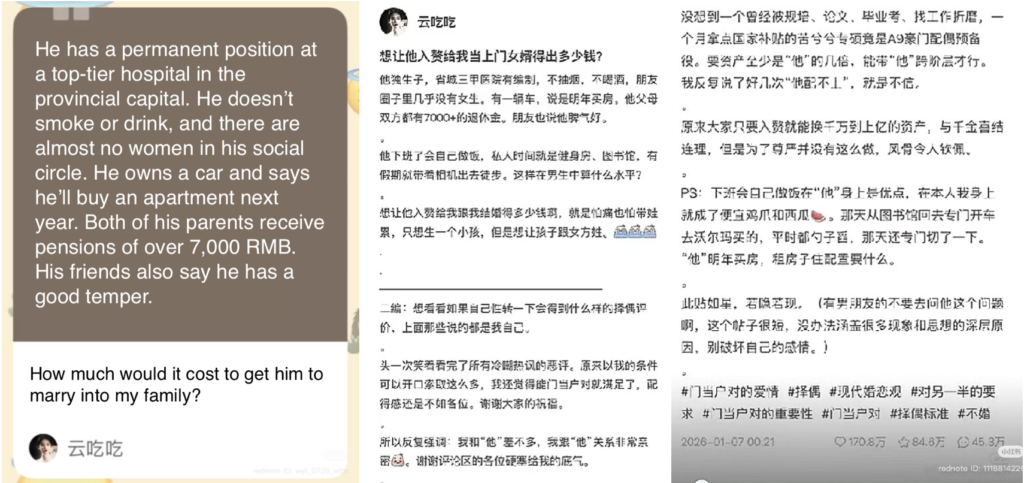
Figure 2. Screenshots of the original post on RedNote. Note. From RedNote user 云吃吃, 2026.
The original poster is a woman. In China, there is a long-standing custom where men provide a significant payment to the bride’s family at marriage, commonly known as a bride price(a traditional betrothal payment from the groom’s family). This practice is rooted in traditional marriage systems rather than being a modern invention. Today, however, the issue of bride price has become highly controversial, because contemporary relationships no longer follow the old model, where a woman would marry into the husband’s family, become part of his household, and gradually detach from her own family while contributing mainly through childbirth and domestic roles.

Figure 3. A Chinese Wedding Banquet. Note. myoldtime.com, 2017.
That said, the purpose of the original post was not simply to discuss this background. Instead, the author was reflecting on how to “price” herself in the context of marriage discussions with her boyfriend. She listed her own personal conditions in text form, but cleverly switched the perspective—presenting herself as if she were male, and framing the situation as her boyfriend marrying into her family as a live-in son-in-law. She then asked how much money would be needed in this scenario, effectively reversing the logic of bride price, which was later regarded as an interesting social experiment.
The Comment Section
Although marriage and relationships are topics that most people will inevitably encounter in their lives, people rarely offer unsolicited or fully honest opinions on such personal matters in offline settings. It is uncommon to openly share one’s genuine thoughts or advice about something as significant as another person’s life decisions. However, once online, the situation shifts. Much like the dynamics behind road rage, the combination of anonymity and a sense of personal distance lowers the psychological barrier to expression. People are more willing to express what they really think, almost like thinking aloud. Sometimes they even speak in a blunt, exaggerated, or even sarcastic manner in the discussion.
The Ironists
Some users directly assigning an astronomical price to the man.
“At least tens of millions, otherwise what are you even dreaming?”
“He can’t even give birth and still dares to set a price.”
“Start from one hundred million.”
“How did you even come up with that?”
What is striking about these comments is not just the numbers themselves, but the confidence with which people quantify a human relationship. These ironically high “prices” also demontrate an exaggerated way of saying: “Don’t even think about it. You don’t deserve him”. Commenters here are not engaging in a real negotiation, but reinforcing the patriarchal hierarchy of worth within their mind. When the same logic of objectification is applied to men, it suddenly appears absurd.
The Calculator
Some comments approached the issue in a more “rational” way, focusing on opportunity cost.
“Would he need to quit his job? If so, that should be compensated.”
“You have to consider his future income loss.”
This reveals a clear double standard in how contributions are valued: once in marriage, men needs to get paid for staying at home, while women are not. Because women’s contributions to family has long been taken for granted and undervalued. The baseline expectations varies between gender.
The reflective ones
A smaller but important group began to reflect on the implications.
“After reading this, I actually feel more confident about myself.”
“So this is what women are usually judged like?”
Commenters say they have developed a deeper understanding of how gender relations and marriage in the Chinese context are closely tied to economic considerations. Generally neutral in tone. These comments tend to focus on recognising the underlying structure rather than taking a confrontational stance. In most cases, such views receive broad agreement and support among female users. This is where the post shifts from entertainment to social critique.
The End of the post: Post Removed, Account Banned

RedNote repeatedly removed the post, stating that it violated community guidelines. Eventually, the platform banned the user’s account. From the platform’s perspective, banning the account was a straightforward way to “resolve” the situation and signal control over the conflict. However, that was not the end of the story. Because the post had already gone viral, many users reposted it through screenshots and even created memes containing QR codes linking to archived versions of the deleted content. In the end, the entire controversy turned into a kind of rumour.
Figure 4. Screenshot of the original user profile on RedNote. Note. Screenshot from RedNote (2026).
Essence of Online Misogyny: Double Standards
This case suggests that misogyny online is not always expressed through direct hate speech towards women. Instead, gender conflict can appear in more subtle forms. Indirect or ambiguous expressions, such as irony or generalisation, can still contribute to a hostile environment (Sinpeng et al., 2021). In this case, when the same criteria are applied to men, they suddenly seem excessive or unrealistic; yet when applied to women, they are taken for granted. These less visible forms of misogyny often emerge in discussions that ignore women’s needs, desires, and claims to basic resources.
Why Misogyny Spreads: Low Barrier, High Impact
First, it is low-barrier. Unlike discussions about AI, politics, or economic policy, participating in a gender debate requires no specialised knowledge. Everyone has some form of personal experience or opinion, so it’s easy for discussions like this to pull people in.
Second, it is emotional by default. Gender is closely tied to identity and relationships, so these discussions easily trigger anger or frustration. This kind of emotional content tends to travel further, as people are more likely to comment, share, or argue about it. This process is closely related to what Guan and Chen (2025) describe as “othering” in Chinese cyberspace, where individuals are reduced to simplified group identities. Discussions shift away from individual perspectives and toward group-based confrontation.
In addition, these discussions often collapse very quickly into simplified positions. What starts as a specific situation can easily turn into generalised statements about “all women” or “all men.” Once this shift happens, people are no longer responding to the original topic, but to a broader sense of identity. This makes the discussion more intense, but also less meaningful, as nuance is gradually lost.
Platform Amplification: When Conflict Becomes the Norm
What you see on your feed isn’t random. Hate speech is often shaped by platform structures rather than simply individual intentions. Yes. It’s not just about individual users. This helps explain why such attitudes can become normalised, even when they are not overtly aggressive. Because content is filtered, ranked, and recommended based on “engagement” (Flew, 2021). This also creates a subtle feedback loop. The more people react, the more visible the content becomes, and the more it appears as something widely accepted or representative. In reality, what we see is often a result of repeated amplification rather than a balanced reflection of public opinion.
As Matamoros-Fernández (2017) describes, when digital platforms do not merely host harmful content, but actively shape its visibility and circulation, it creates a form of “platformed” hate. Conflict performs extremely well in this system. Posts that make people angry or defensive tend to get more interaction than calm, balanced ones, so the algorithm keeps pushing them to more people. In this case, misogyny-related topics become great engagement bait. Your clicks, comments, shares, and watch time matter.This doesn’t mean platforms are deliberately promoting misogyny. As Pariser (2011) points out, algorithmic filtering quietly shapes what we see. Over time, it can create the feeling that certain types of conflict are everywhere, even if they are not as universal as they seem.
Conclusion
Online misogyny takes many forms. It is not limited to explicit hate speech, but also appears through subtle norms, expectations, and everyday assumptions. In a platform environment that rewards attention and amplifies emotionally charged content, such patterns become more visible, more frequent, and often more uncomfortable to encounter. This is why these patterns can feel overwhelming at times, even when they are not as dominant as they appear.
Not every argument is worth joining. When a discussion turns into identity conflict, stepping away is often more productive than engaging. Recognising this, and choosing where to place your attention, is one of the few ways to stay grounded in an age of information overload. This does not mean completely disengaging from online discussions, but rather learning to participate more selectively and critically, without being constantly drawn into cycles of reaction.
Reference
Flew, T. (2021). Hate speech and online abuse. In Regulating platforms (pp. 91–96). Polity.
Guan, T., & Chen, X. (2025). Threat perception, otherness and hate speech in China’s cyberspace. Journal of Contemporary China, 1–16.
Massanari, A. (2017). #Gamergate and The Fappening: How Reddit’s algorithm, governance, and culture support toxic technocultures. New Media & Society, 19(3), 329–346.
Matamoros-Fernández, A. (2017). Platformed racism: The mediation and circulation of an Australian race-based controversy on Twitter, Facebook and YouTube. Information, Communication & Society, 20(6), 930–946. https://doi.org/10.1080/1369118X.2017.1293130
NRMA. (2021, May 3). What’s driving road rage. Open Road. https://www.mynrma.com.au/open-road/advice-and-how-to/driving/whats-driving-road-rage
Sinpeng, A., Martin, F., Gelber, K., & Shields, K. (2021, July 5). Facebook: Regulating hate speech in the Asia Pacific. Final report to Facebook under the auspices of its Content Policy Research on Social Media Platforms Award. Dept of Media and Communication, University of Sydney & School of Political Science and International Studies, University of Queensland.
Suler, J. (2004). The online disinhibition effect. CyberPsychology & Behavior, 7(3), 321–326. https://doi.org/10.1089/1094931041291295
Be the first to comment