Have you ever at one time opened TikTok or Instagram, and gone straight toward the area of comments? All things seem normal in the beginning, but quickly turn negative, especially when the content is issued by women.
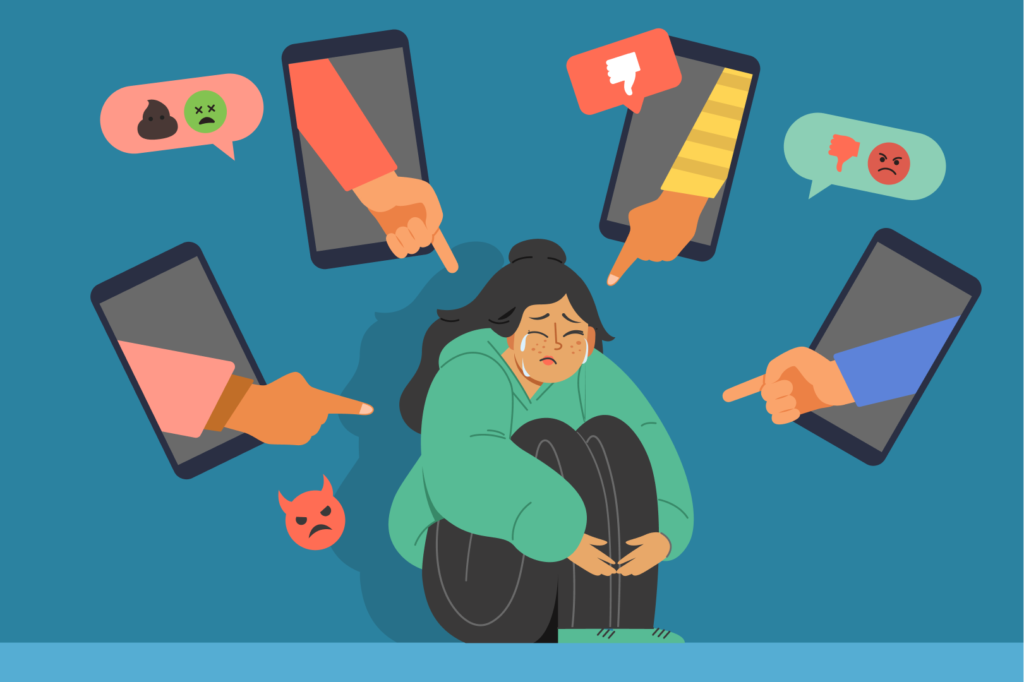
Social media use and cyberbullying (Emotional First Aid, n.d.)
This seems normal online. Platforms such as Instagram, TikTok, and Reddit are designed for fun, creative, and social experiences. But for many women, being online is not always simple. Only uploading a video or photo can attract unnecessary comments, evaluations, and even harassment.
This made me wonder: why is it so common for women to receive this kind of treatment on the internet? I also discovered this when reading comment sections, situations can become bad very fast, particularly when the content is uploaded by female persons.
In this article, I hold the argument that gendered cyberbullying is not produced by a few “bad persons” online. Instead, it is formed by how platform operates—especially its algorithms, design selections, and social norms. Platforms are not really neutral. They help promote this behavior.
It’s More Than Just Comments
When people discuss hate speech, they always depict it as an offensive utterance which targets a particular group of people. But this is more than what we call a “mean comment.” Research indicates that hateful speech may possess actual and long-standing influences, for example letting people feel unsafe, left out, or not willing to express opinions (Sinpeng et al., 2021).
Another essential thing to point out is that the influence of hate speech does not restrict itself to extremely serious circumstances. Even every day jokes, insults, or repeated criticism will accumulate through time. Finally, this therefore may cause persons to completely keep far away from network space (Guan & Chen, 2026).
This especially has relation for women, who often become targets that are attacked. However, the method of assault often exceeds simple differing views, and instead concentrates on outward appearance, gender duty or sexual inclination.
Why Women Face More Harassment Online
YouTube. (n.d.). You will not believe who cyberbullied this high schooler for nearly two years!
It needs to be pointed out that the harassment forms which women encounter are frequently not same with those of men. This thing on the whole has connection with what researchers name the “sexual double standard”. Fundamentally speaking, female groups are required by society to display themselves in a specific manner on the internet. But on the other hand, no matter what things they do, they can possibly meet with criticism. (Mahlknecht & Bork-Hüffer, 2023).
For example, if a woman posts something confident or expressive, she might be accused of “attention-seeking.” But if she avoids posting, she will be regarded as an invisible person. It seems that there is no “right” way to survive on the Internet.
For this reason, the comment section can easily become a space for people feel free to judge women’s bodies, clothes, or behaviour. Even when it seems minor, constantly being exposed to such attention will also affect people’s self-awareness and whether they are willing to continue to participate in online activities.
Platforms in Action: Reddit and TikTok
To understand the role played by the platform, Reddit is a good example. The platform is closely related to events such as #Gamergate, where women in the game industry are targeted with harassment and threats (Massanari, 2017).
What has the interest is that this is not one accidental occurrence. The structure of Reddit, as all people know it, provides convenience to the expansion of this kind of culture.
For example:
Posts that get more “like” become more visible
Controversial content tends to get more engagement
Users can remain anonymous
On account of this circumstance, harmful information is able to get rapid diffusion, hence individuals do not always have the consciousness of responsibility for that which they utter. Massanari (2017) gives description of this as a “poisonous technical culture,” in which the system itself can push out harmful conduct.
Reddit shows how communities become harmful, while TikTok shows how algorithms spread harm faster.
TikTok’s “Recommended For You” page on the main basis decides what users can watch according to the total interaction quantity. This indicates that those videos which obtain a strong reaction—no matter it is positive or negative, they have a bigger possibility to get promotion.
This means those videos receive a strong response—whether positive or negative are more likely to be promoted.
For example, videos can easily become a place for people to comment on other people’s figure, appearance or behavior.
On TikTok, once the content gets attention it usually attracts a large number of viewers. But this exposure may soon cause negative reactions in the comment section. A real-world example also shows how easily this kind of harassment can happen.
YouTube. (n.d.). St. Louis woman cyberbullied for her smile [Video]. YouTube. https://youtu.be/dBdCscQ2l70
At the same time, the platform is not always able to respond effectively. Some harmful content still stays up even after being reported, which will make users feel that reporting doesn’t work at all (Sinpeng et al., 2021).
How Platforms Shape Behaviour
Therefore, it is crucial to study in depth how platform design shapes user behaviour. Another way to understand gender cyberbullying is to examine platform design. It is easy to assume cyber harassment is simply caused by malicious behavior. But the design of the platform will encourage certain types of interaction over others.
Let us take an example: social media platforms priorities visibility and interactivity. Social media platforms are designed to maximise user engagement, therefore they push users to quick emotional responses rather than thoughtful ones.
Comment areas are frequently turned into places of impulsive responses. People may produce sharp or critical statements without considering the consequences. When negative comments are given emphasis, they will become more obvious and strengthen this vicious cycle.
Comments toward women’s appearance or behaviour attract more attention, making them more visible. This may make become normal the thought that women can be judged or criticised online.
Another factor is online harassment is the feeling of distance between users. When people interact online, they do not meet face to face and more convenient to speak things they would not speak in real life.
On websites such as Reddit, this is more obvious due to the anonymity. The ability to create accounts anonymously, reducing consequences and encouraging more radical actions, such as harassment.
Even in applications such as TikTok or Instagram, where users have public profiles, there is still a distance. Video commenting is completely different from in-person communication. This means that the users can consider content as that which needs responding to, rather than giving attention to the creators behind the content.
This demonstrates that cyber harassment does not only lie in individual intents. Online communication facilitates harmful behavior due to the nature of its structure.
Over time, cyber harassment can become normalized. By repeatedly viewing negative remarks, people can start to regard them as a part of the internet.
As an example, the comments about the body or appearance of women are common on platforms such as TikTok. Humans recognize the harm that they cause since they are so frequent. Oppositely, they are discredited as a joke, opinion, or even the way social media works.
Over time, this creates an environment where harmful behaviour is not only tolerated but expected.
The Impact on Users
Gender cyberbullying also affects emotions. Over time, it influences how women use internet, making them more cautious about what they post.
This mode of thinking causes great consumption of energy. It produces what may be called “invisible work” — additional exertion that is needed only for joining cyber space in a safe way.
edit their content multiple times
avoid certain topics
restrict sharing content
These are not necessarily very apparent, yet they influence the manner in which individuals communicate online. In the long term, they would be able to lower self-confidence and desire to participate in activities.
It is also highly important to note that not all women have the same experience of being harassed online. A target is determined by factors like race, sexual orientation, and identity. As an example, ethnic minority women can experience various types of discriminations, such as racism and sexism.
This indicates that a part of users confronts higher dangers and graver disturbances. Thus, online experiences of these individuals might be completely different compared to the experiences of other users.
Necessity is in the holding of this viewpoint; therefore, it can also explain that solutions need to consider the thought from many different angles. A method that suits all situations cannot be enough to deal with the complicated condition of network destruction.
Numerous websites encourage people to report abusive material. This theoretically should cut down on evil behavior. In reality, however, reporting systems are not very effective.
The reason why this is the case is that the audit system is too difficult for people to understand the surrounding. There are also some abusive remarks that are not necessarily violative of the rules and create a hostile environment.
Response time is another problem. Unless the harmful material is removed quickly enough, even after it has been deleted, the traumatic experience of the victim will not fade.
Trust is also an issue. When people think that reporting is ineffective, they might abandon these systems and enable bad conduct.
Meanwhile, individuals are under pressure to remain online. Social media is directly connected with social life, opportunities, and even careers. Visibility occupies a particularly special place as far as the content part is concerned.
This has created a relatively tough situation. From one aspect, users possibly hope to protect themselves through releasing less content or keeping far from attention. Conversely, reducing contact is the loss of opportunities or connectivity.
For women, this can feel like a continuous trade-off:
stay visible → risk harassment
stay safe → lose visibility
This contradiction highlights that gender cyberbullying is not only about personal experience, but also about whether you can get digital space and opportunities.
One comparatively large cause that this problem does not stop existing lies in the design aspect of social media platforms. Majority platforms depend on user mutual action, for example “like”, “comment” and “share”, for keeping users’ usage.
Content which can arouse intense reaction therefore achieves better effect. It is a pity that this circumstance frequently contains disputed or passive contents.
Harmful behavior is not accidental. It is shaped by how platforms reward attention. As Guan and Chen (2026) have put forward, the interactions that happen on the internet are many times molded by the responses of emotion and the perceptions in regard to threat.
What About Free Speech?
Certain individuals may hold the argument that this is merely a component of the freedom of speech. The viewpoint is that people should be permitted to express words freely on the internet.
But this point cannot completely reflect the real working condition of that platform. Platforms are not only silent spaces—they make use of calculation programs and inspection mechanisms to decide which contents are not permitted to be viewed (Massanari, 2017).
Also, when some particular groups keep on being made targets and are kept outside of dialogue, hence not all people hold equal opportunities. Therefore from one angle, the failure to carry out regulation on harmful content can actually impose restriction on fairness.
Why This Matters
The impact of gender cyberbullying is far more than personal experience.
Some female persons have the choice to post fewer contents, evade some specific topics, or even depart from network platforms in an overall way. Through the passing of time, this shall bring alteration to which individuals can obtain display on the internet.
If some specific voices become no longer heard, therefore the diversity of cyber space can be decreased. This problem not merely belongs to a single individual, therefore it has an impact on the whole level of public speech.
The gender-related cyberbullying is not the thing that takes place on the internet. It is formed through the platform’s design, calculation procedures, and society’s expectations.
Building a safer internet requires not only rests on reducing wrong conduct, but more ensuring that everyone can paricipate safely.
Reference List
Massanari, A. (2017). Gamergate and The Fappening: How Reddit’s algorithm, governance, and culture support toxic technocultures. New Media & Society, 19(3), 329–346. https://doi.org/10.1177/1461444815608807
Belinda Mahlknecht & Tabea Bork-Hüffer (2023) ‘She felt incredibly ashamed’: gendered (cyber-)bullying and the hypersexualized female body, Gender, Place & Culture, 30:7, 989-1011, DOI: 10.1080/0966369X.2022.2115981
Sinpeng, A., Martin, F. R., Gelber, K., & Shields, K. (2021). Facebook: Regulating Hate Speech in the Asia Pacific. Department of Media and Communications, The University of Sydney & The University of Queesland.
Tianru Guan & Xiaotong Chen (2026) Threat Perception, Otherness and Hate Speech in China’s Cyberspace, Journal of Contemporary China, 35:158, 1337-1352, DOI: 10.1080/10670564.2025.2475051
YouTube (n.d.) You will not believe who cyberbullied this high schooler for nearly two years! Available at: https://www.youtube.com/shorts/uu0DBZ6jhD0 (Accessed: 17 April 2026).
Smith, J. (2022) Cyberbullying and Social Media. Oxford University Press.
Be the first to comment