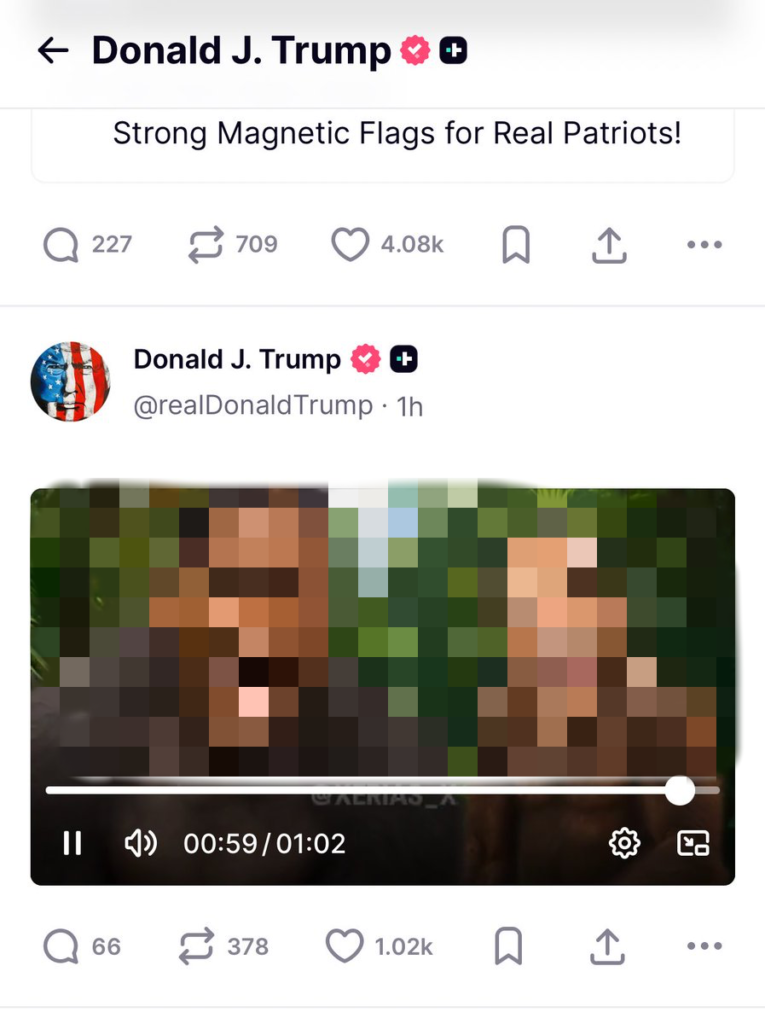
To people superise, this is not from anonymous online spray or Meme bloggers; It comes from Donald Trump.
This is a short video produced by AI, with exaggerated visual effects and absurd plots. This kind of content seems to attract attention rather than cause thinking. The comment area was quickly brushed – smiling, forwarding meme, People regard it as daily entertainment. But this “joke” itself is not neutral. In the surface, it has some political expressions, but in fact it borrows the long-standing racist image and packages it into a seemingly casual or even unharming video. When this happens, the line between humor and injury becomes blurred.
This leads to a broader question: in today’s network culture, what happens when offensive content is seen as a laughingstock rather than a query object?
When Political Content Becomes Entertainment
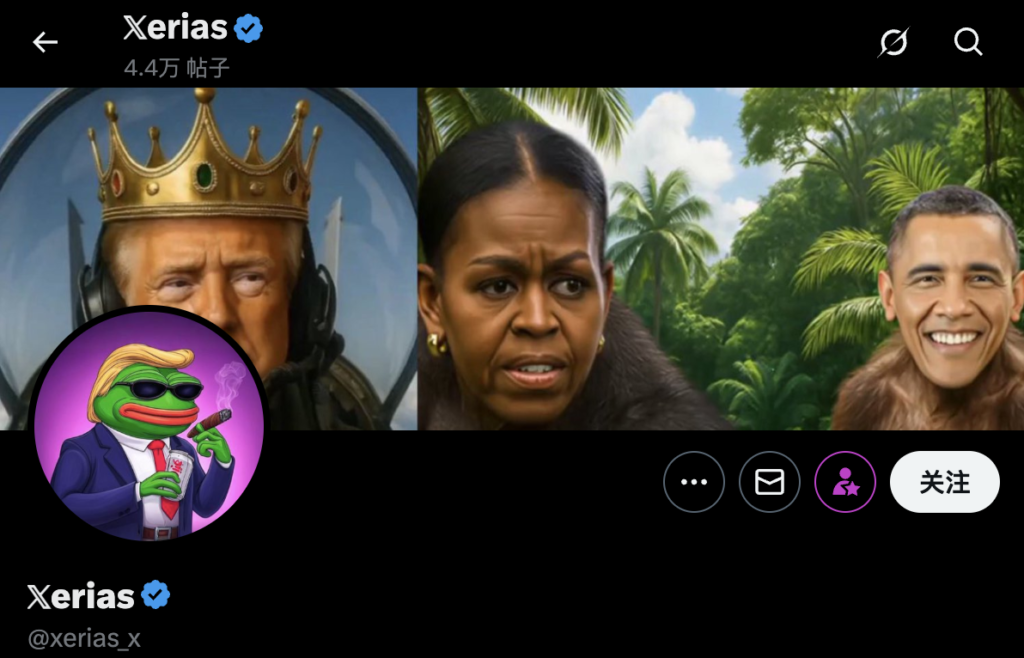
On the evening of February 5th 2026, Donald trump released a video on his Truth Social account, account, which triggered a strong public reaction. The video continues part of the trite narrative of election conspiracy theory by him and his team. However, at the end, there is a racial discrimination portrayal of Barack Obama and Michelle Obama – changing their faces into primates in the jungle. This image has a long and extremely offensive history. The post was deleted next day. However, it had already been widely shared online and attracted criticism from politicians, media commentators and civil rights organizations. What is eye-catching is not only the video content itself, but also how it is interpreted and accepted.
In the face of controversy, the Trump team initially airily called the video “internet meme video” in the email. This is not a neutral description, but a way of reshaping how the content is understood: it weakens the racist meaning in the video and packages it as a “joke” or entertainment content in daily culture, rather than political or social issues that need to be taken seriously. This method is not uncommon in the digital context.
This is important because it changes the way people view content. When harmful content is classified as “expression pack” or “just a joke”, their kernel will not become harmless. Instead, they just change the way people interact with them (Betts& Spenser, 2017). In this process, an image that might have obvious racial discrimination has instead become part of jokes and emotional reactions. Finally, the boundaries between politics, entertainment and harassment become blurred. When interaction is described as humor, people are less likely to think about the consequences of their actions. This may lead to a state of “moral detachment” (Zhu et al., 2022). Converting video into emoticon like materials does not eliminate its harm; On the contrary, it will change the way people experience and spread this harm. Harmful content will gradually lose its original context and become something that people can consume and react to at will.
Therefore, Trump’s video is not only a controversial case of political communication but also shows the way the Internet operates today: when harmful content is repackaged in the form of entertainment or humor, the damage caused by it will not disappear, but will continue to spread in a more covert way.
“It’s Just a Joke”
So, what happens when offensive content is packaged as a joke? In many cases, people no longer ask “is this harmful?” but “is this humorous?” this change seems small, but it does change people’s understanding and response to content.
Much harmful content on the Internet is not aggressive on the surface. Instead, it appears in the form of humor, irony, or exaggeration, making it feel familiar and even slightly funny (Sakki & Castrén, 2022). Once a content can be interpreted as”just a joke”, it is difficult to be taken seriously by the public. IIt also becomes harder to question whether the content is harmful, as there are always people who respond with “You have no sense of humor.” “Just a joke” often becomes a natural defense – people say offensive words without having to bear moral responsibility (Bemiller & Schneider, 2010).
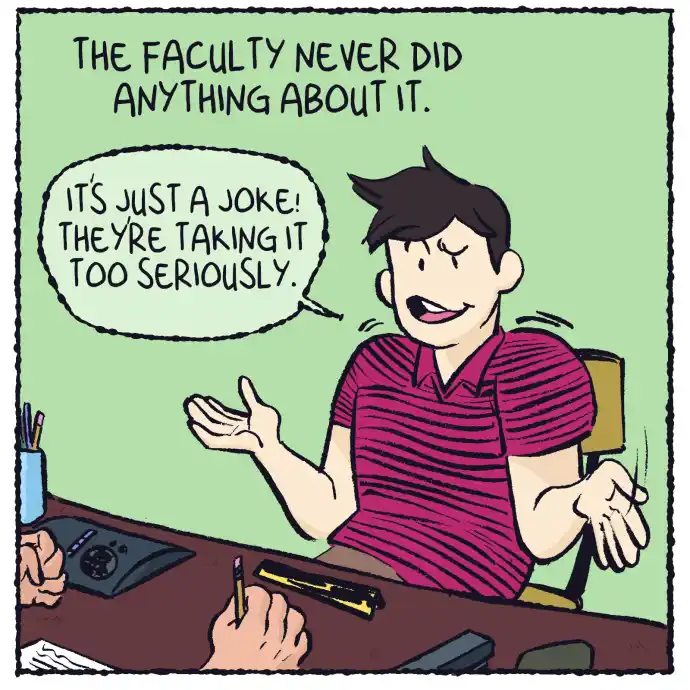
More importantly, this kind of content does not exist passively. Schwarzenegger and Wagner (2018) pointed out that humorous expressions do not produce meaning alone but form a “discursive ensemble” through the interaction of users. In this process, memes, jokes and videos may initially appear as harmless humor. Over time, they gradually gain clearer meanings through interaction. However, the individuals involved can always keep a distance from them and understand their behavior as “just participating in jokes”
Mainly, all this did not happen in a harmless environment. According to the Australian Bureau of Statistics, 70% of users have experienced negative online experiences. This means that these seemingly harmless jokes often circulate in spaces that are already full of aggression and risk. Against this background, humor does not alleviate the problem. Instead, it makes harmful expressions easier to ignore and more likely to spread (Guan & Chen, 2026).
Over time, these seemingly small interactions will gradually accumulate. Content that was once clearly considered as offensive begins to be taken for granted. This is not because the content itself has changed, but because the way people view it has changed. This is not because the content itself has changed. Rather, it is because the way people view it has changed. And this is the reason why harmful ideas continue to spread.
Viral Without Responsibility: Amplification by Platform Logics
If humor makes harmful implication easier to be ignored, then the platform also makes spread easier. Social media is not just an Internet space for users to publish content. It is more like a “filter”, constantly determining what can be seen and what is ignored. However, this “filter” is not a neutral channel, but a system designed to maximize user participation (Carlson& Frazer, 2018).
In such a system, the authenticity of the content is less important. What is matter is whether it can attract attention and how much it attracts attention. Like, comment and repost— seemingly simple interactions— are transformed into signals by the platform and further amplify the scope of content dissemination. Therefore, what gets promoted is often not the most accurate or ethical content, but the content that is most likely to trigger a reaction. For this reason, harmful content based on humor is particularly destructive (Zhu et al., 2022). They are often framed as entertainment. People like it, share it, adapt it, – often lack thoughtfulness. Importantly, these behaviors continuously feed signals back to the platform, so that the content can be further promoted.
At the same time, platform governance often fails to keep up with this spread speed. In reality, a large amount of content is released every day. Reviewing this information one by one is far beyond the scope of the software or algorithm. As a result, most of the content does not appear after the review is passed, but is published and disseminated first, and then further processed by the platform after attracting attention or being reported (Roberts, 2019). For humorous, satirical or “non-serious” content, policies often create a gray area, and harmful content can continue to spread (Matamoros-Fernández, 2017). Coupled with the non-transparent audit mechanism and the i inconsistent enforcement (Flew, 2021), many problems were not really blocked but were only “delayed”.
Similar situations are not uncommon. For example, actress Leslie Jones has been subjected to racist harassment on social media for several days. However, it was not until the incident attracted widespread attention that the relevant account was banned. This shows that the intervention of the platform often occurs after the damage has been caused, rather than before it spreads.
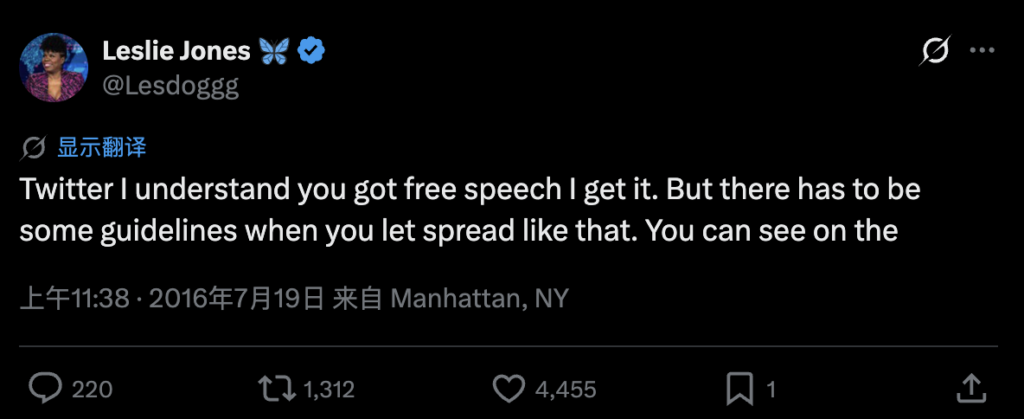
Any content can quickly become popular, but the responsibility cannot keep up. Platform dependent mechanisms – exposure, interactivity, and algorithm recommendation – inadvertently magnify such content. At the same time, the platform tools and law enforcement system for the supervision of the content unable to achieve comprehensive supervision. The combination of these two points leads to harmful expressions easier to spread and gradually penetrate into daily network culture.
Participating in the Culture
The above example shows that harmful content spreads in high-profile cases. Actually, similar developments are also reflected in daily network interactions. Massanari (2017) pointed out that in many social media platforms, most users do not know what behavior is executable through formal rules. On the contrary, they learn by repeatedly observing the behavior of others, or are influenced. This process affects the culture of the platform and may lead to the normalization of harmful behavior over time. This phenomenon can be understood as a “toxic techno cultures”, that is, a harmful cultural environment shaped by platform design, community norms and user practice.
When disparaging humor, satirical or offensive remarks frequently appear and are not questioned, they begin to be gradually regarded as part of the normal communication on the platform. What some people think is a “joke”, it may still have an exclusive or discriminatory meaning to others. Harmful expressions are integrated into the daily communication between users in this context. Similarly, the lack of obvious opposition to such content also plays an important role in this process (sinpeng et al., 2021). When harmful content is dealt with in silence, or only responded with humor and interaction, it will strengthen the impression that such behavior is accepted.
On Instagram and similar platforms, this process is especially visible in comment sections and meme-based content. Some short videos even compile “mean” or offensive comments into meme-style edits. Research shows that this kind of harm is not uncommon. 9% to 25% of users have experienced cyberbullying on the platform, and the comment section plays a central role in these interactions (Zhong et al., 2016). Many online users have already pointed out how toxic Instagram comment sections can be. In these discussions, people often try to explain why this happens: suggesting that offensive remarks tend to gain more attention, precisely because they provoke strong reactions. unkindness and mean have become the best weapon to gain popularity. People rush to show their “humor” in order to get praise, even if it toxic.
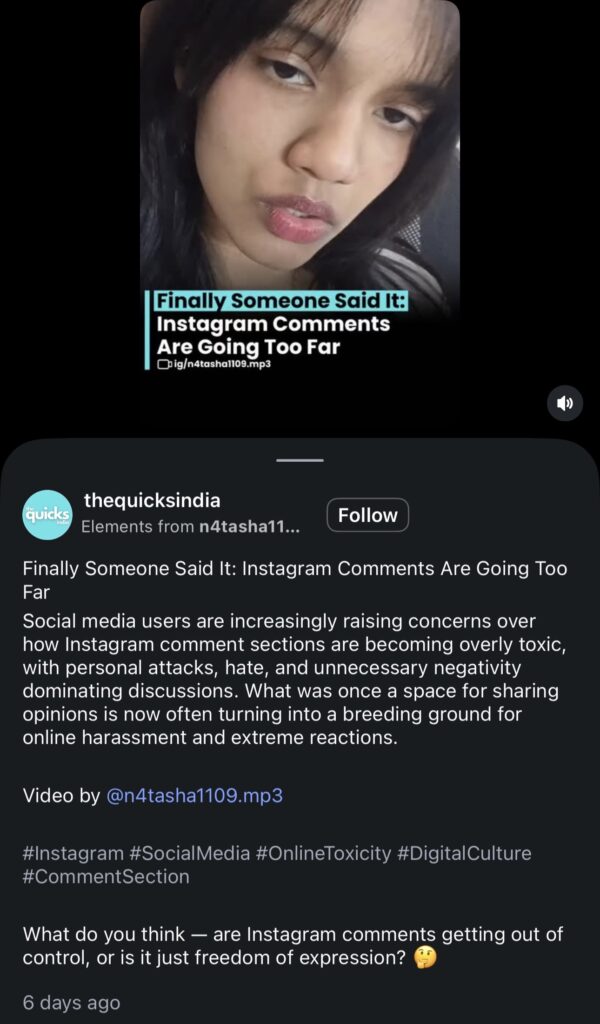
In this way, online harassment will gradually become normal. I Its continued existence stems not only from the platform regulatory visibility and user interaction, but also from the platform culture surrounding its development. Once harmful speech becomes part of the community environment, it is no longer considered abnormal. On the contrary, it has become a behavior that people take for granted and no longer consider harmful.
When harm no longer looks like harm
“There’s this sort of clown show that’s happening in social media and on television, and what is true is that there doesn’t seem to be any shame about this among people who used to feel like you had to have some sort of decorum and a sense of propriety and respect for the office, right? That’s been lost.”
— Barack Obama
Humor, or hate speech? The key question is not only whether some content is offensive, but also how people first understand them. When harmful remarks are repeatedly packaged as humor, spread across platforms, and embedded in daily interactions, they not only spread, but also change people’s perception of harm (Massanari, 2017).
The same pattern appears at different levels – including humor, platform and culture. What was once clearly identified as racism, sexism or abuse is now more likely to be ignored, shared and questioned. The line between humor and injury never disappears. It just becomes less obvious in the internet, so it is easier to ignore.
This is why such content is particularly difficult to deal with. Harmful ideas are spreading all the time. Their communication style also makes them feel familiar, attractive, and even taken for granted. In this sense, the problem lies not only in regulation or management, but also in how network culture shapes people to question or interest.
Therefore, if harmful content continues to be regarded as laughable rather than an object requiring critical review, its impact will not diminish. On the contrary, it may only become another stem of viral transmission, which is widely spread and becomes a part of daily network expression.
Reference List:
Australian Bureau of Statistics. (n.d.). Online safety. https://www.abs.gov.au/statistics/measuring-what-matters/measuring-what-matters-themes-and-indicators/secure/online-safety
BBC News. (2026). Trump says he “didn’t see” part of video with racist clip depicting Obamas as apes. https://www.bbc.com/news/articles/ce8r8y78g10o
Bemiller, M. L., & Schneider, R. Z. (2010). It’s not just a joke: Sexist humor and the production of gender inequality. Sociological Spectrum, 30(4), 459–479. https://doi.org/10.1080/02732171003641040
Betts, L. R., & Spenser, K. A. (2017). “People think it’s a harmless joke”: Young people’s understanding of the impact of technology, digital vulnerability and cyberbullying in the United Kingdom. Journal of Children and Media, 11(1), 20–35. https://doi.org/10.1080/17482798.2016.1233893
Carlson, B., & Frazer, R. (2018). Social media mob: Being Indigenous online. Macquarie University. https://apo.org.au/node/234656
Flew, T. (2021). Regulating platforms. In Digital platforms and communications policy (pp. 77–105). Polity Press.
Guan, T., & Chen, X. (2026). Threat perception, otherness and hate speech in China’s cyberspace. Journal of Contemporary China, 35(158), 1337–1352. https://doi.org/10.1080/10670564.2025.2475051
Le Monde. (2026, February 15). Obama condemns ‘clown show’ after Trump shares racist monkey video. https://www.lemonde.fr/en/international/article/2026/02/15/obama-condemns-clown-show-after-trump-shares-racist-monkey-video_6750504_4.html
Los Angeles Times. (2016, July 19). Twitter bans Milo Yiannopoulos after Leslie Jones harassment. https://www.latimes.com/entertainment/la-et-mn-twitter-milo-yiannopoulos-20160719-snap-story.html
Massanari, A. (2017). #Gamergate and The Fappening: How Reddit’s algorithm, governance, and culture support toxic technocultures. New Media & Society, 19(3), 329–346. https://doi.org/10.1177/1461444815608807
Matamoros-Fernández, A. (2017). Platformed racism: The mediation and circulation of an Australian race-based controversy on Twitter, Facebook and YouTube. Information, Communication & Society, 20(6), 930–946. https://doi.org/10.1080/1369118X.2017.1293130
Roberts, S. T. (2019). Behind the screen: Content moderation in the shadows of social media. Yale University Press.
Sakki, I., & Castrén, L. (2022). Dehumanization through humour and conspiracies in online hate towards Chinese people during the COVID-19 pandemic. British Journal of Social Psychology, 61(4), 1418–1438. https://doi.org/10.1111/bjso.12543
Schwarzenegger, C., & Wagner, A. (2018). Can it be hate if it is fun? Discursive ensembles of hatred and laughter in extreme right satire on Facebook. Studies in Communication and Media, 7(4), 473–498. https://doi.org/10.5771/2192-4007-2018-4-473
Sinpeng, A., Martin, F., Gelber, K., & Shields, K. (2021). Facebook: Regulating hate speech in the Asia Pacific. The University of Sydney & The University of Queensland.
The Conversation. (2016). Comparing Black people to monkeys has a long, dark simian history. https://theconversation.com/comparing-black-people-to-monkeys-has-a-long-dark-simian-history-55102
The Guardian. (2016, July 18). Leslie Jones leaves Twitter after racist abuse. https://www.theguardian.com/culture/2016/jul/18/leslie-jones-racist-tweets-ghostbusters
Truth Social. (2026). Post by @realDonaldTrump. https://truthsocial.com/@realDonaldTrump
Wikipedia contributors. (n.d.). Leslie Jones (comedian). Wikipedia. https://en.wikipedia.org/wiki/Leslie_Jones_(comedian)
Zhong, H., Li, H., Squicciarini, A., Rajtmajer, S., Griffin, C., Miller, D., & Caragea, C. (2016). Content-driven detection of cyberbullying on the Instagram social network. In Proceedings of the Twenty-Fifth International Joint Conference on Artificial Intelligence (IJCAI-16) (pp. 3952–3958).
Zhu, H., Ou, Y., & Zhu, Z. (2022). Aggressive humor style and cyberbullying perpetration: Normative tolerance and moral disengagement perspective. Frontiers in Psychology, 13, 1095318. https://doi.org/10.3389/fpsyg.2022.1095318
Be the first to comment