“Social media platforms cannot process all the hate speech because of the amount of it is too huge”, this might be the first impression of people towards the platforms when they deal with hate speech. So, it seems like the public can understand that some harmful content might be skipped.
During the 2024 Indian election period, Meta failed to moderate advertisements that contain hate speech towards specific groups, showing that the problem exists not only in the inappropriate content that couldn’t be deleted in time. It reveals a deeper problem that the moderation system often fails to understand the specific context of the content it reviews.
According to The Guardian’s report, researchers have submitted several political advertisements that include anti-Muslim comments, religious hatred, and even violent incitement to the platform during the election period. Some of these advertisements were approved to post. Importantly, these are not random cases. They are constructed by the existing hate speech, spread widely throughout the Indian society at that time.
This case shows that when the platform fails to identify and deal with hate speech, it may lead to more serious outcomes than we imagined. It will exacerbate the existing hostility in society and strengthen the connection between exclusion and the risk of violence in the real world. Reuters cited research data in its 2025 report that the number of hate speeches against minorities in India increased by 74% in 2024 and peaked during the election period (Singh, 2025). Therefore, this blog aims to explore why platforms face difficulties when hate speech happens in some local contexts.
Professor Katherine Gelber from The University of Queensland’s School of Political Science and International Studies suggested that the definition of hate speech should be more detailed. She said:
Facebook has made big strides in the last few years to address hate speech on its platform,” Professor Gelber said. But the main problems are firstly, it does not have enough local contextual knowledge or input, and secondly it relies on a single definition globally to flag hate content.
My argument is that the failure of the content moderation mechanism is not only because the platform operates on a large scale, or there are too few reviewers, or the artificial intelligence is not perfect. The deeper problem is that the platform is used to treat hate speech as a type of content that can be managed through fixed rules and standardised processes. In fact, hate speech is always related to specific languages, history, religious conflicts, identity contradictions, and the local political environment closely.
Why hate speech moderation cannot be separated from context
If we understand hate speech as a fixed form of content, the problem will be much simpler. It seems that the platform only needs a list of insulting, offensive, and dangerous phrases, and then let the system automatically mark them, and finally, the reviewer makes the final decision. But the reality is not like that.
Hate speech is difficult to regulate, not only because of its large number, but also because its harm often cannot be judged by wording alone. The danger of a content often lies not only in its content itself, but also in the social environment in which it appears, the historical background behind it, the groups it targets, and how people in a specific context may understand it.
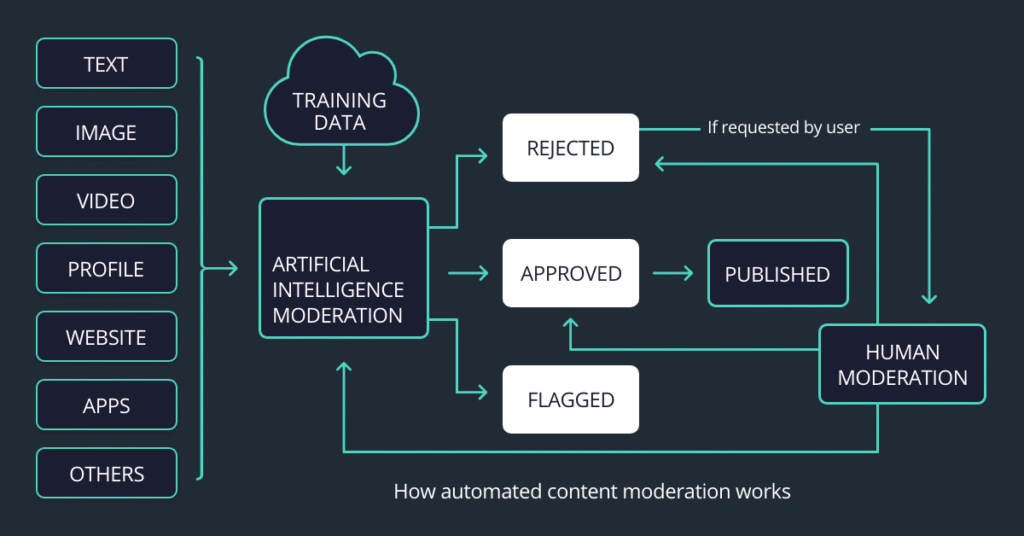
Source: (Sinha, 2024)
In Facebook: Regulating Hate Speech in the Asia Pacific, Sinpeng et al. (2021) pointed out that hate speech is closely related to language and context. The platform’s global community guidelines, classifiers, and standardised moderation system cannot fully capture the actual meaning of these comments in different regions (Sinpeng et al., 2021). In order to understand its harm, the platform needs to understand the local situation and maintain continuous interaction with the local community. In the eyes of the platform, the content of “intense expression” or “clear political views” may be completely different in the eyes of people living in this society, because they understand the usage of these words in real life and the possible consequences. For them, this may not be an ordinary difference of opinion at all, but a clear exclusion and threat.
Sarah Roberts (2019) also shows a similar point. Content moderation is not just a technical classification work, but a judgment process that needs to consider the nature of the content, the intentions behind it, possible consequences, and cultural significance (Roberts, 2019). The reason why these decisions are difficult is not because of the carelessness of the reviewers, but because the meaning of the content largely depends on the local context.
Roberts (2019) also emphasised that human moderators need to have language skills, cultural knowledge, and an in-depth understanding of the rules of the platform in order to make relatively appropriate decisions.
This is also why the moderation of hate speech cannot be simply concluded. Many dangerous contents are not easy to identify. Some messages do not contain obvious insulting words at all, but continue to portray a group as dangerous, mean, suspicious or unworthy of equal treatment through hints, labelling, historical allusions, satire, or words that “everyone knows what it means”.
Guan and Chen (2025) provide an effective way to understand this: hate speech is often not simply about offending people but constructing certain groups into threats to complete “othering” (Guan & Chen, 2025). Therefore, the real question is not only whether the platform has deleted the contents, but also whether the platform can really understand the harm caused by these contents in a specific local environment.
What Exactly Did Meta Fail to Understand?
Meta’s failure in advertising moderation during the 2024 Indian election is a direct case of such problems. According to The Guardian, political advertisements submitted by researchers contain anti-Muslim remarks, religious hatred and incitement to violence, but many of them are still approved (Ellis-Petersen, 2024). Meta’s negligence lies not only in some obviously insulting remarks but also in ignoring a dangerous narrative structure that has gradually grown in the local political environment.
This case happened during the national election. The political situation was highly tense, and public sentiment was actively mobilised. The election itself is a time when the polarisation of group identity, thinking, and emotions is rapidly intensifying. When religious identity, nationalism, and political competition happen together, the content that seems to be a political expression may actually accelerate social exclusion and hostility.
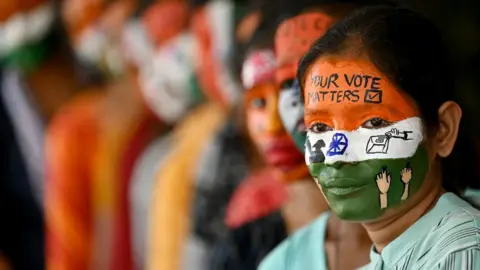
Source: (BBC, 2024)
The BBC later cited data from the Indian Hate Laboratory to report that the number of hate speech against minorities in India in 2024 increased by 74% compared with the previous year, most of which were aimed at Muslims, and the peak occurred during the election (Sebastian, 2025). Therefore, Meta’s moderation occurs in a tense, polarized, and dangerous public situation, which should be processed differently in a neutral environment.
From this perspective, Meta’s moderation failure is to understand the actual meaning of the words in the advertisement under a specific local context. The platform may regard them as ordinary political propaganda, exaggerated rhetoric, or slightly controversial content. But in the local context, this information has been closely related to anti-Muslim arguments, religious hostility, and actual harm to specific groups.
Why Platforms Fails in a Context Like India?
If we regard this case as just an ordinary moderation mistake, the problem does not seem to be big: the system failed to block some advertisements, and the platform only needs to improve the rules next time. But the more important question is, why does this happen in such an obviously high-risk environment? Meta is not just a misjudgment of a few contents. It fails to realise why these advertisements pose a danger against the background of political polarisation and high sensitivity to religious identity.
Firstly, platforms often focus on words, while local politics relies on narratives. In the context of the Indian general election, the real crisis is often not just a few words, but a series of well-known, widely recognised and repeated hate narratives.
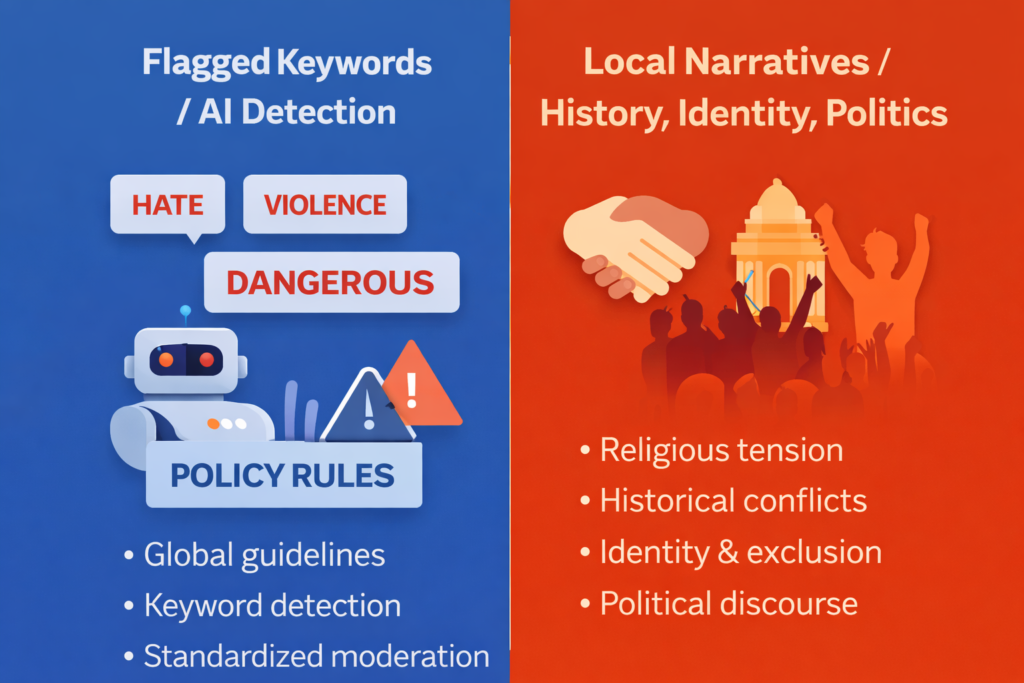
Advertising looks like political propaganda on the surface, but in fact it may repeat a deeper message: a group is dangerous, suspicious, or a threat to the country or the majority of people. The Guardian’s investigation clearly shows this. Meta-approved ads are based on anti-Muslim hate narratives and forms of political mobilisation that already exist in India. This also coincides with Guan and Chen’s (2025) argument that hate speech usually plays a role by portraying certain groups as a threat, which is exactly how “othering” works.
Moreover, the one-size-fits-all moderation model is difficult to work in a highly politicised local environment. Platforms usually try to manage the harm of speech around the world through a set of global standards. But the degree of harm of hate speech is not uniform. Content that doesn’t seem to matter in other places may cause real group conflict, discrimination, and even violence in certain contexts.
Sinpeng et al. (2021) indicate that hate speech relies highly on language and context, and the global community guidelines and the classifiers cannot fully capture the risk locally. To understand the types of hazards involved, the platform needs to understand the local situation and maintain continuous interaction with the target community (Sinpeng et al., 2021). Professor Gelber mentions that the government should also be involved to change this situation:
But because so much occurs on privately run platforms, what is needed right now is a multi-layered approach where users, community organisations, the platforms and government all play a role in mediating and remedying harmful speech online. We are hoping to raise awareness of the scope and scale of the problem in the Asia Pacific region.
At the same time, the platform cannot be a neutral judge, as they own the power to decide what content can be seen and which content is considered harmful. Matamoros-Fernández (2017) demonstrates the concept of “platformed racism,” which highlights that the racism on the platform is not only caused by users but also contains other factors. The design, algorithms, policies, and governance practises of the platform will also amplify, generate, and cover up racist remarks (Matamoros-Fernandez, 2017). In the case of India election, this means that once Meta approves these advertisements, it not only fails to prevent the spread of harmful content, but also helps these content enter a wider visible space. Ritumbra Manuvie, a law professor at the University of Groningen in the Netherlands, believes the platform should strength its oversight, otherwise:
The platforms are earning money off of this. They are benefiting from it, and the whole country is paying the price.
Why This Matters Beyond India
The case reveals a broader and deeper problem in platform governance. As long as the platform continues to use standardised moderation logic to deal with hate speech with regional characteristics, they are doomed to fail elsewhere.
Sinpeng et al. (2021) pointed out this problem. They believe that the meaning and harm of hate speech are closely related to language, culture and context. Without sufficient local knowledge and continuous interaction with target groups, the platform cannot truly understand its harm (Sinpeng et al., 2021). India’s case clearly shows this problem: elections, religious identity, nationalism and hate speech are intertwined, but the platform still fails to identify the risks.
This means that the problem is not only that the political environment of a country is extremely complex, but also that there are structural limitations on platform governance itself. As Roberts (2019) reminds, content moderation is never a simple technical selection, but a process involving language ability, cultural knowledge and social judgement.
As long as the platform continues to believe that moderation can mainly be solved by scaling, automation and general standards, they will continue to encounter trouble in such a context-dependent environment.

This is also the reason why this case will lead to broader governance issues. The key to the problem is not only why Meta made the wrong decision at that time, but also whether the platform takes local risks seriously, invests enough resources to improve language and cultural capabilities, and takes more systematic responsibility for the foreseeable damage. Instead of just focusing on whether a specific content should be deleted, it is better to explore whether the platform is responsible for its design selection, moderation process, resource allocation, and risk management.
References
BBC. (2024, April 11). India election 2024: When are they, why do they matter and who can vote? Www.bbc.com. https://www.bbc.com/news/world-asia-india-68678594
Ellis-Petersen, H. (2024, May 20). Revealed: Meta approved political ads in India that incited violence. The Guardian. https://www.theguardian.com/world/article/2024/may/20/revealed-meta-approved-political-ads-in-india-that-incited-violence
Guan, T., & Chen, X. (2025). Threat Perception, Otherness and Hate Speech in China’s Cyberspace. Journal of Contemporary China, 1–16. https://doi.org/10.1080/10670564.2025.2475051
Klepper, D., & Pathi, K. (2024, May 2). As India votes, misinformation surges on social media: “The whole country is paying the price.” AP News. https://apnews.com/article/india-election-misinformation-meta-youtube-703a56c73f9341393f05400ea218b87d
Kulkarni, D. (2025, January 14). Mark Zuckerberg’s Controversial Statement : मार्क झुकेरबर्ग यांच्या अडचणी वाढणार; भारताची संसदीय समिती मोठं पाऊल उचलणार. Politics News on Sarkarnama. https://sarkarnama.esakal.com/desh/mark-zuckerberg-india-parliamentary-action-dk88
Matamoros-Fernández, A. (2017). Platformed racism: the mediation and circulation of an Australian race-based controversy on Twitter, Facebook and YouTube. Information, Communication & Society, 20(6), 930–946. https://doi.org/10.1080/1369118x.2017.1293130
Roberts, S. T. (2019). BEHIND THE SCREEN : content moderation in the shadows of social media. Yale University Press.
Sebastian, M. (2025, February 11). India Hate Lab: Anti-minority hate speech up 74% in 2024, says report. BBC News. https://www.bbc.com/news/articles/cpwx9942x72o
Singh, K. (2025, February 10). Anti-minority hate speech in India rose by 74% in 2024, research group says. Reuters. https://www.reuters.com/world/india/anti-minority-hate-speech-india-rose-by-74-2024-research-group-says-2025-02-10/
Sinha, D. (2024, June 7). Content Moderation: What is it and why your business needs it | TechAhead. TechAhead. https://www.techaheadcorp.com/blog/content-moderation/
Sinpeng, A., Martin, F., Gelber, K., & Shields, K. (2021). Facebook: Regulating Hate Speech in the Asia Pacific. https://ses.library.usyd.edu.au/bitstream/handle/2123/25116.3/Facebook_hate_speech_Asia_report_final_5July2021.pdf?sequence=3&isAllowed=y
The. (2021, July 5). Regulating hate speech in the Asia Pacific. News; The University of Queensland. https://news.uq.edu.au/2021-07-05-regulating-hate-speech-asia-pacific
Be the first to comment