Griefbots promise comfort by recreating the dead through AI. But behind that promise lies a harder question: who owns a person’s data, voice, and digital identity after death?
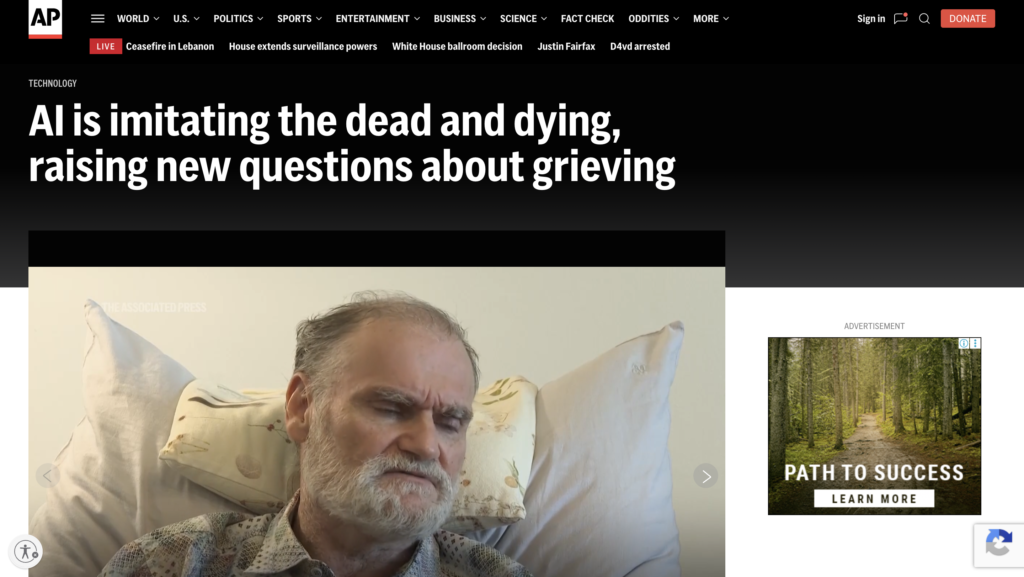
There is a view that people think that death will end the conversation. But electronic life will not end easily. Mobile phones save voice memos, chat software saves thousands of messages, and social media stores photos, videos and other voice records. Therefore, sadness also spread to the platform. Some artificial intelligence technologies have been developed to turn them into interactive systems, and these systems act like the wreckage that has left. It is crucial because its change is to change the view of mourning and what can be done with such traces.
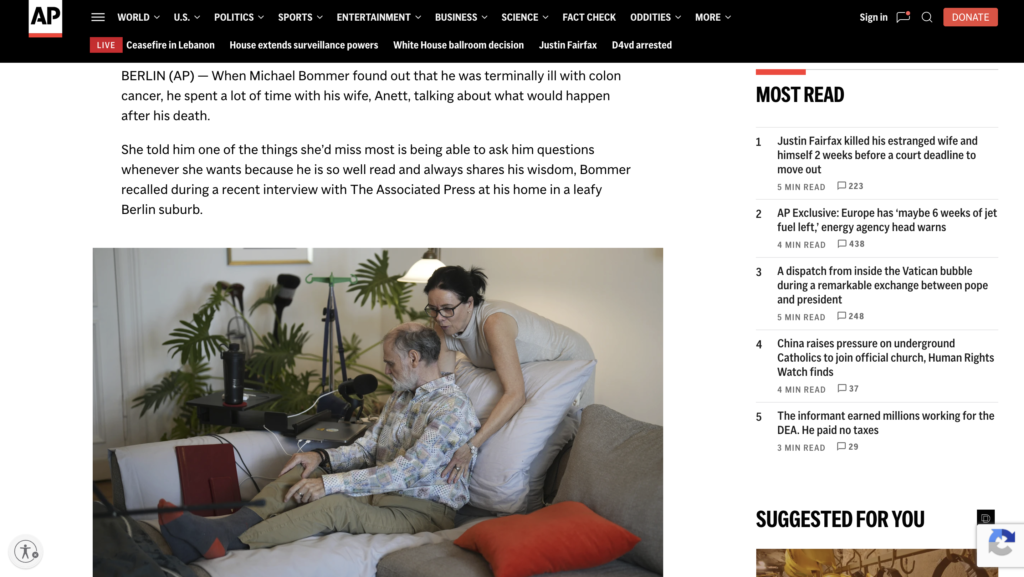
One of the latest cases can explain why it has become not a hypothetical situation anymore. In 2024, Michael Bommer chose to record his voice and create an AI version of himself because his family would need it after his death (Associated Press, 2024). The case is read gently, and thus it should be noticed. Bommer had made his choice based on a personal and voluntary decision. However, it also illustrates the broader policy issue. Once a voice with many memories is added into a system, it no longer stays in the history of one family. What is perceived as a consolatory measure by one family can quickly become a much more significant concern regarding consent, privacy, and power of the platform.
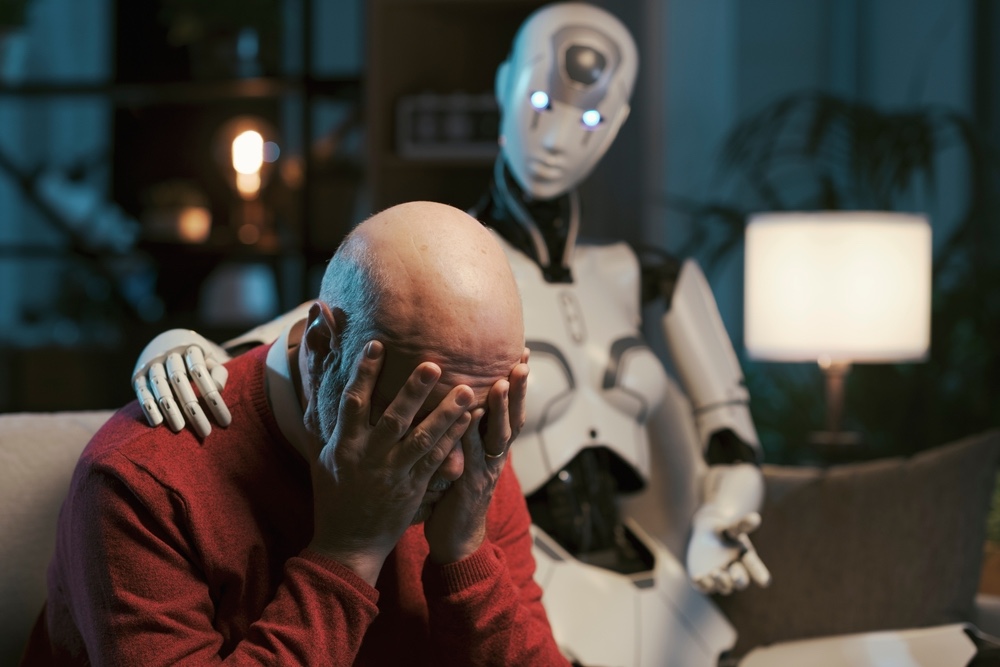
What exactly is a griefbot?
A griefbot is an AI system that can be built to simulate a deceased person based on their online identity. It could utilize messages, voice records, pictures, videos or social media posts in order to generate familiar responses. That is why the griefbot is not just an ordinary chatbot. By contrast, a regular chatbot provides information or does a job. A griefbot attempts to restore tone, memory and personality. Its aim is to prolong a relationship beyond death. The problem is not that AI could duplicate a voice or the manner of speaking. The problem is that it can transform personal traces into an interactive experience that appears to continue the social engagement of the dead.
Griefbots are a governance problem as well as a new product. Privacy is situational, it is not only determined by whether the information is accessible to all or restricted to a particular group (Nissenbaum, 2018). That is important in this case. The messages, voice recordings, and family photos were not meant to be used in the future by an AI system to read out in the voice of the deceased. These online platforms are also prone to establish regulations prior to any comprehension of the outcomes of them by the masses (Suzor, 2019). Griefbots are part of such a trend. They give data a new role. They also pose issues of consent, ownership, dignity and who controls the decision on what happens to a person’s digital identity after their death.
The Michael Bommer case: comfort, consent and unease
The case presented by Michael Bommer allows understanding of griefbots due to its being concrete and personal. According to the Associated Press report, in 2024, there was a man named Bommer in Berlin, who died of terminal colon cancer. Following numerous discussions with his wife regarding the events that would follow his death, he elected to record his voice and assist in creating an AI model of himself. His family would then have the opportunity to communicate with such a version when he was no longer around (Associated Press, 2024). This case is important as it was not hidden, accidental, and not imposed by a company. It was a conscious decision that was made prior to death.
On the surface level, the appeal is simple to comprehend. The choice made by Bommer might appear to be kind instead of disturbing. It may be viewed as the last present given to his family in the era of fear and loss. The griefbot can provide consolation because it provides a familiar voice within reach. That is why this case cannot be considered as weird.
It explains why some individuals may desire such technology. In certain circumstances, the griefbot could also seem to be less of a product and more of a bid to cushion the ultimate nature of death.
Nevertheless, this warmth cannot solve the more difficult questions. An individual can consent to record his/her voice, but this is not a solution to how an AI rendition of them will sound, evolve, or persist. Information is contextual, and Bommer recorded his voice on the family situation, so it is not an objective technical situation (Nissenbaum, 2018). Companies and platforms commonly establish terms of use prior to the population observing the effects (Suzor, 2019). Here, not only the risk of privacy loss is at stake. It is that grief is managed by a system, personality may be distorted, and the boundary between remembrance and artificial presence of someone begins to vanish.
Why this is a privacy and digital rights issue
The case becomes a privacy issue once the ownership of Bommer’s voice and its original purpose come into question. Privacy is situational rather than secretive (Nissenbaum, 2018). That is important to consider. A voice recording, a personal message, or a family picture is not always perceived the same way in different environments. These materials might start as part of an intimate personal relationship, but then they can be transferred into a technical environment which allows them to serve a new purpose. This is not about data surviving death. The problem is in how griefbots transfer personal traces across contexts and this shift changes the meaning of such traces and their application.
This change is also problematic in terms of consent. People may agree to leave recordings without meaning that every subsequent usage is fair or justifiable. An AI system has the capacity to combine, repeat and rework the material in forms that no human being ever thought possible before. There is also an unresolved situation with the family. Family members may think that they are preserving memories, but their actions are also a form of making choices on behalf of individuals who cannot refuse them. That is why the concept of data reuse is significant. It is not about whether it is possible to get the old data. It is about how that data transforms into a mechanism that still is active and speaks and responds in the life of the living persons.
In this sense, griefbots should be considered as a problem of the rights of digital beings, but not a domestic issue. They make people think about dignity, identity and control in death. Digital voice is more than just data. It is also the way a person is recalled and portrayed. When platforms or companies are able to choose what becomes of that voice then they take control over identity itself. Griefbots make mourning a governance issue. The issue of who has the privilege of establishing a person’s digital afterlife and who gains through such a decision is raised by them. They also bring up the issue of how it is possible to protect the deceased when they are no longer capable of advocating their cause.
From memorial to market
Although the Bommer situation seems confidential, it is not a confidential case anymore after some time. When griefbots are made visible, they can be used by others as examples. Talk of deathbots has increased as an increasing number of people experiment with AI models that replicate the deceased. A famous case was that of Joshua Barbeau who used GPT-3 to simulate text messaging between him and his deceased partner Jessica (Milmo, 2024). It received media coverage since it demonstrated how effortlessly an intimate memory could be translated into a roboticized interaction. To put it another way, griefbots have ceased to be the prerogative of one family. They are becoming a repetitive pattern of how AI can be integrated in mourning.
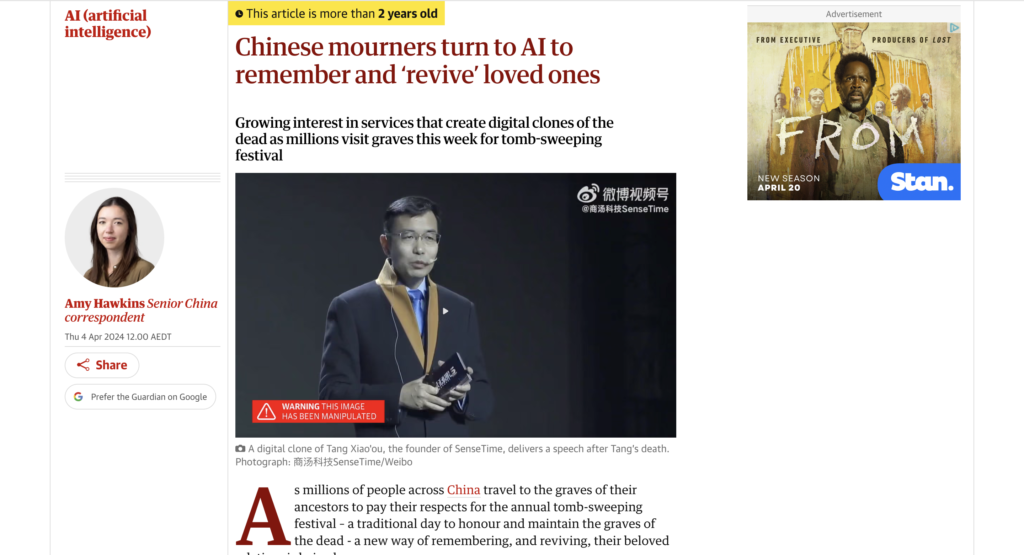
When griefbots are introduced to the market, the question becomes more acute. In 2024, a Guardian article on the Chinese Qingming Festival revealed that AI resurrection services were already being advertised to people wishing to access digital representations of deceased relatives (Hawkins, 2024). The services are advertised as providing consolation, yet they also transform grief into a consumer good. Then it becomes possible to package, price and scale loss. AI does not only mean an instrument. It is also impacted by data, infrastructure and power (Crawford, 2021). Such a description is closely related to griefbots when remembrance begins to pass through the paid services and platform design.
A griefbot could be viewed as a personal endeavor to recall someone, but it easily turns into a component of a larger platform logic. As soon as mourning is formalised by a service, design decisions begin influencing the form of memory access, duration of the interaction and types of presence that are maintained. This transition becomes more apparent with the digital afterlife industry (Hollanek & Nowaczyk-Basińska, 2024). Not only emotional discomfort is the issue. The issue is that personal recollection may turn into product design. By that point, grief is not just experienced. It is managed, organised and possibly commercialized.
Who should set the rules for the digital dead?
As of now, the main issue is not whether griefbots can be developed. The critical question is whose role it is to define the boundaries. Families might think that they ought to make the choice since they are the nearest to the deceased. Companies might think that they have the choice as they create the devices. But these viewpoints alone cannot be taken into consideration. According to Suzor (2019), digital platforms tend to establish regulations before people fully comprehend what is at stake. In case companies are permitted to determine the duration of activity of the griefbot or what data it can access or how it speaks, then they do not provide a service. They define the conditions of the digital afterlife.
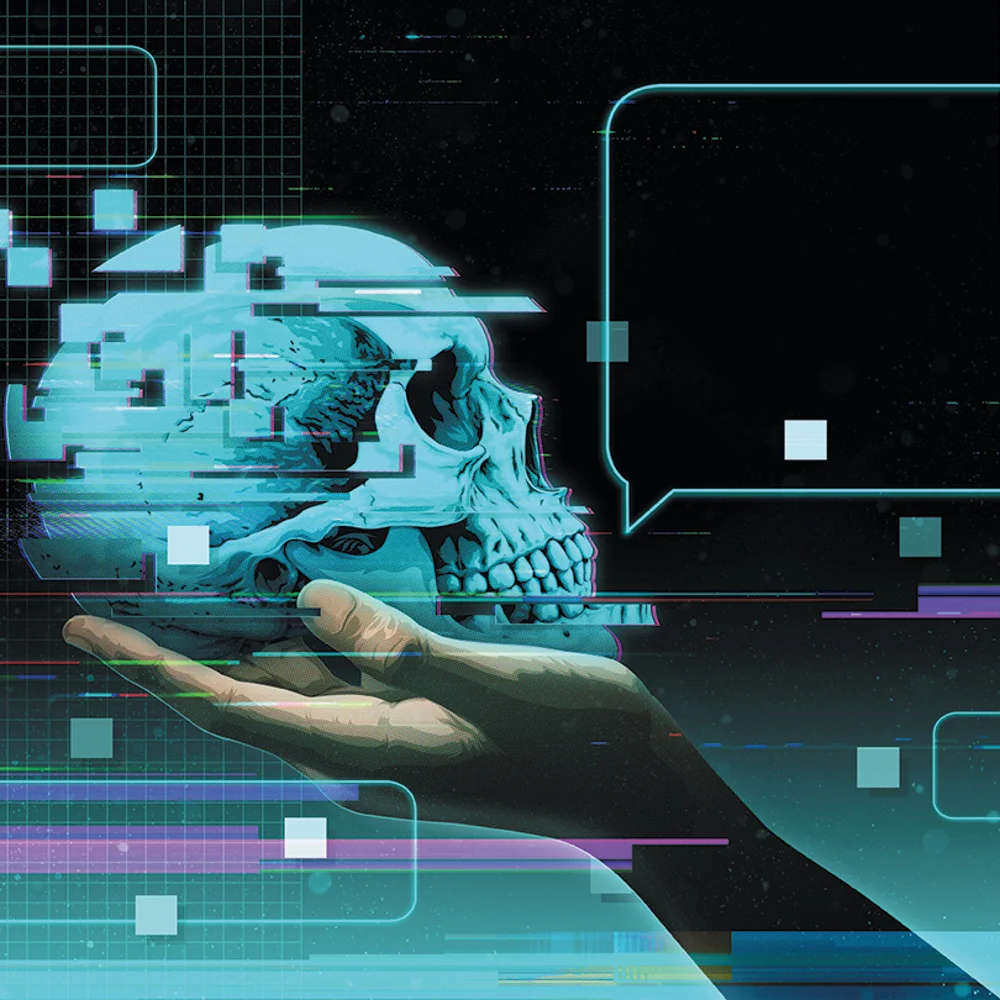
but also about who controls the digital presence of the dead. Source: Scientific American.
Deathbots can be used to do more than just comfort users that are grieving. They have the potential to also make emotional and social adaptation to loss challenging (Lindemann, 2022). This point is important because the griefbots are not merely memory preservers. They are able to sustain a person in their social presence in such a manner that affects the manner in which the living mourn. It is therefore not a question of whether a system appears comforting in the short term. It is a question of whether it produces dependency, disorientation or the feeling of being compelled to interact. At such times, a griefbot stops being a passive memory machine and starts challenging the concepts of responsibility, damage and what platform design means.
One possible solution is to start with clearer boundaries. Unless the deceased has explicitly agreed before his death, the artificial intelligence data of the individual’s corpses shall not be reused. Relatives can’t have unlimited access to data because of sadness. The company also needs to explain what data to use, how to train the system, when it can be used, and how to turn it off. It belongs to governance decision-making. The sad robot shows that memory, identity and mourning will be affected by the power of the platform. Since the dead can continue to speak through artificial intelligence, there should be a law to protect dignity, because people can’t leave the decision to the company’s whims.
What griefbots force us to confront
The sad robot is crucial because it shows that death does not equal the end of the data, and the data is not fixed. When voice, message history or home photo collection is entered into the artificial intelligence system, the memory becomes dynamic and is easily affected by various applications. So the problem is much more serious than a single moving case or a single family solution. The sad robot is not only a source of comfort. They are also devices that redefine the concepts of social relevance of consent, privacy, identity and sadness in the platform era.
Therefore, the real question is not whether artificial intelligence can reproduce the dead. The real question is who should have this ability and what are its limitations? If society allows companies to make such a decision, sadness, memory and digital identity will increasingly rely on product design rather than social values. This is a better response to start with clear consent, reducing data use, and improving the dignity of the dead. When the dead can communicate with the world with the help of artificial intelligence, it is necessary to supervise the protection of memory and the living.
References
ABC News. (2024). Cancer patient uses AI to help family remember him [Video]. YouTube. https://youtu.be/NKJv8pcbXKw?si=tOBhMfUXFf9d5axA
Associated Press. (2024, June 4). AI is imitating the dead and dying, raising new questions about grieving. AP News.https://apnews.com/article/ai-death-grief-technology-deathbots-griefbots-19820aa174147a82ef0b762c69a56307
Crawford, K. (2021). The Atlas of AI: Power, politics, and the planetary costs of artificial intelligence. Yale University Press. https://doi.org/10.12987/9780300252392
Hawkins, A. (2024, April 4). Chinese mourners turn to AI to remember and ‘revive’ loved ones. The Guardian. https://www.theguardian.com/technology/2024/apr/04/chinese-mourners-turn-to-ai-to-remember-and-revive-loved-ones
Lindemann, N. F. (2022). The ethics of “deathbots.” Science and Engineering Ethics, 28(6). https://doi.org/10.1007/s11948-022-00417-x
Milmo, D. (2024, June 15). ‘I felt I was talking to him’: Are AI personas of the dead a blessing or a curse? The Guardian. https://www.theguardian.com/lifeandstyle/article/2024/jun/14/i-felt-i-was-talking-to-him-are-ai-personas-of-the-dead-a-blessing-or-a-curse
Nissenbaum, H. (2018). Respecting context to protect privacy: Why meaning matters. Science and Engineering Ethics, 24(3), 831–852. https://doi.org/10.1007/s11948-015-9674-9
Suzor, N. P. (2019). Who makes the rules? In Lawless: The secret rules that govern our digital lives (pp. 10–24). Cambridge University Press.
Hollanek, T., & Nowaczyk-Basińska, K. (2024). Griefbots, deadbots, postmortem avatars: On responsible applications of generative AI in the digital afterlife industry. Philosophy & Technology, 37(2), Article 63.https://doi.org/10.1007/s13347-024-00744-w
Be the first to comment