
A story we have heard before —— and cannot ignore
She was a doctor, a professional who was doing her job seriously in an environment with high pressure.
Then, she became a target.
According to a news report from The Standard, on August 1 in 2025, Dr. Shao, a 57 year old obstetrician committed suicide, jumped from the rooftop of a building in the hospital in Zhoukou, China. What began as a series of medical disputes developed into a serious online controversy, spreading rapidly across social media platforms. Short videos, negative narratives, and accusations were all over the internet, drawing in thousands of users.

At first, it seemed like another online controversy.
But, it did not stay like that.
In the following months, criticism kept developing into consistent harassment and bullying, personal attacks towards her became more and more serious. As more users joined in, they reinforced each other’s claims, causing the incident to develop. When the situation became very serious, the online environment surrounding Dr. Shao was extremely negative and toxic.
After a short period of time, she committed suicide.

Similar things like this are not strange to us recently, and I have a question in mind. If platforms say that they can regulate harmful content, why do incidents of online hate continue to develop into real-world harm?
I argue that we should not see the issues as a result of user behaviour, we should understand it as a structural problem. And the issues of definitions of harm are not clear, algorithms amplification and the limits of moderation systems make the situation go out of control.
From dispute to digital spectacle
The case of Dr. Shao started from several medical disputes she has encountered, the considered medical decisions and different understanding of responsibility have caused the disputes. However, once these issues got into the digital space, their meaning began to change.
A report from Shanghai Observer suggested that, in one of the disputes, a 22-year-old pregnant woman suffered a sudden amniotic fluid embolism. Dr. Shao performed a hysterectomy as her family agreed, successfully saving the lives of both mother and baby. However, afterwards, the patient’s family began claiming to be victims of medical malpractice online, spreading rumors that Dr. Shao had misdiagnosed and violated regulations, calling her a “murderer”.
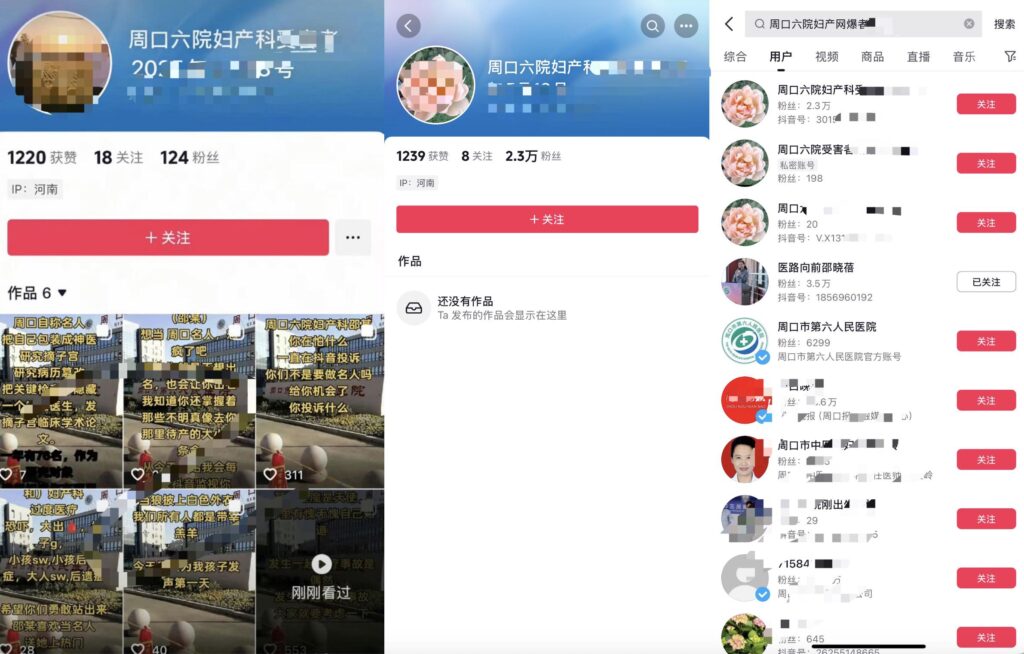
Soon, they connected with families from two other disputes. One involved a patient who refused a medically recommended caesarean section, which led to fetal death. Another concerned a child diagnosed with cerebral palsy years after birth, with the family blaming Dr. Shao. Together, these families formed a group of accusations.
In those short videos and posts, narratives were edited and truths were made up. Surgical consent forms were not mentioned, medical conditions were simplified, and false claims including the fabricated content that Dr. Shao had “killed 78 people”, and began to spread. These contents kept amplified by platform recommendation systems, and getting large numbers of views, comments, and shares.
A medical dispute was turned into a negative event online.
This change was important. At the moment the issue was exposed online, it was no longer involving medical or legal processes, visibility and engagement online became dominant. The more attention the content received, the more it spread, even if the content is not true. The platform environment reshaped not only how the event was communicated, but also how it was understood by the public.
The case of Dr. Shao has revealed the concerns and issues of platform governance.
Harmful Content Online
“Hate speech is regarded as a kind of speech that requires a policy response due to the harms it causes.” ——Sinpeng et al. (2021)
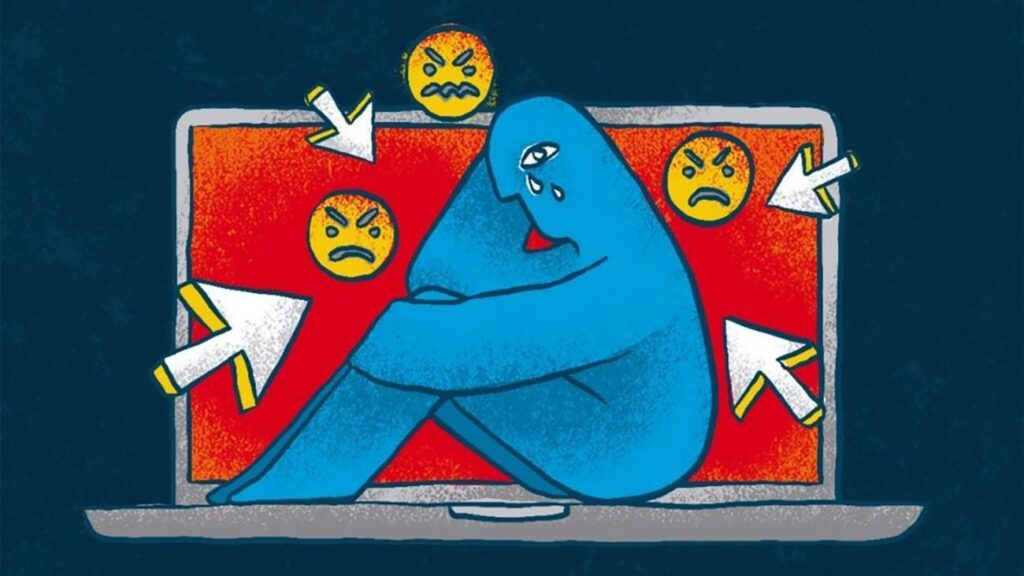
Let us understand the term of hate speech first. It can be towards a specific group, a country, a culture, and in Dr. Shao’s case, a specific individual. According to Sinpeng et al. (2021), hate speech can lead to real harm, therefore it needs a policy response. It can harm in a way that is similar to physical injury, since verbal assault might lead to physical wounds. What is more, the quick development and the characteristic of digital platforms made the issue of hate speech online an urgent and concerning issue.
Then, the question is, can the platform system successfully detect the harmful content and remove them on time?
You may think that harmful speech online is very easy to identify, but in reality, it is not the case. One of the reasons that the situation developed so quickly is because online harm is difficult to define.
The truth is, not all harmful content is obvious abuse. As Sinpeng et al. (2021) shows, hate speech is often depending on language, context, and cultural interpretation. Content that may appear neutral can still cause harm, but they are unregulated because it does not meet platform definitions which are narrow.
What is more, according to Ariadna Matamoros-Fernández (2017), in these digital platforms, they usually detect hateful content on racism, genders, religions and so on. Facebook policy mentions that humour is accepted, however, what is defined as “humour”, and to what extent is humour acceptable? As a result, many negative comments on the internet can be disguised as humour, but they can be harmful.
Ariadna Matamoros-Fernández (2017) has mentioned the concept of “platformed racism”, it talks about how harmful content on platforms is not only caused by individual users but also by platform structures. These harmful contents might look like humour, opinion, or critique so that the systems can not detect them, and they are amplified through platform systems such as sharing, liking, and system recommendation.
This can also be seen in the case of Dr. Shao. During that time, many posts were not direct threats or abusive language. In fact, they have questioned her medical skill by saying she is not a qualified doctor. These comments might be seen as criticism or opinion. When these comments repeated and spread across multiple platforms, they created a toxic environment which finally led to the tragedy of Dr. Shao.
What is more, these harmful contents are cumulative. Because a single post might be unimportant, but the exposure of similar narratives can indeed shape public perception. In the Shao’s case, users perceived a continuous chain of claims that affected one another. In the end, this circle produced a sense of legitimacy.
In this sense, the issue is not only about the content, it is about how often it is repeated, by how many users, in what broader narrative.
Amplified by design: the role of algorithms
On the one hand, the harmful content can not be detected by the platform, on the other hand, the platform’s algorithms are also making the issue a higher level.
Digital platforms are more complex than the information spreading. As Flew (2021) argues, the platforms can decide what is visible with the fact that they prioritise engagement and visibility. Content that can attract users’ attention, even if it is negative, is more likely to be promoted, recommended and perceived by more and more audiences.
It was obvious in Dr.Shao’s case. After the negative content was posted, just in a few days, short videos including narratives by the “victims”, and misleading claims were everywhere on the platforms. More and more users engaged with these posts through commenting, sharing, and liking as the content gained more visibility, causing more audiences to see these contents.
What is more, this process is also because of platform logic. According to Massanari(2017), in her analysis of Reddit, the platform’s features such as their upvoting systems and visibility rankings increase the spread of certain types of content. The content that has more users engaged, becomes more visible, allowing it to reach wider audiences. In this way, controversial and harmful content get more visibility, which causes the spread of toxic messages. Also, algorithmic systems tend to recommend content that has strong emotional reactions, including anger and outrage. Therefore, controversy becomes a form of visibility.
It helps to explain why the situation developed so rapidly. The algorithmic systems kept encouraging and recommending individual comments, and finally turned these medical disputes to a serious public controversy. These accusations were put together into a story of mutual blame, becoming a knife that hurt Dr. Shao deeply.
Therefore, we can think of online hate as not only the product of individual user’s behaviour. It is deeply shaped by how the platform works, they prioritise visibility and attention. Harmful contents would not spread this fast if there are no these processes of amplification. It means that platforms not only can reflect public opinion, they also can shape it. The platform’s algorithmic systems are deciding which voices can be heard and which information can be seen. As a result, public understanding of events and information is shaped not only by truth and accuracy, but more by visibility, which further emphasizes the harmful content.
Moderation has real limits
What is more, there is also a limitation in the moderation system, even if the harmful content can be recognized by platforms. According to Sarah T. Roberts (2019), content moderation is not all automatic, in fact, it needs humans to do the job. They are described as “commercial content moderators”, they need to go through thousands of images, texts and posts in one day. However, human intervention means that no matter how fast content moderators delete inappropriate posts, users are posting much faster and in much greater quantities. This means that moderation can only stop some of the inappropriate posts, not prevent them. Therefore, harmful content is usually only properly addressed after it has been viewed and liked by countless users.
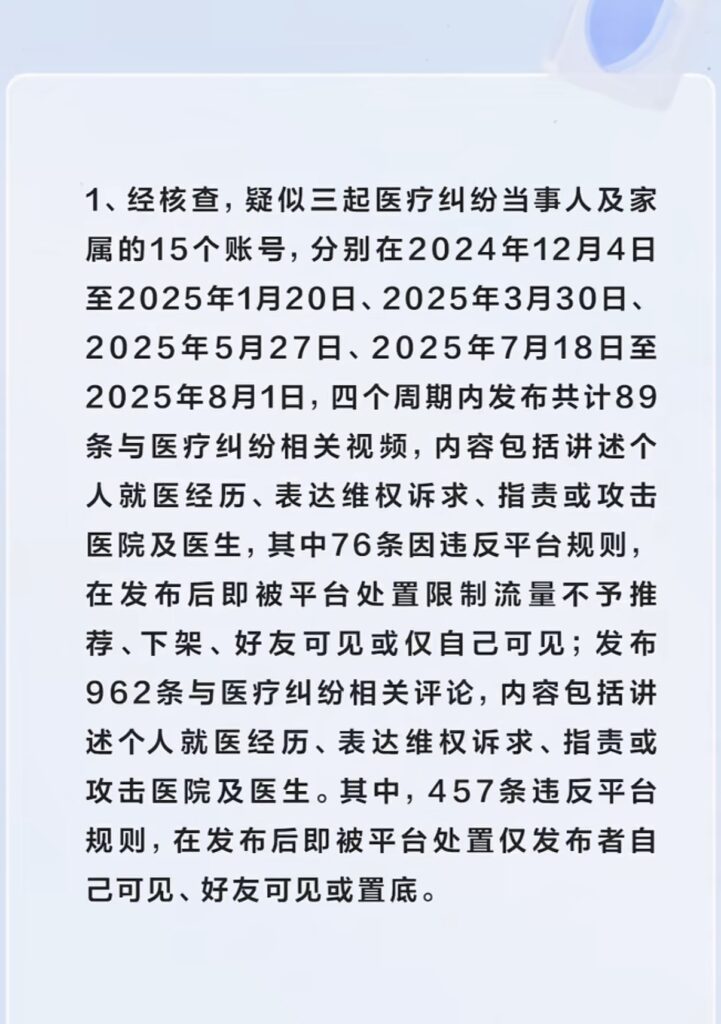
The case of Dr. Shao is in a similar situation. Dr. Shao’s case is similar. Although the platform removed the videos after identifying the content posted by those claiming to be victims, it wasn’t timely enough. According to Douyin’s announcement after the incident, 15 accounts suspected to belong to the parties involved in the three medical disputes and their families posted a total of 89 videos related to the medical disputes within four periods: December 4, 2024 to January 20, 2025; March 30, 2025; May 27, 2025; and July 18, 2025 to August 1, 2025. The videos included recounting personal medical experiences, expressing demands for rights protection, and criticizing or attacking hospitals and doctors. Of these, 76 videos violated platform rules and were immediately restricted from promotion, removed from shelves, or made visible only to friends or the user after posting. There were also 962 comments related to the medical disputes, including recounting personal medical experiences, expressing demands for rights protection, and criticizing or attacking hospitals and doctors. Of these, 457 violated platform rules and were immediately made visible only to the poster, friends, or pinned to the bottom of the page. We can see that not all posts were taken down, many weren’t even detected and successfully removed. This further confirms the platform’s governance and moderation issues.
Harmful content spreads extremely quickly, and by the time a platform reacts to it, the damage has already been done, ultimately leading to tragedy.
Conclusion
In conclusion, the case of Dr. Shao told us that online hate is not the result of individual behaviour, it is the result of digital platforms governance, their abilities to detect harmful content, and the limitation of content moderation.
These issues of concern create conditions in which online harm can lead to real and hurting consequences. In order to successfully solve this issue, we need something more than stricter rules or better moderation. It might require a deeper examination of how platforms are designed, their priorities, and how they influence public perceptions.
If digital platforms continue to develop in this way, the conditions that cause harm will persist, and similar tragedies are likely to occur again.
References
Flew, T. (2021). Regulating platforms. Polity Press.
Massanari, A. (2017). #Gamergate and the Fappening: How Reddit’s algorithm, governance, and culture support toxic technocultures. New Media & Society, 19(3), 329–346. https://doi.org/10.1177/1461444815608807
Matamoros-Fernández, A. (2017). Platformed racism: The mediation and circulation of an Australian race-based controversy on Twitter, Facebook and YouTube. Information, Communication & Society, 20(6), 930–946. https://doi.org/10.1080/1369118X.2017.1293130
Roberts, S. T. (2019). Behind the screen: Content moderation in the shadows of social media. Yale University Press.
Sinpeng, A., Martin, F., Gelber, K., & Shields, K. (2021). Facebook: Regulating hate speech in the Asia Pacific.
Jiefang Daily. (2025, August 6). Zhoukou doctor’s death highlights failures in responding to cyber violence. https://www.jfdaily.com/staticsg/res/html/web/newsDetail.html?id=959792
The Standard. (2025, August 5). Tragic death of obstetrician-gynecologist in China sparks outrage over cyberbullying. https://www.thestandard.com.hk/china/article/308319/Tragic-death-of-obstetrician-gynecologist-in-China-sparks-outrage-over-cyberbullying
Be the first to comment