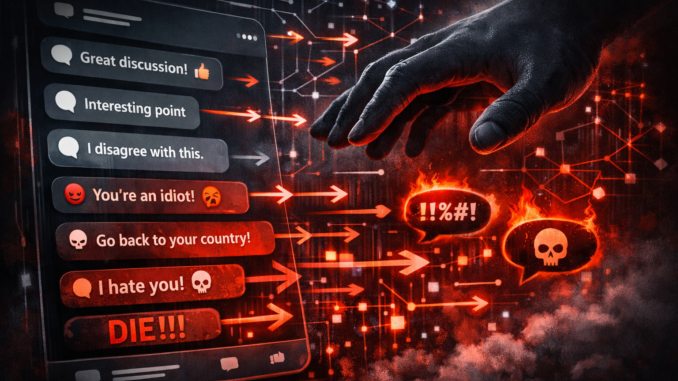
Comment sections on the internet often follow a familiar pattern. A post goes up. A few comments appear. Then something shifts. A joke lands, but it is not really a joke. It feels off, a bit hostile. Someone else joins in, and within minutes the whole conversation turns aggressive. What started as a “public discussion” quickly becomes something else entirely.
If you spend any time online, this probably feels familiar. You see it under news articles, social media posts, and videos. It happens again and again, across different platforms. And it raises a simple question: why does this keep happening?
The easiest answer is to blame users. Some users are just hateful, and online spaces seem to bring that out. But that explanation does not really hold up. When the same pattern shows up across different countries, platforms, and contexts, it is hard to see it as a series of isolated cases. It starts to look like something bigger.
Hate speech is not only the result of failed moderation. It is also shaped by the environments in which it appears. It draws on existing inequalities, takes meaning from cultural context, and is influenced by how platforms themselves are designed.
What Even Counts as Hate?
At first glance, hate speech seems easy to identify. Racism, homophobia, and abuse appear obvious enough. But in practice, defining hate is far more complicated.
Sinpeng et al. (2021) show that hate speech is highly contextual. It is shaped by local histories, languages, and political conditions.
What may seem harmless to an algorithm — or even to a moderator unfamiliar with that context — can carry a long history of humiliation, exclusion, and discrimination for the people targeted.
This creates a fundamental problem for platforms. Social media companies operate at scale. They rely on standardised policies, automated detection systems, and general categories to moderate content across millions of users. But hate does not operate in standardised ways.
As a result, there is often a gap between how platforms define harm and how users experience it.
Sinpeng et al. (2021) note that Facebook’s definition of hate speech does not capture many indirect or culturally specific forms of harm.
Content can still be labelled as “not against community standards” even when it contributes to fear, exclusion, or degradation. This is not just a technical limitation. It is a political one.
Definitions determine what counts as harm, whose experiences are recognised, and which forms of injury remain invisible. In this sense, the problem is not only that platforms fail to remove harmful content — it is that they do not always recognise it as harm in the first place.
Platforms Are Not Neutral Spaces
Another mistake in public discussion is the belief that social media are a neutral space on which people merely express their already established opinions. In such a case, platforms are just digital stages and users are the real actors. However, this perspective loses its validity the moment one truly examines its usage. Carlson and Frazer (2018) show that
Indigenous Australians’ experiences online are shaped by ongoing racism, unequal power relations, and the continuation of offline inequalities in digital environments.
Social media is not separate from society — it reflects and extends it. More importantly, platforms do not just contain harmful content. They shape how it spreads.
This is where the idea of platformed racism becomes important. Harmful content online does not remain static. It moves. It is shared, reposted, recommended, and amplified. A racist comment that might reach a small group offline can quickly circulate to thousands online. And visibility changes behaviour.
You can see this dynamic in everyday platform use, especially on TikTok. Sometimes it only takes a few interactions for your feed to change. You watch one or two videos that are a bit emotional or controversial, and suddenly your “For You” page starts filling up with more of the same.
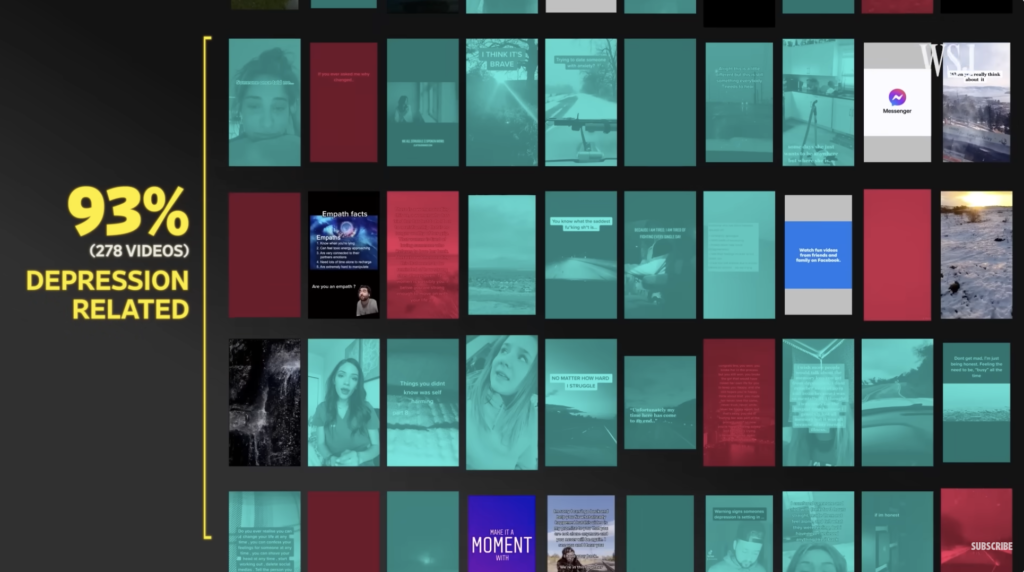
This is not just a personal impression. A widely discussed investigation by The Wall Street Journal (2021) found that TikTok can figure out what users are interested in surprisingly quickly, often based on something as simple as how long they watch a video. Over time, the content becomes more focused, sometimes moving toward more intense or potentially harmful topics.
What starts as fairly neutral browsing can quickly turn into a highly curated feed shaped by engagement. In this sense, algorithms are not simply responding to what users like; they are also reinforcing and intensifying those preferences over time.
When certain kinds of content gain attention, they signal what is acceptable. Over time, this creates a feedback loop: content that provokes strong reactions becomes more visible, and more visibility encourages more of the same behaviour.
Outrage does not simply spread, it is rewarded. As users engage with it, the algorithm learns to prioritise this kind of content and pushes it even further.
The system is not neutral. It shapes what gets seen.
When Online Hate Becomes Offline Violence
A recent example makes this dynamic much clearer. Following the July 2024 Southport attacks in the UK, many rumors were circulating online, and one such rumor was the incorrect claim that the suspect was a Muslim migrant. Reuters reported that the circulation of these false posts led to a week-long series of rioting, promoting the question of whether the social media companies need stronger regulatory measures.
What makes this case especially important is that the connection between online speech and offline harm was not simply speculative. According to Ofcom’s 2025 consultation for safety measures, the 2024 UK riots served as an example of a crisis of a crisis in which online content was then accompanied by unrest and violence throughout the country. The regulator stated that online services were used to spread hatred, provoke violence, target racial and religious groups, and encourage attacks on mosques and asylum seeker accommodation. Ofcom also noted a “clear connection” between online activity and violent disorder on UK streets.
This case matters not because social media “caused” the riots in a simple sense, but because it accelerated them. It shows that online hate is not just speech floating harmlessly in a digital space.
Platforms did not create anti-immigrant sentiment. But they allowed it to travel faster, reach further, and intensify more quickly than before. Rumours became narratives. Narratives became outrage. And outrage became mobilisation.
This is the critical point: platforms do not need to create hate, they play a central role simply by amplifying it.
Why Online Hate Is Not Just “Words”
One reason platforms have often been slow to act is that online hate is still sometimes treated as less serious than offline harm. It is dismissed as “just words” or “just comments.”
But research shows that its impact is far from trivial. Carlson and Frazer (2018, pp. 12–13) demonstrate that
online racism affects emotional wellbeing, shapes participation, and can lead to fear, exhaustion, and withdrawal.
Importantly, harm is not limited to direct targets. Repeated exposure to racism, even when directed at others, can create a sense of exclusion and vulnerability within entire communities.
Sinpeng et al. (2021) identify a related pattern in their study of LGBTQ+ page administrators in the Asia-Pacific. Many reported frequent exposure to hate speech and limited support from platforms. The authors describe a form of “reporting fatigue” (p. 4), where users gradually stop reporting harmful content because previous reports seem to have little effect.
Over time, this erodes trust. Users do not disengage because the problem disappears. They disengage because they no longer believe anything will change.

Recent data from the eSafety Commissioner (2025) supports this pattern. Individuals from targeted groups are significantly more likely to encounter online hate, and many choose not to report it because they expect no meaningful response.
Once this becomes normal, participation is no longer equal. Platforms may claim to give everyone a voice, but if speaking comes with unequal risk, that promise does not hold.
Why Users End Up Doing the Work Platforms Claim to Do
Another way to understand why online hate persists is to ask a different question: who is actually responsible for dealing with it?
Platforms present themselves as the primary regulators of online spaces. They design policies, enforce community standards, and claim responsibility for keeping users safe. But in practice, much of this work falls on users.
People report harmful content, block accounts, moderate discussions, and manage the emotional toll of repeated exposure. These actions are often invisible, yet they form the everyday reality of navigating social media. As Gillespie (2018) argues,
content moderation is not simply a technical or policy-driven process, but relies on distributed forms of labour that are often overlooked and underappreciated.
While platforms benefit from engagement and participation, users are left to enforce the rules in real time. This creates a structural imbalance. Platforms profit from attention. Users absorb the cost of harm.
This imbalance becomes especially visible when reporting systems fail. When harmful content is not removed, it does not disappear. Instead, it lingers — and users are left to deal with it themselves. For those most frequently targeted, this often means stepping back, staying silent, or avoiding certain spaces altogether.
In this sense, reporting systems are not just technical tools. They shape how users experience the platform. When reporting is slow, unclear, or ineffective, it sends a message not just about the content, but about whether users are actually being heard.
How Platforms Turn Outrage into Visibility
At this point, it becomes difficult to treat online hate as a simple failure of moderation.
If harmful content continues to circulate, gain attention, and shape behaviour, then the issue is not only that platforms are failing to remove it. It is also that the systems themselves are designed to allow, and at times even reward, its visibility.
Social media platforms are driven by engagement. Content that provokes strong emotional reactions — anger, outrage, fear — tends to generate more interaction. More interaction leads to more visibility. And more visibility encourages similar content.
This creates a cycle in which outrage attracts attention, attention trains the algorithm, and the algorithm in turn amplifies outrage. Within this cycle, harmful content is not just tolerated, it becomes structurally advantaged.
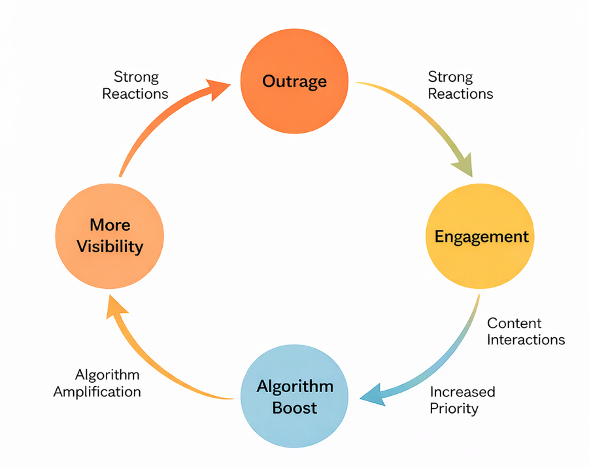
The system does not need to promote hate intentionally. It only needs to reward engagement. And because hate often generates strong reactions, it fits seamlessly into this logic.
This is how hate speech still manages to survive despite the presence of policies on moderating. Deleting certain posts will not solve the problem when there is still an infrastructure promoting such behavior.
Rethinking Responsibility
If the problem is structural, then the solution cannot rely solely on better moderation. It requires a shift in how responsibility is understood.
For a long time, discussions about online hate have focused on individual users — what they say, how they behave, and whether they should be punished. But this focus overlooks the role of platforms in shaping the conditions under which that behaviour occurs.
Platforms are not neutral intermediaries. They design the environments in which interaction takes place. They decide what is visible, what is amplified, and what fades into the background. This means that responsibility cannot be placed entirely on users.
It must also include:
- • How algorithms prioritise content
- • How policies define harm
- • How reporting systems respond
- • How platform design shapes behaviour
Without addressing these structural factors, efforts to reduce hate speech will remain limited.
Conclusion: Beyond Moderation
It is easy to think of online hate as a problem caused by bad users, but that explanation is too simple. Hate speech persists because of how platforms are structured: how harm is defined, how content is amplified, and how responsibility is distributed. This is not just a failure of moderation; it is a feature of the system.
Social media does not simply reflect society, it shapes it. In doing so, it shapes who is heard, who is ignored, and who feels able to participate at all. The question, then, is not just how to remove hate speech, but how to redesign the systems that allow it to thrive.
References
Carlson, B., & Frazer, R. (2018). Social media mob: Being Indigenous online. Macquarie University.
eSafety Commissioner. (2025). Fighting the tide: Encounters with online hate among targeted groups. Australian Government.
Gillespie, T. (2018). Custodians of the internet: Platforms, content moderation, and the hidden decisions that shape social media. Yale University Press.
Lamarr Institute. (2023). Hate speech and digital violence: How artificial intelligence can help combat hate online. https://lamarr-institute.org/blog/ai-against-hate-speech-digital-violence/
Ofcom. (2025). Consultation: Additional safety measures. https://www.ofcom.org.uk
Reuters. (2024, August 9). UK revisits social media regulation after far-right riots. https://www.reuters.com/world/uk/uk-revisits-online-safety-act-after-far-right-riots-2024-08-09/
Sinpeng, A., Martin, F., Gelber, K., & Shields, K. (2021). Facebook: Regulating hate speech in the Asia Pacific. University of Sydney & The University of Queensland.
The Wall Street Journal. (2021, July 21). How TikTok’s algorithm figures you out [Video]. YouTube. https://www.youtube.com/watch?v=nfczi2cI6Cs
Council of Europe. (2024). Systemic mapping of national responses to hate speech in Ukraine. https://pjp-eu.coe.int/ru/web/partnership-governance/-/launch-of-the-report-systemic-mapping-of-national-responses-to-hate-speech-in-ukraine-
Be the first to comment