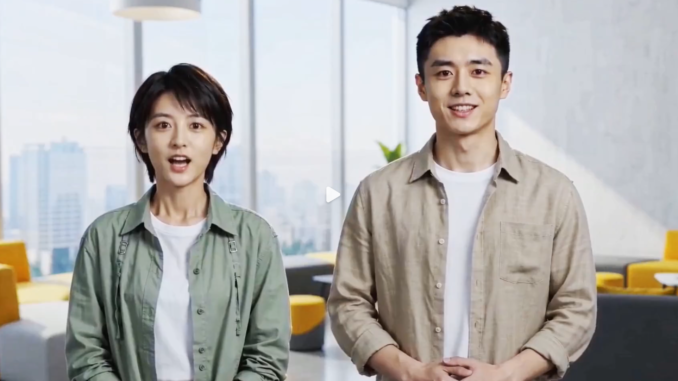
If you’re a fan of short dramas, maybe you’ve already watched one starring AI actors. Data shows that 3 of every 10 short dramas watched during the Spring Festival holiday are AI-generated.
On March 18, media giant Yao Ke Drama made a splash with its official announcement: it has signed on AI actors “Qin Lingyue” and “Lin Xiyan” to star in their upcoming AI-driven series.
Yaoke Media / Weibo
At the same time, the company has registered their social accounts on Xiaohongshu, TikTok and other social media platforms, allowing these two AI actors to share daily moments just like real human beings.
This is completely a dramatic decision. For the first time, AI actors step out of supporting roles into main performers. No matter how, the prevalence of AI in short dramas is undeniable.
This trend has a severe impact to the short drama industry. Prior to this, the income of short drama actors had already reached exorbitant levels. Top-tier human actors’ remuneration has long been skyrocketing, even can be compared to those entertainment celebrities.
A-list short drama performers can earn a daily salary of 50,000 to 80,000 yuan; an actor can gain 350,000 to 700,000 yuan per project. Such astronomical pay has become a haevy burden for small and medium-sized production companies, making it difficult for them to cover the costs.
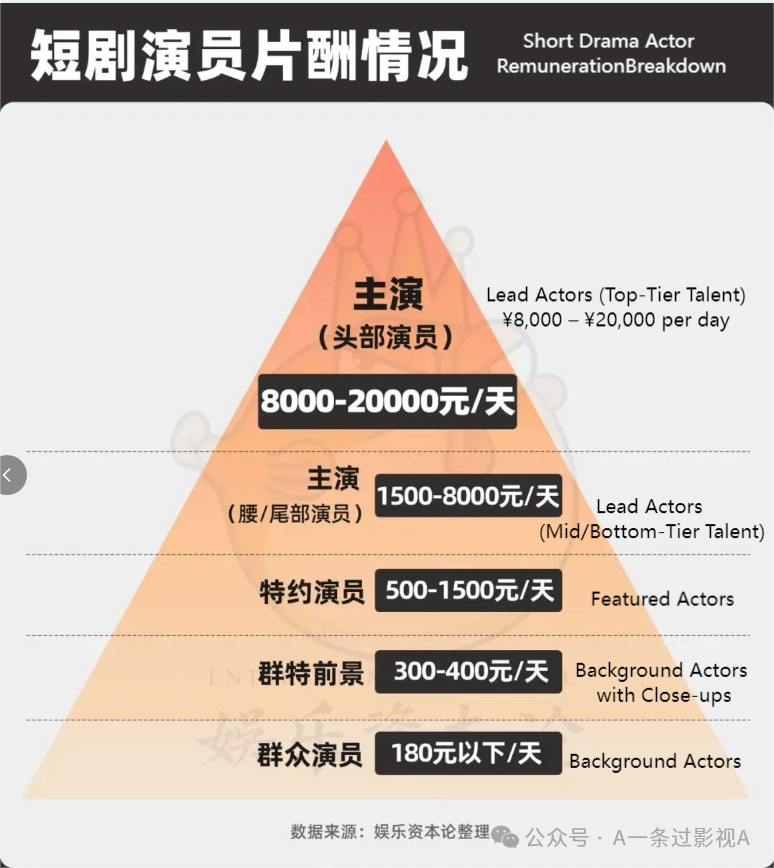
Official Account / Yitiaoguo Film & TV A
With AI’s disruption, this once-lucrative bonus seems to be fading away.
Chen Yuxi, a former short drama leading actress who used to earn 3,000 yuan per day. Now she has taken a one-third pay cut, yet still struggles to find roles.
Once-active WeChat groups for recruiting short drama actors have fallen silent, and even short drama directors have claimed that they plan to switch careers to AI-driven drama production.
It seems that AI short drama actors appear to be “killing off” human performers. But is this true? The answer is that human actors could not simply be replaced by AI in the future.
Inherent Limitations of AI Tech: Imperfect, data-based and black box
A obvious shortcoming of AI is its lack of perfection.
As Olhede and Wolfe argues:
It is not feasible to design an algorithm which is optimal with respect to all metrics at once.
This fundamental limitation becomes particularly obvious in the production of AI short dramas, where the core challenge is simulating the authentic behavior of human actors.
To replicate a convincing human performance, algorithm must account for an overwhelming array of complex variables : it should not only physical movements and vocal inflections, but also the subtle emotional changes.
Due to the limitations of algorithm design, AI is unable to optimize all variables simultaneously.
While modern AI has resolved basic technical mistakes such as generating extra fingers or distorted limbs, its limitations are bare.
When AI encounter with complex facial expression, rather than one-note feelings like simple happiness or sorrow, it may fail. A human actor can convey grief mixed with anxious, while AI can hardly simulate.

Guokr / QQ.com
These imperfections shatter the audience’s immersive viewing experience, because its artificiality feature impossible to ignore.
After all, you probably don’t want to be pulled out of your mood because of indecent expression of AI.
Another limitation of AI is that it cannot innovate beyond its fixed training data.
A similar theory was previously mentioned in Position: Universal Aesthetic Alignment Narrows Artistic Expression.
The models lack the ability to independently judge the aesthetic value of different expressions and only follow the statistical rules derived from the training data of mainstream aesthetics.
It neither has independent aesthetic sense, nor possesses original creativity.
Instead, it can only repeatedly replicate patterns within the human-provided dataset, making it extremely difficult to break out of established frameworks and create something new.
Today’s mainstream models rely heavily on photos of celebrities and internet influencers. As a result, AI-generated faces are often criticized in the industry for being generic and lacking its uniqueness.
Worse still, training data carries aesthetic bias. As mentioned in Regulating Platforms:
The data that inform decisions are often biased in terms of sampling practices… or reflect societal biases.
Most images feature refined, popular facial features, which is why plastic-like “influencer faces” are quite common in short dramas.
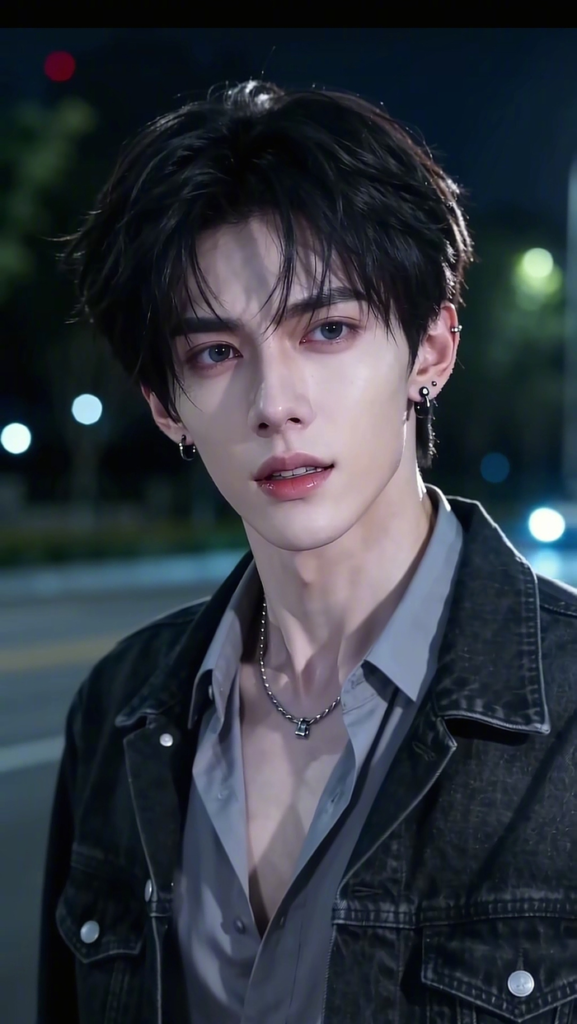
Sina Kansidian / Weibo
Almost all the main characters share nearly the same face: female with big eyes, a pointed chin, a high nose bridge, and fair skin; male with thick eyebrows, big eyes, and a high nose bridge.
Therefore, although AI can appear visually human, it fails to offer real diversity or character.
Over time, audiences easily get tired of the repetitive, uniform appearance and gradually lose interest, as they cannot connect with characters that lack individuality.
The black-box nature is a defining feature of AI, which means AI short dramas are more likely to cause copyright disputes.
As Crawford in The black box society : the secret algorithms that control money and information mentioned
“All publicly accessible digital materials——including personal privacy data or potentially damaging data——may be harvested for training datasets… When data sets are no longer personal privacy assets but merely infrastructure…”
Under such circumstances, personal data, especially that of celebrities, is no longer treated as private information but incorporated into free material databases for AI training.
Recently, cases of infringement by AI actors have emerged constantly. Moreover, the AI actors Qin Lingyue and Lin Xiyan mentioned at the beginning of this essay have been accused of resembling the actor Zhai Zilu and bearing close similarities to artists such as Liang Jie, Zhao Jinmai, and Zhang Zifeng.
Therefore, unauthorized use of AI should be further restricted, and the establishment of a sound AI accountability system is extremely urgent.
Public resistance to AI actors persists
Nowadays, a segment of the public still holds opposing attitudes toward AI actors.
Just like when AI painting first emerged, some people referred to AI-generated artworks as “corpse parts” and even insulted those who used AI to create.
Similarly, many people look down upon AI-generated short dramas, dismissing AI actors as “fake human”.
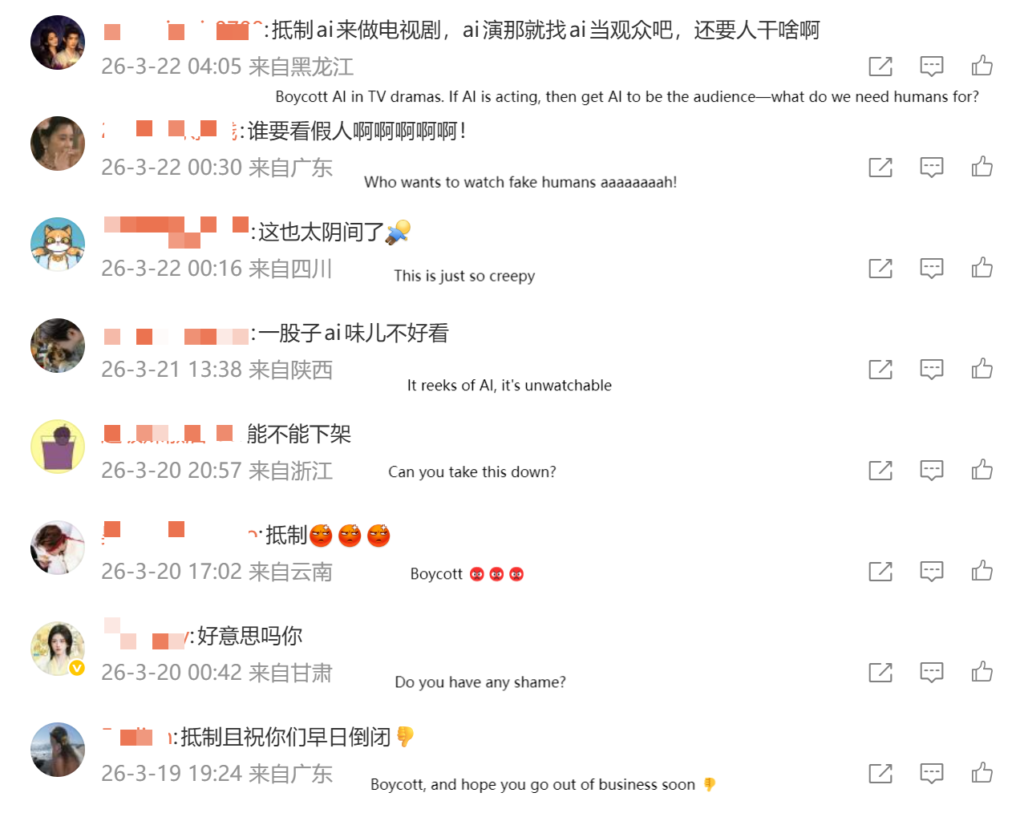
Yaoke Media / Weibo
Such emotions ultimately stem from the fact that human afraid that AI gradually deprive of their unique subjectivity.
As stated in From Robots to AI: Techno-sciences vs. Literature and Arts, Positivism vs. Humanism:
Among the few certainties mankind possessed were its unique nature and the conviction that no being but man can fulfill what is within human power. Artificial Intelligence’s ability to create artistic productions shifts the way we define being human.
When artificial intelligence is designed to mimic human traits, it may erode the unique value of human existence. Therefore, the anxiety about AI is essentially a fear of dehumanization.
They fear that technology will render insignificant the qualities that constitute human uniqueness, thereby undermining human dignity.
People’s fear and hatred toward AI are not merely because AI will replace actors’ jobs, but more that it will reduce the art of performance to a series of algorithm-generated procedures.
A commentary on AI actors from Movie Review Today points out that the reason performers like Ruan Lingyu, Jackie Chan, and Maggie Cheung are great is because they are living human beings. They struggled and grew through countless small supporting roles on set, forging a fleeting sense of fragility that not even AI algorithms can replicate.
This reaffirmation of the value of humanity precisely reveals the root of public anger.
At its core, the public’s resistance to AI actors stems from rejecting the way it negates the core value of human art, it also disregards human subjectivity.
People’s dislike to AI actors can also be explained by the Uncanny Valley theory. Mori (2012) proposed that:
As we make robots and other entities appear more human, our affinity for them initially increases. However, past a certain point, they risk appearing cold and eerie, turning our affinity into aversion.
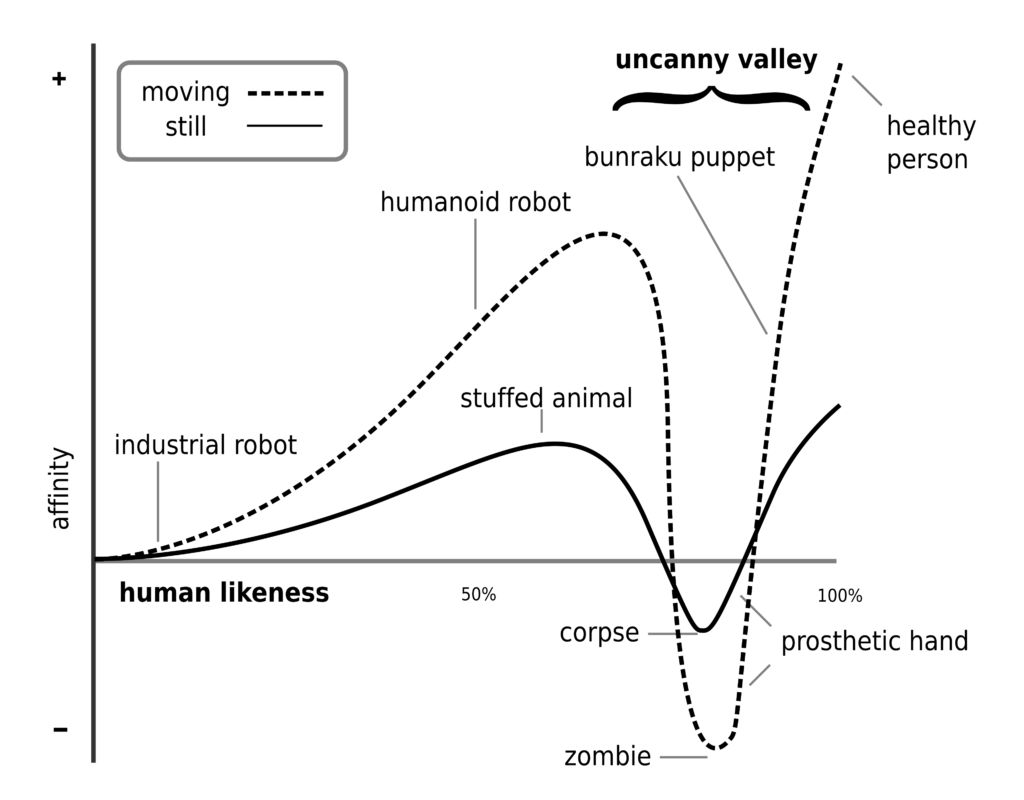
Wikipedia
The human-like characteristics of AI actors are the starting point of discomfort.
To align with audiences’ perception of “actors”, AI-generated characters often replicate human facial features, body movements, and even tone of voice.
Although these designs are intended to make AI actors more acceptable, it is precisely this deliberate similarity that triggers audience aversion.
For example, in a short video generated by Seedance 2.0, despite the highly realistic expressions of the AI actress, many flaws are still exposed in the details.
Netizens pointed out that the female character could speak fluently with meat in her mouth, and her teeth appeared and disappeared continuously, which looked extremely weird.
Just like this video, audiences instinctively judge AI by human standards. However, when AI exhibits “non-human” features due to technical limitations, these problems are exaggerated infinitely, further intensifying the audience’s hatred to AI.
AI can only mimic emotions, yet it still lacks soul
In the late 19th century, “Clever Hans” was a horse widely believed to possess advanced intelligence, capable of solving mathematical problems and spelling words.
In reality, it merely responded by capturing unconscious body language and facial cues from its questioners.
This phenomenon later became known as the Clever Hans effect, or observer-expectancy effect.
As The Atlas of AI: Power, Politics, and the Planetary Costs of Artificial Intelligence notes:
The story of Hans is now used in machine learning as a cautionary reminder that you can’t always be sure of what a model has learned from the data it has been given.
The same logic applies to AI-generated short drama actors.
They cannot truly perceive complex human emotions; they only react to instructions based on fixed “signals” to simulate emotional changes. Such imitation remains superficial, lacking a genuine human soul.
This is especially critical in acting. Great works often rely on actors’ creativity and authentic emotional expression.
As short drama actress Chen Yuxi recalled about a project she participated in for a top short drama studio: “The production team respected the actors’ creative input and gave us time to develop the characters. Some lines and performances were improvised spontaneously during filming.”
A famous example is Jack Nicholson’s iconic line “Here’s Johnny!” in The Shining, which was entirely improvised.

Sina Kansidian / Weibo
By contrast, AI can only follow rigid instructions mechanically, unable to create surprises or genuine moments, inevitably lacking human touch.
As mentioned in The Limits of AI in Understanding Emotions: Challenges in Bridging Human Experience and Machine Perception:
Unlike human perception, which integrates personal experience, context, and emotional complexity, AI relies on surface-level lexical and syntactic patterns—failing to grasp the subjective depth of emotional experience.
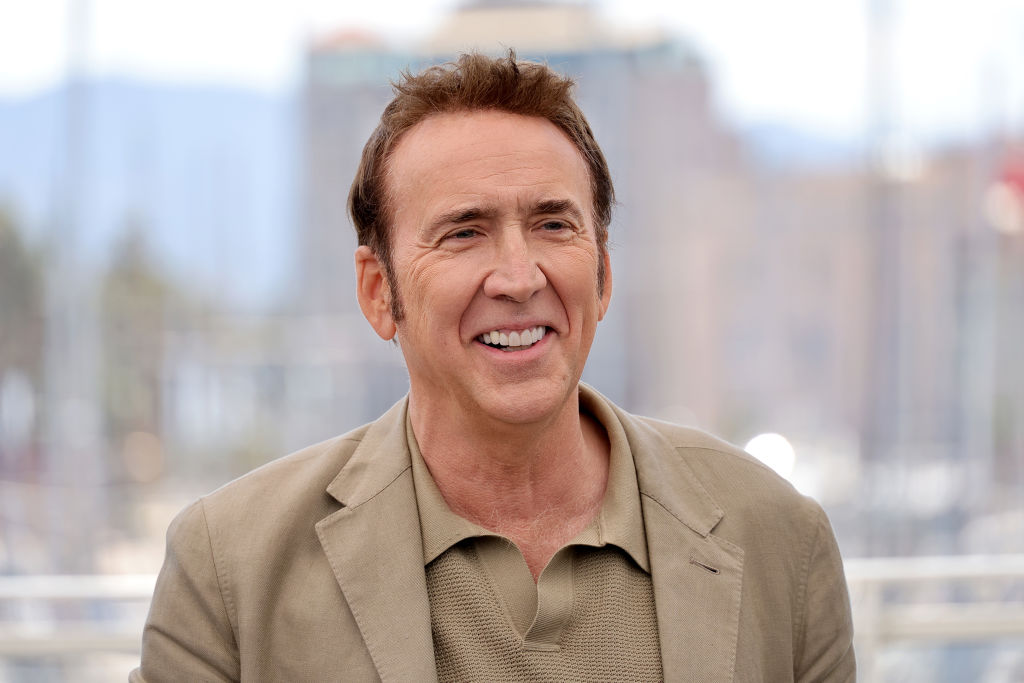
In 2025, Oscar-winning actor Nicolas Cage publicly criticized AI actors at the Saturn Awards, arguing that they “cannot reflect real human conditions and emotional experiences.“
He warned that if actors rely on AI, they will lose “sincerity, purity, and the pursuit of truth,” reducing acting to a profit-driven product stripped of artistic value.
The Epoch Times
There are also rumors that in the future, all supporting roles below the second male lead will be played by AI.
In response, director Yu Zheng issued a statement: “This may be a temporary trend, but real human performances and humanity’s imagination and need for fellow human beings can never be fully replaced by AI.”
What can we do to find balance
To achieve balance, we should make one thing clear: AI is a tool, not an opponent.
First, clarify the rational division of labor between AI and human actors.
AI performers are highly suitable for rigid, repetitive, and low-creativity roles such as extras, passersby, or minor supporting characters that do not require rich emotional expression.
This can eliminate some low-skilled performers, improve overall industrial efficiency in content production, and reduce costs. Human actors, in the meanwhile, can continue to focus on portraying roles with complex emotions.
Second, platforms must strengthen legal and ethical supervision.
All AI-generated content should be clearly and compulsorily labeled to ensure audiences’ right to know.
At the same time, the use of training data must be strictly standardized to avoid copyright disputes caused by the black-box nature of AI.
Third, governments should guide the industry to pursue human warmth, prevent uniform and repetitive AI faces, and emphasize genuine emotion.
In this way, AI can truly become a powerful creative assistant that improves efficiency and expands possibilities, rather than a cold substitute or weakens the essence of art.
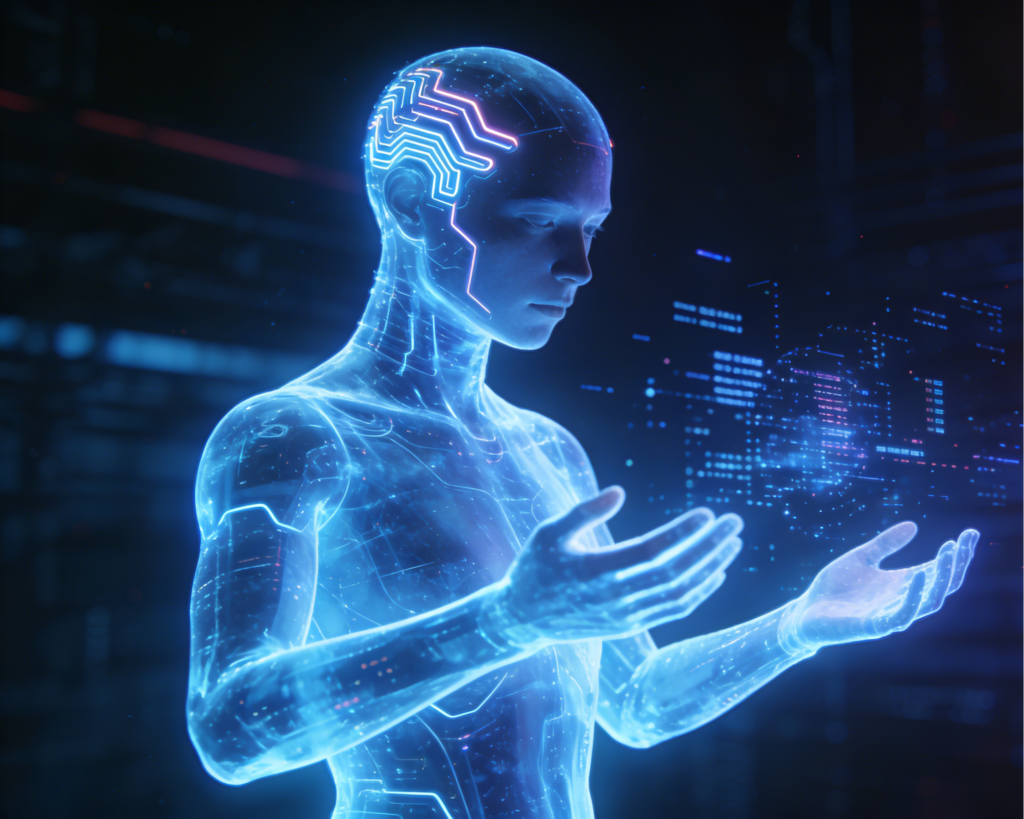
Perhaps the impact brought by AI is not entirely negative. It has prompted the short drama industry to re-examine audience needs, continuously improve itself, and inject new vitality into its development.
References:
Flew, T. (2021). Regulating platforms (pp. 72–79). Polity Press
Guo, W. M., Qian, Q., Hasan, K., & Du, S. (2026). Position: Universal aesthetic alignment narrows artistic expression. arXiv preprint.
https://doi.org/10.48550/arXiv.2512.11883
Pasquale, F. (2015). The black box society: The secret algorithms that control money and information. Harvard University Press.
Oancea, M. I. (2025). Frankenstein or Pygmalion? Literary tradition and the reception of artificial intelligence. Caietele Echinox, 49.
https://doi.org/10.5565/rev/caie.1234
Diel, A., Lalgi, T., Teufel, M., Bäuerle, A., & MacDorman, K. (2025). Eerie edibles: Realism and food neophobia predict an uncanny valley in AI-generated food images. Appetite, 208, 107926. https://doi.org/10.1016/j.appet.2025.107926
Crawford, K. (2021). The atlas of AI: Power, politics, and the planetary costs of artificial intelligence (pp. 1–21). Yale University Press.
Finet, A., Kristoforidis, K., & Laznicka, J. (2025). The limits of AI in understanding emotions: Challenges in bridging human experience and machine perception. ResearchGate. https://doi.org/10.13140/RG.2.2.33812.83841

Very nice article. I definitely love this site. Stick with it!
You really make it seem so easy with your presentation but I find this matter to be really something which I think
I would never understand. It seems too complicated and extremely broad for me.
I am looking forward for your next post, I will try to get the hang
of it!
Hmm it looks like your website ate my first comment (it was extremely
long) so I guess I’ll just sum it up what I wrote and say, I’m thoroughly enjoying
your blog. I as well am an aspiring blog blogger but I’m still new to everything.
Do you have any tips and hints for novice blog writers?
I’d definitely appreciate it.