
As a young Olympic gold medalist with a mixed Chinese American identity background, Eileen Gu has always been in the centre of attention. Initially, online discussions often focus on her competition performance. However, they gradually turn to questioning her identity and motives. This change soon alters the discussion’s tone. In the comment sections of online platforms, more aggressive expressions like sarcasm, insinuations, and taunts are increasingly common. Unlike direct insults, these tend to be more subtle in nature.
On today’s online platforms, users can easily participate in public discussions, which means the boundaries of communication have been broken down. These platforms make it easier for everyone to express their opinions and also allow different voices to be heard. However, when discussion involves sensitive topics such as identity and belonging, they tend to become polarized and lead to emotional expressions. In this kind of online environment, famous people are the first to face criticism. Eileen Gu is an example of this.
What happens during the Milan Winter Olympics?

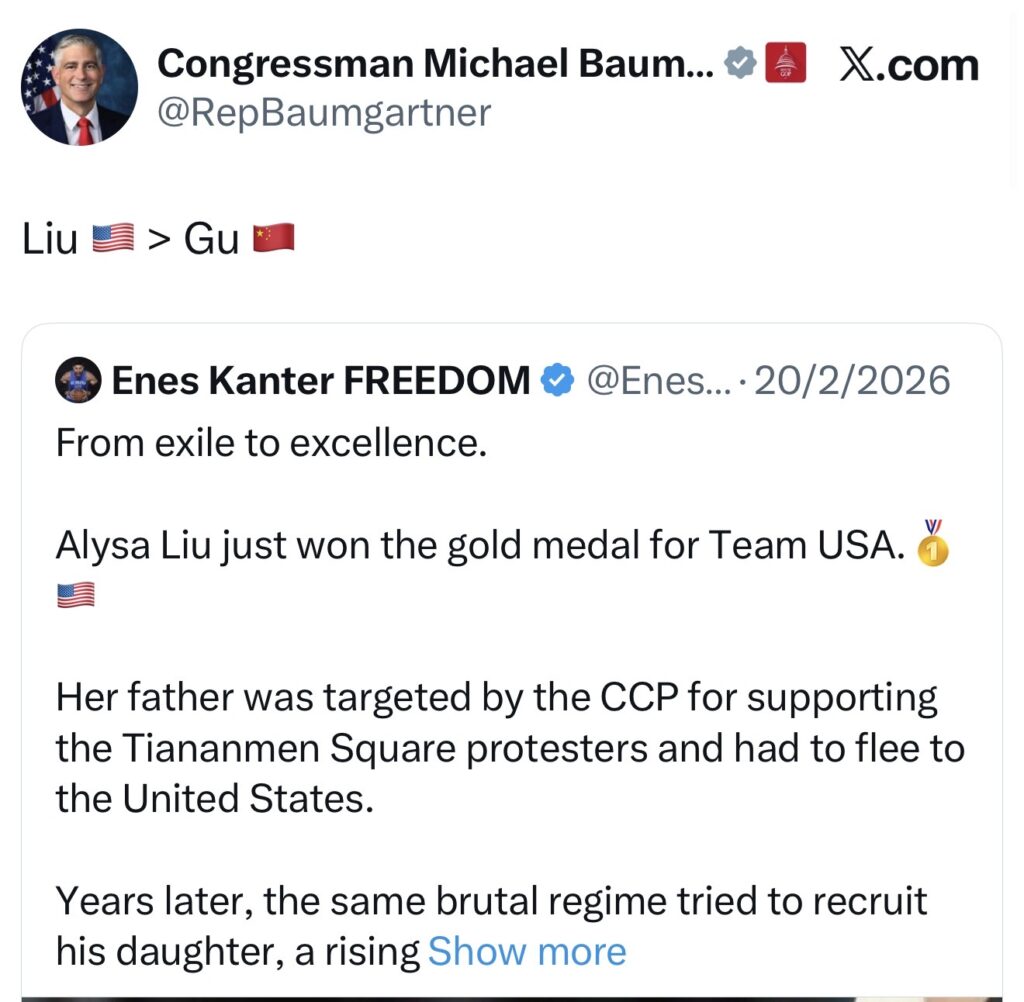
In the Winter Olympics season that just ended in late February, American figure skater Alysa Liu took the gold medal. Many people began comparing her to Eileen Gu, another skier with Chinese ethnicity who competes for China. On the United States social media platform X, in addition to the public, politicians also actively joined the discussion to express their views (Figure 1) and even engaged in hate speech. The focus of the discussion shifted from the competition to race, identity, and political stance.
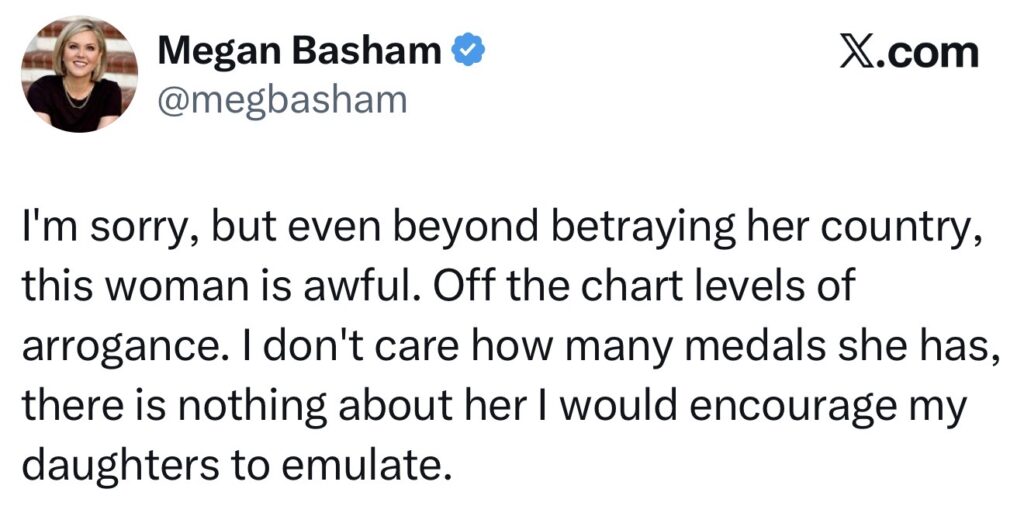
Meanwhile, journalist Megan Basham described Eileen Gu’s decision to compete for China as “betraying her country”, blaming her for disloyalty to the United States. She also used aggressive language such as “awful” and “off the chart levels of arrogance” to label Eileen Gu. She also stated that she would not “encourage her daughters to emulate her” (Figure 2). This post illustrates that the controversy surrounding Eileen Gu has now risen to the level of personal attacks.
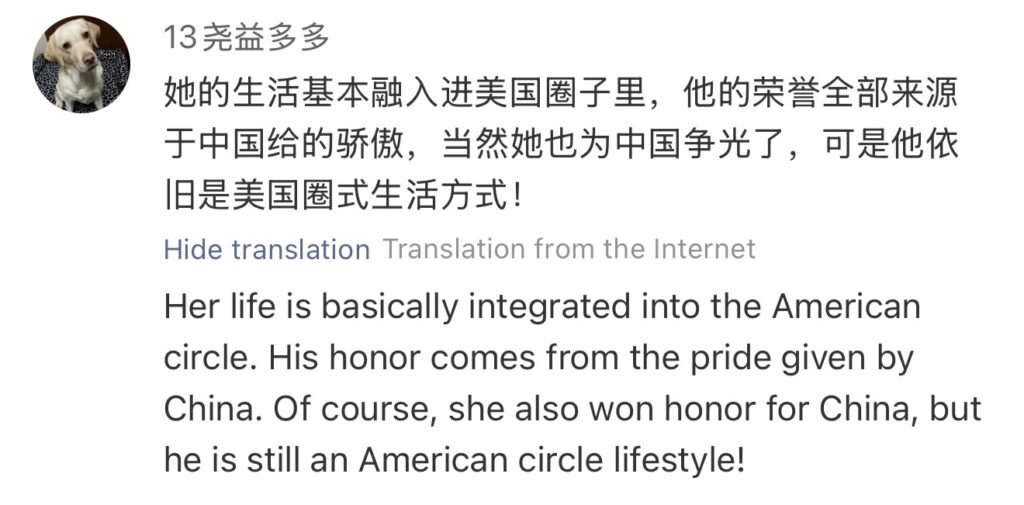
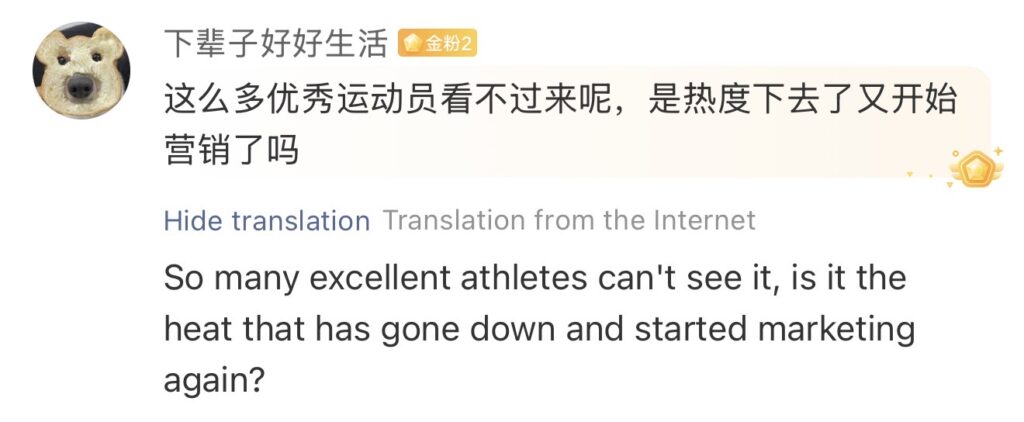
However, not all comments about Eileen Gu on the Chinese internet are supportive. It seems that her choice to compete for China and win a gold medal, should have made it easier for her to gain support. But on Chinese social media, some people are still posting hate speech about her in a sarcastic and ironic manner. On the social media platform Weibo, the criticism against her mainly revolves around terms such as “seasonal Chinese” (Figure 3), “marketing” (Figure 4), and “American lifestyle” (Figure 5). Such comments convey the suspicion that Eileen Gu’s connection to China is unstable. Her decision is also regarded as being driven by a mix of personal interests and commercial purposes.

Online attacks on Eileen Gu in both the United States and China seem to question her choices, but the logic behind them differs. On X, the discourse positions her more directly in the framework of national loyalty, with the focus on whether she has betrayed the United States. In contrast, discussions on the Chinese internet focus more on eligibility of whether she is qualified to be considered “one of us”. It feels more like an ongoing examination of identity and belonging.
In the following sections, this blog will focus on analyzing the Chinese internet, exploring how social factors, platform dynamics, and moderation mechanisms shape the formation of hate speech.
Identity controversy

Firstly, our discussion starts with the controversy about Eileen Gu’s identity. Guan and Chen (2025) state that:
people marginalize, reduce value and portray specific social identities by using discursive othering, due to the gap between in-group and out-group, which develop a sense of threat (p. 1343).
This explains why the hate speech directed at her always focuses on three core questions: 1) Whether she truly can be considered Chinese, 2) whether she is truly loyal to China, 3) whether her choices are driven more by personal benefits. The deeper issue here is the boundaries of identity and belonging.
In the case, other is not someone fully outside the nation. Eileen Gu is not someone who stands completely outside the nation. She is close to that boundary but maintains a distinction. Therefore, this almost-belonging without full belonging has caused her to be questioned.
In many cases, hate speech online does not originate from proven facts, but from suspicion. Eileen Gu won gold for China, while also living and growing up in the United States. This background makes it difficult to place her in a single or purely defined identity category. For these internet users, this ambiguity stirs their doubts.
From social anxiety to online hostility
From a broader perspective, these internet users are also influenced by China’s social environment. It shows a palpable rise in scepticism, anger, and an overarching emotion of deprivation in China, which may contribute to populist content, conspiracy theories, and hate speech (Guan & Chen, 2025, p. 1351). Thus, the hostility toward Eileen Gu is born in an environment already filled with a negative atmosphere and loss of balance.
In this real-world environment, people are turning to the internet to find targets for projecting and venting their stress, anxiety, and other bad emotions. The internet has become an exit for their emotional release. This is because the platforms have a wide dissemination range, so it is easier for users to meet people with similar beliefs. Through constant interaction and agreement, their views are reinforced.
As a result, as a successful athlete who gained fame at the young age, Eileen Gu has become a target for others’ anxieties regarding class, ethnicity, and sense of belonging.
The hidden hate
As a medium of communication, language can create new meanings in online interactions. Phrases like “seasonal Chinese,” “marketing,” and “American circle lifestyle” mentioned in the case may make people wonder what hidden meanings lie behind these labelled terms when the publisher places them in this specific context.
Hate speech on online platforms rarely presents itself in the form of direct abuse anymore. Hate speech can be described as expressing, encouraging, stirring up, or inciting hatred towards a group of people differentiated by a specific trait or collection of features, such as race, ethnicity, gender, religion, nationality, and sexuality (Parekh, 2012, as cited in Flew, 2021, p. 115). In the case of Eileen Gu, the hate speech topics cantered on her nationality, mixed-race background, and growing-up environment. People overlook her achievements and instead focus on her demographic features. There is a very practical reason behind this: achievements are undeniable facts, but identity and belonging are easier to be challenged or questioned.
Also, Flew (2021) claims that:
hate speech works by making the target an unwelcome presence and legitimate object of hostility (p. 116).
Those hate speech posted online turn impression of Eileen Gu into a two-faced, manipulative, and suspicious women. Once this impression is established, the hostility on her becomes reasonable.
Moreover, Guan and Chen (2025) write that hateful narratives in China have many forms, including humour, satire, and playfulness (p. 1351). This proves that compared to direct hate speech, humorous or subtle expressions are more easily accepted and shared. The point is that this kind of playful hostility can avoid to be detected by China’s strict platform moderation systems. Under these restrictions, obvious hateful language is filtered or banned. Therefore, expressions with hidden meanings can be posted on platforms in a more clever way.
Conflict as content and profit

In contrast to offline interactions, online platforms break down geographical barriers. As a result, the impact of comments that may seem scattered can have a bigger impact. According to Guan and Chen (2025), sensational, emotional based and negative narratives naturally can gain a greater focus (p. 1338). This shows that the platform does not treat all content equally. This also aligns with the nature of mainstream content on Chinese online platforms, which tends to be concise and attention-catching. Compared to objective and detailed explanations, brief and emotive expressions are more likely to be seen.
Terms like “seasonal Chinese” hold a distinct advantage on the platform. They are simple, easy to remember and with a humorous tone. Users just need to like, share or reply to increase the exposure and keep engaging in. In this way, the platform amplifies whether a post or comment can gain interaction and data consistently.
The problem is that once hate speech is keeping getting shared, the way they are perceived by users begin to change. If similar statements are repeatedly being viewed, users may assume that everyone is saying this. Moreover, the tone of the discussion on the platform may become misdirected. People will then truly doubts about identity, belonging and motivation.
It is practical that conflict itself is valuable content for platform. When conflict topic appears, users tend to stay longer on the platform to keep finding more about what happens. As a result, data including comments, shares, and views will perform better. As a medium, the platform will provide greater opportunities for the visibility of such content due to the operational logic, quietly supporting these profitable contents. So, the hate speech about Eileen Gu seems to be the result of users losing control of their emotions. In fact, the primary goal of platforms that enhance content visibility and pursue profits are helping hostility to spread further.
Therefore, conflicts on the platform are procedural. They begin with disputes over competition results, develop into identity-based doubts, and then, through repeated interactions, deepen into more persistent hostility (hate speech). In this stage, hostility has gone beyond simply being an emotion expressed in comments or posts. It has become part of the platform’s content.
The blind spots of moderation

People may think that platforms only need stricter moderation to improve platform atmosphere, but reviewing vague comments is not a simple task.
China’s largest short-video platform TikTok, uses Artificial Intelligence (AI) as tool to assist with content moderation. However, Alkiviadou (2022) warns that automated mechanisms may fail to catch up on the complexity of language and which leads to abuses of minority group’s freedom of speech and the right to non-discrimination (p. 103). This points out the limitations of moderation systems. As the technology used in the system, AI may fail to recognize complex expressions that rely on specific context. This is why subtle forms of hate like metaphors or jokes in the case are able to remain visible to the public. As Alkiviadou (2022) conclude that:
AI is still struggling to understand the nuanced meanings in language or to identify what is the real intention behind (p. 105).
Although moderation can not completely ban online hate speech, but it forces hate speech to change the way it is expressed. These post or comment publishers know that direct insults will be banned, so they post more hiddenly instead. This means that language itself will adapt to the environment by changing its form. Therefore, the cruel challenge of moderation is that platforms are constantly chasing after an expression that is constantly renewing. Therefore, online platforms still can not find a balance between profitability and maintaining the platform atmosphere.
Platforms do more than just amplify content
From the perspective of platforms and society, the bigger problem is that the online environment is constantly turning identity disputes into shareable hostility. What platforms amplify is never just the content itself.
Moreover, people may be adept at viewing others through the lens of distrust, exclusion, and stereotypes. Once this becomes the norm for daily life, the logic of judgment and the adaption for perceiving differences for people themselves will be reshaped.


Be the first to comment