Welcome to the age of AI
Artificial Intelligence has become the one of the most popular topics in recent years. The popularity of related topics suddenly surged along with the stocks of those artificial intelligence companies. Imagine asking AI whether you should change careers, get any latest information and plan a trip for you. Things that previously required people to search and organise information themselves can now be solved simply by typing a couple of sentences into AI. AI is everywhere: research, study, work, and even daily decisions.

For me, personally, I have asked ChatGPT to planning my workout and basketball drills for more than a year. I often would chat with Grok and address some pointed political and social issues, as well as some philosophical discussions. They always give me timely and comprehensive replies, no matter when or where. I would not ask them about relationships though, since I believe they cannot truly understand emotions and feeling.
It feels intelligent, but can we trust it?

AI is not an independent thinker; it reflects patterns in data that provided in its training. That makes it powerful, but also biased and potentially misleading at the same time. In my opinion, AI is more of an advanced and upgraded searching engine that are capable to select and gather information. However it does not judge, only presents (in a more communicative way). Their “judgement” is shaped by data, design, and statistical patterns that means their outputs can reproduce bias and should not be treated as independent decision-makers. They will predicting likely outputs, yet they are all based on data as well. Even though it has the name of artificial intelligence, it is not capable to have its own opinion, hence deliver the idea whatever it gets from the internet.
What AI actually is?
AI is difficult to define because even “intelligence” itself has no universally agreed definition (Wang, 2019, pp.1–37). Nowadays, it is considered as a branch of computer science that focused on building machines which can perform tasks typically requiring human intelligence. Instead of following rigid or step-by-step instructions like traditional software, AI systems learn from data, recognize patterns, make decisions, and improve over time. It is kind of like teaching computers to think, hear, see and response in a way that is similar to human. AI uses algorithms to analyse large amounts of information (e.g. photos, text, or clicks) and identifies patterns, rather than being explicitly programmed for every outcome.
AI, especially generative AI, works by predicting likely outputs based on data. Therefore it’s not “thinking” or “understanding” like humans, it just breaks them down into patterns, and simply duplicate the actions. Hence create an illusion of “AI is doing something just like human”.
I called AI “an advanced and upgraded” search engine. The traditional search engine retrieves existing info from the internet by capture keywords. All the content it grabs are all uploaded by other individual earlier, which could contain harmful or misleading information.
People assuming AI would do it differently since it looks like it would “select” and generates new responses based on patterns. However all the data used for its training and the content it gets from the internet are all from human individual after all, so they are likely to contain harmful and misleading information as well.
The process of fetching information and generating responses is hidden from the user’s view does not mean that artificial intelligence itself is qualitatively different or a leap forward compared to search engines. AI is more than a search engine, but less than real intelligence. It could be the mirror of the internet, but a rearranged one.
Not a living consciousness, but a lifeless algorithm
AI is the science and engineering of making intelligent machines (Helm et al., 2022, pp. 117). It is an engineering project rather than actual intelligence. It’s about creating systems that perform tasks associated with intelligence rather than creating an actual intelligence.
Like I mentioned earlier, I believe AI cannot truly understand emotions and feeling. Then how does it give us the illusion of it being an actual intelligence?
It’s all about datafication, which is the process of turning many aspects of human life (e.g. emotions, movement, speech, social relations) into quantifiable data (Crawford, 2021, pp. 8-10). Crawford shows that this data is never raw but is collected, labelled, and interpreted through human and institutional choices that embed biases. It means that AI does not understand emotions and the information it learned at all, it just knows that “human are doing so” and its patterns ask it to do the same thing. It cannot feel happy; it just sees human would happy in such cases. It does not feel sad; it just knows human would be sad in similar situations. AI turning human behaviour into data, and then learn from the data which inherits its patterns.
At the same time, just like how algorithms on digital platforms determine what content is seen, promoted, or suppressed (Flew, 2021, pp. 80–82), the algorithms of AI are also determining what elements it would generate in response to the users based on their datafication.

ChatGPT would save details of the users automatically or manually as “Memories”
AI systems are built on datafication processes that driven by digital platforms, and their outputs reflect the same biases and incentives which embedded in those systems.
Platforms such as social media are collecting a large amount of data, and put them into analysation of user behaviours, then turning user behaviours into a greater amount of data.
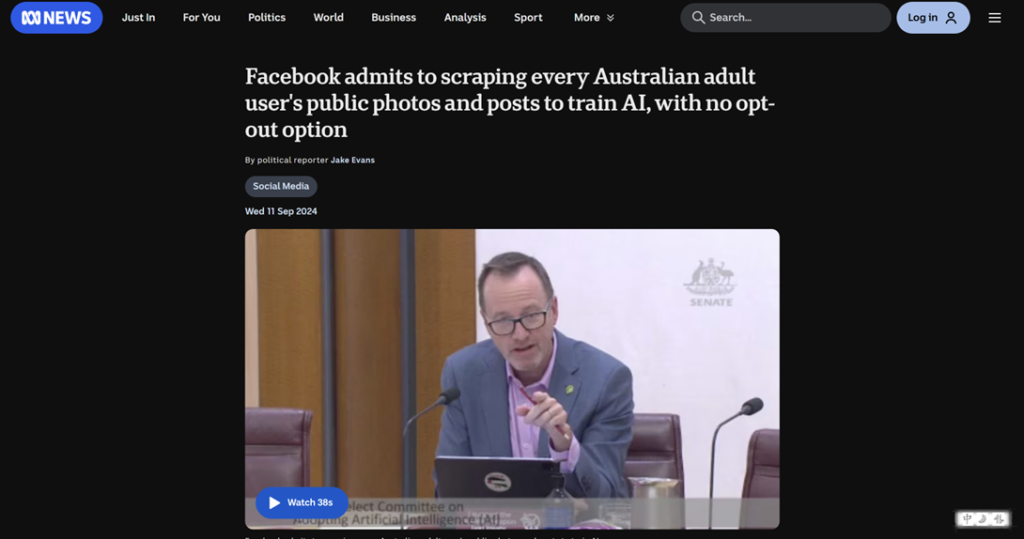
The platform such as TikTok heavily relies on AI for big data and promotion. It needs to identify each users interesting topic by analysing how long they stay on each kind of videos and what they have recently searched. TikTok relies heavily on AI-driven recommendation algorithms to personalise content. These systems continuously adjust what users see by analysing user behaviour. The goal is maximising engagement rather than accuracy or truth (Wang, 2022, pp.60-66).
As long as TikTok keeps suggesting the same type of video, users would feel more entertaining, yet becoming more one-sided as well.
The data that used by AI is not neutral; it is shaped by:
- User behaviour: how users react to different kind of topics, what they search, how long they stay on each video.
- Platform design: what the platform goal is, what is its expected outcome.
- Commercial incentives: how much the benefit is to shape such kind of data in the level of commercial.
Algorithms, on the other hand, decides what content will be presented to the users. However it is not designed for presenting the truth and blocking false information. Instead, it is optimised for user engagement, which means it would show the content that can keep users engaged. As long as it retains users, the algorithm will push it to them regardless of its authenticity.
People would treat the popular content as “high quality”. However, what becomes “popular” is already filtered by data.
AI is trained on the data that comes from these two systems. Its outputs are shaped, not objective. Those bias in datasets are all absorbed into AI’s pattern and database. Garbage in, garbage out. Therefore leading to the situations such as reproduce historical inequality. Biased data has been transformed into biased outputs, and viral content are overrepresented.
Extreme views have amplified. Like I said, AI cannot truly understand these concepts of emotion and opinion, it just knows that there are human saying so. AI doesn’t just reflect reality, it reflects platform-shaped reality.
“SkinnyTok” – extreme body image content spiral on TikTok
In the recent years, there were a group journalists and researchers investigated TikTok accounts belonging to teen users to see how big the impact of AI algorithm is. After the team interacting with a small amount of the topic such as dieting, fitness and body image content. Within the following hours, TikTok’s algorithm on the “For You” page began recommending extreme weight-loss advice and highly idealised body standards such as “what I eat in a day” videos with dangerously low calories. These advices are actually extremely dangerous to individual’s health, especially the teenagers who are still growing. This phenomenon became widely referred to as “SkinnyTok”.
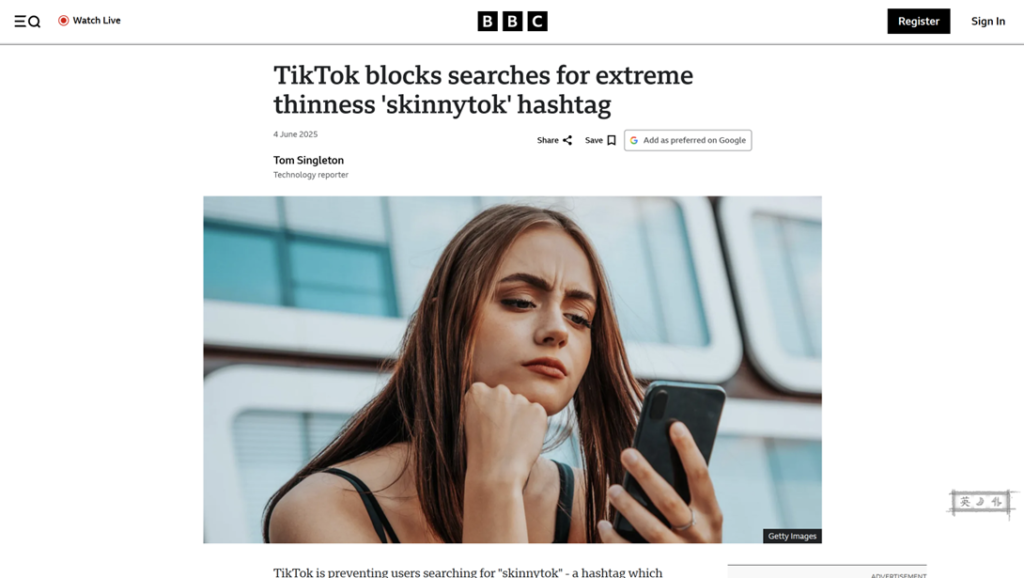
The algorithm rapidly narrows content exposure. Users are no longer able to get in touch with the content from other perspectives, but being pushed into increasingly extreme content clusters. In this case, once the teen accounts have conducted actions and interactions such as diet or losing weight, their suggestion page is full of videos on the exact same theme, and becoming increasingly extreme. The AI algorithms gradually draw users to the center of the topic, making it impossible for them to escape. AI requires no human intent or planning, it just quantifies the engagement signals such as watch time, likes, pauses, and trying to perusing more of them. It can’t distinguish between truth and falsehood, or even what’s appropriate and inappropriate. It was built to pursue higher user engagement and push any video as long as they can achieve this goal.
Generative AI cannot be excluded as well. Its moral compass and bottom line are set by its developers. AI itself has no concept of good or evil, nor can it learn. It’s like a child who doesn’t learn on its own, relying solely on its parents’ teachings. If the parents overlook anything, the child will transmit inappropriate values.
Many of those videos in the case mentioned above are AI-assisted or AI-generated: scripted advice, voiceovers, and even recycled “tips”. This allows mass production of similar and misleading narratives. You get waves of nearly identical, reinforcing content instead of a few creators.
The more inappropriate and extreme cases the AI algorithm recommends on the platform and the higher the views of those videos, the more the generative AI will believe these are “efficient” and “what users need.” It will then recommend these to users and its pattern will expand content in this direction, that causing user-created videos to become even more inappropriate and extreme. This further leads to the generative AI generating increasingly extreme suggestions for future users.
AI is not neutral; its opinion is based on its data. Their goal is being efficient, not morally outstanding, and they cannot correct themselves. They only gather and expand information in specific directions based on user needs. This process gives the illusion that they possess those tasks by their own thoughts and ideas.
AI is like Skynet, and all of us can be John Connor
People treat AI as neutral and authoritative being that is smarter than human. However it can hallucinate that confidently with wrong answers and reflect bias since it lacks context or ethics. This is a no intentional misinformation. No one needs to lie. It’s all about the system itself amplifies selective reality.
The danger is not AI itself, but how people trust it. Should AI make all the decisions for us? What would happen when we outsource judgement?
In my opinion, we can let AI handle those low-level and repetitive tasks and jobs, which can free us from tedious repetition and allow us to pursue higher achievements. At the same time, we should never delegate all the problems and tasks beyond repetitive work to AI. As humans, we need to have the ability to deal with problems. Life is about constantly solving problems, making progress, and achieving peace in return. We should view AI as an asset. If we lose these abilities because of AI, we will actually regress. The tasks we delegate should be those we are good at, so we would simply need to addressing something we good at rather than missing a piece in our lives even if the uncontrollable external force disappears. Just as having calculators doesn’t mean we can give up learning mathematics.
Meanwhile, users need critical thinking and platforms need accountability. We need regulation on this so we would not feeling lost in the big data.
AI is powerful, yet not truly “intelligent”. It reflects the world that including its flaws.
Don’t confuse confidence with understanding.
Reference
Wang, P. (2019). On defining artificial intelligence. Journal of Artificial General Intelligence, https://doi.org/10.2478/jagi-2019-0002
Helm, M., et al. (2022). Understanding basic principles of artificial intelligence: A practical guide for intensivists. Annals of Intensive Care. https://doi.org/10.1186/s13613-022-01097-8
Crawford, Kate (2021) The Atlas of AI: Power, Politics, and the Planetary Costs of Artificial Intelligence. New Haven, CT: Yale University Press.
Flew, Terry (2021) Regulating Platforms. Cambridge: Polity.
Wang, P. (2022). Recommendation algorithm in TikTok: Strengths, dilemmas, and possible directions. International Journal of Social Science Studies. https://doi.org/10.11114/ijsss.v10i5.5664
Singh, A. (2025, June 20). Student flaunts use of ChatGPT at graduation ceremony, faces backlash: “Next-level foolish”. NDTV. https://www.ndtv.com/offbeat/student-flaunts-use-of-chatgpt-at-graduation-ceremony-faces-backlash-next-level-foolish-8713770
Australian Broadcasting Corporation. (2024, September 13). How to spot a fake image: AI manipulation. ABC News. https://www.abc.net.au/news/2024-09-13/how-to-spot-a-fake-image-ai-manipulation/103646188
Evans, J. (2024, September 10). Facebook admits to scraping every Australian adult user’s public photos and posts to train AI, with no opt-out option. ABC News. https://www.abc.net.au/news/2024-09-11/facebook-scraping-photos-data-no-opt-out/104336170
BBC News. (2024, September). How AI helped spread misinformation over Australian boy’s disappearance. https://www.bbc.com/news/articles/c4gr6q6256do
Be the first to comment