
Introduction
TikTok often gives people a relaxed, fast and harmless feeling.
There are dance short videos, jokes, fashion content, and all kinds of short videos that people keep browsing on the platform.
This kind of superficial image is very important. It helps TikTok package itself as a neutral entertainment platform. Compared with Facebook, it doesn’t look so political. Compared with X, it doesn’t look so full of opposition. It gives people the feeling that users spontaneously want to share the daily life.
But the understanding is too simple. TikTok is not a neutral platform. As Matamoros-Fernández’s analysis of “platformed racism” pointed out, the platform is not a passive container for carrying content. Its design, rules and governance itself will shape how hateful content is amplified and circulated.
It doesn’t simply carry the content and then quit. As Woods and Perrin said, the design choices, user tools, complaint mechanisms and information flow arrangements of the platform are not neutral, and they will directly affect how the content is disseminated.
The reason why this matter is important is that hate speech on the Internet is not just “uncomfortable words”. It is also related to cybe threats, violence, and making public spaces more unsafe for targeted groups. Tiktok also said that it wanted to strike a balance between freedom and preventing harm. In the updated Community Guidelines in 2023, Tiktok said that the audit should protect human dignity and make certain content disqualified to be recommended by For You feed. TikTok also said that it has a zero-tolerance policy for organized hate behavior, including white supremacy and anti-Semitism.
However, TikTok’s real case records do not support this commitment.
In 2024, a report released by the Institute for Strategic Dialogue found that white supremacist content is still easy to find on TikTok. Users may be pushed because of some vague entries like “fyp” or some words replaced by homophones. This is contrary to the company’s claim to be a fair, open and neutral platform.
The Case Study
The most powerful contemporary case at present is the report released by the Institute for Strategic Dialogue in 2024, TikTok and White Supremacist Content.
The researchers did not use any high end operations or internal websites. They only used the functions of the platform like ordinary users including keyword bar search, hashtag, and For You Page. Within about 20 hours, 90 personal accounts that clearly published white supremacy were found. The sample finally includes 108 screens released by 75 accounts. They believe that all of these 108 screens violate tiktok’s rules about self proclaimed hate speech and hateful behavior.
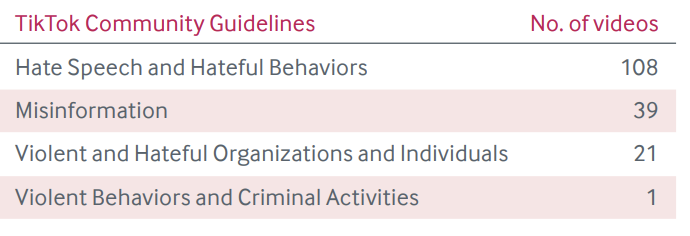
The concern of this report is not only that.
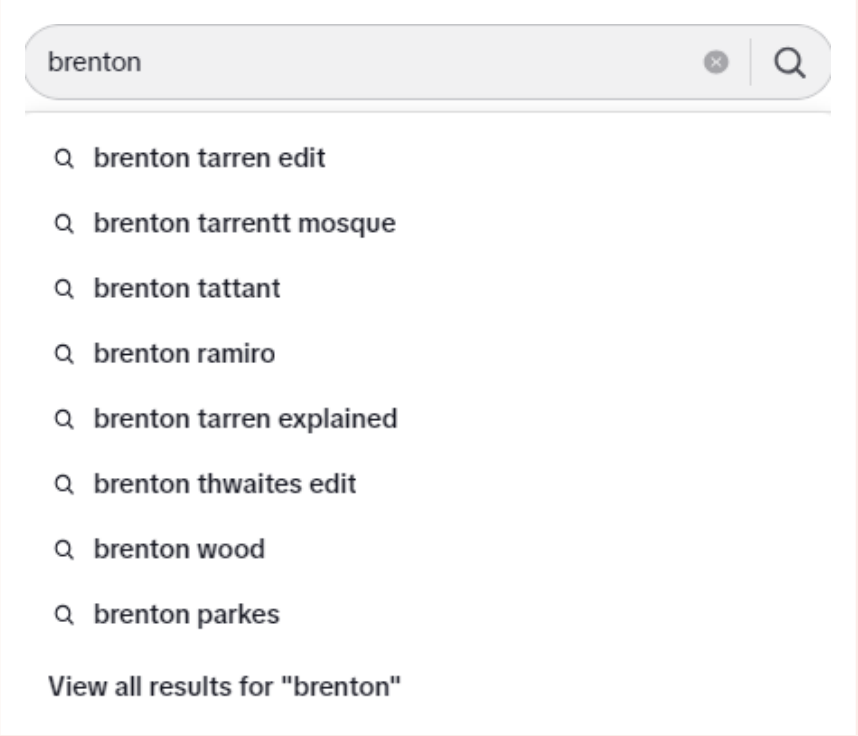
Researchers also found that TikTok’s own search suggestions sometimes help users bypass banned search terms, because the system will give names and phrases that have been deliberately spelled, variant or blurred. The report also found that TikTok is likely to recommend white supremacist content through its own system. Even videos published by small accounts can get a very high number of views.
The report also found that some of these hate speech contents stayed on the platform for weeks, months, or even years. Another part of the report points out that even if a video is deleted, sound related to it may still remain on the platform and be used again by other users. A sound from a Dylann Roof related video is still available on TikTok and has been used in 13 other public videos.
The Neutrality is a Myth
The platform may encounter difficulties in the audit. If it’s just because “we’re too busy”, they just need to add more auditors or improve the filtering technology to speed up the processing.However, according to the above case analysis, it is not difficult for us to know that some hate speech that has existed for a long time has not been deleted and has existed on the platform for a long time. Isn’t this the platform’s own design to help the spread of harmful content? In that case, the platform is not neutral. It is part of the mechanism itself.
Ariadna Matamoros-Fernández proposed the objections of ” neutral” that the platform has always told.She proposed the concept of “platformed racism”. She believes that platform racism comes from the design, business models, policies, algorithms of social media platforms, and the culture of use formed around these platforms. In her opinion, the platform not only carries racist topics, but also may amplify these topics and create an environment for the spread of topics.
The ISD report also clearly replied to this point. The report points out that TikTok’s own functions help users bypass audits, and the platform’s algorithms seem to be amplifying white supremacist content. Therefore, the problem of the platform is not only that these comments were not deleted in time, but also why the platform let these contents circulate more and more widely.
That’s why I don’t think the word “neutral” is valid here. I don’t think a truly neutral platform should take the initiative to help users find extremist search terms that have been deformed. After deleting the extremist video, the sound that can be reused should still be kept.
Review Issues
Sarah T. Roberts pointed out that large scale content review cannot completely solve the problem of platform review. She suggests that content moderation involves complex judgments about meaning, intent, context and cultural specificity, and that these moderation practices are often opaque to the public while relying on low-status, dispersed and frequently outsourced human labor.
Now, Tiktok relies more and more on automation. According to the DSA transparency report released by Newsroom in 2024, the company said that in the first half of 2024, 80% of illegal videos in the European Union were removed by automated audit technology, higher than 62% in the previous year. Tiktok also said that 80% of the illegal content has been removed by automation technology.
In my opinion, there is nothing wrong with the platform using automation to review the video itself, but over reliance or only using automation to review the video content will cause problems.
As we mentioned above in the case analysis, white supremacist content often uses coded language, irony, visual code, historical symbols, or slightly deformed spelling to avoid the automated review of the platform. If the platform continues to pursue faster and more automated audits, and at the same time, the hate content becomes more and more hidden and more adapts to the rules, then the audit loopholes are not accidental, but the result of the system itself.
Although I found that there is an obvious reporting tool button on the platform when I use TikTok. But “there is a report button” is not the same as “real protection”. If hateful content has been recommended, copied, saved and repeatedly used, the burden has been transferred to the targeted users.
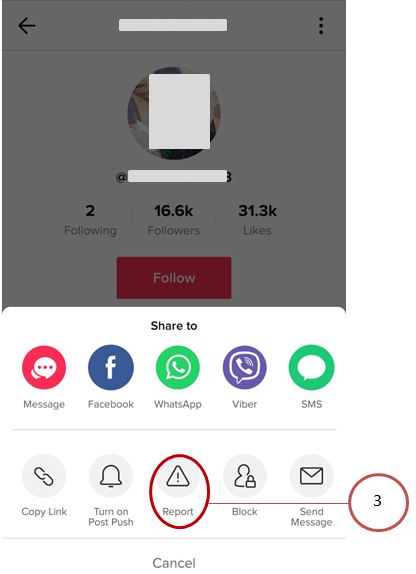
I strongly agree with the view put forward by Woods and Perrin that the complaint system should have been an early warning mechanism for discovering larger structural problems. If similar hateful content always comes back through search and recommendation, then the problem is not only the execution, but also the product design.
Power Lives in Opacity
TikTok likes to package “transparency” as evidence of its own responsibility. It will emphasize that it regularly releases transparency reports, publishes law enforcement data, and constantly emphasizes safety and accountability in public statements. On the surface, it seems to be very reassuring.
TikTok said in the sixth DSA transparency report released in February 2026 that the company has been issuing transparency reports since 2019. The report covers information on the deletion of illegal content, illegal content reporting, user complaints and comment enforcement in Europe.
However, the published data does not prove that the platform has opened up space for external reviewing. Because the data is selected by the platform itself, they control how the audience sees the platform’s advantages. And guide the public to understand these figures as proof of the effectiveness of platform governance.
TikTok should not simply give the public data, but let the public check what these numbers mean. As announced by the European Commission in October 2025, Tiktok should provide researchers with sufficient access to public data. The key reason for this access is that users can only get real feedback when they use it themselves.
While Tiktok has the right to sort the content, whether the content has been deleted, what is hateful behavior and so on, it also has the obligation to supervise its audit process by the outside world. This is also a way to help Tiktok become a more neutral platform and build credibility.
What should Change
If TikTok truly wants to prove it takes hate speech seriously, I believe it must do the following:
- It must regard white supremacist content as a “systemic risk”, not just a certain kind of illegal content. This kind of content needs to be reviewed by trained humans, not just faster machine speed.
- It should publish more detailed evidence on how the review of hate-related content works. The broad success rate figure is not enough. Clearer data such as misjudgment rate, processing time, user complaint results, repeated violations, and how hate content continues to appear through deformed language.
- It should add more external audits. Otherwise, platform accountability will ultimately become nothing more than public relations rhetoric.
- It should invest more in human judgment instead of relying on computer algorithms. Hatred will constantly change, disguise, and be hidden in jokes, clips, sounds and symbols. As long as these transmission paths are still there, even if the platform deletes individual content, hatred will continue to circulate.

Conclusion
The case of White Supremacist is enough to show that TikTok is not a neutral platform.
Platform over reliance on automated auditing vulnerabilities allows users to post hate speech by distorting text. The sounds of the deleted video will still leave traces on the platform. The essence of the problem is that the tiktok system is helping the circulation of these contents.
I don’t think tiktok can be simply understood as just a platform for “executing rules”. It is also a governor who distributes visibility, manipulates audits, and restricts external observation. It does not stand outside the spread of hatred, but is deeply involved in it.
The real question that should be asked is not just whether TikTok has written a set of community guidelines, but whether it is willing to take responsibility for the communication system it has built.
References
De Bailliencourt, J. (2023, March 21). Helping creators understand our rules with refreshed Community Guidelines. TikTok Newsroom. https://newsroom.tiktok.com/community-guidelines-update?lang=en
European Commission. (2025, October 24). Commission preliminarily finds TikTok and Meta in breach of their transparency obligations under the Digital Services Act [Press release]. Shaping Europe’s Digital Future. https://digital-strategy.ec.europa.eu/en/news/commission-preliminarily-finds-tiktok-and-meta-breach-their-transparency-obligations-under-digital
Figure 1. https://nypost.com/2024/04/01/lifestyle/viral-tiktok-video-freezes-scrolling-how-to-fix-it/
Figure 2 & 3. https://www.isdglobal.org/wp-content/uploads/2024/09/TikTok-White-Supremacy.pdf
Figure 5. https://motionarray.com/stock-video/judge-hand-banging-court-gavel-1186157/
Matamoros-Fernández, A. (2017). Platformed racism: The mediation and circulation of an Australian race-based controversy on Twitter, Facebook and YouTube. Information, Communication & Society, 20(6), 930–946. https://doi.org/10.1080/1369118X.2017.1293130
O’Connor, C., & Holt, J. (2024). TikTok and white supremacist content. Institute for Strategic Dialogue. https://www.isdglobal.org/wp-content/uploads/2024/09/TikTok-White-Supremacy.pdf
Roberts, S. T. (2019). Understanding commercial content moderation. In Behind the screen: Content moderation in the shadows of social media (pp. 33–72). Yale University Press. https://doi.org/10.12987/9780300245318-003
TikTok. (2024, October 24). Digital Services Act: Publishing our third transparency report on content moderation in Europe. TikTok Newsroom. https://newsroom.tiktok.com/dsa-third-transparency-report?lang=en-150
TikTok. (2026, February 27). Digital Services Act: Our sixth transparency report on content moderation in Europe. TikTok Newsroom. https://newsroom.tiktok.com/digital-services-act-our-sixth-transparency-report-on-content-moderation-in-europe?lang=en-150


Be the first to comment