The Myth of the Neutral Playground
I still remember stepping into the world of the internet more than two decades ago. For me, it was an endless playground where I could create an internet persona that felt like a secret, complementary version of my real self. There was a pure, simple thrill in waddling through the snowy plains of Club Penguin, meeting strangers across the globe through Dance Dance Revolution forums and obsessively checking Instant Messenger to see if my friends were online. I remember the rush of starting my first microblog on Twitter, engaging in petty feuds with random strangers, and creating those cringey email addresses we are now far too embarrassed to share. We spent hours tumbling down Wikipedia rabbit holes, fueled by a sense of infinite discovery to make sense of the world.
In those early days, the web felt like a wild frontier. We explored search engines with total optimism, feeling like we were part of a massive experiment in human connection. It was clear even then that digital platforms were tools into a global “heterogeneity” making it easy to tap into diverse knowledge and find people from all walks of life. They offered a way to grow ideas instantly through “multiplicity,” supported by a web of constant, seamless “connectivity.” We viewed these platforms as neutral pipes, passive stages where our social lives could unfold without interference.
Today, that convenience is everywhere. We live in an age of instant gratification where every question is answered and every social tie is maintained with a simple tap or scroll. This is what Terry Flew (2021) calls the “platformized internet.” It’s a shift that turned the internet’s open, decentralized potential into a streamlined, centralized system that now fuels our daily economic and social lives. However, this transition came with a hidden cost: the loss of that very neutrality we took for granted.
The problem is that this immense power now operates in what Nicholas Suzor (2019) calls “Lawless” governance. For years, we’ve allowed digital platforms, especially those global titans like META, Amazon, and Google, to govern our online lives with almost unlimited discretion. For example Meta as the market leader Facebook is currently sitting at more than three billion monthly active users, according to the Statista (2026). Meta Platforms owns four of the biggest social media platforms, all with more than one billion monthly active users each: Facebook as the core platform, WhatsApp, Messenger, and Instagram.
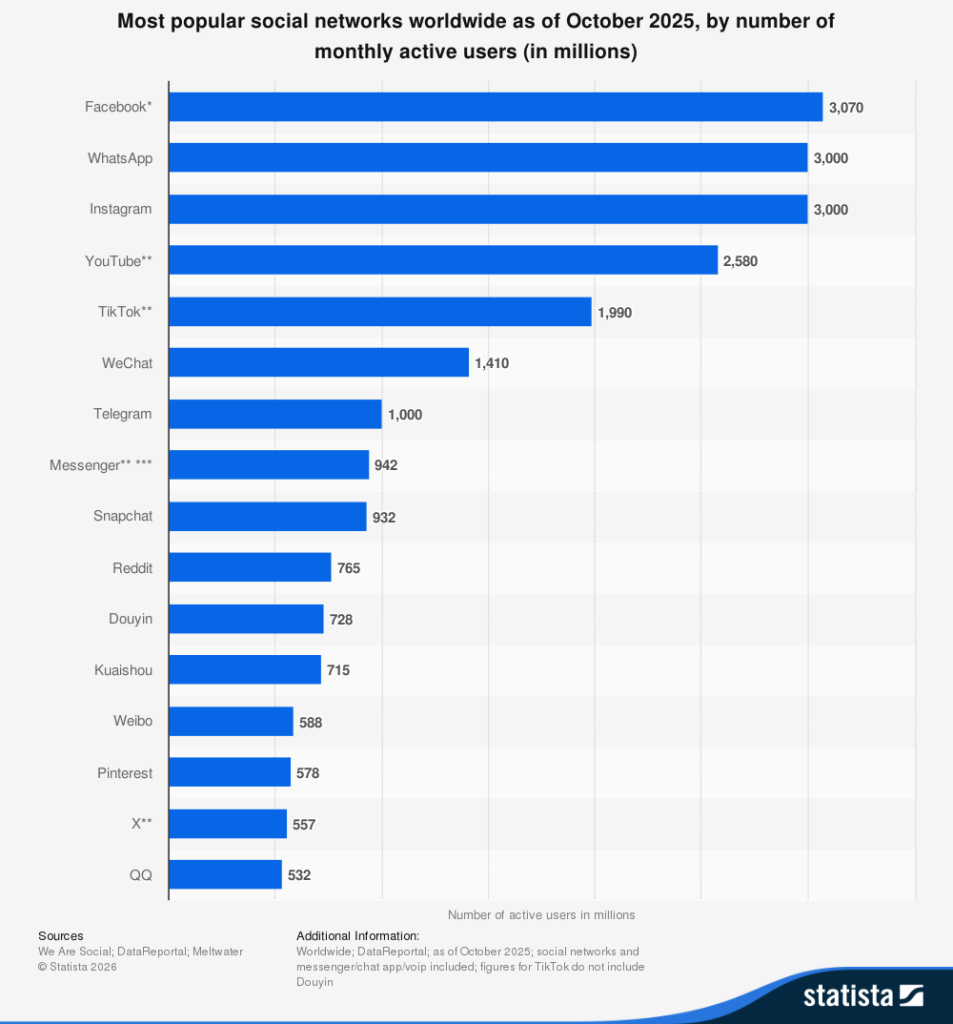
Those global titans are accountable primarily to the market and their shareholders, operating without traditional constitutional checks and balances. Legally, these platforms are private property, which in reality, they have become the essential infrastructure of our modern society. This “Lawless” environment is exactly why we now find ourselves trapped in the “Black Box”, as Nicholas Suzor (2019) and Pasquale (2015) described, of algorithmic management. Behind the opaque “Terms and Conditions” we blindly accept a set of hidden rules that prioritize engagement, data extraction, and exponential growth over the actual safety and digital rights of billions of people around the world using them. From deciding what content deserves our attention to controlling the cloud infrastructure where our digital lives are stored, they operate with a level of authority that often feels lawless.
This shift reveals the hidden complexity of connectivity. While we succeeded in linking billions of people, we failed to anticipate the systemic fallout in which stamped an era of deep polarization and rampant misinformation. Platforms have evolved from neutral message boards into active architects of discourse, where algorithms, like those on X (formerly Twitter), are fine-tuned to dominate our feeds. This is the calculated byproduct of an insatiable appetite for growth, proving that tech titans prioritize engagement over accountability as the real-world consequences. It is indeed a fundamental flaws of governance.
The evolution reached a tipping point where the “world changed tech” just as much as “tech changed the world”, including children’s playground that shifts to digital spaces. The big question we face, as a digital society, is what role we want platforms to play in governing our lives (Gillespie, 2018). Growing up alongside the boom of Big Tech was exhilarating, but looking back, it was also deeply confusing. The playground wasn’t always perfect.
The Age of Global Techlash and the World Response.
It is now a difficult time to be a social media giant. After decades of operating with near impunity, the Titans of Tech are finally facing what Terry Flew (2021) describes as the “Global Techlash.” Borrowing the term from a 2017 article in The Economist, Flew argues that a cocktail of platform safety failures, a systemic lack of transparency in content moderation, and a growing public hunger for more democratic digital spaces has reached a boiling point. As the result, a massive wave of legislation aiming to replace the “wild west” of self-regulation with formal, government-led governance mechanisms. From the rigid oversight of the European Union’s AI Act to the high-stakes battles over copyright and hate speech, the message is clear: the era of the platforms’ “absolute discretion” is coming to a close.
This resentment started in the fires of repeated scandals that proved the “neutral playground” was actually a data mine. The Cambridge Analytica scandal back 2016-2017 remains a cautionary tale, revealing how Meta (then Facebook) allowed the personal data of over 50 million users to be harvested without consent for political profiling for the US electoral campaign. It was the moment the world realized that our “private” social connections were being sold as a commodity to the highest bidder.
More recently, the 2024-2025 multi-state lawsuit against Meta has doubled down on this critique. Dozens of states alleged that Meta intentionally designed Instagram and Facebook to be addictive to children, deploying features like the “infinite scroll” and “near-constant alerts” while downplaying documented harms to youth mental health. These cases provided the smoking gun: that the “Black Box” model was predatory.
This techlash has triggered a global domino effect. This global domino effect is perhaps most visible in the European Union, which has positioned itself as the world’s most rigorous “digital sheriff.” The EU has moved to surgically remove the tools of political polarization back through Digital Service Act. Under new transparency rules, platforms are now strictly regulated in how they display political advertisements, with a near-total ban on the use of sensitive personal data, like your religion or sexual orientation, to “micro-target” you with political propaganda.
Furthermore, the landmark EU AI Act has established a red line against the “Black Box” of automation. It bans AI systems that engage in social scoring or “manipulative subliminal techniques,” and places heavy restrictions on high-risk AI usage in public spaces. These regulations signal a shift away from the “Lawless” era. They suggest that if a platform cannot prove its AI is safe and its advertising is transparent, it simply does not have the “social license” to operate within The Union’s borders.
The trend of “de-platformizing” the internet soon mutated into a focus on the most vulnerable users: children. Australia officially became the global pioneer for this trend when it passed the Online Safety Amendment (Social Media Minimum Age) Act in late 2024, with the world-first ban taking effect on December 10, 2025. Under this regulation, giants like TikTok, Instagram, and X are prohibited from allowing anyone under 16 to hold an account, regardless of parental consent. What makes the Australian model particularly striking is its “platform-centric” enforcement, as the law threatens tech titans with staggering fines of up to A$49.5 million if they fail to take “reasonable steps” to prevent underage access.
While the government frames this as a “duty of care” to protect the mental health of the next generation, it has ignited a fierce debate over Digital Rights. To prove compliance, platforms are now forced to implement invasive age-assurance technologies, such as facial scanning. As a classic “Privacy Trade-off”, the Government frames it to keep children safe from algorithms, while we might be handing their biometric data to the very titan companies we no longer trust.
In Indonesia, as the largest social media market in Southeast Asia, the response has been even more dramatic. Rather than a total blanket ban like Australia’s, the Government of Indonesia introduced the Child Protection in Digital Space Regulation (PP Tunas). Passed in March 2025 and fully implemented just last month in March 2026, PP Tunas represents a fundamental shift in how the state views its role in the digital ecosystem. Under the leadership of Minister Meutya Hafid, the Indonesian government has categorized “Mega Titans” like YouTube, TikTok, Meta’s suite, X, and gaming giants like Roblox and Bigo Live as “high-risk platforms” for minors. Meutya Hafid’s justification cuts right to the heart of the power imbalance of the digital platforms: the government is no longer willing to let parents “fight the algorithm giants alone.” By restricting children under 16 from accessing these specific high-risk platforms, the state is attempting to dismantle algorithmic influence by sheer regulatory force.
As PP Tunas comes into effect, platforms are scrambling to adapt. Roblox, for instance, has already attempted to comply by introducing “additional controls” for content and communication features for its younger players. But we have to ask: is this enough? Or is it merely a superficial fix for a structural problem? When a platform simply “adds a filter,” does it actually change the addictive nature of its architecture?
As we watch this rollout, we must confront the question Tarleton Gillespie (2018) poses: what role do we actually want these platforms to play in governing our lives? While the government’s intervention feels like a necessary rescue mission, Nicholas Suzor (2019) warns that tech companies have become the “preferred way to enforce the law” because they can cheaply influence billions of users at once.
However, this efficiency always comes at the cost of due process. New laws around the world are imposing tough requirements on how the industry deals with personal data, hate speech, and copyright. But by forcing platforms to act as the state’s digital gatekeepers, we are moving from a “Lawless” corporate playground into a highly regulated state fortress.
In this fortress, the state and the platforms negotiate the boundaries of our digital lives behind closed doors. The Titans of Tech, known for using neuroscience to keep users addicted through the “infinite scroll,” are now being asked to use that same power to “protect” us. In this scenario, the central question remains: are the users, especially the children this law aims to protect, truly being heard as citizens with rights, or are they just being managed as risks to be mitigated?
Co-Regulation and Reclaming the Agency
The relationship among users, The Government, and Digital Platforms is one of the most thought-provoking puzzles of our era. Researchers call this as the “Privacy Paradox” (Chen & Cheung, 2018). We fear surveillance yet “pay” for digital life with our intimate data. Under the guise of “guarding” children, tech giants rake in billions while building a biometric “Black Box” we can neither see nor challenge. In this digital age, children’s safety has become the ultimate excuse for a total data enclosure
To move beyond symbolic gestures, we must change the rule of the game. If the “Titans of Tech” used neuroscience (Jonathan Haidt, 2025) to engineer addiction through infinite scrolls, we must use that same science to reverse the effect. I propose the notion that co-regulation is the only viable path to reduce the toxicity of algorithmic governance. We need a “Whole-of-Government” approach where the state and platforms collaborate to “nudge” the digital environment toward health rather than dopamine-driven dependency.
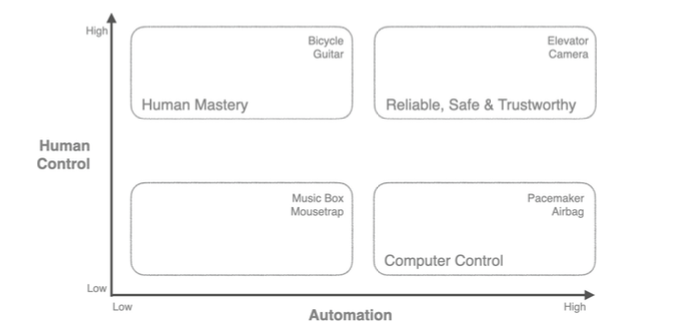
This shift requires Ben Shneiderman’s Human-Centered AI (HCAI) framework (2022). Shneiderman argues that AI should “amplify, augment, empower, and enhance” people, not replace human agency. By prioritizing human control, reliability, safety, and trust, we can replace “Lawless” automation with accountable design. Instead of blanket bans that push children into unmonitored corners, co-regulation should mandate “Safety-by-Design” features that return agency to the user.
We can “reverse-engineer” addiction by implementing neuroscience-backed nudges: First, technical automatically shifting a screen to black-and-white (grayscale) after an hour of use to reduce the visual “reward” of the interface. Second, implementing mandatory “blackout” screens or “forced friction” during late-night hours to break the infinite scroll loop. Third, moving away from secret, engagement-based ranking to a system that is “reliable” and backed by independent oversight to more chronogically contents.
True digital governance respects a child’s right to participate while ensuring the space is safe, fair, and humane. If neuroscience was used to make us stay, it can certainly be used to help us leave.
Reference List
Chen, Z.T., Cheung, M. Privacy perception and protection on Chinese social media: a case study of WeChat. Ethics Inf Technol 20, 279–289 (2018). https://doi.org/10.1007/s10676-018-9480-6
Flew, T. (2021). Regulating platforms. Cambridge: Polity Press.
Flew, T., & Gillett, R. (2021). Platform power and policy in transforming media environments. Media International Australia, 178(1), 7–18.
Gillespie, Tarleton (2018). Custodians of the Internet: Platforms, Content Moderation, and the Hidden Decisions That Shape Social Media, first edition (Yale University Press, 2018), 14-15.
Haidt, J. (2024). The Anxious Generation: How the Great Rewiring of Childhood Is Causing an Epidemic of Mental Illness. Penguin Press.
Pasquale, Frank (2015). The Black Box Society (Harvard University Press, 2015).
Shneiderman, B. (2022). Human-Centered AI. Oxford University Press, Oxford.
Suzor, N. P. (2019). Lawless: The Secret Rules That Govern Our Digital Lives. Cambridge University Press.
The Economist. (2017, August 10). Internet firms face a global techlash. https://www.economist.com/international/2017/08/10/internet-firms-face-a-global-techlash
Cadwalladr, C., & Graham-Harrison, E. (2018, March 17). Revealed: 50 million Facebook profiles harvested for Cambridge Analytica in major data breach. The Guardian. https://www.theguardian.com/news/2018/mar/17/cambridge-analytica-facebook-influence-us-election
Office of the Attorney General. (2023, October 24). Attorney General James and multistate coalition sue Meta for harming youth. [Press release]. https://ag.ny.gov/press-release/2023/attorney-general-james-and-multistate-coalition-sue-meta-harming-youth
European Commission. (n.d.). DSA: Impact on online platforms. European Commission – Shaping Europe’s Digital Future. Retrieved April 15, 2026, from https://digital-strategy.ec.europa.eu/en/policies/dsa-impact-platforms
eSafety Commissioner. (2025). Social media age restrictions. Australian Government. https://www.esafety.gov.au/about-us/industry-regulation/social-media-age-restrictions
Reuters (2026, March 25). Roblox will introduce new controls in Indonesia to comply with child social media laws. Reuters. https://www.reuters.com/world/asia-pacific/roblox-will-introduce-new-controls-indonesia-comply-with-child-social-media-2026-03-25/
BBC News. (2024, November 7). Australia to ban social media for children under 16. https://www.bbc.com/news/articles/c89vjj0lxx9o

Be the first to comment