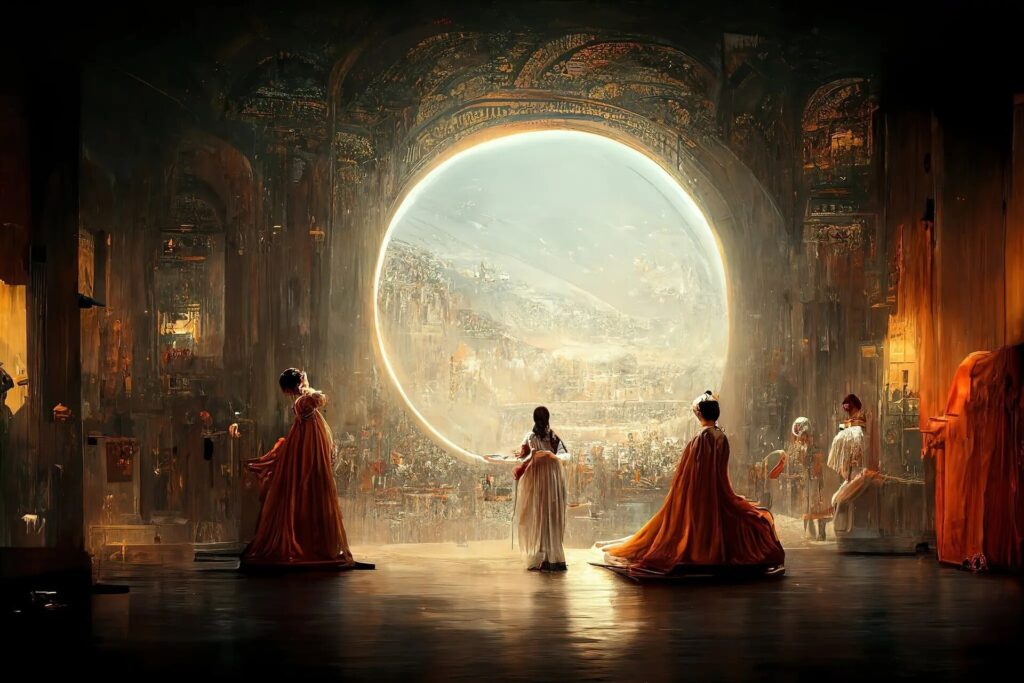
The AI artwork Théâtre D’opéra Spatial, generated by Jason M. Allen using Midjourney (Source: https://commons.wikimedia.org/wiki/).
Is AI Coming for Creative Jobs?
Have you noticed that in 2026, as AI continues to develop at an incredible speed, the once widely discussed “tool AI” has begun to move into the realm of artistic creation? You may see traces of AI everywhere—from your friends’ profile pictures to recommended posts on online platforms and illustrations on various art websites—often accompanied by mixed praise and criticism. The efficiency of AI is astonishing: within just a few seconds, it can produce works that might take human creators hours to complete. If you are someone who loves art, would this make you feel anxious? If AI can create images and stories within seconds, will human creative workers eventually become obsolete?
Although AI-generated art tools are rapidly transforming creative industries, they are unlikely to fully replace human creativity. However, it is undeniable that the emergence of AI is bringing changes to the creative industry, particularly by reshaping the freelance art market—automating certain tasks, lowering barriers to image production, and raising new concerns about copyright, labour, and digital rights.
What Is AI-Generated Art?
To understand AI-generated art, it is first important to understand what AI actually is. The term AI refers to artificial intelligence, a technology capable of performing a wide range of tasks closely related to everyday life, including chatting, organising data, and even creating visual artworks. But how does it work? At its core, relies on algorithms. An algorithm can be understood as “a set of rules and processes established for calculation, data processing, and automated reasoning” (Flew, 2021). In simple terms, an algorithm is a set of instructions that tells a computer how to process information and produce results. Based on these algorithms, AI systems combine large amounts of data with strong computing power to recognise patterns and generate outputs.
But how can AI produce works that appear to demonstrate human-like creativity? AI image generation tools such as Midjourney and Stable Diffusion are trained on massive datasets of images. Machine-learning algorithms analyse patterns within these datasets—such as colours, shapes, and artistic styles—and then generate new images based on the text prompts provided by users. From this perspective, AI does not “create” art in the same way humans do. Instead, it recombines patterns learned from existing data through an algorithmic process.
How Freelance Artists Make a Living Online?
Before the rise of digital platforms, the illustration industry largely relied on institutions such as publishing houses, advertising agencies, or game companies to provide stable employment opportunities. Today, however, more and more illustrators work as freelancers and take commissions online, giving rise to a digital creative labour market. In this model, creators use online platforms to find clients and job opportunities, while the platforms themselves act as intermediaries connecting the two.
In China, many freelance illustrators receive commissions through specialised commission platforms, the most well-known being Mihuashi and Huajia. These platforms allow clients to post requests, browse artists’ portfolios, and contact illustrators, while also providing artists with opportunities to showcase their work and obtain commissions. Similar models also exist in Europe and North America, where artists often accept private commissions through online communities, commission platforms, or social media. More broadly, this form of work that relies on digital platforms to obtain employment can be understood as a form of the platform labour economy.
Within this market structure, many freelance illustrators specialise in ACG (animation, comics, and games) styles. Typically, clients first present their requirements, after which artists create customised illustrations and receive payment. The process usually includes several stages—such as sketches, line art, colour drafts, and the final artwork—to align the client’s expectations with the final result. In other words, before the emergence of AI image generation technologies, the creation of commissioned illustrations mainly depended on the skills and time investment of human artists.
What Happens When AI Starts Making Art?
As discussed earlier, with the help of text prompts, ordinary users can now quickly generate images that match their needs using tools such as Midjourney or Stable Diffusion. The development of this technology has reduced some of the demand that previously required commissioning illustrators to create customised artworks. Some researchers have described this shift as the automation of creative labour. At the same time, AI image-generation tools have lowered the barriers for ordinary people to access and engage in visual creation, allowing more users to obtain personalised visual content at a lower cost.
However, these changes have also had a noticeable impact on the freelance illustration industry. From an economic perspective, some illustration tasks that were previously completed by human artists are now being replaced by AI-generated images. This has led to a decline in commission opportunities and has, to some extent, pushed down market prices. For artists who have just entered the industry and whose skills are still developing, this competitive pressure can be particularly significant, and some may even lose the motivation to continue pursuing creative work due to changes in the market environment.
In addition, the development of AI-generated art has also raised concerns about the sources of training data and copyright issues. It is undisputed that the works in the training datasets have been copied without permission from, or payment to creators (Otmar et al., 2024). As a result, many artists view this practice as plagiarism or improper use of their work, which has led to protests and collective resistance in different parts of the world. In the private commission market, many ACG artists argue that AI-generated images are an insult to “human art”, while in commercial illustration markets, the increasing use of unauthorised AI-generated images has resulted in a large number of low-cost, mass-produced illustrations (Luo, 2024).
From a technical perspective, these controversies also reveal an important characteristic of AI creation: AI systems themselves do not possess real creative experience, but instead rely heavily on training datasets to learn visual patterns. In this sense, AI-generated images are closer to an algorithmic recombination of existing visual styles rather than genuine artistic creation. Furthermore, although AI image generation is fast and inexpensive, it still struggles to meet complex design requirements. In fields that require highly consistent visual logic, storytelling, or refined aesthetic judgement—such as professional illustration and design—AI often cannot fully satisfy the detailed expectations of creators or clients. This also suggests that, at least for now, AI does not have the ability to fully replace human artists.
When an AI Painting Won an Art Competition……
In fact, AI art had already stirred controversy in the mainstream art world. In August 2022, at an art fair held in Colorado, the artwork Théâtre D’opéra Spatial (translated as Space Opera Theater) won first place in the digital art category. The work was generated by American designer Jason M. Allen using the AI image generation tool Midjourney, and was later refined using Adobe Photoshop. The event quickly sparked heated debate online, with many artists accusing Allen of violating the spirit of artistic creation and comparing the act to cheating.
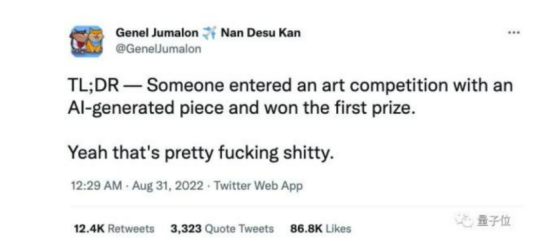
Source: The Paper (2022), https://m.thepaper.cn/baijiahao_19787969
Allen, however, stated that he had not deceived anyone and had complied with the competition rules, and insisted that he would not apologise. At the same time, others argued that the boundaries of art would expand alongside technological progress, and that AI-generated art should therefore be accepted with a more open attitude.
This event also raises questions about the boundary between AI and human creativity. Is AI truly redefining what “creative” means, or is it simply acting as a mirror that reflects the vividness and value of human emotion? The key difference between the two lies in the fact that AI lacks creative intention and does not possess context—such as an artist’s inspiration, identity, purpose, or the historical context of a work. Instead, AI primarily recombines existing visual elements.
In contrast, human artists’ creative practice is deeply rooted in emotional experience. Painting is not only a representation of the “seen world,” but also a response to the “felt world.” In works created by human hands, emotions are translated into perceptible expression through composition, colour choices, and brushstroke intensity. Even when working with the same theme, different artists will produce entirely different visual languages due to their unique life experiences and emotional states. This variability is precisely what makes human art difficult to replicate.
Therefore, painting is not merely a process of image production, but also a form of emotional externalisation and communication. When viewers engage with a work, they are, to some extent, entering into a dialogue with the artist’s emotions. In contrast, although AI can imitate styles and recombine visual elements, it struggles to truly carry the depth of emotional experience rooted in lived human life.
This also relates to the value of creative labour. The value of artwork often comes from originality, rather than simply assembling appealing results through formulaic structures or rhetorical techniques. Even when users provide text prompts to describe the desired image, this process is more like giving AI a direction rather than engaging in a complete creative act. The final output is still the result of algorithmic interpretation and recombination of existing data, not a work produced through an artist’s series of aesthetic judgements and creative decisions.
Japanese animation director Hayao Miyazaki also once stated in the documentary The Kingdom of Dreams and Madness: “I would never want to incorporate this (AI-generated art) into my work. I feel it is an insult to life itself. I feel we are reaching the end of an era where humans have lost faith in themselves.”
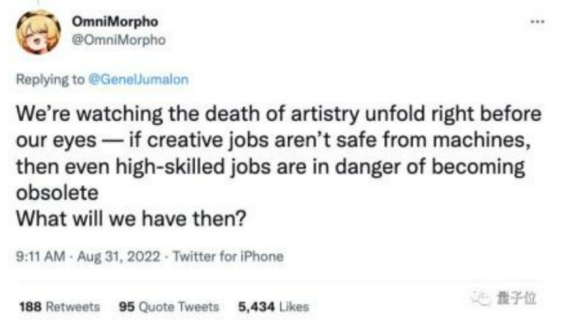
Source: The Paper (2022), https://m.thepaper.cn/baijiahao_19787969
From this, we can see that because the creator is not a human, AI-generated works lack the artist’s personal emotional investment and “spiritual projection.” At the same time, AI is also unable to truly generate a unique individual style, as it can only produce images based on existing styles created by others. In this sense, this process may dilute the value of the art market, which has traditionally been built on the distinctiveness of individual artistic style. Against this background, whether AI-generated works should be allowed to participate in art competitions remains an unresolved and ongoing debate.
What is the future of AI art?
As AI image generation technology continues to develop, an increasingly important question is: how should AI art be governed and positioned in the future? From the perspective of Digital Policy & Governance, this is not only a technological issue, but also a broader social question about market structures and the distribution of power. As Kate Crawford argues in The Atlas of AI, artificial intelligence systems are fundamentally “political,” because they reshape how resources, power, and opportunities are distributed in society.
In the context of art, this means that technology platforms gain increasing influence in the creative industry through the development of generative models. With the widespread use of tools such as Midjourney, the barriers to image production have significantly decreased, making visual content creation more scalable and automated. This shift is reshaping the creative labour market, forcing creators to renegotiate their position within a rapidly changing technological environment.
As a result, some have begun to question whether governments and platforms need to establish clearer governance frameworks for AI-generated content. For example, policymakers may need to consider how to encourage technological innovation while preventing platforms from gaining excessive control over the creative market. However, at the same time, many creators have already begun using AI tools as assistive instruments. The future of art production may therefore increasingly take the form of coexistence between human creators and AI tools, not a fully machine-dominated creative industry.
So, will AI replace artists? Probably not—whether from a technical perspective or in terms of artistic value, AI art still finds it difficult to reach the level of human artists. However, it has undeniably entered the art world as a convenient and widely accepted tool. Rather than reaching a simple outcome, the future of AI art is still being contested. What is clear, however, is that this is not just a technological shift, but a broader transformation of creative labour, power, and value that is still unfolding.
Reference
Flew, T. (2021). Regulating platforms. Polity Press.
Otmar, R., Michael, R., Mullins, S., & Day, K. (2024). Ethics and the use of generative AI in professional editing. AI and Ethics.
Luo, L. (2024). Research on workplace strategies of female ACG freelance illustrators from the perspective of field theory [Master’s thesis, Northwest Minzu University].
Crawford, K. (2021). The Atlas of AI: Power, politics, and the planetary costs of artificial intelligence. Yale University Press.
Be the first to comment