
Many people think that cyber violence is nothing more than quarreling and cursing in the comment section, and closing the page may be over.
However, the controversy over the “doxxing” of Baidu Vice President Xie Guangjun’s daughter in March 2025 makes it difficult for people to take this matter lightly. According to Reuters, the storm was originally just a dispute on the Internet, but later it developed into the leakage of other people’s privacy information, the rapid spread of public opinion, and the continuous cyber attack of the parties. Baidu denied internal data leakage, saying that the relevant information came from illegal overseas “doxxing databases”, and said that employees and executives had no right to access user data (Reuters, 2025).
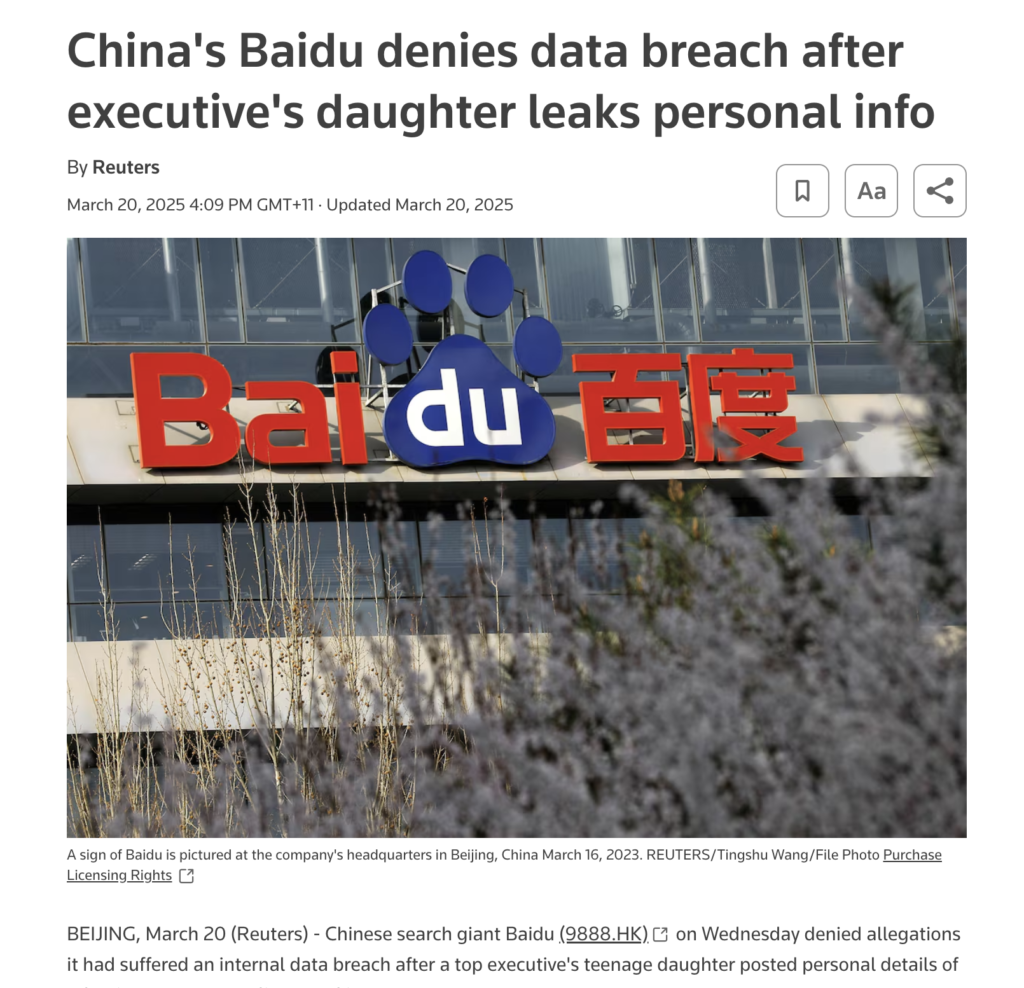
This matter has attracted great attention, not only because of the special identity of the protagonist, but also because it leads to a more important problem: Why does a seemingly ordinary online disagreement turn into personal information exposure, harassment and reality threats so quickly? Platforms often describe themselves as spaces that support freedom of expression, but the truly difficult problem is not the expression itself, but when the expression has turned into online harms, can the platform still continue to position itself as a merely neutral “speaking space” (Flew, 2021). Flew (2021) directly put “hate speech and online abuse” into one of the key issues of platform governance in Regulating Platforms, which reminds us that the problem is never just “whether “Rights”, but whether the platform is still willing to assume responsibility and accountability after the speech has caused harm (Flew, 2021). In other words, what is really worth asking is not what users say, but how platforms can make these contents seen, forwarded, screenshotted, attached, and finally amplified into harm.
What exactly is “doxxing”?
The most easily misunderstood part of “doxxing” is that it is often said to be an “upgraded version of cyber violence”. But what’s really terrible about it is that it turns personal information into an attack gateway. Once the identity information of name, phone number, address, school, social media account, work unit, and even family members is made public, it will no longer be just information, but will become a material for onlookers, humiliation, abuse and continuous harassment. Its danger is not to leak a message, but that the damage will spread rapidly after the information is leaked. It links privacy invasion, online abuse, group pile-on and offline intimidation together to form a chain of harm.
This is also why it can’t just be regarded as users’ emotional out of control, or that some people say too much on the Internet. When discussing hate speech and online abuse, Flew (2021) emphasized that the problem is not whether speech is “sharsh”, but whether it will repeat, spread, and cause long-term harm to specific individuals or groups (Fle W, 2021). In China’s cyberspace, Guan and Chen (2025)’s analysis of threat perception and otherness is also very helpful. Cyber hostility often does not break out randomly, but gains the power of collective mobilization by shaping certain people into “problemful”, “threatening” or “worthy of being targeted” (Guan & Chen, 2025). In this sense, the most dangerous part of “opening the box” is not just information leakage. Instead, it will quickly tell the onlookers that this person deserves to be chased.
Is the question really just “Everyone talks too much”?
The platform likes to advertise that it provides an open free speech or freedom of expression space. You can speak, comment, refute, forward, and even “speak truth to power”. But platform speech is never single. It is always tied with algorithms, comment areas, hot searches, group chats, forwarding, private messages, and screenshot diffusion mechanisms. That is to say, speech is never just “a word” on the platform, but is sorted, recommended, seen and amplified. Because of this, once speech is tied together with doxxing, harassment, misinformation and even extremist content, the question is no longer just “can you say it”, but “speech under what conditions will hurt others” (Flew, 2021).
If Week 6 lecture has been reminding us of the tension between freedom of expression and online harms, then “doxxing” is almost one of this tension extremely examples. On the surface, it looks like a group of users are “expressing opinions”, “reasoning” and “exposing each other”. But in fact, it relies on the disclosure of personal information, the emotional mobilization of onlookers, and the visibility structure on the platform. When discussing hate speech in China’s cyberspace, Guan and Chen (2025) pointed out that the expression of hostility is often combined with identity construction, threat perception and altrification processes. This means that the so-called “expression” on the platform does not always exchange opinions equally, and it may also push an individual or group to a position of being stigmatized, humiliated and excluded (Guan & Chen, 2025). Therefore, the question is not only what users say, but whether platforms will make certain speech easier to be amplify, and finally change from free expression to harm.
Why does the platform amplify the damage?
First, platforms are not the background board. The reason why the malice of a few people can escalate into collective harm is that the platform gives them the conditions for circulate. The comment area can be pile-on, group chat can organize siege, screenshots can be spread twice, and the popularity mechanism will make the controversy more and more visible. Second, having rules does not mean having governance. Many platforms have written anti-harassment, anti-privacy infringement and anti-bullying content policies, but the real key is whether these rules are implemented in a timely manner and consistently. Third, platform architecture itself may become an amplifier of harm. Massanari (2017) put forward the concept of “toxic technocultures” when analyzing Reddit, explaining algorithm, governance and community culture It will jointly support the continuous circulation of harmful behavior. Sinpeng et al. (2021) also pointed out when studying how Facebook governs hate speech in the Asia-Pacific region that although the platform has improved its ability to identify and respond to hate speech, it is still difficult to fully identify context-dependent The form of injury, and the execution is not always consistent (Massanari, 2017; Sinpeng et al., 2021).
In other words, “doxxing” is not a few people who suddenly lose control, but the platform makes this out of control faster, bigger and more difficult to stop. Looking at the Baidu incident from this perspective, it has actually triggered three layers of discussion: first, how users use leaked information to commit online abuse against others; second, how the public can quickly turn the controversy into data gover Nance and platform trust; Third, why such problems eventually return to “platform responsibility”. Reuters reports show that the controversy quickly expanded from an online argument to a broad discussion about Baidu data security and corporate responsibility (Reuters, 2025). That is to say, although the enterprise denies that the data comes from within, it will still raise public questions about the platform’s data protection, reporting mechanism, content review and harm response.
Why does China specialize in “doxxing”?
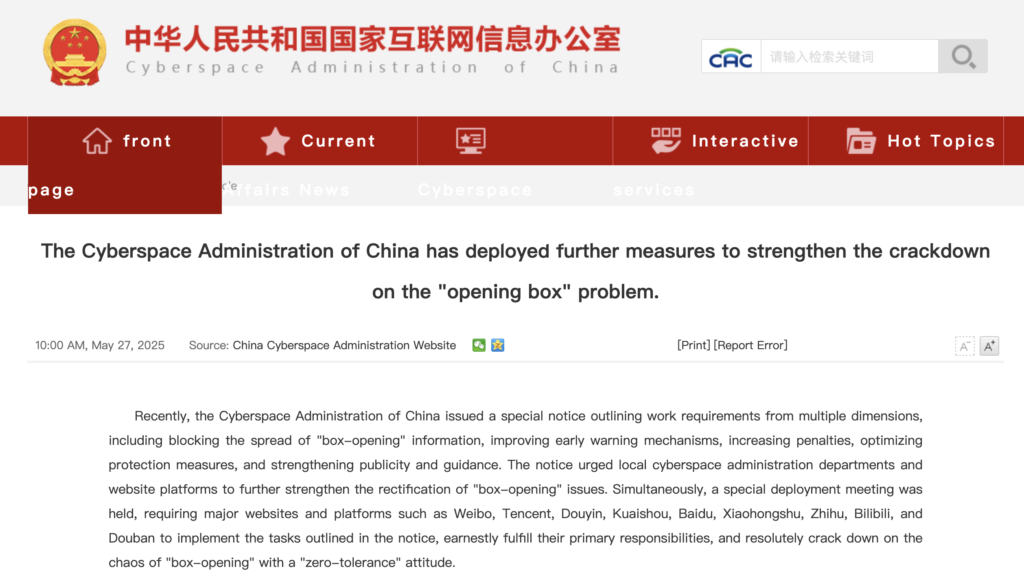
If the Baidu incident has put the “doxxing” issue into a broader public discussion, then the network information department will further deploy and rectify the “doxxing” in May 2025, which means that this issue has been clearly put into the framework of policy and governance. According to the notice issued by China Netxin.com, the regulatory department requires strengthening rectification from multiple dimensions such as blocking the “doxxing” information dissemination, improving the early warning mechanism, increasing punishment, optimizing protection measures, strengthening publicity and guidance, and calling Weibo, Tencent, TikTok, Kuaishou, Baidu, Xiaohongshu, Zhihu, Bilibili, Douban And other key platforms to implement and earnestly fulfill the main responsibility; the notice also mentioned that the relevant illegal information has been comprehensively cleaned up in the early stage, accounts and groups have been strictly disposed of, and three large-scale website platforms have been punished in accordance with the law (Cyberspace Administration of China, 2025).
Supervision is no longer just a certain illegal content, but the whole chain of harm – from the illegal acquisition of personal information, to dissemination, comment incitement, group organization, to victim protection and rapid response. This is just in response to the issue emphasized by Sinpeng et al. (2021): platform governance should not only stop at the presence or absence of rules, but must be implemented in actual implementation, local context understanding and high-risk content processing. For the harm of “doxxing”, if the management only waits until the content has been viral and then slowly deletes the post, it is actually equivalent to letting the harm complete the dissemination first and then remedy it. Therefore, China’s rectification of “opening the box” clearly tells the platform that this kind of harm can no longer be regarded as users’ own business, but online safety issues that you must be responsible for.
Is it really enough to delete the post?
Deleting a post does not prevent human flesh search attacks. By the time the content is deleted, it may have been screenshotted, forwarded, quoted and spread elsewhere. Therefore, content review is very important, but you can’t just rely on review. Many people think that moderation is just deleting posts in the background, or the platform “deal with it when something happens”. However, when Roberts (2019) studied commercial content moderation, he emphasized that this is not ancillary work, but how the platform governs visibility, risk and participation. The core mechanism of n (Roberts, 2019).
How should the platform be responsible?
First, the platform should block the spread faster. For doxxing, the response speed itself is part of the protection. Second, the platform should protect the victims more effectively. Quick reporting entrance, temporary restrictions on forwarding and comments, privacy protection, risk tips, victim support, these are not “additional functions”, but basic governance responsibilities. Third, the platform should be safely written into the system. Truly mature governance is not only to delete posts after the fact, but also to reduce the opportunity of personal information being used as a weapon, besieged and organized, and harassment to be continuously amplified from the beginning. Week 6 lecture proposes duty of care and safety by design, which is actually pushing the discussion from content policies to more systematic risk management. The notice of China’s Cyberspace Department in 2025 also emphasizes rapid reporting, risk warning and upgraded protection measures, which is highly consistent with the direction of “embedding security into the platform mechanism” (Cyberspace Administration of China, 2025). In the end, if platforms already have the ability to design recommendations, manage comments, handle reports, and limit the speed of dissemination, they certainly also have the ability and responsibility to embed safety into these systems. Sinpeng et al. (2021) remind us that if the rules are not implemented, it is difficult to really deal with local hate speech and online abuse; Roberts (2019) reminds us that moderation from It is all part of platform governance, not additional services; Flew (2021) pulls all this back to the core of platform regulation: the platform cannot only enjoy scale, traffic and participation, but also avoid the public responsibility brought about by it.
Conclusion: If the platform shapes the public space, it can’t just enjoy the traffic.
The reason why “unboxing” deserves serious discussion is not only because it is cruel. It is because it clearly illuminates an inherent problem: networked harm is never just the out-of-control of individual users, but the result of the joint effect of platform structure, information circulation, privacy protection and governance response.
It is not against freedom of expression. The real question is whether platforms can continue to use the language of free speech to avoid their responsibility in the process of online harms, harassment and doxxing being amplified.
If the platform determines who is more likely to be seen, who is more likely to be besieged, and who is more likely to be unprotected, then it does not only provide a space for expression. It also shapes the conditions for injury.
References
Cyberspace Administration of China. (2025, May 27). 中央网信办部署进一步加强“开盒”问题整治工作 [Cyberspace Administration of China deploys further measures to strengthen the regulation of doxxing-related problems]. https://www.cac.gov.cn/2025-05/27/c_1749968642745140.htm
Flew, T. (2021). Hate speech and online abuse. In Regulating platforms. Polity.
Guan, T., & Chen, X. (2025). Threat Perception, Otherness and Hate Speech in China’s Cyberspace. Journal of Contemporary China, 1-16.
Massanari, A. (2017). #Gamergate and The Fappening: How Reddit’s algorithm, governance, and culture support toxic technocultures. New Media & Society, 19(3), 329–346.
Reuters. (2025, March 20). China’s Baidu denies data breach after executive’s daughter leaks personal info. https://www.reuters.com/technology/cybersecurity/chinas-baidu-denies-data-breach-after-executives-daughter-leaks-personal-info-2025-03-20/
Roberts, Sarah T. (2019) Behind the Screen: Content Moderation in the Shadows of Social Media. New Haven, CT: Yale University Press.
Sinpeng, A., Martin, F., Gelber, K., & Shields, K. (2021, July 5). Facebook: Regulating hate speech in the Asia Pacific. Final Report to Facebook under the auspices of its Content Policy Research on Social Media Platforms Award. Dept of Media and Communication, University of Sydney and School of Political Science and International Studies, University of Queensland.
Be the first to comment