Introduction
Rednote (the official name of Xiaohongshu), as one of China’s largest social media platforms, boasts hundreds of millions of users and is used by nearly everyone in China. In 2025, following the U.S. ban on TikTok, the platform unexpectedly attracted a massive influx of “TikTok refugees”. And briefly topping the U.S. App Store charts very quick. With such a massive user base, the platform’s issues have gradually begun to surface.

Fig 1. Rednote platform interface (WPIC, 2026)
Looking at Rednote’s annual report, how much time have you spent on the platform? Have you ever opened Rednote at midnight looking for a specific product, only to find yourself spending hours browsing highly personalized recommendations? This platform, which claimed “Inspire Lives: Share and discover the wonders of the world.(Xiaohongshu, n.d),” appears to encourage users to share their life experiences. In fact, it is heavily influenced by data collection and algorithmic systems. Although Rednote claims to be a user-generated content platform, but the podcast argues that it is a data-driven commercial system. Rednote transforms everyday sharing into targeted advertising and algorithmic push notifications. This has raised serious concerns about privacy and digital rights.
The podcast will explore how users data is collected, repurposed, and analyzed on Rednote without users’ awareness and shaping consumer behavior in ways users rarely see.
Rednote’s unfair terms and privacy collection practices
In social media platforms, user behavior is not only bound by law, but also subject to dual regulations from the platform’s Terms of Service (ToS) and technical design. However, this “platform governance” is essentially a form of private power. It granting the platform significant discretionary authority while offering users virtually no substantive rights. This will raising serious issues regarding digital rights and fairness.
When registering a Rednote account, each user is required to sign a ToS, which most people don’t read carefully due to the large amount of dry and complex text. However, this document is actually very important. It include user privacy management, collection rights, legal responsibilities, account management, etc. (Xiaohongshu, 2025). Simply put, the Term of Service is the platform granting you usage rights, and you accepting its rules. Whether it’s Rednote or other software, users are given the option to agree to the terms . Ironically, users seem to have a choice, they are still ultimately controlled by the platform. When people press the “disagree” button, they are refused access to Rednote or other software. In other words, to use the Rednote platform, one must unconditionally accept all the platform’s terms, with no room for negotiation. The user’s only right is to “leave”. So, we can say that social media platforms have extensive control over user behavior through their terms of service. These terms of service are more like contractual agreements than democratic governance structures (Suzor, N. P., 2019). Platform terms and conditions rarely restrict those in power. They grant platforms enormous discretion but give users almost no real rights.
As Tan (2018) shows,
Social media platforms regulate users through contractual rules and technological.

Fig 2. Data collection image
While Rednote may resemble a public space in real-world use, it remains a commercial platform and the private property of a company (Suzor, N. P, 2019). When the company needs profit, the platform ceases to be neutral (Massanari,2017). User data is collected through the platform’s technology. Rednote records user browsing content, stay time, likes, favorites, comments, and search keywords to precisely identify content of interest. On the other hand, it digitize user information, build user profiles, and customize personalized page recommendations. However, these operations are not widely noticed. People simply feel that the platform understands their needs and that they are a perfect fit. This subtle approach makes people more interested than concerned about privacy breaches, thus creating a privacy paradox (Chen & Cheung, 2018). Even if users realize their information is being collected, they are powerless because they have signed a ToS when using the platform. Essentially, Rednote users cannot prove that their information has been illegally collected. The platform appears to offer a choice, but in reality it doesn’t.
Delving deeper, Rednote users are unaware of the extent to which their personal data is collected and what it is used for. Rednote’s collection of user profiles can be described as surveillance capitalism. The platform collects user data, uses artificial intelligence to predict and infer user behavior. Then produces content to influence that behavior. The poposal is to convert user data into commercial value. In fact, while Rednote users may accept the platform analyzing their data for personalized recommendations, the platform also uses this data for advertising, which violates contextual integrity (Nissenbaum, 2018). If Rednote were simply analyzing user information for personalized recommendations, it would benefit users and align with Respect for Context. However, from the perspective of Rednote’s commercial backend, the platform divides users into eight groups for advertisers, allowing them to target more precise audiences for advertising.
Advertising disguised as daily sharing: Rednote’s hidden deception
There are many types of advertising on social media. Some are direct advertising, and some give users free rewards after watching advertising. However, on Rednote, advertising are often hidden and hard to notice. In the Rednote community, there is a culture called “seeding” (grass-planting culture). This means users share their real experiences with products to attract more people to buy them. But the platform is not a charity. It needs to make profit. So, Rednote has developed its advertising business model. Rednote provides a platform for brands called “Pugongying” (English transfer as Dandelion). On this platform, brands can see users who have more than 3,000 followers, and see data about these users, such as their audience’s age, gender, interests, location, and user categories. With this data, brands can decide whether to collaborate with these users to promote products. Rednote then earns commission from this process. As mentioned in the podcast, this does not respect contextual integrity.
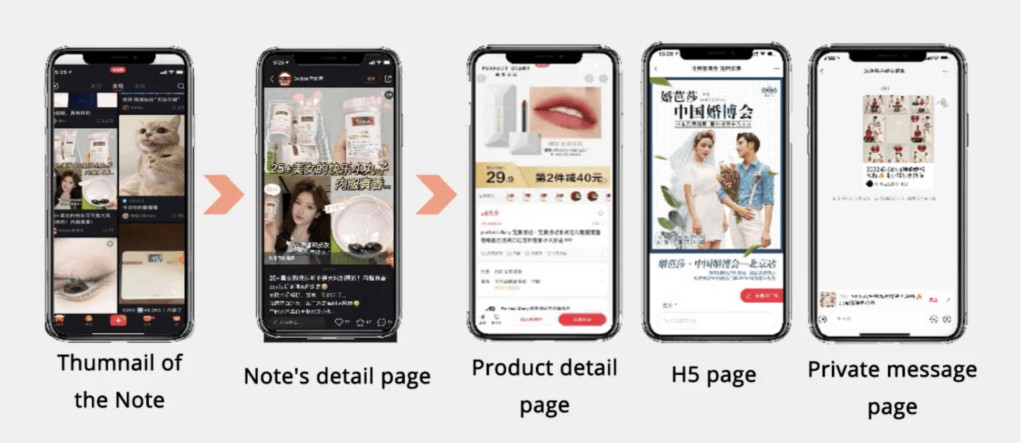
Fig 3. The process of how does Rednote advertising look like and how to make people consumption
At the beginning, advertisements were very obvious. People could easily find which content was an advertising. However, as business developed, these advertising became disguised as “real sharing” and gained a lot of likes. What you think is a “daily recommendation” is often carefully designed by brands and the platform. The platform is never neutral. Because of profit, even when it knows this content can be misleading, it does not strictly control it. Instead, it allows these ads to spread rapidly in a deceptive manner (Massanari, 2017). Users’ right to know is then diminished. What Rednote users perceive as genuine experience sharing is actually targeted marketing content. Advertising transparency is rapidly declining.
The impact of Rednote of users is not simply that there are “too many advertising,” but the adversiting are disguised as “real life.” This creates a subtle form of control over users. The platform influences what users see and what becomes popular. All of this is based on the analysis of users’ personal data and privacy information.
From market perspective, the Australian Competition and Consumer Commission report illustrate that
platforms’ collection and use of data not only affect individual privacy, but also translate into market power, conflicts of interest, and structural unfairness (ACCC, 2021).
As Rednote has become one of the most popular social media platforms in China, it continues to commercialize. Many service providers have emerged in the advertising industry, such as agencies and MCN organizations. These service providers often contact influencers directly and bypass Rednote’s official website to commercial collaborations and promote products. For brands, the advantage is that they can achieve greater returns and exposure with lower costs.
For example, if Brand A wants to promote a product, the collaboration price with User B on “Pugongying” is 30,000 RMB. The platform will also take 10% as a commission. This means Brand A needs to pay 33,000 RMB in total. However, if Brand A contacts User B through other agencies and makes a private collaborate, they may only need to pay 30,000 RMB or less. From User B’s perspective, brands will consider whether the cost brings enough return. Lower prices make it easier for brands to choose collaborate. This kind of cooperation becomes common. In the industry, this is called “under-water collaboration.” This lack of transparency in advertising creates more digital rights issues. Users cannot clearly find the content they see is an advertising or a genuine recommendation. As a result, the trust in platform becomes increasingly confused and unstable.
Emptying wallets: How Rednote controls user consumption
Platforms like Rednote can be understood as a form of algorithmic governance. Algorithms make what users see and how they interact. Then guides users’ online behavior. Many young people make impulsive purchases at midnight. While emotions may be stronger and be a fact at midnight, but it is also the platform that amplifies and guides the desire to consume, gradually weakening users’ autonomy. Rednote collects user data and uses algorithms to predict what each user likes and wants they see. Based on this, similar content is continuously pushed to their homepage. It seems like personal choice, but in fact, it is shaped by the platform. This raises concerns about freedom from manipulation.

Fig 4. Xiaohongshu’s Read-Like-Buy circle
When a Rednote user searches for “beauty products” on the platform, a large amount of related content will be pushed to the user’s personal homepage immediately. According to The Mere Exposure Effect, people tend to develop a greater liking for familiar things (ZAJONC, 1986). The same principle applies on Rednote. Users are more likely to like and purchase items they are frequently exposed to on the platform. In fact, a similar rule exists in the marketing industry, known as “The Rule of Seven”. This rule states that consumers need to be exposed to a piece of information multiple times before taking action. Rednote is a platform where this rule is highly applicable. On Rednote’s pages, users can continuously scroll to access content, which is composed of many different “notes (posts)”. Users can click on the content they want to see to obtain more information. Rednote places the same type of content or products on the homepage to quickly familiarize users with them, thereby stimulating consumption. Therefore, although it seems that users make their own consumption decisions, the platform is not neutral. It tends to favor its own interests, thereby influencing users’ consumption decisions.
Rednote, like WeChat, is a platform frequently used by Chinese people in their daily lives. Rednote users are aware that the platform collects and monitors their personal data and privacy. However, there still a lot of reasons that people must use it. This creates a privacy paradox (Chen & Cheung, 2018). Unlike single social and sharing platforms, Rednote has strong social value. New news and information often be share there first, and uses friends are also using it. At the same time, it also has information value. Rednote is more like a search engine where users can find answers to many questions. Because Rednote is one of the mainstream platforms in China, users cannot give it up, thus perpetuating the privacy paradox in a vicious cycle.
Conclusion
In conclusion, Rednote is an unavoidable platform. It has strong social attributes and practicality. However, as a commercial platform, it is not neutral. Users’ digital rights have been continuously undermined. The lack of transparency in advertising, and mandatory service terms all confirm this. At the same time, users’ privacy is collected and analyzed by the platform. This allows advertisers precisely to find target audiences, but users are often don’t know how their data is used.Clearly, displaying users’ personal data to advertisers by the platform is beyond the scope of contextual integrity. Different with governments, platform does not need to bear the legal responsibilities of users like a country, nor does it need to guarantee your civil rights on the platform. Rednot is still a private commercial companies. Therefore, privacy and digital rights still the main issues on Rednote. It need stronger social regulation and more complete legal frameworks to solve these problems.
Reference list
Tan, C. (2018). Regulating Content on Social Media: Copyright, Terms of Service and Technological Features. UCL Press. https://doi.org/10.14324/111.9781787351714
Lagioia, F., Jabłonowska, A., Liepina, R., & Drazewski, K. (2022). AI in Search of Unfairness in Consumer Contracts: The Terms of Service Landscape. Journal of Consumer Policy, 45(3), 481–536. https://doi.org/10.1007/s10603-022-09520-9
Xiaohongshu. (n.d.). About us. https://www.xiaohongshu.com/protocols/about
Xiaohongshu. (2025, January 19). User terms of service. https://agree.xiaohongshu.com/h5/terms/ZXXY20250119002/-1
Suzor, N. P. (2019). Lawless : the secret rules that govern our digital lives. Cambridge University Press. https://doi.org/10.1017/9781108666428
Massanari, A. (2017). Gamergate and The Fappening: How Reddit’s algorithm, governance, and culture support toxic technocultures. New Media & Society, 19(3), 329–346. https://doi.org/10.1177/1461444815608807
Chen, Z. T., & Cheung, M. (2018). Privacy perception and protection on Chinese social media: a case study of WeChat. Ethics and Information Technology, 20(4), 279–289. https://doi.org/10.1007/s10676-018-9480-6
Nissenbaum, H. (2018). Respecting Context to Protect Privacy: Why Meaning Matters. Science and Engineering Ethics, 24(3), 831–852. https://doi.org/10.1007/s11948-015-9674-9
Australian Competition and Consumer Commission. (2021). Digital advertising services inquiry Final report (ACCC 08/21_21-58, pp. 1–197). Australian Competition and Consumer Commission. https://www.accc.gov.au/system/files/Digital%20advertising%20services%20inquiry%20-%20final%20report.pdf
ZAJONC, R. B. (1968). ATTITUDINAL EFFECTS OF MERE EXPOSURE. Journal of Personality and Social Psychology, 9(2), 1–27. https://doi.org/10.1037/h0025848
Image reference
WPIC Marketing + Technologies. (2026). How brands use RedNote (Xiaohongshu) to drive demand & commerce in China[Image]. https://wpic.co/blog/guide-to-xiaohongshu-red-in-china/
Tripathi, D. (2023, September 14). The power of first-hand data collection: Unlocking insights and innovation [Image]. LinkedIn. https://www.linkedin.com/pulse/power-first-hand-data-collection-unlocking-insights-deepak-tripathi/
Nanjing Marketing Group. (2024). How to advertise on Rednote (Xiaohongshu) [Image]. https://nanjingmarketinggroup.com/blog/how-to-advertise-on-rednote
Digital China. (n.d.). Xiaohongshu: A must-have marketing tool for beauty & lifestyle brands in China [Image]. Medium. https://medium.com/digital-china/xiaohongshu-a-must-have-marketing-tool-for-beauty-lifestyle-brands-in-china-2b3135f17d60



Be the first to comment