What seems like harmless children’s play on the Roblox platform reveals serious concern, where weak privacy protections and profit-driven design have already left hundreds of Australian children vulnerable to online grooming.
It is more than just an online game
When kids log into Roblox in their free time or after school, it is more than just playing an online game. Before the widespread adoption of online games, children’s play was mostly physical, social and locally based, often occurring in outdoor environments such as schoolyards and neighbourhood parks (Cakan & Acer, 2025).
With game platformisation like Roblox, current children’s play has become more digitally and globally connected. Notably, platformisation is not digitalisation, nor a neutral digital space. Engineering scholars argue that,
Platformisation, on the other hand, refers to the use of platforms for business purposes, which can be distinguished depending on the spatial range of digital market transactions (Capello et al., 2025, p. 2).
The business purposes explicitly demonstrate how the Roblox game serves not only as a space for everyday leisure, where children simply play, interact and build creativity, but also as a profit-driven model that extracts value from children’s online activities. Therefore, rather than passively hosting the game, Roblox tracks what children click, how many times they spend and what they purchase.
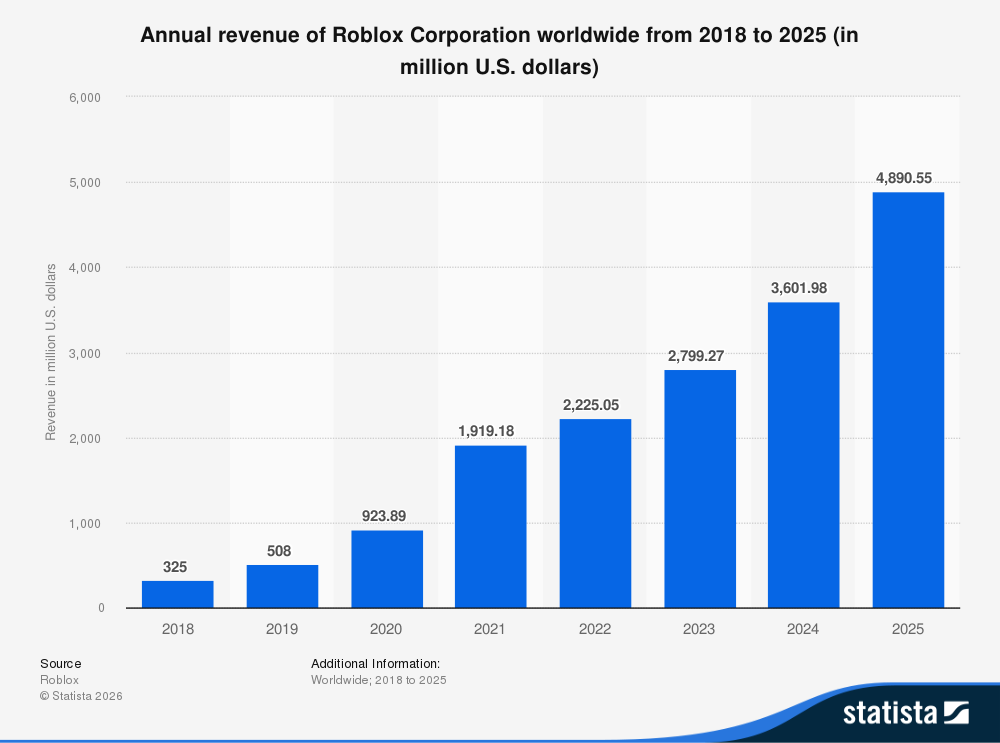
Annual profit of Roblox Corporation worldwide from 2018 to 2025 in million U.S. dollars (Roblox, 2026)
Economic researchers Chen et al. (2022) contend this typical incentives and control mechanisms of online games help organise platforms as systems that coordinate value among users. However, this view risks overlooking underlying power imbalance, as media and communications scholar Flew (2021) situates within wider “techlash” against digital platforms, where companies, like Meta Platforms and Google, have been criticised for prioritising data extraction and engagement over user well-being.
Roblox and children’s privacy safety
Parenting reporter Bethany Braun-Silva (2026) critically examines what parents should be watchful of regarding Roblox safety, especially amid concerns over online child exploitation, because:
- ● Roblox is a “co-experience” platform, which blends gaming, creativity and social interaction.
- ● Features on Roblox, like text and voice chat, allow children to privately or publicly message other users.
- ● Reported cases regarding child safety reached over 13,000 in 2024, according to Hindenburg Research Report.
- ● Siblings rescued after an alleged kidnapping by a 19-year-old they met on Roblox (Lieb, 2026).
Messaging feature is what Braun-Silva seriously stresses, as kids might face sexualised content and adults trying to contact them, regardless of whether Roblox has moderation systems.
As the digital platform paradox argued by Flew (2021), Roblox increasingly becomes a space for children’s social interaction, yet it remains owned and governed by a private company. While such incidents may appear isolated or episodic, they point to a deeper structural problem with the platform, which demonstrates what Law scholar Wang (2021) critiques as the imperfection of managing cyberspace due to deviations and imbalances at the level of privacy law enforcement.
Such as unclear boundaries of authority, inconsistent standards and a lack of efficient coordination mechanisms exist, despite the laws being written. Consequently, the implementation of privacy and data governance was not used effectively.
This tension suggests that risks experienced by users are not merely individual or accidental but reflect broader challenges in how privately controlled platforms assume public roles without equivalent public accountability.
We know our kids’ age, but do platforms?
What further makes Roblox particularly significant is its large and predominantly young user base. Data from the Roblox Report (2026) reveals that daily users as of Quarter 4 2025 reach up to 144 million, with almost 40 million under 13 years old.
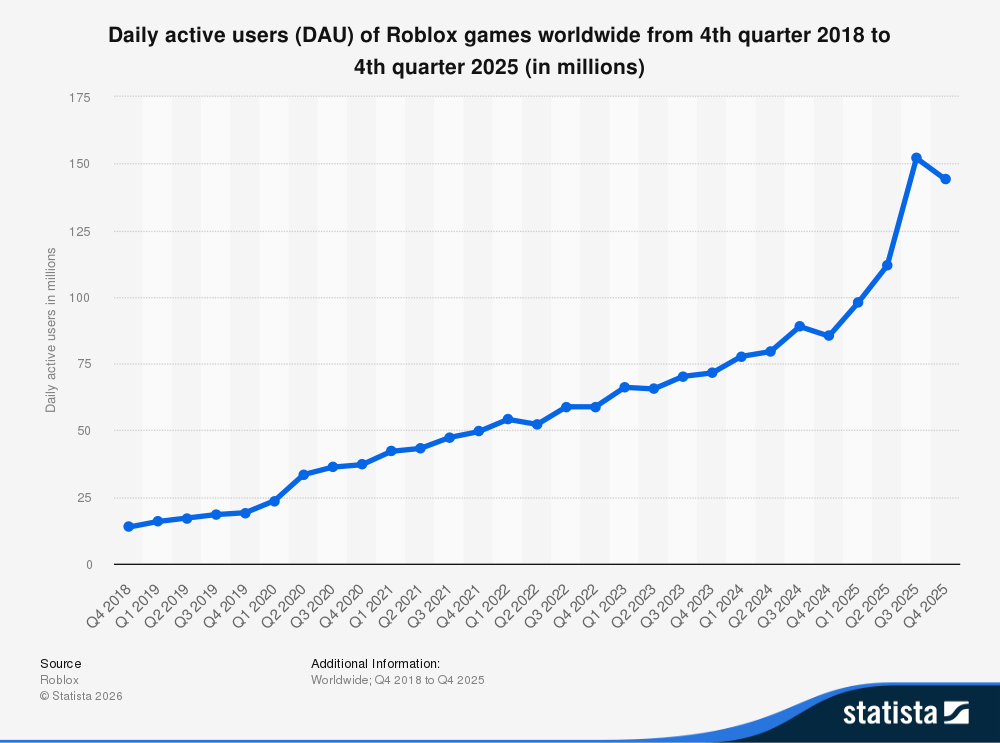
Daily active users (DAU) of Roblox games worldwide from 4th quarter 2018 to 4th quarter 2025 in millions (Roblox, 2026)
Positioned as the second-largest market for Roblox, Australia may face heightened risks of children’s privacy issues, which can lead to online grooming and child exploitation. Poor protection from the platform regarding usernames, age signals, chat behaviour and friend network can make it easier for offenders to identify and target minors, as seen in recent charges against a Queensland man who is accused of grooming hundreds of children on Roblox (Butler, 2026).
Cases reported by ABC Reporter Ahmed Yussuf (2026) further show the risks embedded in Roblox, especially for children under 13. Although current research frames Roblox as an alternative method of developing children’s cognitive skills (Han et al., 2023; Morreale, 2024), parents still express anxieties about data protection, risky interactions and the clarity of Roblox’s privacy and security practices, indicating a gap between the safety features offered by Roblox and parental expectations (Smithwick et al., 2024; Tunca, 2026).
Both parents and children may have significant concerns related to privacy, security and platform governance. A father, Jason, explained to ABC about his deeper concerns that the person interacting with his son on Roblox was playing as an older female character.
“In the game, claiming they were a 16-year-old in Vietnam. In a poem sent to the 14-year-old, the person described a sex scene with a male Roblox character named Taph.” Jason said.
This case of Jason’s son, who was exposed to sexualised conversation and potential online grooming, indicates how the Roblox age verification system could still be overlooked by the platform, as seen in the screwing alternative account’s discussion on Reddit.
Sexual abuse on Roblox can be classified into sexually explicit design and sexual exploitation (Kou et al., 2025). The scholars argue that “assets” on this gaming platform, such as user-generated content (UGC), scripts, avatars and narratives, might contain sexualised content that is not effectively moderated.
Therefore, the interaction experienced by Jason’s son did not occur in isolation but was also facilitated by the platform’s affordances, which enable continuous, often unmonitored interaction through UGC and chat systems.
The sexually explicit messages and role-play scenarios shared with Jason’s son reflect how Roblox assets could become a trigger of online violence, as seen in how the Taph character was used to intimately flirt with Jason’s son. More importantly, the case demonstrates sexual exploitation on cyberspace, where adult actors usually disguise themselves to build trust with young users.
This case later suggests that the risk is not simply the presence of “bad actors,” but the way platform architecture enables such behaviour. The integration of communication tools and anonymity (Copland, 2021), followed by UGC, may further create an environment where harmful interactions could be normalised within gameplay (Manxiang et al., 2022).
This is evident in how users create alternative accounts (anonymous), a practice widely discussed on Reddit in threads such as “Do you have an alt account, and why?”.
The scholars further confirm how anonymity can encourage dishonest behavior that harms the innocent children’s user experience. Therefore, rather than viewing Jason’s case as an unfortunate exception, it should be understood as evidence of broader governance challenges.
Parents found it hard to change the age settings on Roblox
Flew’s (2021) critique of online terms of use is later evident in the struggles that parents face when managing children’s accounts, particularly in the inability to identify users’ ages.
Roblox’s terms of use are often complex, vague and serve as a “take-it-or-leave-it” consent, which makes it difficult for child users to achieve genuine informed agreement.
Digital media researcher Suzor (2019) argues that this common situation can create a power imbalance, where the platform preserves ultimate authority while users remain bound to an agreement that they may not fully understand.
The number of comments from parents reported by Ahmed Yussuf on ABC News (2026) reflects the severe anxiety about their children’s privacy and safety. Mr Gorman’s 10-year-old son has been listed in the 16 to 17-year-old age category, and his age on the platform was 17, which is highly risky for being exposed to default content for that age. Similarly, Kerry Goulding, whose eight-year-old son put his age as 21, is worried that her son could have access to adult content on the platform.
The unfamiliarity of these restrictions exposes that the platform can limit user control indirectly through data governance and regulatory compliance mechanisms, which may not fully empower users to manage their privacy or data use (Wang, 2021; Xu et al., 2025). Such an agreement is frequently found to be difficult to read and understand, thereby questioning Roblox’s governance accountability.
When privacy fails, children pay the emotional price
Apart from parents’ concerns, children who experience this online abuse and grooming may suffer from trauma as they grow up. Jessica (not her real name) talked to ABC with her parental permission, had been playing Roblox since she was 11, and was being targeted by “predators” on the platform multiple times.
The unpleasant childhood experience makes Jessica feel like a growing person with much loss of innocence, leaving her with trust issues when interacting with people. She is now 16 years old and has become asexual.
I have barely any male friends. I’m now asexual, anything sexual of a nature really triggers me. She spoke to the reporter (Yussuf, 2026).
Long-term studies by mental health scholars have confirmed online grooming mediated by platform elements can perpetuate a sense of fear, anxiety and embarrassment (Schmidt et al., 2023). Scholars later stress that sexual images or videos circulated and unintentionally seen by victims can cause re-traumatization of the abusive event, as seen in Jessica’s avoidance of talking to men.
I feel like I lost my innocence because I was exposed to all that stuff at a young age.
In this regard, Jessica is a victim of online sexual abuse (OSA).
Similar to cyberbullying on social media, psychological distress in online games often happens because the platform can allow anonymity-driven harassment (Masri-zada et al., 2025).
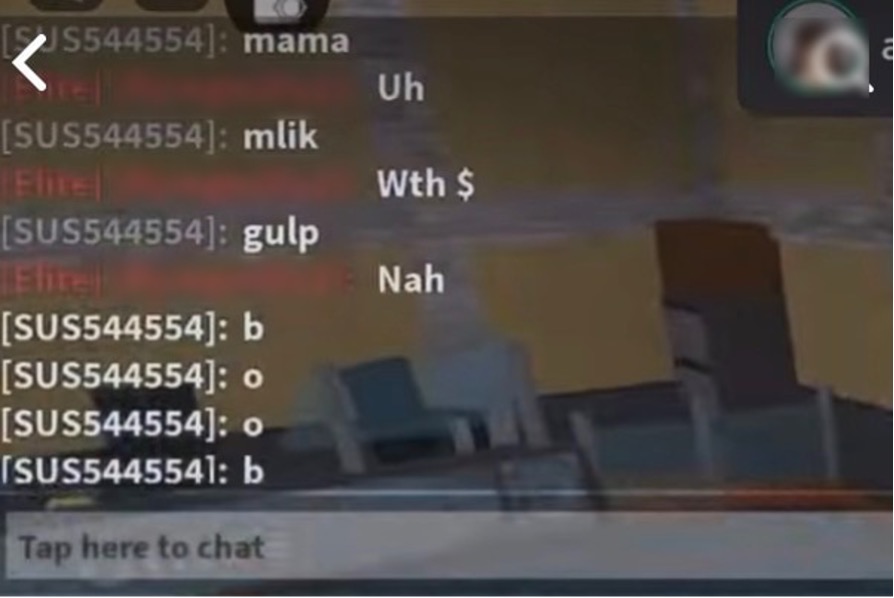
Jessica’s milk sexual conversation (Yussuf, 2026)
In Roblox’s online grooming case, Jessica believed that she was chatting with someone her age for years, as the platform’s governance ruled. However, the conversation later became suspicious when the users used inappropriate language, like the word “milk” sexually, to Jessica.
Online grooming of child users mediated by platform affordances contributes to worsening mental health in adolescents.
Rethinking platform and parent responsibility
As a platform, Roblox’s governance reveals a gap between platform power and accountability. As Suzor (2019) argues, platforms avoid pre-moderation due to the scale and speed of user-generated content worldwide. Although the company has control over what happens on Roblox, it often occurs after the incident is reported to the platform, blurring the visibility of platform moderation.
From Flew’s (2021) perspective, Roblox can increase the platform’s privacy and safety by strengthening its business model to reflect different levels of risk, scale and social impact based on age level. This approach includes redirecting the main function of Roblox as an online game for children and controlling the data use for commercial purposes (Flew & Martin, 2022).
In Australia, the Government cannot ban this from kids under 16 because it primarily functions as an online game. In 2025, the eSafety Commissioner put forward nine safety commitments that Roblox should respect to ensure the platform was compliant with the Australian Online Safety Act.
Roblox put on notice by Australian government over child grooming worries (9 News Australia, 2026)
Active responses led by the Australian government exhibit a step forward for mandating default privacy settings, restricting adult-child conversation and caregivers’ involvement.
As Kou et al. (2025) imply, ensuring child safety on the Roblox platform requires content moderation and proactive identification of predatory behaviours embedded within platform interactions. However, Microsoft researcher Gillespie (2018) suggests that the neutrality of the platform governance often remains questionable, which may continue to perform their impartiality.
Moreover, over-reliance on platform structures and government agencies risks overlooking the roles of families in navigating and children’s digital experiences. Psychological researchers Schneider et al. (2017) highlight the higher parental supervision and paternal engagement in childhood significantly reduce problem gaming in adolescence.
This indicates that platform harm is not merely a governance failure but also a gap in parental mediation and digital literacy. Thus, effective governance must combine platform accountability with social and parental safeguards.
Reference
9 News Australia. (2026, February 10). Roblox put on notice by Australian government over child grooming worries | 9 News Australia [Video recording]. https://www.youtube.com/watch?v=_OwltQ2s10A
Bethany Braun-Silva, A. B. C. (2026, February 3). What parents should know about Roblox safety features amid renewed concerns over online child exploitation. ABC News. https://abcnews.com/family/story/parents-roblox-safety-features-amid-renewed-concerns-online/?id=129816382
Butler, J. (2026, February 9). ‘Disturbing’: Australian government demands review of Roblox’s PG rating after reports of child grooming. The Guardian. https://www.theguardian.com/australia-news/2026/feb/09/australian-government-roblox-rating-child-safety
Cakan, A., & Acer, D. (2025). Analysis of preschool children’s outdoor play behaviours. Journal of Outdoor and Environmental Education, 28(3), 387–413. https://doi.org/10.1007/s42322-024-00174-4
Capello, R., Ciappei, S., & Lenzi, C. (2025). Digitalisation, platformisation and the transformations of local labour markets. Papers in Regional Science, 104(4), 100103. https://doi.org/10.1016/j.pirs.2025.100103
Chen, L., Tong, T. W., Tang, S., & Han, N. (2022). Governance and Design of Digital Platforms: A Review and Future Research Directions on a Meta-Organization. Journal of Management, 48(1), 147–184. https://doi.org/10.1177/01492063211045023
Copland, S. (2021). Dark, clear or brackish? Using Reddit to break down the binary of the dark and clear web. Continuum, 35(5), 719–731. https://doi.org/10.1080/10304312.2021.1983255
Flew, T. (2021). Regulating Platforms. Polity Press.
Flew, T., & Martin, F. R. (Eds). (2022). Digital Platform Regulation: Global Perspectives on Internet Governance. Springer International Publishing. https://doi.org/10.1007/978-3-030-95220-4
Gillespie, T. (2018). Regulation of and by Platforms. In J. Burgess, A. Marwick, & T. Poell, The SAGE Handbook of Social Media (pp. 254–278). SAGE Publications Ltd. https://doi.org/10.4135/9781473984066.n15
Han, J., Liu, G., & Gao, Y. (2023). Learners in the Metaverse: A Systematic Review on the Use of Roblox in Learning. Education Sciences, 13(3), 296. https://doi.org/10.3390/educsci13030296
Kou, Y., Hernandez, R. H. (Lindy), & Gui, X. (2025). “The System is Made to Inherently Push Child Gambling in my Opinion”: Child Safety, Monetization, and Moderation on Roblox. Proceedings of the 2025 CHI Conference on Human Factors in Computing Systems, CHI ’25, 1–18. https://doi.org/10.1145/3706598.3713170
Lieb, M. (2026, February 4). Siblings rescued after alleged kidnapping by 19-year-old they met on Roblox. Good Morning America. https://www.goodmorningamerica.com/news/story/siblings-rescued-after-alleged-kidnapping-19-year-met-129794514
Manxiang, Y., Baopeng, Y., Chen, Y., Li, T., Yixian, Y., Xiaobin, Q., & Yu, X. (2022). A trusted de-swinging k-anonymity scheme for location privacy protection. Journal of Cloud Computing, 11(1). https://doi.org/10.1186/s13677-021-00272-4
Masri-zada, T., Martirosyan, S., Abdou, A., Barbar, R., Kades, S., Makki, H., Haley, G., & Agrawal, D. K. (2025). The Impact of Social Media & Technology on Child and Adolescent Mental Health. Journal of Psychiatry and Psychiatric Disorders, 9(2), 111–130.
Morreale, D. (2024). Roblox and the Pervasiveness of Play: What Game-Making Communities Can Teach Us About Participatory Practices in Affinity Spaces. International Journal of Communication, 18, 4281–4299.
Roblox. (2026). Global Roblox games DAU 2025. Statista. Statista. https://www.statista.com/statistics/1192573/daily-active-users-global-roblox/
Schmidt, F., Varese, F., & Bucci, S. (2023). Understanding the prolonged impact of online sexual abuse occurring in childhood. Frontiers in Psychology, 14, 1281996. https://doi.org/10.3389/fpsyg.2023.1281996
Schneider, L. A., King, D. L., & Delfabbro, P. H. (2017). Family factors in adolescent problematic Internet gaming: A systematic review. Journal of Behavioral Addictions, 6(3), 321–333. https://doi.org/10.1556/2006.6.2017.035
Smithwick, A., Nguyen, C., Gorial, E., Tran, N., Flores, A. M., & Munyaka, I. N. S. (2024). ‘Parent seeking Roblox Safety Help’: Comparing Parental Roblox Concerns to Roblox Offerings. 2024 IEEE International Symposium on Technology and Society (ISTAS), 1–9. https://doi.org/10.1109/ISTAS61960.2024.10732489
Suzor, N. P. (Ed.). (2019). Who Makes the Rules? In Lawless: The Secret Rules That Govern our Digital Lives (pp. 10–24). Cambridge University Press. https://www.cambridge.org/core/books/lawless/who-makes-the-rules/6688999078ABFE0821E84D76A055BE70
Tunca, S. (2026). Navigating parental concerns in children’s engagement with roblox – a multi-method analysis of emotional and thematic patterns across online communities. BMC Psychology, 14(1), 84. https://doi.org/10.1186/s40359-025-03802-w
Wang, L. (2021). Global network security governance trend and China’s practice. International Cybersecurity Law Review, 2(1), 93–112. https://doi.org/10.1365/s43439-021-00025-8
Xu, P., Li, J., & Sun, Z. (2025). Exploring Privacy Leakage in Platform-Based Enterprises: A Tripartite Evolutionary Game Analysis and Multilateral Co-Regulation Framework. Information, 16(3), 193. https://doi.org/10.3390/info16030193
Yussuf, A. (2026, March 15). Inside the experiences of Roblox for parents and children. ABC News. https://www.abc.net.au/news/2026-03-16/inside-the-experiences-of-roblox-for-parents-and-children/106337574
Be the first to comment