Background
In April, 2024, a game boosting named Fat Cat suicide by jumping from the Chongqing Yangtze River Bridge into the River in China. His sister claimed online that her brother was abandoned by his girlfriend Tan Zhu after spending hundreds of thousands yuan on her. This news suddenly became an internet sensation.
Within days, Fat Cat was portrayed as a lovesick victim, while Tan Zhu was labeled as a “gold digger.” Her photos, ID number, and home address were exposed online. A widespread campaign condemning Tan Zhu erupted across the internet. At the same time, the Chongqing Yangtze River Bridge was covered with food deliveries ordered by netizens as a tribute to Fat Cat.

After a few days, the story took a turn. Actually, Tan Zhu was not a “gold digger,”and the relationship between she and Fat Cat was far more complex. However, the harm Tan Zhu suffered was already irreversible.
From the Fat Cat issue(NextShark, n.d.), we can find that multiple factors working together cause hate speech and online harm. Platforms failed to stop the spread of information in time. Algorithms kept pushing extremely divisive content. Netizens joined the public condemnation without verifying the facts. They changed this chain reaction from online harassment to real-world harm.
The Mob
Before we blame the algorithm, we need to look at ourselves. The mob is not a mindless crowd. It is made of individuals who choose to hate, label, and perform.

Us vs. Them
Online harassment often relies on a simple, black-and-white story of hate. People tend to use labels to understand complex human behavior, which makes others “othering” and turns them into targets to be attacked.
The Integrated Threat Theory proposed by Stephan and Stephan (1996) can help explain how this hate comes about. The theory divides threats into realistic threats and symbolic threats. In the Fat Cat issue, the label of “gold digger” was not just aimed at Tan Zhu personally. It quickly became a symbolic threat. This is a perceived threat to the emotions, finances, and even social status of “honest and lovesick” men. This label especially raised collective anxiety and anger among male groups.
The labels “gold digger” and “simp” reflect a deep gender anxiety(Online Hate Prevention Institute, n.d.) in the society nowadays. In the dating and marriage market, men worry that their financial worth could be objectified, so that they will be used as an ATM. On the other hand, women are stigmatized by the “gold digger” label. Their normal desire for relationships is twisted into being seen as money-worshipping. When this anxiety is amplified online, gender antagonism is created. The Fat Cat incident happened to become an outlet for this anxiety. Who Tan Zhu really was did not matter. What mattered was that she could be shaped into the stand-in of the “gold digger.”
As Guan & Chen (2026) said, “differences in social identity (in-group/out-group distinction) provoke threat perceptions, which lead individuals to employ discursive ‘othering’ strategies to marginalize, devalue, and demonize certain social identities.” In other words, users constantly strengthen the line between “us” and “them.”
In the Fat Cat issue, lovesick male victims were portrayed as a sympathetic “us,” while the so-called gold digger was constructed as an evil “them.” This moral judgment of “them” by “us” forms the violence of identity politics.
Many netizens ordered food deliveries as a tribute to Fat Cat. It seemed to be a way to mourn the deceased. In reality, it was a form of performance art. They portrayed themselves as allies of justice. Each food delivery placed on the bridge served to draw a clear line against the “gold digger,” and prove that they stood on “our” side. When this behavior was massively replicated, recorded in videos, and spread online, it became a ritual of group identity. The crusade against Tan Zhu was essentially an act of revenge against the fictional group of “gold diggers.”
The Spiral of Silence
In the online violence, there was also a silent majority. They might have seen those extreme comments and felt something was wrong, but they chose to stay quiet. The reason is that the opposing voices might be drowned out, or even attacked. The Spiral of Silence theory(Pfiffelmann, n.d.) proposed by the famous German sociologist and public opinion scholar Elisabeth Noelle-Neumann can explain this phenomenon.
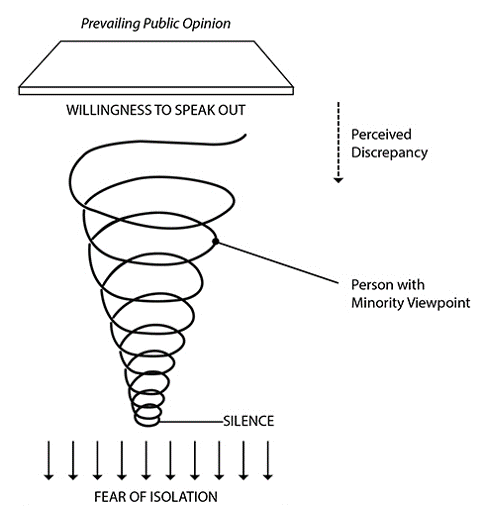
When people feel that their views belong to the minority, they choose to remain silent, which in turn makes the majority’s voice seem even more justified. To some extent, this silence is also a form of tolerance toward violence.
The System
These behaviors did not happen in a neutral environment. Carlson & Frazer (2018) found that users’ engagement with social media operated not within a neutral space, but within a multi-layered terrain of cultural beliefs and practices, relationships with many kinds of communities, constant interactions with hostile others, and exposure to many forms of often harmful materials. This hostile and stimulating environment originates from the platforms themselves. Their algorithms, rules, and community structures shape users’ behavior together . Therefore, platforms played a major role in causing this online trial to eventually spiral out of control.
Massanari (2015) uses the concept of “toxic technocultures” to describe how platform design, algorithms, and community structures together enable harmful behaviors. Platform structures provide fertile ground for toxic technocultures. Woods & Perrin (2022) state that the design choices made by the companies in constructing these platforms are not neutral; they have an impact on content and how it is shared. In order to achieve high traffic and user engagement, platforms’ algorithms, design, and business models tend to amplify extreme and emotional content.
The Algorithm’s Hunger
Algorithms have a bias toward hot topics. Here we can introduce the concept of the “attention economy.”(Harris, 2017)
Guan & Chen (2026) found that “sensational, emotional-arousing, and negative narratives naturally get more visibility.” This explains why content full of anger and confrontation is more easily amplified by algorithms.
When the Fat Cat incident was labeled with tags like “gold digger” and “simp,” these emotionally charged and controversial topics were quickly recognized by algorithms and pushed to trending lists, attracting more people to join in and watch. Once you click on a video about the Fat Cat incident, the algorithm determines that you are interested in this topic and recommends more related content. The longer you watch and the more you interact, the more confident the algorithm becomes in its judgment. Soon, your homepage is filled with similar content. All the information you see reinforces the same narrative. You can’t see different opinions or access the complex truth. Algorithms build “information cocoons” for people and trap them deeper inside.
According to statistics, the Fat Cat incident topic on Weibo received 1.22 billion views. On Douyin, videos with related tags easily gained millions of likes. The more users participate, the higher the traffic becomes. Platforms then profit from it.
Flawed by Design
Platforms have design flaws that may not truly benefit user safety. As Massanari (2015) said, “accounts are pseudonymous and easily created.” This low-barrier environment lowers the cost for individuals to participate in attacks. Costa and Halpern (2019) argued that these design choices, deliberately or otherwise, exploit cognitive biases and nudge users towards one set of behaviors or another. As a result, the rationality and even autonomy of each user may be compromised. The system is designed to encourage user engagement, rather than reflection and protection. When an ordinary woman labeled as a “gold digger” is attacked by the entire internet, the platform’s reporting and intervention mechanisms fail to function in a timely or effective manner.
This idea has moved beyond academia. In 2019, the UK government officially proposed a statutory ‘duty of care’ for online platforms in its Online Harms White Paper (Home Office, 2019). According to this concept, Woods & Perrin (2022) claims that platforms have a responsibility to ensure that they do not cause foreseeable risks to users. Therefore, they should predict and prevent the risk of algorithms leading to online violence, and cut off harmful content from spreading actively. In the Fat Cat incident, platforms only took passive action to remove violating information after Tan Zhu’s personal details had been doxxed and spread across various platforms.
According to official reports, it was not until May 4 that Weibo cleaned up 2,569 violating posts in batches and deactivated 235 accounts. By that time, Tan Zhu had already suffered days of online harassment. As Beijing Daily criticized, “Platforms allowed unverified information to stay on trending lists, turning normal discussions into confrontation and division.” This model of reactive cleanup rather than prevention shows platform negligence. Platforms have an obligation to make their content moderation data and processes public, as well as accept oversight from independent regulatory bodies. In China, the Cybersecurity Law, the Personal Information Protection Law and the Data Security Law(China Law Translate, n.d.) have already set basic obligations for platforms. But the Fat Cat incident alarms us that the enforcement and regulatory mechanisms of these laws still need to be strengthened.
Post-Truth
The consequences of online harm are real and heavy. It not only delivers a devastating blow to the victims, but also erodes our shared social trust. It may lead to more similar tragedies.
Some netizens exposed Tan Zhu’s home address and took videos. In more extreme cases, people began doxxing her family and releasing their personal information. They claimed that “her whole family should die.” The judgment quickly spread from online abuse to offline harassment. From attacking the individual to attacking her family, this harassment escalated continuously. The doxxing, death threats, and reputational damage that Tan Zhu suffered are the most direct consequences of online hate speech.
On May 19, 2024, the police clarify facts behind Fat Cat suicide case(China Daily, 2024). The relationship between Fat Cat and Tan Zhu was normal. There were genuine feelings between them. Tan Zhu did not trick him out of money under the name of love.
The police found that Fat Cat’s sister deliberately portrayed Tan Zhu as a gold digger and a liar. She hired multiple people to write posts for her to gain public sympathy. She also bought online traffic on platforms to deliberately push the incident to higher visibility, so that she could systematically manipulate public opinion.
Some online influencers and marketing accounts also joined in it. They may not have cared about whether Fat Cat lived or died, but they cared about traffic. A single emotionally charged post could generate millions of views and advertising revenue. When online violence can be bought and operated, it is no longer just a collective emotional outburst. It turns to be a business.
Public opinion then turned around. Netizens started attacking Fat Cat’s sister, accusing her of feeding on her brother’s death. Some people simply stopped talking about the incident. Those “evidence” posts widely shared online before seemed as if they had never existed.
In the frenzy of online public opinion, the truth never really matters. Living in the post-truth era, emotions spread more easily than facts. People rush to take sides, judge and vent their feelings, but few are willing to wait for the truth. A large number of netizens picked sides in this emotional dispute without clearly knowing the facts, which contributed to online harassment. When the truth finally arrived, it no longer mattered as a new hot topic had already emerged. The next round of online judgment had quietly begun. Only people like Tan Zhu suffered irreversible harm.
After truth: Disinformation and the cost of fake news (HBO, 2020)
Normalised Toxicity
Carlson & Frazer (2018) found that groups who suffer long-term online hate and discrimination tend to develop behaviors such as self-censorship and political silencing. If we are exposed to this kind of online violence and participate in it frequently, it may make us numb, indifferent, and even see it as normal.
Massanari (2015) used the term “toxicity” to describe this phenomenon, arguing that such a culture gradually becomes normalized. We may no longer be surprised by doxxing. Instead, we will see it as a way to solve problems. This poisoning of society is a more long-term harm.
What Can We Do?
As the old saying goes, one should not do evil, even if it seems small. In this online harm, everyone seemed to do just a little, such as a share, a comment, or a like. However, all these small acts together could be enough to destroy a person.
The truth was the easiest thing to lose. Platforms avoided responsibility by claiming to be neutral, and users excused their actions in the name of justice. In the end, no one took responsibility for the tragedy.
We need stronger rules to make platforms think about users’ safety when they design their sites. At the same time, when we see a simple story online, we should ask ourselves whether the truth might be more complicated. We should consider if our words and actions are really helpful, or they may hurt someone. Next time when we face a similar online issue, maybe we can try to understand more and judge less. I hope that we can make the internet a healthier place by working together.
References
Carlson, B., & Frazer, R. (2018). Social media mob: Being Indigenous online. Macquarie University.
China Daily. (2024, May 21). Ex-girlfriend of ‘Fat Cat’ didn’t scam him. https://global.chinadaily.com.cn/a/202405/21/WS664bf9aaa31082fc043c8342.html
China Law Translate. (n.d.). Cybersecurity Law of the People’s Republic of China (English translation). https://www.chinalawtranslate.com/cybersecurity-law/
China Law Translate. (n.d.). Data Security Law of the People’s Republic of China (English translation). https://www.chinalawtranslate.com/data-security-law/
China Law Translate. (n.d.). Personal Information Protection Law of the People’s Republic of China (English translation). https://www.chinalawtranslate.com/en/Personal-Information-Protection-Law/
Costa, E., & Halpern, D. (2019, April 15). The behavioural science of online harm and manipulation, and what to do about it. Behavioural Insights Team. https://www.bi.team/publications/the-behavioural-science-of-online-harm-and-manipulation-and-what-to-do-about-it/
Guan, T., & Chen, X. (2026). Threat perception, otherness and hate speech in China’s cyberspace. Journal of Contemporary China, *35*(158), 1337–1352. https://doi.org/10.1080/10670564.2025.2475051
Harris, T. (2017, July 26). How a handful of tech companies control billions of minds every day [Video]. YouTube. https://youtu.be/C74amJRp730
HBO. (2020, March 2). After truth: Disinformation and the cost of fake news (2020) | Official trailer | HBO [Video]. YouTube. https://youtu.be/GLi7cNAJKA8
Home Office. (2019, April 8). Online harms white paper factsheet. Home Office in the media. https://homeofficemedia.blog.gov.uk/2019/04/08/online-harms-white-paper-factsheet/
Massanari, A. (2015). #Gamergate and The Fappening: How Reddit’s algorithm, governance, and culture support toxic technocultures. New Media & Society, *19*(3), 329–346. https://doi.org/10.1177/1461444815608807
NextShark. (n.d.). Netizens mourn death of ‘Fat Cat’ gamer. https://nextshark.com/netizens-mourn-death-fat-cat-gamer
Online Hate Prevention Institute. (n.d.). Distorted narratives: The ‘gold-digger’ stereotype in Chinese culture. https://ohpi.org.au/distorted-narratives-the-gold-digger-stereotype-in-chinese-culture/
Pfiffelmann, J. (n.d.). Spiral of silence theory. https://www.jean-pfiffelmann.com/spiral-of-silence-theory/
Stephan, W. G., & Stephan, C. W. (1996). Predicting prejudice. International Journal of Intercultural Relations, *20*(3–4), 409–426.
Woods, L., & Perrin, W. (2022). Obliging platforms to accept a duty of care. In M. Moore & D. Tambini (Eds.), Regulating big tech: Policy responses to digital dominance (pp. 93–109). Oxford University Press.


Be the first to comment