How Echo Chambers Create Conditions for Hate Speech
In our daily lives, we can often hear “echo chamber.” Simply speaking, it refers to a situation where users are mainly exposed to information that reinforces their existing beliefs. We can understand it as that when we browse social media, big data will constantly push content that we may be interested in or have agreed with, and information that we disagree or are not interested in is gradually filtered out of this ” chamber “. In fact, many people do not realize that what they see online is not a neutral reflection of reality, but a carefully filtered version shaped by algorithms. Over time, this can quietly influence how we think, what we believe, and even how we see other people.
Taking my personal experience as an example, as a woman, when I browse short video platforms, I often come across content which talk about the situation of women in Chinese society, such as marriage, inheritance rights, and gender norms. These contents often appear in the form of “stating facts“, such as they may talk about property issues in divorce or society’s expectations of women’s behavior, but in the process of presentation, there is also an implicit emphasis on gender inequality. As the algorithm continues to recommend similar content, this information gradually dominates my information environment, causing the related issues to be more intense and bigger. This kind of content usually has a strong emotional color, especially anger or dissatisfaction, so it is easier to generate interaction and be recommended by the platform again. And we can easily find that it creates a cycle: the more emotional the content is, the more people interact with it, and the more the platform pushes it further.
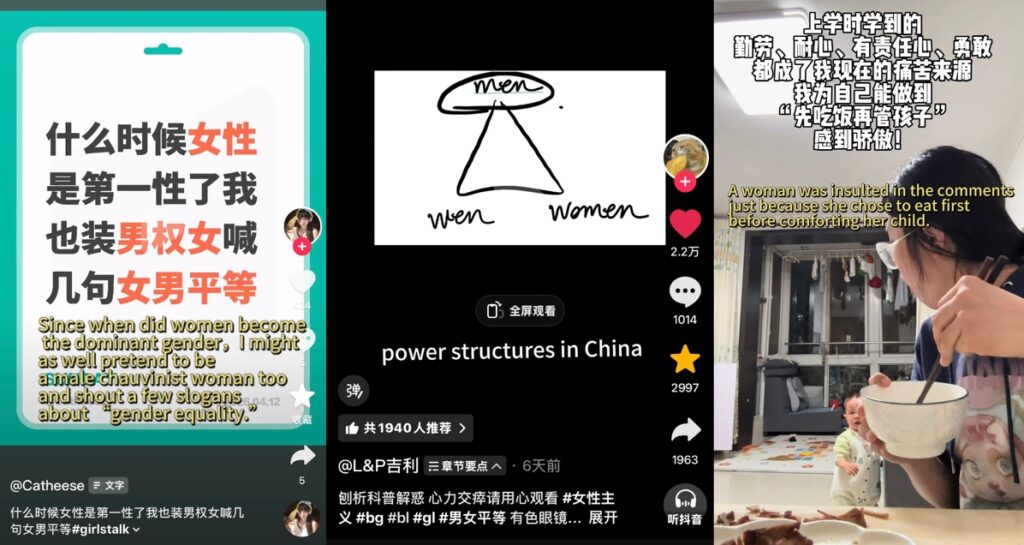
When the platform repeatedly pushes this kind of content filled with anger and conflict, it is not only “reflecting reality” but also participating in shaping users’ cognition. In such an information environment, some female users may gradually deepen their distrust of men, and another part of male users who think they have been “hurt” in gender relations are likely to come across another set of equally dissatisfied and hostile narratives on the platform. As a result, both sides are more likely to use offensive and even hate speech to express their views in the comment section, turning issues that could have been discussed more calmly turn into emotional confrontations instead.
This phenomenon is not accidental. As discussed in Platformed Racism: the Mediation and Circulation of an Australian Race-Based Controversy on Twitter, Facebook and YouTube, the idea of “platformed racism” suggests that the spread of hate speech is not only from individual users, but also closely related to the structural mechanism of the platform. Through recommendation algorithms, interaction mechanisms and content distribution logic, platforms tend to make controversial and emotional content easier to be seen, shared and more likely to be reproduced. In other words, hate does not simply “appear” on the platform but is constantly amplified in the way the platform operates (Matamoros-Fernández, 2017). Even if we deliberately try to avoid this kind of content, big data systems will still continue to push it to us due to their inherent limitations.
It is worth noting that this kind of hostile expressions does not always appear in the form of direct attacks. In many cases, it will be packaged as jokes, punchlines, or memes, and will appear repeatedly in a seemingly easy and even humorous way when users are less vigilant. It can potentially strengthen user’s stereotypes and deepen the divisions between groups in a subtle way. Within this echo chamber, hate speech can gradually become normalized which seem as a “seemingly normal” way of expression.
Why moderation fails on platforms
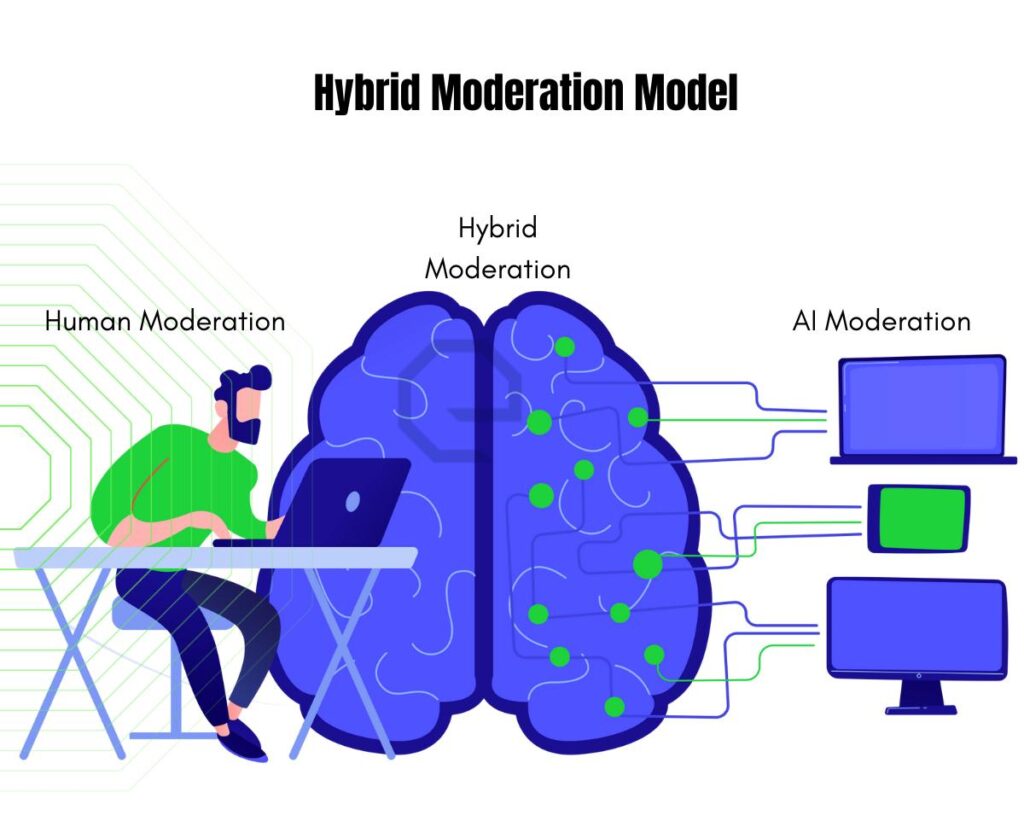
As we can see, most of social media platforms rely on content moderation to manage hate speech, and content moderation is often carried out through a cooperation of human moderators and AI systems. However, due to limitations in technology, resources, and cultural or linguistic understanding, this management method often has inaccurate and lag problems. As a result, the dissemination of harmful content cannot be controlled in a timely and effective manner (Sinpeng et al., 2021).
Limits of automated moderation
In order to improve the moderation efficiency on a huge amount of content, platforms like TikTok and Redbook will use AI for the initial moderation. This not only saves labor costs and greatly reduces the audit burden of the platform but also helps meet the needs of everyday users who expect quick review and posting. But in the same way, this will also expose a big limitation: AI moderation mainly reviews and judges based on keywords and surface texts, which makes it difficult to identify the context, emotions and implicit intentions behind the text.
For example, something that sounds like a harmless joke to outsiders may actually carry strong hostility in a specific online community. If users use irony, metaphors, homophones, or memes to express hate, the system may fail to recognize it. As a result, harmful content can be allowed to spread. This means that if users use irony, metaphors, homophones, memes and other seemingly normal but ambiguous ways to express themselves, even if these contents are aggressive or hostile, the AI moderation may identify them as “normal content”, thus allowing them to be released smoothly. In other words, many hate speeches do not appear in the form of direct abuse, it is often spread in more hidden and indirect ways, which are the most difficult part of the current automated moderation system to deal with (Sinpeng et al., 2021). This also indirectly proves that the moderation problem of the platform is not simply a lack of technical capacity, but a deeper tension between the complexity of language and the ways users strategically express themselves.
Local context and language gaps
Platforms which face global users such as Twitter, whose content moderation rules are often uniformly formulated and applicable to different countries and regions. However, the differences in cultures and languages of different countries make people’s understanding of what constitutes hate speech is obviously different (Sinpeng et al., 2021). For example, gestures with specific insulting meanings in the Korean context, even if they are made into meme and used globally, may not be considered offensive by other users. Similarly, in the Chinese Internet environment, users often use some superficially neutral words to metaphorically express hostility, such as calling men with macho tendencies “bro” or calling self-centered women “little fairies”.
On the surface, these expressions may seem normal literally, but in specific contexts, they carry clear negative evaluations and even hostility. This phenomenon shows that when the platform relies on a set of unified moderation standards based on surface identification, it can often only identify more direct and explicit hate speech, while difficult to understand these cultural and context-dependent implicit expressions. This leads to the normal publication of a large number of hostile contents, which weakens the effectiveness of platform governance. In general, the limitations of platform governance are not only just reflected in technical capabilities but also reflected in their inability to cope with the multiple tensions between language complexity, cultural differences and information dissemination speed at the same time.

Reactive nature of moderation
User reporting is a very common thing, but the logic behind this matter is that the content that the platform determines that can be published normally after the preliminary moderation of AI may have a hate speech that AI cannot judge. If it is reported by the user, the platform will intervene and deal with it manually. It means that the platform cannot stop it in advance but can only be deleted after the hate speech has been spread through the algorithm and may have a certain influence. The deletion at this time does not mean that the effect of hate speech disappears. Because hate speech is often more eye-catching, its spread is much faster than the efficiency of deletion, so that hate speech has been widely spread before it is deleted, and its impact is difficult to completely eliminate which shows a kind of “irreversibility”.
How hate speech shapes user perception and values
This process is often slow and not immediately noticeable, but it can have long-term effects on how users perceive others.
To make this more concrete, I can use my own experience. As a feminist, I do not think marriage or heterosexual relationship is the ultimate goal of women. Therefore, when I use the social media, the platform will constantly push me content related to this position, as well as some views that are against it. Under the repeated recommendation of the algorithm, I will continue to deepen my understanding of women’s rights and equality-related issues and gradually strengthen my position. At first, this may seem like a positive process of learning and awareness. However, this strengthening is not completely positive. I am well aware that the ultimate core appeal of the pursuit of feminism is to pursue equality, but because the platform tends to push content that is more conflicting and emotional tension, which is often mixed with expressions of hostility and even hate, this can lead me and many users gradually to start regard the male group as objects that hinder the development of women’s rights, which contributes to a clear sense of gender division.
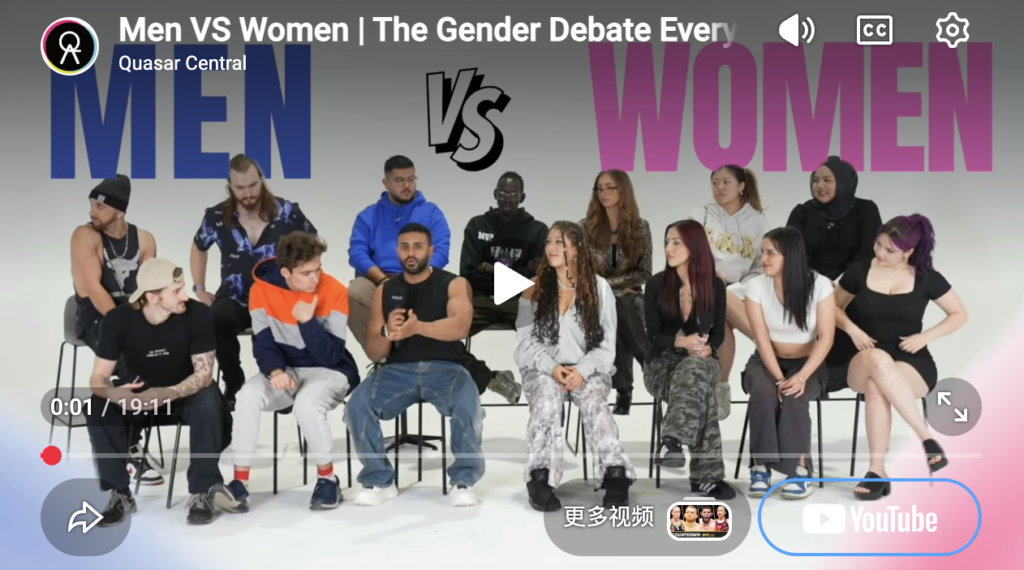
In this kind of information environment, I find myself unconsciously dividing the users on the platform into “us” and “them” – “us” are who support feminism and “they” are who oppose feminism (Guan & Chen, 2025). This group division is further reinforced in the debate in the comment sections and intensifies through aggressive and even hateful expressions. What’s more noteworthy is that with the continuous recommendation of algorithms and the re-creation of users, these hateful contents are gradually packaged into jokes, punchlines or meme, which reduces people’s sensitivity in the process of repeated appearance and those serious issues will start to feel like entertainment or attention-seeking.
Because of that, I think the impact of hate speech is not only reflected in user expression but also reflects in gradually changes of the thinking way of others and society in the platform environment, and in doing so, it will deepen divisions between different groups (Guan & Chen, 2025).
In summary, the spread of hate speech in contemporary social media is not the accidental result of a few users’ emotional out of control, but the product of the interaction between platform structure, algorithm mechanism and moderation. These factors together create an environment where emotional and divisive content is more likely to spread. From the continuous strengthening of views in the echo chambers, to the amplification of emotional content on the platform, to the limitations of content moderation at the technical and cultural context. Those series of mechanisms have jointly shaped an information environment that is prone to division and misunderstanding. In such an environment, hate speech is not only spread, but also gradually affects the way users understand others and society in repeated viewing.
This also means that social media is no longer just a neutral social tool. It invisibly promotes the formation of people’s perception of others and society. Therefore, the control of hate speech should not only rely on blocking or deleting rectification but also requires rethinking the platform’s role in moderation, algorithmic recommendations, and its understanding of local cultural contexts. For users, it is equally important to improve the ability to distinguish and reflect on what they see online. Only by being aware of the possible deviations in the platform push can they maintain more rational judgment and draw knowledge that is beneficial to themselves in such an environment. This is why understanding how platforms work is not just a technical issue, but something that affects all of us in our everyday lives.
References
Guan, T., & Chen, X. (2025). Threat perception, otherness and hate speech in. China’s.cyberspace. Journal of Contemporary China, 1–16. https://www.researchgate.net/publication/389631498
Matamoros-Fernández, A. (2017). Platformed racism: The mediation and circulation of an Australian race-based controversy on Twitter, Facebook and YouTube. Information, Communication & Society, 20(6), 930–946. https://doi.org/10.1080/1369118X.2017.1293130
Sinpeng, A., Martin, F., Gelber, K., & Shields, K. (2021). Facebook: Regulating hate speech in the Asia Pacific. University of Sydney & University of Queensland. https://ses.library.usyd.edu.au/bitstream/handle/2123/25116.3/Facebook_hate_speech_Asia_report_final_5July2021.pdf?sequence=3&isAllowed=y
Jubilee. (n.d.). Men vs women: The gender debate everyone’s avoiding [Video]. YouTube. https://www.youtube.com/watch?v=AjRYPkDgi7w
Be the first to comment