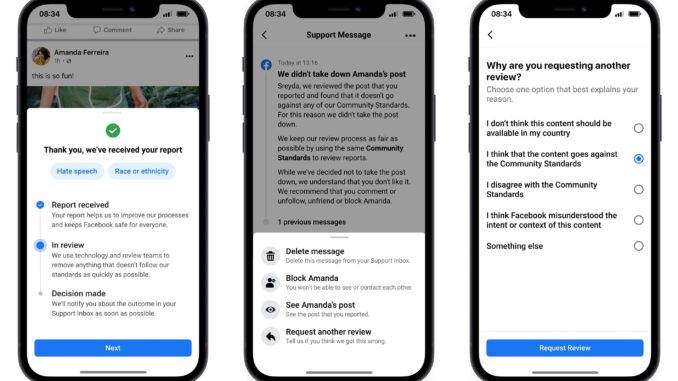
Reporting harmful content online is meant to feel straightforward. You see something abusive, misleading, or clearly harmful — you report it. In theory, platforms review the content, take appropriate action, and the system works.
But in practice, the experience is far less certain.
Content often remains visible. Enforcement feels inconsistent. And over time, many users stop engaging with reporting systems altogether. Anyone who has reported a post for example, a politically charged misinformation claim or a piece of targeted harassment, only to receive a notification stating that it “does not violate community guidelines” will recognise this gap immediately.
The issue is not simply whether content is removed or left online. It is whether the system itself is capable of recognising harm in the first place. These tools did not emerge by accident. Reporting systems and fact-checking mechanisms were introduced in response to a specific governance crisis, most visibly during the 2016 United States presidential election. Platforms like Facebook were widely criticised for enabling the rapid spread of false stories, conspiracy content, and inflammatory political messaging at scale.
What made this moment significant was not just the presence of misinformation, but the realisation that platform infrastructure itself was shaping how that content spread and was consumed.
In response, Facebook introduced a third-party fact-checking program in December 2016, partnering with external organisations to review content flagged by users and reduce the visibility of posts rated as false (Meta, 2016). Reporting tools were expanded alongside this initiative, creating a system where users could flag content, which would then move through a moderation and verification process.
By the 2020 United States election, this model had expanded significantly. Fact-checking labels, distribution limits, and reporting mechanisms had become central to Meta’s governance strategy (Meta, 2020), forming a multi-layered attempt to manage misinformation while maintaining open expression. At the time, this model appeared both practical and politically viable. It allowed platforms to present moderation not as direct control, but as a procedural, collaborative process.
However, nearly a decade later, these systems are under increasing strain. Users are disengaging. Platforms are scaling back fact-checking initiatives. Governments are stepping in with regulation.
Perhaps we need to acknowledge that reporting systems and fact-checking mechanisms are not simply failing in practice, but are structurally limited forms of platform governance. Designed to manage harm through detection, verification, and response, they struggle to regulate content shaped by identity, emotion, and context. As a result, they produce inconsistent outcomes, erode user trust, and shift the burden of governance away from platforms and onto users and regulators.
Why Reporting Ever Made Sense
At first glance, reporting systems and fact-checking appeared to offer a reasonable solution to a growing crisis.
Following the 2016 election, platforms were under intense pressure from two directions. On one hand, they were criticised for allowing harmful content to spread unchecked. On the other, they were accused of bias whenever they intervened too aggressively. Reporting tools and third-party fact-checking offered a convenient middle ground.
Instead of platforms making unilateral decisions, users could flag problematic content, external organisations could assess its accuracy, and platforms could act on those assessments while maintaining distance from the decision itself. As Meta’s own framing suggested, the goal was to “reduce the distribution of false news” without compromising free expression (Meta, 2018).
From a governance perspective, this was a significant shift. As Sinpeng et al. (2021) argue, platforms increasingly rely on users and third-party actors to participate in moderation systems, effectively outsourcing elements of governance while retaining ultimate authority (p. 3). Reporting systems therefore do more than remove harmful content by redistributing responsibility, positioning users as active participants in maintaining platform safety.
Underlying this model is a critical assumption: that harmful content can be effectively addressed through detection and verification.

If misinformation is identified early and corrected through fact-checking, its impact can be reduced. This reflects a broader belief that online harm operates primarily through false or misleading information, and that restoring factual accuracy can stabilise discourse. But this assumption begins to break down when we look more closely at how harm actually functions online. As Guan and Chen (2025) demonstrate, hostility in digital spaces is often driven not by factual misunderstanding, but by perceived threats to identity, values, or social status (p. 8). This creates a fundamental tension: reporting systems are designed to identify and correct inaccurate information, while much of the harm they attempt to address is not rooted in factual error at all.
Where the System Starts to Fail
The limitations of reporting and fact-checking systems become clearer when we examine how harmful content actually operates online. These systems are designed for scale. They rely on standardised categories, clear violations, and efficient processing.
But harmful speech does not function neatly at scale.
Hate speech, in particular, is deeply contextual. Its meaning depends on language, cultural references, political environments, and the identities of those involved. As Sinpeng et al. (2021) note, hate speech is “highly dependent on language and context,” making it difficult for global moderation systems to interpret accurately (p. 1). This creates a disconnect between user experience and platform response.
Users may report content they perceive as harmful for instance, coded language targeting a specific ethnic or religious group, yet platforms may not take action if that content does not meet predefined thresholds or lacks explicit indicators such as slurs. Over time, this inconsistency contributes to what Sinpeng et al. (2021) describe as “reporting fatigue,” where users disengage from reporting processes because they no longer trust that their actions will lead to meaningful outcomes (p. 20). Reporting, in this sense, shifts from a tool of accountability to something closer to a symbolic gesture.
A second limitation lies in the reactive nature of reporting systems. These systems depend on users identifying and flagging content after it has already been produced and circulated. But the production of harmful content is continuous and socially driven.
As Guan and Chen (2025) explain, online hostility is often linked to perceived threats to in-group identity and status (p. 8). This aligns with intergroup threat theory, where conflict emerges from deeper anxieties around belonging, power, and hierarchy. This helps explain why fact-checking alone has limited impact.
Fact-checking can correct whether a claim is true or false. But it does not address why that claim resonates, why it spreads, or why it continues to be reproduced within communities. In many cases, harmful narratives persist precisely because they reinforce identity and belief systems, not because they are factually accurate. Taken together, these issues point to a structural mismatch.
Reporting systems are designed for efficiency, standardisation, and scale. But the harms they attempt to regulate are contextual, socially embedded, and continuously reproduced. This is not simply a failure of implementation but a limitation built into the model itself.
Meta and the Limits of Fact-Checking
These structural limits become more visible when we examine how platforms have implemented reporting and fact-checking systems in practice. Following the 2016 election, Facebook’s third-party fact-checking program relied heavily on user reporting: flagged content would be reviewed, labelled where necessary, and its distribution reduced (Meta, 2016). By 2020, this system had expanded into a central governance framework, combining reporting tools, fact-checking labels, and algorithmic intervention (Meta, 2020). At a structural level, the system appeared robust.
It combined user participation, external verification, and platform enforcement into a multi-layered moderation model. But its effectiveness remained uneven.

As Sinpeng et al. (2021) demonstrate, even when users actively report harmful content, enforcement outcomes vary significantly due to the context-dependent nature of hate speech (p. 1). Content that does not fit clearly within predefined categories may remain visible, despite being experienced as harmful by users. This reinforces the perception that reporting systems are unreliable. By 2025, Meta announced a major shift: it would end its third-party fact-checking program in the United States and move toward a Community Notes model (Meta, 2025).
This decision is significant not because it refines the system, but because it signals a loss of confidence in fact-checking as a primary governance tool. The shift reflects the deeper limitations already discussed. Fact-checking is effective when addressing clearly false claims. But it struggles with content that is emotionally charged, politically contested, or rooted in identity. As Guan and Chen (2025) argue, harmful discourse is often driven by perceived threats to group identity, meaning that correcting factual inaccuracies does not necessarily reduce hostility (p. 8).
Meta’s evolving strategy highlights a central tension: systems designed to manage harm through procedural mechanisms of reporting, verification, and labelling are increasingly unable to address the social and political dynamics that produce harm in the first place.
From Platform Problem to Governance Crisis
The limitations of reporting and fact-checking systems are no longer confined to platform design.
They are now shaping broader debates around regulation and governance. As platforms struggle to produce consistent outcomes, governments are stepping in to impose formal oversight. In Australia, the Online Safety Act empowers the eSafety Commissioner to investigate complaints and require the removal of harmful content, signalling a shift from voluntary moderation to enforceable regulation (eSafety Commissioner, 2025).
Similarly, the European Union’s Digital Services Act requires platforms to implement more effective notice-and-action systems, reflecting concerns that existing reporting mechanisms are insufficient (European Parliament and Council of the European Union, 2022).
But regulation does not resolve the underlying issue. It makes it more visible.
Platforms are being asked to produce consistent, context-sensitive decisions at scale, while the systems they rely on remain structurally limited in their ability to interpret context and meaning.
This is where fatigue becomes systemic. Users are fatigued by reporting processes that do not lead to meaningful action. Platforms are fatigued by the challenge of balancing competing demands around safety and free expression. Regulators are fatigued by the slow pace of voluntary reform and the difficulty of enforcing standards across global systems. What began as a technical solution to misinformation has evolved into a contested and unstable form of governance.

So What Now?
Reporting systems and fact-checking mechanisms were introduced with a clear objective: to make online spaces more accountable while preserving open expression. In the aftermath of the 2016 and 2020 United States presidential elections, they appeared to offer a structured and scalable response to misinformation and harmful content.
But their limitations are now increasingly visible.
Reporting systems rely on standardised categories that struggle to capture the context-dependent nature of harm, resulting in inconsistent enforcement and declining user trust. Fact-checking remains limited in its ability to address harm driven not by factual inaccuracy, but by identity, values, and perceived social threats (Guan & Chen, 2025, p. 8). The shift away from third-party fact-checking by platforms such as Meta, alongside increasing regulatory intervention, signals a broader loss of confidence in this model. Reporting is no longer seen as a sufficient solution, only one component within a far more complex and contested system.
Ultimately, the transition from fact-checking to fatigue reflects a deeper mismatch between how harm is produced online and how it is governed. As long as platforms rely on procedural tools to manage issues that are fundamentally social and political, reporting systems will continue to produce uneven outcomes.
The challenge moving forward is not simply improving these systems, but reconsidering whether they are capable of addressing the problem they were designed to solve.
APA Reference List
- Australian Government. (2021). Online Safety Act 2021. https://www.legislation.gov.au/C2021A00076/latest/text
- eSafety Commissioner. (2025, December 23). Industry regulation. https://www.esafety.gov.au/about-us/industry-regulation
- European Parliament and Council of the European Union. (2022). Regulation (EU) 2022/2065 of 19 October 2022 on a single market for digital services and amending Directive 2000/31/EC (Digital Services Act). Official Journal of the European Union, L 277, 1–102. https://eur-lex.europa.eu/legal-content/EN/TXT/?uri=CELEX:32022R2065
- Guan, T., & Chen, X. (2025). Threat perception, otherness and hate speech in China’s cyberspace. Journal of Contemporary China, 35(158), 1337–1352. https://doi.org/10.1080/10670564.2025.2475051
- Meta. (2018, June 14). Hard questions: How is Facebook’s fact-checking program working?https://about.fb.com/news/2018/06/hard-questions-fact-checking/
- Meta. (2025, January 7). More speech and fewer mistakes. https://about.fb.com/news/2025/01/meta-more-speech-fewer-mistakes/
- Mosseri, A. (2016, December 15). Addressing hoaxes and fake news. Meta. https://about.fb.com/news/2016/12/news-feed-fyi-addressing-hoaxes-and-fake-news/
- Sinpeng, A., Martin, F., Gelber, K., & Shields, K. (2021). Facebook: Regulating hate speech in the Asia Pacific. University of Sydney. https://ses.library.usyd.edu.au/handle/2123/26757


Be the first to comment