Introduction
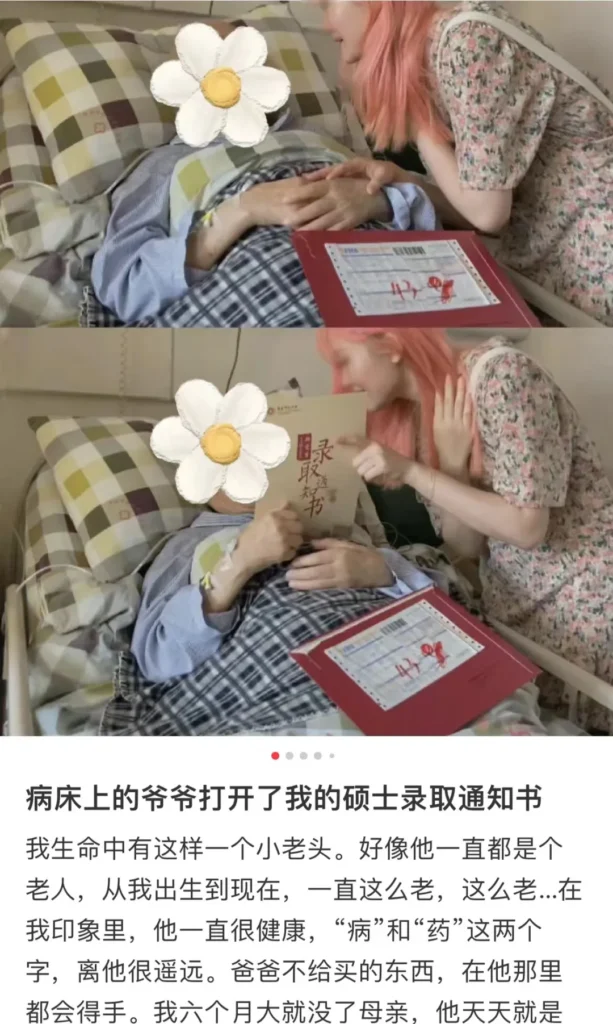
When many people thought that online violence was just a few mean words that they simply ignored and moved on, a young and vibrant life had already left us forever. All that Zheng Linghua experienced reminded us that things were far from being so simple. In 2022, she visited her grandfather in the hospital with a pink hairdo and a graduate admission notice, and posted the group photo on social media. The originally warm and memorable moment was soon stolen, distorted and spread by marketing accounts; strangers insulted, spread rumours about her hair colour, appearance and the photo with her grandfather, even maliciously interpreting it as “older and younger people falling in love”. Over the following months, she tried to dye her hair back to black, publicly refuted the rumours, and fought for her rights one by one. She also admitted that she had fallen into depression and received treatment. In January 2023, 23-year-old Zheng Linghua left this world. In her will, she listed online violence as one of the primary sources of her inner trauma (CCTV News, 2024).
The reason why the Zheng Linghua incident is disturbing is not only because it is tragic, but also because it is too “ordinary”, there were no knives, no blood, and even many of the perpetrators felt that they were “just leaving comments”. However, as the research on hate speech has pointed out, insults, humiliation, exclusion and stigmatisation on the internet can make victims feel frightened, lose their strength, withdraw from the public space, and even be forced into silence (Guan & Chen, 2025). And the reason why such harm can spread so quickly is not because suddenly a group of inherently malicious people gathered online, but because platforms often give higher visibility to emotionally charged, sensational, and observable content, and through recommendations, aggregations, forwards and low-cost participation, turn scattered malice into a collective attack (Massanari, 2017). Therefore, when discussing hate speech and online harms, we cannot only stop at the flimsy conclusion that “the netizens’ quality is poor”, what we need to ask more is how the platform magnifies the harm and why governance cannot only rely on deleting posts after the tragedy, but must shift to a “duty of care” approach centered on risk prevention and platform responsibility (Woods, 2021).
It is not just online violence: it is a case of hate speech and online harm intertwined
Before understanding the Zheng Linghua incident, it is necessary to distinguish between hate speech and online harms. The former generally refers to not just ordinary rude remarks, but expressions that demean people based on their group identities. Specifically, a person is attacked not because of what they have done, but because they are classified into a stigmatized group, such as gender, sexual orientation, nationality, or other social identities. Guan and Chen (2025) pointed out that the key feature of hate speech lies in its targeting of a person’s social identity rather than just their personal traits. It uses the distinction between “we” and “they” to shape certain people into those who are worthy of exclusion, humiliation, and even fear, becoming the “other”.
However, the scope of online harms is much broader. It not only includes hate speech, but also cyberbullying, rumour spreading, persistent harassment, mob-style insults, privacy infringement, and the psychological trauma and social exclusion resulting from these behaviours. In other words, hate speech is a specific type of online harm, while online harm does not necessarily have to conform to the narrow definition of hate speech.
Zheng Linghua’s experience precisely illustrates this point. Initially, she was attacked not because she belonged to a clearly defined minority group in a legal sense. Instead, it was due to a prominent feature – her pink hair – and a photo of her sharing an admission notice with her grandfather on her social media platform Rednote. This was stolen by a marketing account, leading to the dissemination of the first stage of fake information. As a result, in the second stage, she was insulted by strangers for no reason, and even some people deliberately magnified the situation, interpreting it as an “older and younger people falling in love”. They might have intended to attract attention and make money through this explosive and immoral event that goes against human ethics.
Among these attacks, many may not strictly qualify as hate speech, but they undoubtedly constitute serious online harm. Because they continuously humiliate and stigmatise a real-life person through the virtual space of the internet, and even go so far as to spread rumours, pushing an innocent person into fear, depression and self-doubt (CCTV News, 2024).
Guan and Chen (2025) remind us that expressions of hatred often stem from a sense of “threatening”, when a certain appearance, temperament, identity or lifestyle is regarded as deviating from the norm, people may belittle the other party through “otherness”, thereby maintaining the familiar value order of their own.
Zheng Linghua’s pink hair, the image of a young woman, and her openly joyful expression all made her seem like an “unusual” figure in the eyes of some netizens. She did nothing wrong, but she was regarded as an “unusual person” who could be ridiculed, judged, and arbitrarily interpreted. In this sense, although this incident is not exactly the same as hate speech targeting a fixed group, it clearly shares the core mechanism of hate speech, which is to rationalise humiliation and exclusion by portraying someone as an “other” who does not conform to norms (Guan & Chen, 2025).
Therefore, the most alarming aspect of the Zheng Linghua incident lies in the fact that it is neither merely hate speech nor an indistinguishable cyber violence tragedy or online harm, but rather a typical case where the two elements overlap. It teaches us that online harm often begins with the aversion towards “unusual person”, even if the person involved is innocent.
The platform is not neutral: from toxic technocultures to the dissemination logic of the Zheng Linghua incident
If we interpret the Zheng Linghua incident as “someone left a bad comment”, we will miss the most crucial aspect. This kind of harm does not spread naturally. Instead, it is magnified by the platform structure. In other words, the platform is not merely a passive container rather than it actively shapes the visibility, interaction methods, and scale of harm within the social technological environment.
Woods (2021) put it quite simply that the design choices of the platform are not “neutral” as they will affect how content is shared, and through various default settings, recommendation mechanisms, and interaction tools, they will push users in certain directions. That is to say, the platform is not a neutral backdrop. Its algorithms and interaction designs will make emotional and popular content more likely to attract attention and spread.
To be more specific, Massanari (2017) also pointed out that the so-called toxic technocultures are cultivated under the combined influence of the platform’s algorithms, governance, and community norms. She noted that Reddit’s karma points, cross-board aggregation, low thresholds for account and community creation, reluctance of administrators to intervene, and lenient policies towards offensive content all contribute to giving certain hostile content a much greater presence than it would otherwise have (Massanari, 2017).
More importantly, this sense of presence is not accidental. Content that receives high likes will have greater visibility. The default sorting will make users see the “most popular” comments first. And anonymity or nicknames, low-cost account creation, and relatively loose governance make it easier for people to engage in humiliation, jeering, and mobbing without much consequences or penalties (Massanari, 2017).
What does this mean? The harm on the platform is not usually caused by a single terrible comment, but is designed to be something that many “people can do with a gentle push”. When you give a like, post a sarcastic comment, or share someone else’s malicious content, it all seems like small actions. But when the platform aggregates, sorts, rewards these small actions, and then shows them to more people, it turns the scattered malice into a collective atmosphere.
Guan and Chen (2025) also pointed out when identity politics is intertwined with the attention economy, sensational, emotional, and negative narratives will naturally gain more visibility, which is precisely an important condition for the easy spread of online hatred, harassment, and demonisation of others. In other words, the most dangerous aspect of the platform is not merely allowing people to express hostility, but enabling hostility to be more easily seen, imitated, and incorporated.
Putting this framework back into the context of Zheng Linghua’s incident, we can see that the problem is not merely “a few netizens said something wrong”. The report by CCTV News (2024) shows that a touching group photo was stolen and widely spread by multiple marketing accounts. Then, a large number of strangers began to abuse, fabricate rumours, and maliciously interpret her pink hair, appearance, and photos with her grandpa. During the subsequent process of protecting rights, she still had to face the joint attack of numerous keyboard warriors. Each individual comment may seem insignificant, but accumulated together, they are sufficient to cause continuous mental oppression (CCTV News, 2024).
This is precisely the most cruel part of the platform’s amplification logic. It breaks down the harm into many seemingly insignificant actions, making everyone feel that their responsibility is very small, but the victim endures the total harm.
Therefore, I do not wish to simply state that “Zheng Linghua’s case is the Chinese version of the Reddit problem” because the specific mechanisms of different platforms are not the same. However, from an analytical perspective, they are highly similar. Massanari (2017) reminds us that platforms often claim to be “neutral” and refuse to intervene, as if they are merely providing a discussion space. In fact, the so-called neutrality merely prioritises the freedom of expression of the majority over the safety of the minority, and shifts the design responsibility of the platform onto individual users.
Reflection: Why “deleting posts” is not enough
If the previous sections have already demonstrated that the Zheng Linghua incident was not merely an individual’s moral lapse, but rather the result of the interaction between “otherness” and the platform’s amplification, then why can not the governance measures only focus on deleting posts, suspending accounts, and making post-event apologies? Because most of these measures occur after the damage has already spread. They deal with the consequences, but rarely touch upon the fundamental causes that led to these consequences.
If the governance logic is merely “responding to reports before taking action”, then the victims are forced to save themselves in an already out-of-control environment, but if the platform is required to assume the duty of vigilance, it should intervene earlier, such as examining whether the recommendation and popularity mechanisms amplify humiliating content, whether the complaint channels are fast enough, and whether there are more effective risk warning and protection measures (Woods, 2021). Therefore, one of the most profound lessons from the Zheng Linghua incident is that we can no longer treat the platform as an innocent intermediary.
Conclusion
Zheng Linghua’s death forces us to admit that online harm is not merely a few harsh words, it is a kind of social violence that accumulates continuously in the “otherness” imagination, the platform amplification mechanism, and the failure of governance. What is truly terrifying is not just how vicious some individuals are, but that humiliation, public scrutiny, and malicious interpretations have been packaged into low-cost, entertaining, and seemingly irresponsible daily behaviours. Thus, “just left comments” has become the most convenient excuse to absolve oneself, and it has also become the condition under which harm is most likely to continue.
Therefore, when reflecting on the Zheng Linghua incident, we should not merely focus on condemning the perpetrators or expressing regret for the victims. We must also think about what exactly the platform rewards, what it amplifies, and what it ignores. Only when we no longer regard the platform as a neutral backdrop but demand that it assume a genuine duty of care for foreseeable risks can the online space transform from a place that causes harm to a safer public space. Remembering Zheng Linghua should not merely be about remembering the tragedy of a “pink-haired girl” but rather remembering that when malice is repeatedly normalised, comments can truly be lethal.
Reference list
CCTV News. (2024, November 5). “努力想要活下去”的她,最终留下一封遗书走了……. CCTV News. https://xinwen.bjd.com.cn/content/s67297bb0e4b0e1ace8a7ed8c.html
Guan, T., & Chen, X. (2025). Threat Perception, Otherness and Hate Speech in China’s Cyberspace. The Journal of Contemporary China, 1–16. https://doi.org/10.1080/10670564.2025.2475051
Massanari, A. (2017). Gamergate and The Fappening: How Reddit’s algorithm, governance, and culture support toxic technocultures. New Media & Society, 19(3), 329–346. https://doi.org/10.1177/1461444815608807
Woods, L. (2021). Obliging Platforms to Accept a Duty of Care. In Martin Moore and Damian Tambini, M. Moore, & D. Tambini (Eds), Regulating Big Tech : policy responses to digital dominance (pp. 93–109). Oxford University Press.


Be the first to comment