
Two Cases, One Question
What struck me about these two cases, separated by an ocean and a language barrier, is how similar the mechanism of harm turned out to be.
In 2023, a coordinated doxxing campaign swept across Bilibili, one of China’s largest video platforms. Organised through encrypted groups on overseas messaging apps, participants illegally obtained and published content creators’ real names, phone numbers, and home addresses, then followed up with abusive calls, mass false-reporting, and sustained intimidation. Chinese police traced the operation across 18 provinces, involving more than 40 individuals; the lead organisers were reportedly found to be minors.

The Harvard “doxxing truck” targeting student signatories. Source: New York Post.
That same year, several Harvard student organisations signed an open letter on the Israel–Palestine conflict. In response, the conservative group Accuracy in Media sent a truck mounted with an electronic billboard circling the campus, displaying the students’ names and photographs under the label Harvard’s Leading Antisemites. Targeted students reported online harassment, family safety concerns, and damage to their job prospects.
These two cases share a mechanism that the organised exposure of individuals’ identities as a form of public punishment, amplified across platforms and extending into offline harm.
Online abuse and hate speech, as Flew (2021) claims, have become the characteristics of the platform era, and the initial idea of free speech on the internet, as a product of unregulated platforms, is no longer sufficient in a platform-mediated media landscape. Online abuse is not a sudden outburst of outrage: it is built up by the same processes that scholars have pinpointed in hate speech studies: othering, stigmatisation, and platform amplification. Hate speech constructs the grounds of aggression by framing particular persons or groups of people as threats worthy of punishment; platform systems transform that aggression into systematic, scalable and sustained abuse. These harm are becoming more and more networked, targeting, cross-platform, and cross-platform, and which cross the boundary between digital and physical safety, often outgrow the traditional categories of hate speech, and share their logic. Governance should then shift its focus from policing individual posts to designing systems, risk management, and context-specific regulation.
This blog is based on the study of hate speech not in the sense that all the instances described here qualify as a strict legal definition of hate speech, but in that hate speech is a common driver of the broader processes of networked abuse, and the processes that these scholars have identified othering, stigmatisation, platform amplification, and governance failure are operating long beyond the terms of hate speech itself and are shaping the wider terrain of networked harm that platforms now.
What Counts as Online Abuse? Defining the Problem
Hate speech is directed at a group of people, stigmatises it by attributing negative traits to it, and establishes it as a legitimate target of aggression (Parekh, 2012, as cited in Flew, 2021). It need not be violent in speech, can work by use of irony, moral framing, or pseudo-scientific arguments. Certainly, unlike a strict dichotomy, there is a spectrum between discriminatory speech and overtly violent incitement, as Flew (2021) points out by citing Cortese (2006).
Sinpeng et al. (2021) take the definition to the next level. In the analysis of Facebook in the Asia Pacific, they declare hate speech as a speech capable of immediate and long-term harm, and a speech that discriminates against individuals based on perceived group membership. This framing changes the emphasis on the issue of whether or not one has been hurt to the issue of whether structural harm, intimidation, or erosion of dignity is being generated.
Nevertheless, the platform era has brought about new forms of harm that transcend the traditional types of hate speech but possess identical mechanisms. Such campaigns as doxxing, moral witch-hunts, and identity exposure across platforms do not necessarily target individuals based on race, religion or sexuality, the group characteristics that predominantly feature in most hate speech definitions. But they work on the same principle of othering: the quick creation of a target as somebody who seems to deserve collective punishment, which is enhanced by platform systems that encourage the expression of emotion and reduce the cost of action. In this regard, the fuel of hate speech is frequently the stigmatisation and dehumanisation of a target, whereas platform affordances are the engine that turns hostility into scalable, organised abuse.
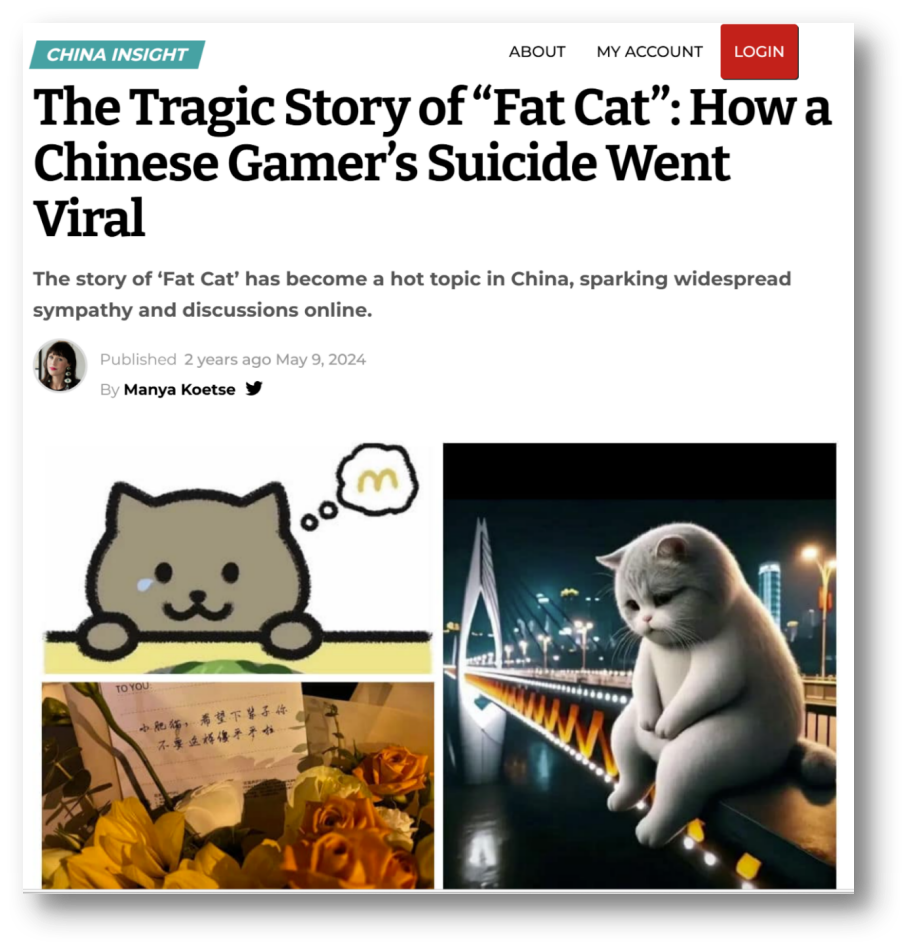
From online judgment to mass harassment in the “Fat Cat” case. Source: Eyes on Digital China.
In China in 2024, a private relationship dispute was repackaged into a viral moral trial that led to over 400 instances of rumour and harassment being investigated by police (the “Fat Cat” case).
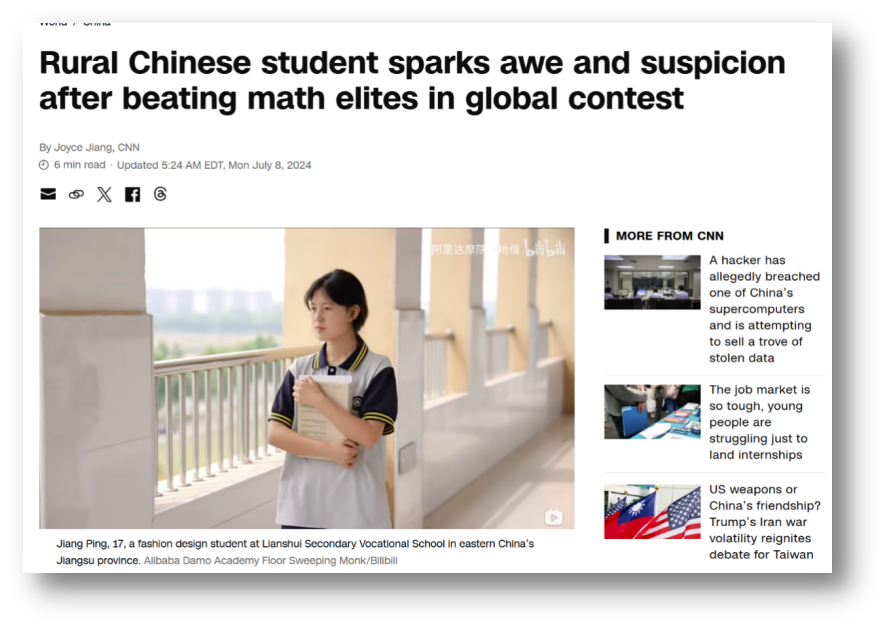
Jiang Ping and the online witch-hunt surrounding her achievement. Source: CNN.
A vocational-school student who placed highly in a maths competition was subjected to gendered and class-based suspicion long before any formal investigation began (the Jiang Ping case). In both instances, the abuse was initiated with a slogan or a manifesto. It began with ethical judgment, scaled by platform sharing and concluded with actual human beings being hunted. When online abuse is constructed based on othering and driven by platform systems, the question that follows is: what is it that platforms do that makes this type of harm so efficient?
How Platforms Amplify Abuse: From Expression to Infrastructure
The concept of platformed racism proposed by Matamoros-Fernandez (2017), based on the Adam Goodes scandal in Australian football, reveals that it is not platforms that host hostile discourse, but rather it is bound up with their design, affordances, algorithms, and governance. In the Goodes case, the recommendation systems of Facebook and YouTube showed users more racist content as they consumed other content, which established feedback loops of hostility. The concept goes beyond race: by reposting, liking, ranking, sharing screenshots, and being recommended by an algorithm, platforms render hostility more visible, repeatable, and scalable.
The damage in the Bilibili doxxing campaign did not take place on a single platform. Co-ordination via encrypted overseas channels was done, followed by attacks via the internal tools of Bilibili (comments, private messages, mass-reporting systems), and the distribution of personal information of victims back across platforms. The hate was not generated by the platform itself, yet its design rendered the campaign operationally effective.
According to the analysis presented by Massanari (2017), when ranked systems, aggregation logics, permissive governance, and community norms are used as demonstrated by the example of Reddit in her analysis of the event of #Gamergate, they form what she refers to as toxic technocultures. The most important point that she makes is that platforms do not actively generate harassment, but through their sociotechnical configurations, the combination of design, policies, and norms, it indirectly thrives. When outrage-driven material is brought into greater publicity and greater reward than subtle discourse, the dispersed anger coalesces into mass abuse.
This reasoning is expanded by the Harvard case to social media feeds. The doxxing truck was a material object, yet its force was powered by digital infrastructure: the names of the students have been harvested on an open letter on the web; the photos of the truck were captured and distributed on Twitter/X and Instagram; the ensuing harassment has been perpetuated using platform-based pile-ons. Platform amplification has become required to give the offline targeting reach and persistence.
Woods and Perrin (2021) note that platforms influence harm in the entry of users; how content is shared, how users interact, and how complaints are addressed. Design decisions are not neutral, and they use cognitive biases and nudge behaviour.
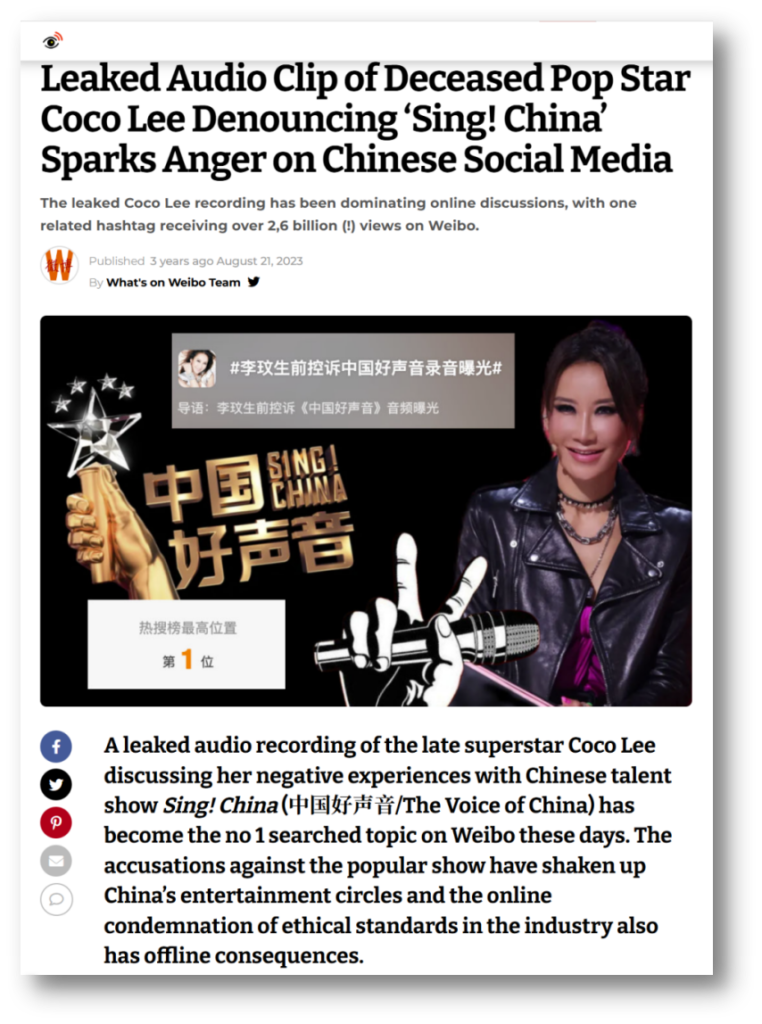
Platform-driven outrage in the aftermath of Coco Lee’s death. Source: Eyes on Digital China.
The response after the death of singer CoCo Lee in 2023 is an example of how these design aspects come into play in practice. When there were recordings of mistreatment by the production team of The Voice of China, it was not just an outcry that came out and died away, but rather was maintained and moulded by the platform environment itself. The algorithm of recommendations continued to keep the scandal going even after the first leak; one-Click interaction tools ensured that millions of users could join a growing pile-on with ease; and as the anger spilt over out of Weibo to Douyin to WeChat, it became easy to target extended targets outside of the program team to individuals who were reportedly harassed in real life. Initially, as sorrow and justified indignation, platform design led to a campaign whose magnitude and duration no individual user wanted or managed.
In case the platforms arrange the circumstances under which the abuse can transpire, even prior to any individual post being flagged, then the governance based solely on the deletion of particular posts is structurally inadequate.
Governance: Why Takedown Is Not Enough
That is why the governance structures that are so limited in their outlook on whether a particular post is defined by the legal measure of hate speech are not enough. The harm mechanisms: othering, platform amplification, and organised targeting are applicable in a spectrum, including but not confined to hate speech. Hate speech can set the fuse on fire, but the platform environment decides the distance of the damage and the speed. This reality would be better addressed with a duty of care approach (Woods and Perrin, 2021), since it focuses on the platform environment in which all these types of abuse are facilitated, and does not evaluate individual posts individually.
The model by Woods and Perrin (2021) is that platforms must be legally obligated to recognise and mitigate foreseeable risks, just as an employer is obliged to provide a safe working environment. In the same way that a building owner cannot get out of the liability by claiming that he/she did not personally light the fire, platforms cannot get out by claiming that the people who posted the content are the ones who did it. Emphasis is placed on systemic risk management: platform design, interaction tools, recommendation systems, and complaint processes. The UK Online Safety Act 2023 was based on this conceptual framework.
However, even well-constructed regulatory schemes have a serious problem: international regulations have a hard time capturing domestic evils. The analysis of Facebook in the Asia Pacific by Sinpeng et al. (2021) demonstrates that the local language, culture, and politics profoundly influence harmful speech. Automated classifiers and Global Community Standards never managed to capture context-specific abuse. Reporting systems created what the authors term as reporting fatigue – users would cease reporting since they would not see any outcome. This trend of pressure-induced, belated moderation is not exclusive to Western providers. It was estimated by a CRN interview archived by China Digital Times and videos on Bilibili that over 70 anti-LGBTQ forums on Baidu Tieba were closed in early 2026; however, only after years of targeted activism, legal action, and public pressure against them. Late moderation does not cancel out harm developed.
This tension can be seen in the very effort of Bilibili to become a community-run site, a so-called Discipline Committee of users, by voting on flagged content, in which Bilibili users vote. The model is novel in its distribution of reviews to the users with local contextual information, yet it is nonetheless primarily reactive: it interferes only after the harmful content has spread, and does not do anything to mitigate the upstream design choices that Woods and Perrin (2021) see as the true location of risk. Even more importantly, community voting will recreate instead of remedy any existing bias there may be: a majority in a platform already shares assumptions about who qualifies as a valid target, and a democratic vote might only reinforce the prejudice. The Bilibili doxxing effort itself was off-platform organised and implemented via coordinated abuse of legitimate features; no volunteer jury would have caught it.
I would say that to have action is necessary. On the platform level: decrease the visibility of content made by outrage; diversify recommendation channels; enhance reporting disclosure; develop a response to cross-platform targeting marketing efforts. On the institutional level: less reliance on self-regulation; demand platforms to show, not just claim, that they have discovered and dealt with foreseeable risks; enable independent regulators to enforce. On a social level: raise platform and algorithm literacy and awareness; promote sceptical participation in pile-ons.
Conclusion
The Bilibili doxxing campaign and the Harvard doxxing truck concluded that online abuse during the platform era is more than an issue of angry comments.
Hate speech studies provide means to comprehend how targets are constructed; platform studies provide us with how such constructions are intensified; and the accumulating body of governance research informs us that content removal through reaction is never sufficient.
It is not a handful of extreme posts in isolation that needs to be governed, but the platform environment itself – the environment that feeds the incitement into exposure, and spectatorship into mass targeting over and over again. I think that is where the actual discussion of platform governance should start.
References
Carlson, B., & Frazer, R. (2018). Social media mob: Being Indigenous online.
China National Radio. (2023, Nov. 23). B站披露一起“人肉开盒”案细节 公安机关:主要活动人员已被处罚. CNR. https://china.cnr.cn/yaowen/20231123/t20231123_526495638.shtml
CRN. (2026, Mar. 7). 我如何让反同者公开道歉,并见证70余个反同贴吧关停. China Digital Times. https://chinadigitaltimes.net/chinese/725711.html
Flew, T. (2022). Regulating platforms. Polity Press.
Guan, T., & Chen, X. (2026). Threat Perception, Otherness and Hate Speech in China’s Cyberspace. The Journal of Contemporary China, 35(158), 1337–1352. https://doi.org/10.1080/10670564.2025.2475051
Joyce Jiang. (2024, Jul. 8). Rural Chinese student sparks awe and suspicion after beating math elites in global contest. CNN. https://edition.cnn.com/2024/07/08/china/china-maths-student-controversy-hnk-intl/
Manya Koetse. (2024, May. 9). The Tragic Story of “Fat Cat”: How a Chinese Gamer’s Suicide Went Viral. Eyes on Digital China. https://www.whatsonweibo.com/the-tragic-story-of-fat-cat-how-a-chinese-gamers-suicide-went-viral/
Massanari, A. (2017). Gamergate and The Fappening: How Reddit’s algorithm, governance, and culture support toxic technocultures. New Media & Society, 19(3), 329–346. https://doi.org/10.1177/1461444815608807
Matamoros-Fernández, A. (2017). Platformed racism: the mediation and circulation of an Australian race-based controversy on Twitter, Facebook and YouTube. Information, Communication & Society, 20(6), 930–946. https://doi.org/10.1080/1369118X.2017.1293130
Moore, M., & Tambini, D. (2021). Regulating Big Tech: Policy Responses to Digital Dominance (M. Moore & D. Tambini, Eds.; 1st ed.). Oxford University Press. https://doi.org/10.1093/oso/9780197616093.001.0001
Qianyu Feng. (2021, Oct. 19). B站把社区氛围交给风纪委员这四年. TMTPOST. https://www.tmtpost.com/5783163.html
Roberts, S. T. (2020). Behind the screen : content moderation in the shadows of social media. Yale University Press. https://doi.org/10.12987/9780300245318
Shannon Thaler. (2023, Oct. 12). ‘Doxxing truck’ drives around Harvard showing names, photos of students who blamed Israel for Hamas attacks. New York Post. https://nypost.com/2023/10/12/truck-at-harvard-ousts-names-of-students-involved-in-letter-attacking-israel/
Sinpeng, A., Martin, F. R., Gelber, K., & Shields, K. (2021). Facebook: Regulating Hate Speech in the Asia Pacific. Department of Media and Communications, The University of Sydney.What’s on Weibo Team. (2023, Aug. 21). Leaked Audio Clip of Deceased Pop Star Coco Lee Denouncing ‘Sing! China’ Sparks Anger on Chinese Social Media. Eyes on Digital China. https://www.whatsonweibo.com/leaked-audio-clip-of-deceased-pop-star-coco-lee-denouncing-sing-china-sparks-anger-on-chinese-social-media/


Be the first to comment