Introduction
In the past, people mainly used search engines to escape from them. In this sense, search is like an entrance. It helps people access the Internet instead of summarizing the Internet for them.
Displaying AI Overviews and other information on the search page, Google no longer simply guides users to other websites. But what should really be noted is that the search should not only be fast, but also directly determine the content that the user sees first, the content that the user is most likely to believe, and the source that users may still click on.
This is precisely the core point of this article: Google’s AI Overviews are not merely a new search function, but rather an algorithmic governance system. As Crawford (2021, p. 8) puts it, “artificial intelligence is a registry of power.” It alters the sequence of information visibility, undermines the control that content producers have over how their content is used, and further shifts the power of online visibility from the open network to the answers generated by the platforms. As a result, the question is no longer merely “Is this feature user-friendly?”, but “When platforms start to answer questions for the public in advance, who still has the power to organize knowledge and distribute attention?”
Google no longer just points you to the web
To understand why AI Overviews have become a governance issue, one must first understand what exactly has been changed. Many people view it as just a new module on the search result page, as if there’s just an additional section of AI summary above the original “ten blue links”. However, if one merely regards it as a change in visual layout, one would be underestimating the significance of this matter.
Traditional search is certainly not neutral either. Google has always been sorting, filtering and recommending. The algorithm is always determining which links should be ranked higher and which should be ranked lower, which content is more “relevant” and which is more “worthy of being seen”. Nevertheless, traditional search still adheres to a fundamental rule: the platform mainly plays the role of a “guide”. It can influence who you see first, but usually still sends you to other websites, where the original content producers complete the subsequent explanation.
The AI Overviews have significantly changed this relationship. It not only “finds answers” for users, but also “organizes answers” for them first. As Google Search Central (2025) explains, “AI Overviews help people get to the gist of a complicated topic or question more quickly, and provide a jumping off point to explore links to learn more.” When users visit the search results page, the first thing they encounter may not be a single source, but a pre-integrated statement of the platform. For ordinary users, this design is undoubtedly convenient because it reduces the cost of comparison and selection. However, this is why users actively move to the original web page, comparing different sources and forming their own judgments is less space.
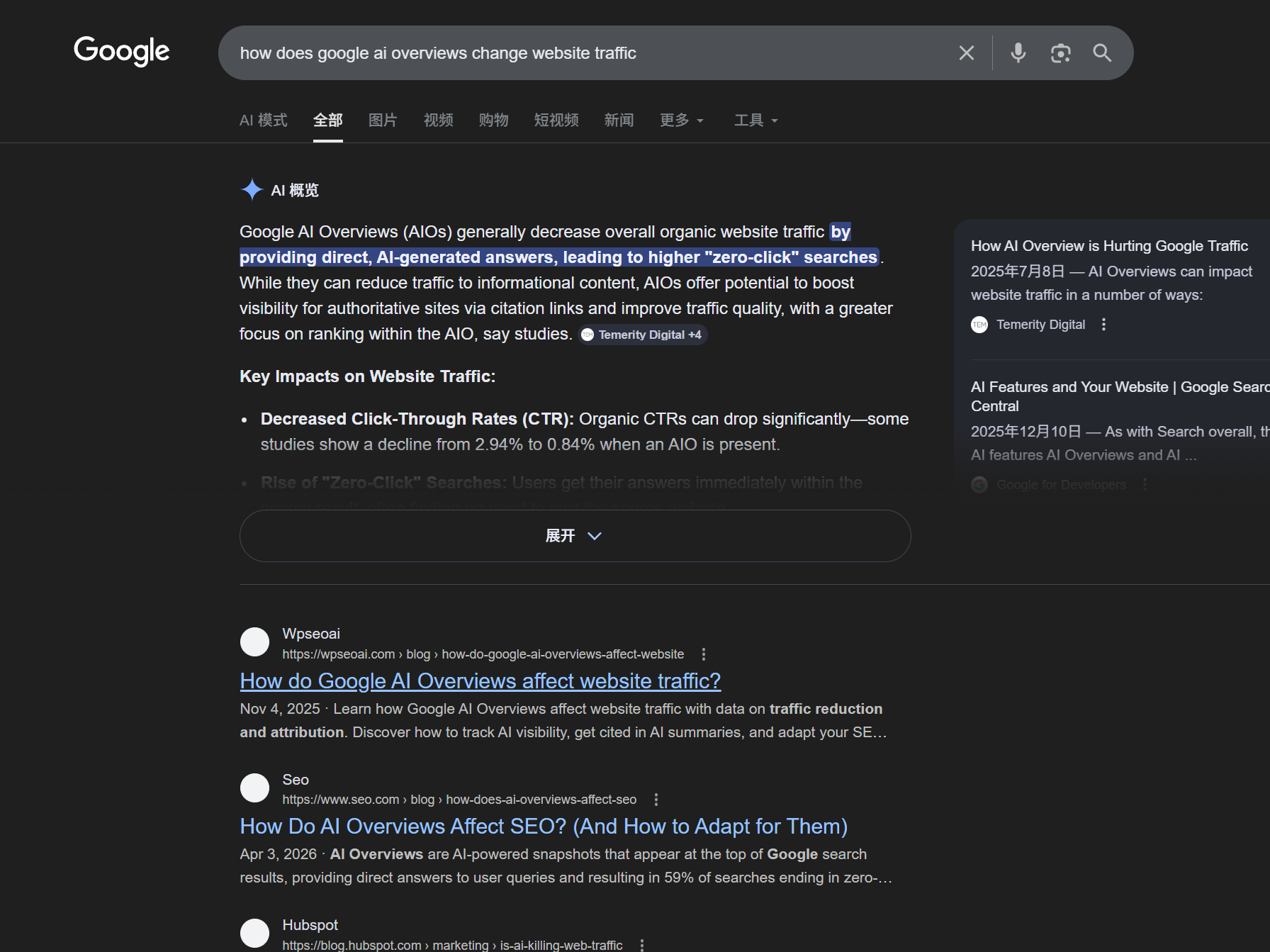
In the online environment, the “first thing you see” is power in itself. The more prominent, direct and comprehensive the expression, the more likely it is to be regarded as the “most important information”. When the platform begins to provide seemingly complete answers based on its own interface logic, instead of simply placing links, it actually deeply intervenes in the starting point of information contact. If search engines begin to play the role of “explaining first”, the platform’s control of knowledge entry points will no longer be just technical ranking, but closer to the governance function of the real world.
Why publishers say AI Overviews change the rules
In the public discussion about AI Overviews, the most common question is “Did it give the wrong answer?” That’s it. However, if the discussion is limited to “accuracy”, it may miss a more in-depth discussion.
What truly upsets publishers, news organizations and content websites is not merely the possibility of AI Overviews experiencing hallucinations, but rather the fact that it is altering the already unequal and now even more imbalanced relationship of rules between platforms and content producers. As the Competition and Markets Authority (CMA, 2026) puts it, the proposed measures are intended to give publishers “more choice and transparency over how their content is used in Google’s AI Overviews.” In the past, even if platforms had extensive distribution rights, content producers still had a basic logic to rely on: as long as their content was relevant and of high quality, there was still a chance to receive clicks through search results, allowing users to access the original webpage, read further, stay longer, subscribe, and even generate revenue.
However, when Google presents a platform-generated answer at the top of the search results, this logic begins to change. The platform can extract information from a large amount of external content, condense the expression, re-integrate it, and then try to solve the user’s initial question on its own page as much as possible. As a result, the original web page continued to exist. Although the original author did not “disappear”, their position in the information chain has regressed significantly. Although the content is still created by others, the first layer of interpretation is increasingly concentrated in the platform interface.
This is why many publishing institutions would say that AI Overviews are not simply “adding a new feature”, but rather “changing the rules”. Here, “rules” do not refer to a specific usage clause, but rather the long-standing set of operating logic of the open network: the platform is responsible for direction, the website for hosting; search is responsible for allocating attention, the original webpage for providing explanations; clicks are both user behavior and a mechanism for content to gain visibility and value rewards. And AI Overviews is weakening this mechanism. It enables the platform to better integrate and re-present others’ content without actually sending users out.
From the perspective of the platform, this can be presented as an enhancement of user experience; but from the viewpoint of the content producers, it means that their control over how the content is viewed, whether it is clicked, and how it is understood is decreasing. This weakening of control is not just a business problem, nor is it just a complaint of the media industry about reduced traffic. It concerns whether knowledge producers in an open network still have a basic negotiating position, whether external websites can continue to be seen by users, and whether the Internet will further degenerate from a “world of scattered web pages” to a “world where a few platform interfaces uniformly distribute and interpret information”.
Therefore, what the publisher said about “the rules changing” is not an exaggerated expression. It points to a more fundamental issue: when the platform not only controls the entry point but also starts to control the first layer of answers, the position of the original content producers in the information ecosystem will be redefined, and this redefinition itself is governance.
This is what algorithmic governance looks like
If the first two parts discussed “what happened”, then this part is intended to answer: Why can this change be called algorithmic governance rather than just an upgrade in search experience?
Often, when people mention “governance”, the first thing that comes to mind is law, government, regulatory agencies and policy documents. However, in the digital platform environment, governance does not only occur in legal documents. It also occurs in the process of interface design, function deployment, default options and algorithms. This method of organizing behavior and attention through technical structure is itself a form of governance.
Instead, the platform has described the steps of selection, extraction, compression, sorting and presentation in the system. What the user sees is only a complete result, but what sources are actually included behind this result, what information is excluded, what expressions are retained, and which complexity is simplified. Which viewpoints is placed in a more prominent position, and there are many opaque judgments. Instead, it is naturally presented in the form of “convenience”, “intelligence” and “time-saving”.
It usually does not exist in the form of mandatory orders, but runs through a seemingly neutral technical process and quietly decides how users interact with the world. Users seem to have options to choose from. Because the link is still there, the web page can also be used. But in reality, this platform has deeply organized the relationship between questions and answers. As Just and Latzer (2017, p. 247) put it, “The result, an algorithmically formed reality, again governs – this time behavior and action, that is, various choices in daily lives.”
However, when the platform begins to speak in the form of answers, this form becomes more concentrated and difficult to detect. The AI summary at the top is often mistakenly thought by many users as “having already been reviewed for me”.
The problem is that this expansion of power does not always have the same clear boundaries of responsibility(Pasquale, 2015). The platform can explain many consequences as the result of the operation of the automated system, hide the concentration of power behind the active governance of packaging, and hide the concentration of power behind the expression of “system-generated”
Therefore, the problem of AI Overviews is not to completely replace the web page or always be accurate, but to allow the platform to manage knowledge entry points in a more integrated and natural way. This is the most typical form of algorithmic governance. Rules are no longer written by law, but are incorporated into the system.
Can regulation catch up?
Judging from the current discussion, at least one thing is clear. This is not just a complaint within the media industry, nor is it just an argument about user experience. It has entered public discussions on platform governance, competitive order and content management(Flew, 2021).
If several large platforms have access, traffic and answer generation functions at the same time, are the market rules too unbalanced?
Determine the default entry point, page layout and the first content that users see. Regulation can require more transparency, more protection and more options, but it may not easily eliminate this structural advantage.
Regulatory intervention is certainly necessary, but in many cases, only after redesigning the information environment of the platform can we try to improve the results.
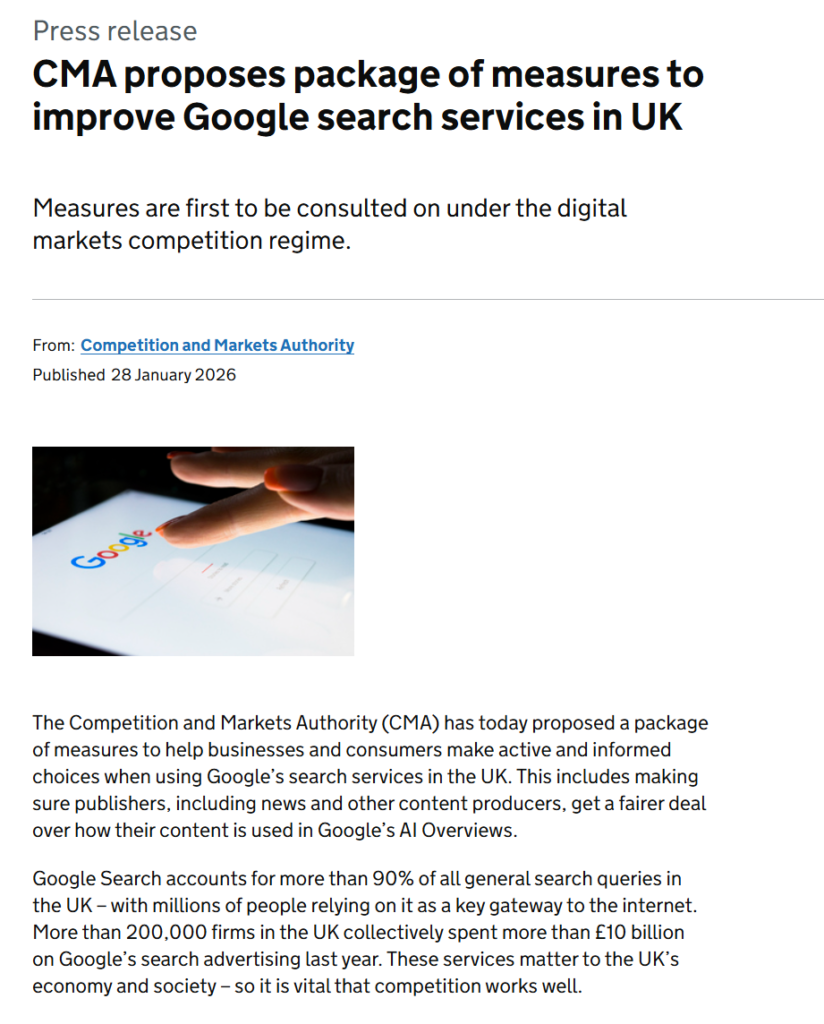
It can restrict certain practices and improve certain unfairness, but it may not be able to restore search to being a more open and decentralized entry point to the internet. This also means that the discussion on the governance of AI Overviews cannot merely focus on “whether there are rules”, but must further inquire: Who designed the rules, who controls the interface, and who has the ability to keep the public within the platform?
Conclusion
Google’s AI Overviews seem to be merely a natural evolution of search: faster, more direct, more like answering questions rather than providing navigation. But this is precisely the aspect that makes them most worthy of critical examination. Because once search no longer merely directs users to the original web pages, but increasingly conducts summaries, explanations and screenings within the platform itself, the platform will no longer merely be an information entry point; instead, it will be actively organizing the information order.
Who gets priority attention, who loses the click rate, who loses control over the content, and who has no clear responsibility after gaining power? These are not technical details, but the core issues of digital governance.
In the past, “search” helped users leave Google and access a more open network. AI Overviews uses Google as an answer space where users can stay. This is precisely why it is not just a change in the search function, but a change in the governance approach.
Reference
Competition and Markets Authority. (2026, January 28). CMA proposes package of measures to improve Google search services in UK. GOV.UK. https://www.gov.uk/government/news/cma-proposes-package-of-measures-to-improve-google-search-services-in-uk
Crawford, K. (2021). The Atlas of AI: Power, Politics, and the Planetary Costs of Artificial Intelligence (1st ed.). Yale University Press. https://doi.org/10.2307/j.ctv1ghv45t
Flew, T. (2022). Regulating platforms. Polity Press.
Google Search Central. (2025, December 31). AI features and your website. https://developers.google.com/search/docs/appearance/ai-features
Just, N., & Latzer, M. (2017). Governance by algorithms: reality construction by algorithmic selection on the Internet. Media, Culture & Society, 39(2), 238–258. https://doi.org/10.1177/0163443716643157Pasquale, F. (2015). The Black Box Society : The Secret Algorithms That Control Money and Information. Harvard University Press,. http://dx.doi.org/10.4159/harvard.9780674736061



Be the first to comment