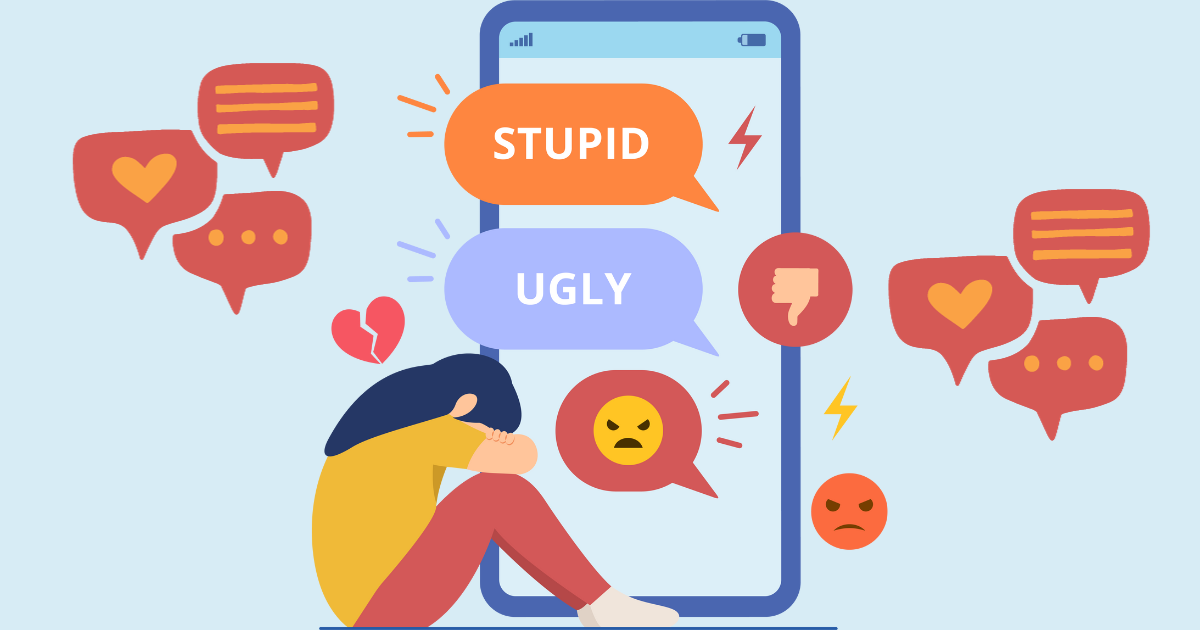
Cui Lili, a Chinese woman who has already been legally recognized as a victim of sexual assault, was later labelled online as a “liar,” an “attention-seeker,” and someone staging a setup for profit.
It may seem like a matter of individual morality. But a closer look reveals something more troubling.
These reactions are not isolated; they are repetitive and patterned. There is a term for this phenomenon: victim blaming.
This leads to another question.
Why are these voices amplified so quickly, even overwhelming the facts themselves?
Using the case of Cui Lili, we will explore a heavy answer:
Social media platforms are not neutral spaces. Through algorithms, design choices, and governance structures, they can invisibly amplify hate and humiliation directed at women.
Why Is a “Proven Victim” Still Denied?
In September 2023, Cui Lili, an employee of a company in Tianjin, was sexually assaulted by the company’s controlling shareholder during a business trip.
She reported the case shortly afterwards. In April 2024, the court sentenced the perpetrator to four years in prison for rape, legally confirming her status as a victim.
However, the story did not end there.
As a result of the assault, Cui developed post-traumatic stress disorder and was later recognized as having suffered a work-related injury. This made her case the first in China to classify workplace sexual assault as an occupational injury.
The company refused to accept this decision, and the dispute continued into 2025.
A court hearing in September 2025 marked a turning point in public attention.
Images of Cui attending the hearing, wearing the same clothes from the day of the assault, spread rapidly on social media. What followed was a wave of large-scale online abuse.

Many users began attacking and defaming her, mocking her appearance, accusing her of seeking attention, and even fabricating claims that she planned to profit from the incident through livestream sales.
This was not a series of isolated comments. It showed clear signs of scale and coordination.
According to information later released by Cui, the total reach of related content approached one hundred million views. The discussions spanned multiple platforms and accounts, including influencers with millions of followers.
But how did this wave of hostility grow so rapidly and reach such a scale?
Where Does the Hate Come From?
These attacks are actually rooted in deeper and more stable social and psychological patterns.
Research shows that in cases of sexual assault, the public often relies on existing gender stereotypes to judge whether a victim is “worthy of sympathy.” When a woman is seen as not fitting the image of an “ideal victim,” she is more likely to be blamed (Masser et al., 2010).
These attacks target individuals but rely on gendered stereotypes to undermine credibility.
In this sense, such expressions are not just instances of online abuse targeting one person. They also reflect broader patterns of gender-based hate speech.
According to Mukka (2025):
Studies suggest that between 16 and 58 percent of women have experienced this type of violence.
Hate does not simply spread. It is amplified.
It may seem intuitive that these voices grow because many people share them. However, visibility on social media does not necessarily reflect majority opinion. It is the result of algorithmic selection.
Platform features such as likes, recommendations, and trending lists actively shape what users see. Research by Massanari (2015) suggests that these design choices can create environments that are particularly conducive to misogyny and antagonistic online cultures. In practice, content that is emotionally charged or controversial is more likely to be amplified.
This dynamic is clearly visible in the case of Cui Lili. A search for her name on Douyin, the Chinese version of TikTok, reveals a pattern: compared to more balanced explanations or supportive voices, content that accuses, mocks, or expresses strong emotion toward her is more visible.
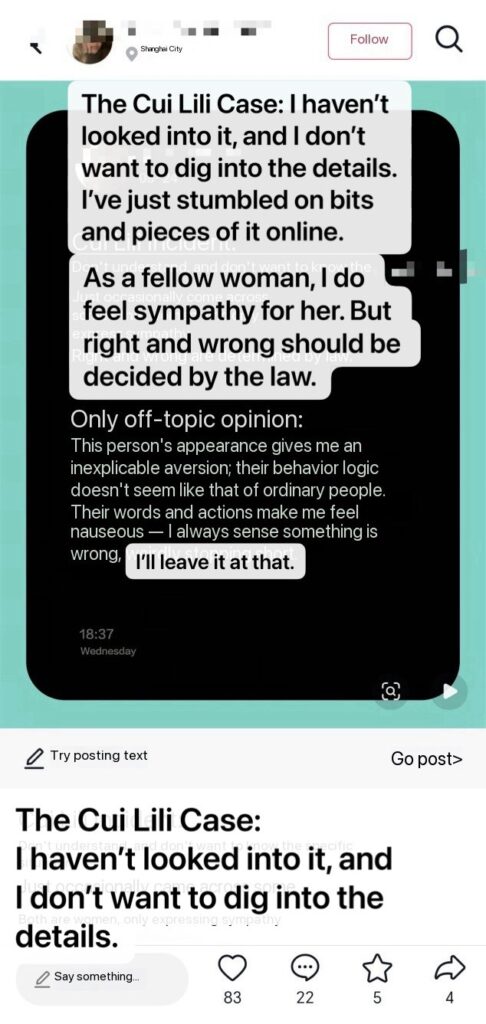
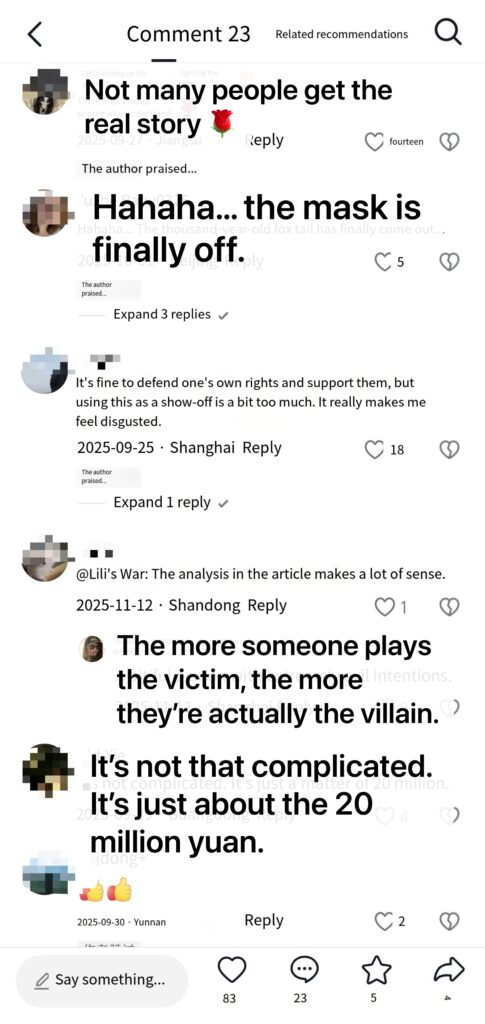
As users are repeatedly exposed to similar viewpoints in their feeds, this repeated exposure can reinforce echo chambers and intensify the false consensus effect, leading individuals to believe that a particular opinion represents the majority (Luzsa & Mayr, 2021).
In this case, hostility toward Cui not only reaches a wider audience, but also reinforces pre-existing biases.
In other words, hate does not simply exist on these platforms. It is structurally amplified and continuously reproduced.
Do All Platforms Tell the Same Story? Not Quite.
Public opinion does not develop in the same way across all platforms.
In this case, different platforms produced noticeably different narratives. On Rednote, aka Xiaohongshu, a social media platform with a predominantly female user base and a strong focus on lifestyle sharing, discussions around Cui Lili were more likely to center on issues such as the case itself, legal rights, and support for her.

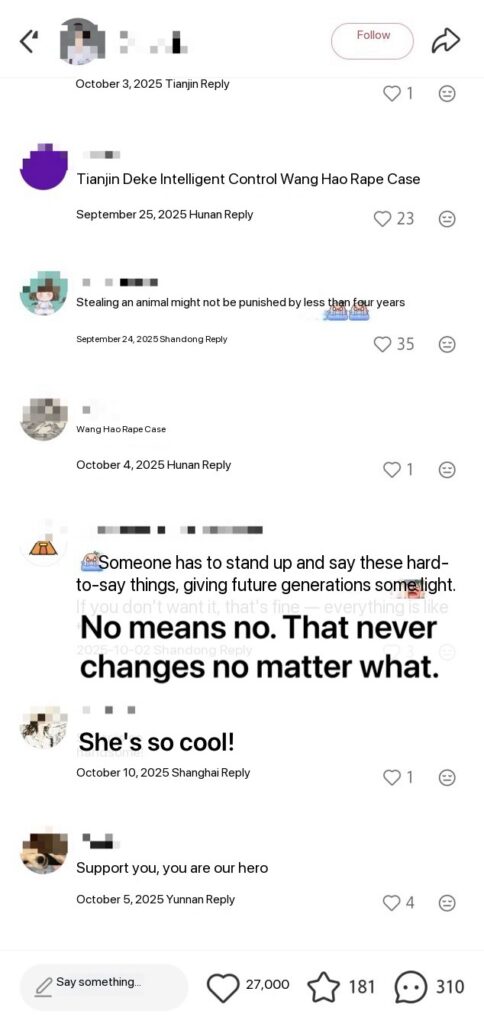
This contrasts with Douyin, where the gender distribution is more balanced and the overall tone of discussion appears markedly different.
While differences in user demographics may play a role, platform design is equally important.
Both platforms host user-generated content, but their logics differ.
PRIZM Group (2024) notes that Douyin operates as a highly automated recommendation system. Users do not need to actively search for content. Instead, the platform continuously feeds videos based on viewing time, clicks, and engagement patterns. As discussed earlier, content that provokes strong emotional reactions, such as controversy, conflict, or hostility, is more likely to be promoted.
Rednote, by contrast, is more search-driven and emphasizes authentic sharing. This tends to create a space oriented toward discussion and experience-sharing rather than attention-driven content.
At the same time, once a negative narrative takes off, the system keeps feeding it. It spreads quickly and becomes harder and harder to control.
This suggests that platforms are not neutral spaces. They actively shape the direction of public discourse in different ways.
Why Can’t Platforms “Control” This?
If platforms amplify harmful content, why do they not simply stop it?
The answer is complex.
From a technical perspective, hate speech is not always easy to identify. It often depends on context rather than explicit keywords (Sinpeng et al., 2021). In this case, several forms of expression can cause harm while remaining difficult for automated systems to detect:
- Words that appear neutral in isolation but become insulting in context, such as “dama,” which can shift from a neutral term for an older woman to a negative stereotype
- Humor, sarcasm, or memes that mask hostility (Matamoros-Fernández, 2017) while increasing shareability and reinforcing stereotypes
- Manipulated images or AI-generated content that distort reality and harm the victim’s reputation
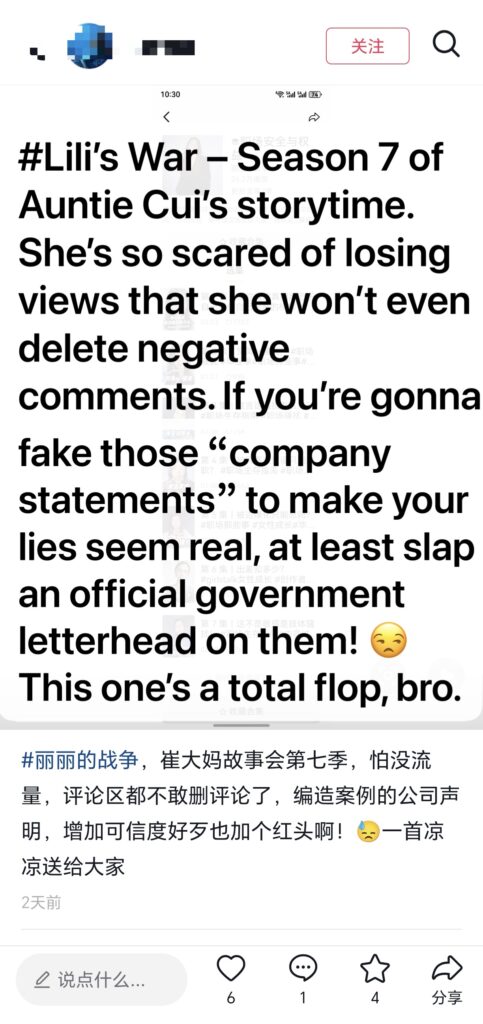
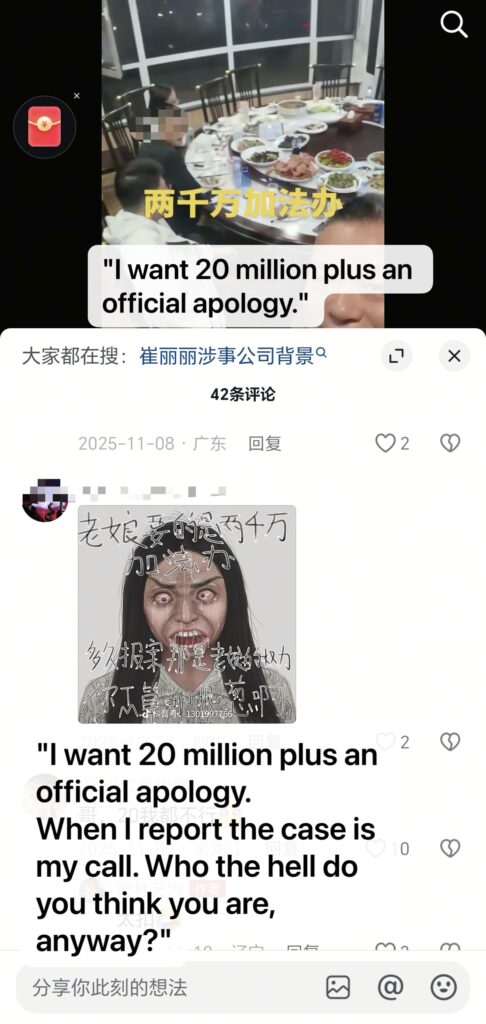
along with a comment featuring a meme
that uses her words to distort and ridicule her image.
Source: Original screenshot
In addition, most content moderation systems operate after content has already been published. While there is some level of pre-screening, such as keyword filtering or detection of explicit violations like violence or pornography, these measures are limited. Subtle forms of abuse, including sarcasm, insinuation, or coded language, often pass through.
More importantly, platforms tend to prioritize engagement signals over potential harm. When emotionally charged or provocative content receives strong early interaction, it is more likely to be amplified. By the time user reports or human moderation intervene, the content may already have spread widely.
Moderation itself also relies heavily on user reporting (Roberts, 2020). However, the reporting process lacks transparency. When users report abusive content, they typically receive minimal feedback.
Users often do not know how decisions are made or what consequences follow, as the system offers little clarity.
As noted by Matamoros-Fernández (2017, p. 935), social media platforms’ technical infrastructure can also be strategically “hijacked”. For example, collective reporting can be used to influence moderation outcomes. When large numbers of users target a specific post or account, the system may prioritize the reported content without fully assessing intent. In some cases, those speaking out may be restricted, while harmful content remains visible.
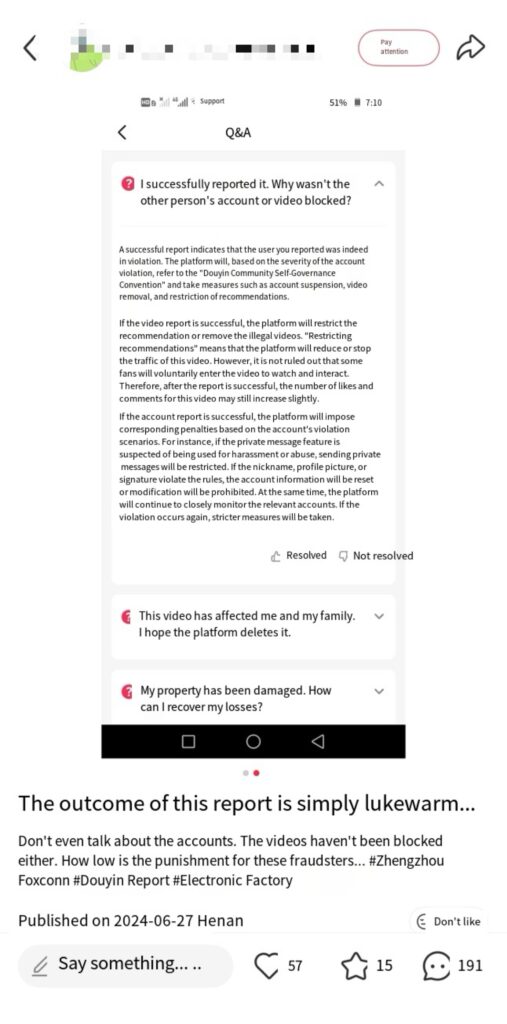
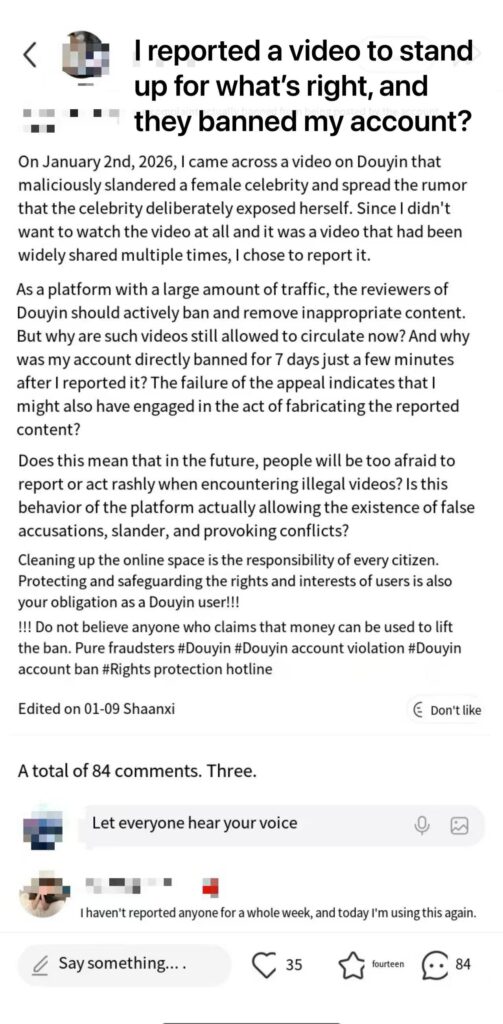
On the surface, platforms provide governance tools. But in fact, these systems lack transparency and predictability, making it difficult for users to trust them. Over time, this can lead to reporting fatigue, where users disengage from moderation altogether (Sinpeng et al., 2021).
It Is About Business, After All.
Looking more closely, the challenges of platform governance are not simply the result of weak regulation. They are closely tied to how platforms are designed and how they operate as businesses. As Woods and Perrin (2021) argue, social media platforms are not neutral technological spaces. Their design choices shape both the way content spreads and how users behave.
Social media platforms rely heavily on user attention and engagement for revenue. This creates strong incentives to promote content that captures interest and encourages interaction (Dong et al., 2026). In this environment, content creators may introduce controversy to increase visibility.
In the case of Cui Lili, this helps explain why content that questions, mocks, or attacks her was continuously amplified. These narratives were not only the result of individual expression, but also the outcome of platform design and commercial incentives working together.
In reality, moderation does not seem to be able to change much. When visibility is driven by engagement and revenue, content that attracts strong reactions is more likely to be promoted, even if it is harmful.
When Platforms Fail, Individuals Turn to the Law.
Cui Lili attempted to respond to online rumors by speaking out, but the attacks against her only intensified. In February this year, after months of sustained harassment, she turned to legal action.
She applied to the court to require platforms to disclose information about those responsible for the abuse. After several months, a number of key accounts were identified.
More than 120 posts and over 260 videos were linked to the attacks, with individual pieces of content reaching up to four million views. The total exposure approached one hundred million. Those involved were not only ordinary users, but also influential accounts and even some professionals.
This shows that large-scale attacks rarely stop without legal intervention.
However, legal action is not accessible to everyone. It requires time, financial resources, and significant emotional resilience. For many individuals, these barriers are difficult to overcome.
More importantly, the impact of online abuse does not simply fade over time. Research shows that sustained online attacks can create serious psychological stress and disrupt daily life (Carlson & Frazer, 2018). Over time, individuals may feel isolated, powerless, and increasingly disconnected from others.
In 2023, a mother in Wuhan who had lost her child was subjected to online abuse over her appearance and behavior. She was criticized for not conforming to expectations of how a grieving mother should present herself. She later took her own life under sustained pressure (Zhao, 2023).
For Cui Lili, who continues to defend her rights, the harm has also been long-term and difficult to bear. She says:
The constant rumors and insults made me question whether ending everything was the only way to escape the situation.
This highlights a crucial point.
When platforms fail to effectively address online abuse, the consequences do not remain confined to public discourse. They extend into people’s real lives, creating lasting and often irreversible harm.
The Problem Is Not Just Hate.
Taken together, these dynamics point to a key insight. Gender-based online abuse is not an isolated phenomenon. It is the result of interacting structural forces.
More specifically, it emerges from three main factors.
First, platform algorithms tend to amplify emotionally charged and conflict-driven content, increasing the visibility of controversial narratives. Second, existing gender biases are continuously reproduced and reinforced in online spaces. Third, moderation systems are often slow and lack transparency, making it difficult to intervene before harm spreads.
Individual attacks are amplified, circulated, and transformed into wider public pressure.
What Needs to Change?
If we continue to frame these issues as problems of individual behavior, similar cases will keep recurring.
What is needed is a shift in perspective. Platforms must be recognized as responsible for the consequences of their design choices.
The concept of a “duty of care” has been widely discussed in recent policy debates, suggesting that platforms, like other industries, should be accountable for the harms their services may cause (UK Government, 2019).
This means that governance cannot be limited to removing harmful content after it appears. It requires addressing harm at the level of design.
For example:
- Adjusting recommendation systems to reduce the visibility of extreme or harmful content
- Increasing transparency in moderation processes so users understand how decisions are made
- Providing more direct and effective support for victims
Social media platforms often present free expression as a core value. But in practice, when this freedom exists within unequal social conditions, it can end up amplifying harm rather than protecting voices.
Cui Lili’s experience points to a difficult reality. Even in spaces that appear open and accessible, women are still more likely to be targeted, questioned, and publicly shamed.
When platforms claim neutrality to avoid taking responsibility for how their systems operate, free expression does not automatically translate into equal participation. Instead, it can mask the fact that some groups are far more exposed to harm than others.
Seen in this light, the issue is not whether free expression should be protected. The real challenge is how to protect it without allowing it to reinforce existing inequalities or enable ongoing harm.
References
Carlson, B., & Frazer, R. (2018). Social media mob: Being Indigenous online. Macquarie University.
Dong, R., Guan, X., Han, X., & Jiang, Y. (2026). Content moderation and creator incentives mechanism amidst controversial content surges. Omega (Oxford), 138, Article 103427. https://doi.org/10.1016/j.omega.2025.103427
Luzsa, R., & Mayr, S. (2021). False consensus in the echo chamber: Exposure to favorably biased social media news feeds leads to increased perception of public support for own opinions. Cyberpsychology: Journal of Psychosocial Research on Cyberspace, 15(1), Article 3. https://doi.org/10.5817/CP2021-1-3
Masser, B., Lee, K., & McKimmie, B. (2010). Bad woman, bad victim? Disentangling the effects of victim stereotypicality, gender stereotypicality and benevolent sexism on acquaintance rape victim blame. Sex Roles, 62(7–8), 494–504. https://doi.org/10.1007/s11199-010-9748-8
Massanari, A. (2015). #Gamergate and The Fappening: How Reddit’s algorithm, governance, and culture support toxic technocultures. New Media & Society, 19(3), 329–346. https://doi.org/10.1177/1461444815608807
Matamoros-Fernández, A. (2017). Platformed racism: The mediation and circulation of an Australian race-based controversy on Twitter, Facebook and YouTube. Information, Communication & Society, 20(6), 930–946. https://doi.org/10.1080/1369118X.2017.1293130
Mukka, N. (2025, November 13). FAQs: Digital abuse, trolling, stalking, and other forms of technology-facilitated violence against women and girls. UN Women. https://unwomen.org.au/faqs-digital-abuse-trolling-stalking-and-other-forms-of-technology-facilitated-violence-against-women-and-girls/
PRIZM Group. (2024, August 29). Xiaohongshu vs Douyin: Differences, tips, and overview. https://www.prizmgroup.com/hk/vision/xiaohongshu-vs-douyin
Roberts, S. T. (2020). Behind the screen: content moderation in the shadows of social media. Yale University Press. https://doi.org/10.12987/9780300245318
Sinpeng, A., Martin, F. R., Gelber, K., & Shields, K. (2021). Facebook: Regulating hate speech in the Asia Pacific. Department of Media and Communications, The University of Sydney.
UK Government. (2019). Online harms white paper. https://assets.publishing.service.gov.uk/media/605e60c6e90e07750810b439/Online_Harms_White_Paper_V2.pdf
Woods, L., & Perrin, W. (2021). Obliging Platforms to Accept a Duty of Care. In Regulating Big Tech. Oxford University Press. https://doi.org/10.1093/oso/9780197616093.003.0006
Zhao, Y. (2023, June 4). Online platforms suspend accounts after a mother, faced with online abuse after her son’s death, commits suicide. Global Times. https://www.globaltimes.cn/page/202306/1291909.shtml


Be the first to comment