A look into the dark side of South Korea’s beauty standards and rising entertainment industry.

The human brain works in fascinating ways – where psychology manipulates your words and actions more than the actual truth. You might be wondering what that even means, so let me give you an example. Think about the last time you were scrolling on TikTok and came across a video of a celebrity that you thought was drop-dead gorgeous. You think about leaving a supportive comment, or even sharing the video to your friends, but upon opening the comments, you are hit with an unexpected wave of hatred:
“So ugly”
“Does she ever look in the mirror?”
“How did she even debut…”
Naturally, you start questioning your original opinion before you had opened these comments. If everyone thinks this celebrity is so ugly, then am I the odd one out for thinking otherwise?
Now, let’s flip the table and imagine the scenario had taken off on a different route. The comments are supportive of the celebrity and also in line with your own opinions. Do you now feel more inclined to hit send on that original comment you were going to make, just because everyone else feels the same way?
Obviously, the response to that will vary from person to person, but I wanted to highlight the concept of the online disinhibition effect – the phenomenon experienced by users of online communities who feel “less restrained, and can express themselves more openly” (Suler, 2004: 321), and how this plays a critical role in modern online discourse. While the example I gave above depicts how digital “bandwagonning” can be used positively – encouraging users of a platform to spread love and support – this concept can easily be turned upside-down, where a collaborative effort of social media affordances drives users to collectively engage in what we know as “hate speech”.
Hate speech vs free speech
Let’s backtrack and go back to square one. What exactly is “hate speech“? Political theorist Bhikhu Parekh (2012: 40) defines hate speech as speech that
“expresses, encourages, stirs up, or incites hatred against a group of individuals distinguished by a particular feature or set of features such as race, ethnicity, gender, religion, nationality, and sexual orientation“.
This can also be seen through multiple layers of severity, with some barely scraping the tip of the iceberg (like the examples I gave above), to those that breach the privacy and security of online users through online harassment such as physical threats, harassment over a sustained period, sexual harassment, or stalking (Duggan, 2017) – all of which were experienced by 18% of the 41% of internet users in the US in 2017 that claimed to be a victim of hate speech (Pew Resarch Centre, 2017).
Parekh then identifies the root cause of hate speech, being to:
stigmatise the target group by implicitly or explicitly ascribing to it qualities widely regarded as highly undesirable.
What this implies is that people will only hate an individual if they go against a subjective rule that has been systematically built over centuries to slowly become an “objective perspective”. There has never been a law that denotes what is considered desirable – society decided everything. But if this is the case, how can we differentiate between hate speech and free speech if users are simply speaking on what society has deemed acceptable?
Cortese (2006) actually visualises this differentiation as stages of severity, where unintentional discrimination without ill intent or an ulterior motive cannot be classified as hate speech, and the possibility of hate only becomes prevalent when the discrimination becomes conscious.
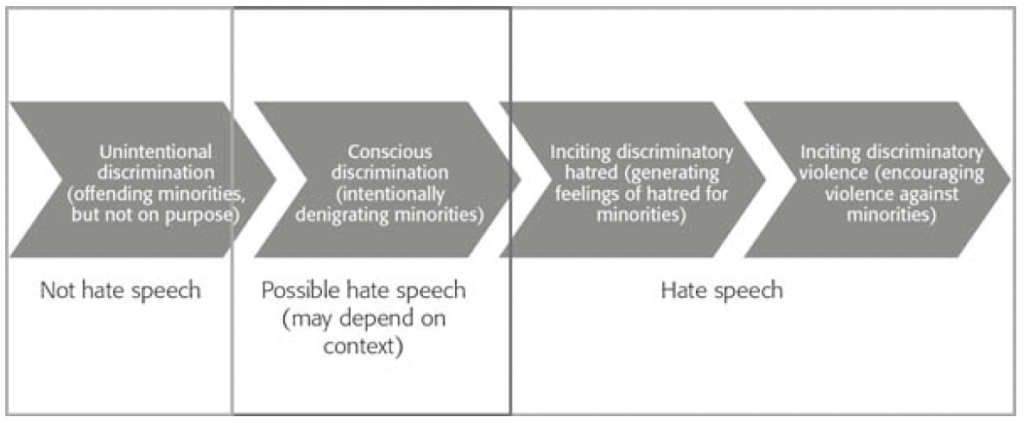
However, this only increases the amount of online harm as users are now finding ways to bypass hate speech guidelines by claiming freedom of speech and a lack of harmful intention. The Australian Government Attorney-General’s Department (2026) defines the right to freedom of opinion as
the right to hold opinions without interference, and cannot be subject to any exception or restriction,
while the UN International Covenant of Civil and Political Rights states in Article 19 that
- Everyone shall have the right to hold opinions without interference
- Everyone shall have the right to freedom of expression; this right shall include freedom to seek, receive and impart information and ideas of all kinds, regardless of frontiers, either orally, in writing, or in print, in the form of art, or through any other media of his choice. (International Covenant of Civil and Political Rights, 1966)
So, the blur between an opinion and harmful speech amplifies, as intention alone cannot simply be defined by how the receiver interprets the speech.
Let’s take a look at a specific K-pop star who has been under the spotlight for harassment since her early debut days to really understand this concept.
Hearts2Hearts Ye-on: A Victim of Online Hate
It’s no surprise that South Korea’s harsh beauty standards have been impacting its citizens for decades. However, these standards are only harsher for celebrities, specifically K-pop idols, who profit from not only their music but also their visual appearance. Ye-on, a fifteen-year-old girl (at the time of her debut), shows exactly how this toxicity plays out in digital platforms today – where anonymity masks intention and bypasses responsibility.

Nate Pann (or simply, Pann) is the “largest anonymous online discussion forum in Korea (that) does not require a login” (Ryu, 2022). This means that online users can not only freely navigate the platform and leave behind their two cents without the hassle of signing up or subscribing, but they also do not need to input any personal information to be associated with their account. This level of anonymity, while on the surface level can seem like great practice for security and privacy, also psychologically enables people with negative intentions to exploit their free will online through hate speech.
Let’s all jump back to the start of this blog, where I briefly mentioned Suler’s online disinhibition effect (2004). Platforms that do not provide the level of anonymity available on Pann have already shown cases of toxic disinhibition in the past, where the lack of face-to-face interactions alone plays enough of a role to eliminate the essence of hesitation and social norms. Suler (2004, pp. 322) also explains that “invisibility gives people the courage to go places and do things that they otherwise wouldn’t” as “whatever they say or do can’t be directly linked to the rest of their lives”.
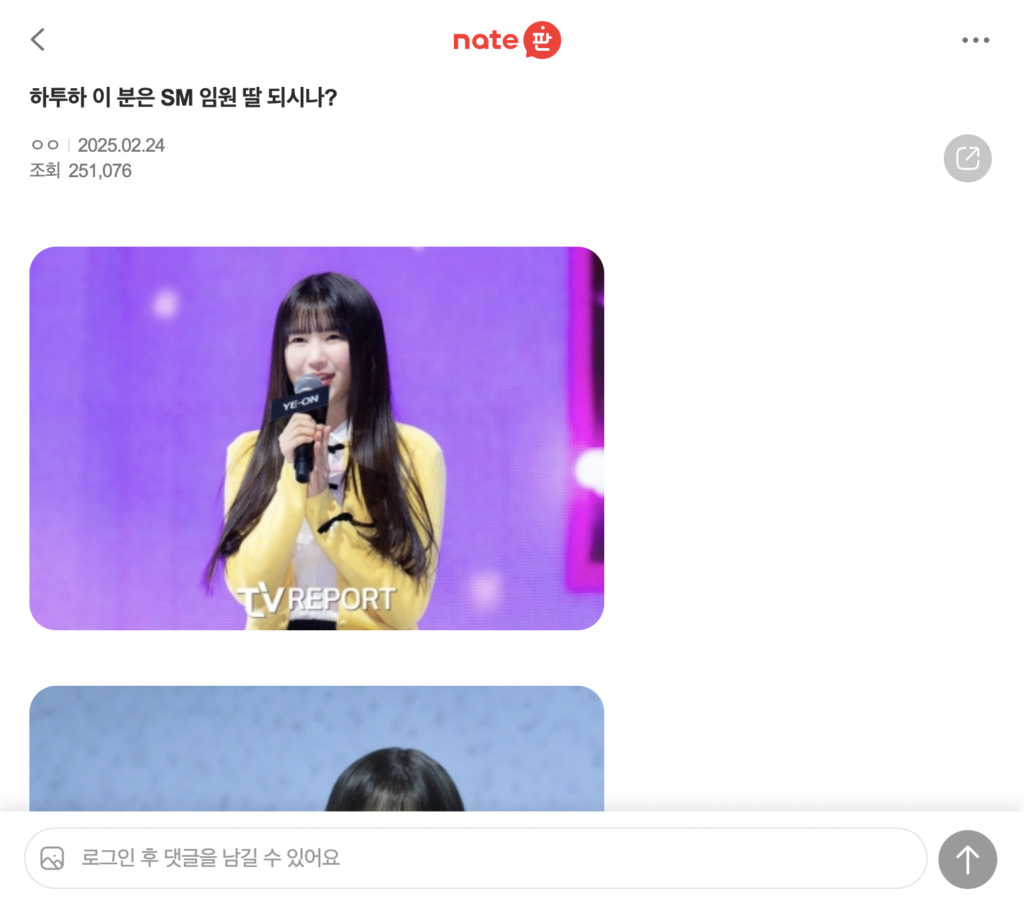
This is why discussion forums like these are generated, where anonymous users believe it is a practice of freedom of speech and opinion to recklessly mock and analyse a teenager’s appearance. To provide context for readers who are unfamiliar with K-pop, the title of this forum sarcastically questions whether Ye-on is family-affiliated with an employee of the entertainment company she is labelled under – “SM” – suggesting nepotism is the only valid reason for the star’s debut, as her appearance falls short of what the general public believes is required for an idol. This controversial forum caught the eyes of like-minded internet trolls who exhibited behaviours of not only Suler’s online disinhibition effect, but also Walther’s (1996) hyperpersonal interactions – a concept of “over-reliance” on the information provided to a user, thus creating a relationship that is “more socially desirable than (what) we tend to experience in parallel FtF (face-to-face) interactions” (1996, pp. 17). This causes users to think that they know more about public figures than they really do, stimulating them to comment purely based on their biased beliefs, and when multiple users with the same opinions come together under one thread, a “conversational relaxation” (Walther, 1996, pp. 26) occurs where writers can create an overarching mood for responders to interact with and respond to, influencing similar responses from users who felt that the original post confirmed their biases, thus creating a “safe space” to anonymously express their opinions.
This thread in particular accumulated over 500 likes and 150 comments, which showcase a fair mix of toxicity and fan support. However, seeing as the original post is still available for interacting with, it can be assumed that no punishments have been imposed in accordance with hate speech rights, such as Article 20 of the same International Covenant of Civil and Political Rights mentioned prior, stating
Any advocacy of national, racial, or religious hatred that constitutes incitement to discrimination, hostility, or violence shall be prohibited by law (International Covenant of Civil and Political Rights, 1966),
showing a clear lack of monitoring and community guidelines offered by Pann. Does this mean that the law refuses to protect victims of hate speech that do not specifically target a nation, race, or religion like Ye-on, despite the lack of methods available to truly measure the level of damage, especially to such a young person? This obviously is not the case, however, as there have been occasions where anonymous users on the same platform have been fined for defamation, such as the recent case of Park Joo-ah, also known as Sojang.
While I did briefly mention earlier that Pann does not require the registration of an account to interact with posts and users, a Nate account is required if a user wishes to report a specific post, which simply asks for information such as an email, username, and a personal phone number, which needs to be verified upon registration. This element questions whether the need for personal information provides a barrier between internet trolls and the severity of their remarks, and just how much is needed to track down the users involved.
While Park Joo-ah was primarily active on YouTube rather than Pann, the act of operating under a pseudonym shows an attempt at anonymity and a lack of confidence in inflicting hate speech under her government identity. However, this proved to not be enough to shield her from punishment, as after a long run of consistent hatred and defamation, the YouTuber was finally sentenced to 2 years in prison, 3 years of probation, 120 hours of community service, and a total fine of 210 million Korean won (Jeon, 2025) in early 2025, under the Korean defamation law that states
defamatory statements may be punished regardless of whether such statements are true or false, with defamation being governed under criminal law, punishable with jail time and/or fines. (Xu, 2022)
It has now only been a year since this example of social justice, and there have not been many advancements made regarding online hate speech monitisation. If social norms and standards allow vulnerable young performers to be placed under immense stress and exposure to public critique, how can they seek protection if not through policy and law? If online anonymous forums like Pann still operate and provide a strangely welcoming atmosphere for people to openly criticise, who is responsible for the governance if the platform fails to step in? Terry Flew (2021, pp. 118) also ends his book chapter on hate speech and online abuse with a critical question that should guide the future of digital policy and governance:
The critical question now is whether platform companies themselves can be relied on to moderate their content in the public interest, or whether the problem points in the direction of government involvement.
References
Australian Government. (2022). Right to freedom of opinion and expression. Attorney-General’s Department; Australian Government. https://www.ag.gov.au/rights-and-protections/human-rights-and-anti-discrimination/human-rights-scrutiny/public-sector-guidance-sheets/right-freedom-opinion-and-expression
Cortese, A. (2006). Opposing Hate Speech. New York: Praegar Publishers.
Duggan, M. (2017). Online harassment 2017. Pew Research Center, 11 July. https://www.pewresearch.org/internet/2017/07/11/onlineharassment-2017.
Flew, T. (2021). Hate Speech and Online Abuse. In Regulating platforms. Polity Press.
International Covenant on Civil and Political Rights. (1966). https://treaties.un.org/doc/publication/unts/volume%20999/volum e-999-i-14668-english.pdf.
Jeon, H (2025). YouTuber who posted a fake video defaming Jang Won-young was sentenced to two years in prison and three years of probation. SBS News
Parekh, B. (2012). Is there a case for banning hate speech? In M. Herz and P. Molnar (eds), The Content and Context of Hate Speech: Rethinking Regulation and Responses (pp. 37–56). Cambridge: Cambridge University Press.
Pew Research Center. (1999). The Internet News Audience Goes Ordinary. Pew Research Center. https://www.pewresearch.org/wpcontent/
uploads/sites/4/legacy-pdf/72.pdf.
Ryu, H., & Pratt, W. (2022). Microaggression clues from social media: Revealing and counteracting the suppression of women’s health care. Journal of the American Medical Informatics Association, 29(2), 257-270. https://doi.org/10.1093/jamia/ocab208
Suler, J. (2004). The online disinhibition effect. In CYBER PSYCHOLOGY & BEHAVIOUR, (No. 3; Vols. 7-7). Mary Ann Liebert, Inc.
Walter, J. B (1996). Computer-mediated communcation: Impersonal, interpersonal,and hyperpersonal interaction. Sage Publications, 3-43
Xu, R (2022). K-Pop’s secret weapon: South Korea’s criminal defamation laws. San Diego International Law Journal, Vol. 24: 201
Be the first to comment