
Introduction
Have you ever felt that when you first open a social media platform, the homepage already seem to know what you want to see next? People often call this experience as “personalization”, as if the platform is helping us quickly find interesting content from huge amounts of information. With so much content to browse, such a recommendation system is very attractive. It makes browsing easier and makes the platform seem more caring and more understanding of users.
But recommendation algorithms are not just a convenient tool. They also decide what people are more likely to noticed, what we may ignore, and what is more worthy of our attention. This article aims to discuss why recommendation algorithms are not just personalized services, but also a mechanism that shapes visibility, attention, and platform power.
The Appeal of Personalization
In an information-rich online environment, the reason why recommendation algorithms are attractive is primarily because they seem to solve a very practical problem: there is too much content, and users cannot do the filtering by themselves. The recommendation algorithms discussed in this article mainly refer to the system of the platform that sorts and pushes content based on users’ behavior signals such as watch time, likes, comments, and swipes. Under these conditions, the recommendation seems like an efficient way of organizing information. It directs users to the information that seems more noteworthy by assigning “relevance” to the content (Just & Latzer, 2019)
Personalisation is also easily accepted because it creates the feeling that a platform “knows” us. Users will feel that their information flow is getting closer to their personal interests, and the browsing process becomes smoother and more effortless. Users can still actively search for content, but the continuously pushed recommended information flow largely reduces the need for users to filter and search for content by themselves.
The increasingly precise experience of personalisation depends on the continuous tracking and analysis of user behaviour. Watch time, likes, comments, shares, and skips all become signals for platforms interpret user preference. In other words, the recommendation system does not understand users naturally. It turns daily behaviors into data, and then uses these data to predict and guide users’ attention (Crawford, 2021). For this reason, personalization should not be regarded as the end of the discussion, but rather the starting point of more important issues.
Algorithms Are Not Neutral
Recommendation algorithms are often presented as a neutral technological system, as if they just send more relevant content to users based on their interests. But this understanding is too simple. Rather than simply reflecting user preference, recommendation algorithms also play an active role in organizing what content users will browse.
The platform can decide which data is the most important, which behaviors are worth including in the judgment, and which content should be pushed more. So the recommendation results are not naturally produced but are based on a series of technical choices and value judgments (Pasquale, 2015).
This is why recommendation algorithms cannot simply be understood as the platform gives user what they wants. The platform will use user behavior to determine preferences, but they also setting the standards for these preferences. More importantly, these standards are often related to the platform’s interests. Advertising and paid promotion are a clear example. The same goes for content that is more likely to encourage engagement and interaction. This shows that the visibility on the platform is not only determined by user interests, but is also influenced by business logic.
Therefore, recommendation algorithms not just respond to user interests but also organize information flow according standards set by platforms. As Noble points out, algorithmic systems do not exist independently of social value and power relations. Instead, they embed specific value priorities into the automated decision making process (Noble, 2018).
That is why the recommendation algorithm is not a neutral tool, but mechanism that further influences what is seen and what is ignored.
Algorithms Shape What We See
If the previous part has already show that the recommendation algorithm is not neutral, then the next question that is more worthy of inquiry is: How exactly does it influence the content that users see? Just and Latzer believe that the information on the network is not presented to users naturally, but rather enters their view after being continuously selected, sorted, and recommended by algorithms (Just & Latzer, 2016).
This also means that the recommendation algorithm does not only determine “what you might like”, but “what is more worthy of being presented to you”. As Gillespie pointed out, relevance is not an objective standard but is a result defined by the platform during its operation (Gillespie, 2014). Under this logic, the content that is more likely to create interaction, retention, and continuous browsing tends to gain more visibility. What is magnified is not necessarily the most important content, but rather the content that best meets the platform’s sorting criteria.
More importantly, this not only affects content distribution, but also gradually shapes users’ attention. When users are exposed to such an information environment for a long time, they will gradually become accustomed to following the content that is more likely to be pushed. This content is usually more likely to trigger emotions or interactions. Gradually, users’ expression styles and browsing rhythms will also align with the platform’s logic. Bucher pointed out that the visibility on the platform always comes with an “invisible threat”. To avoid being overwhelmed, users constantly adjust themselves to adapt to the algorithm (Bucher, 2018).
Therefore, the recommendation algorithm not only shapes what we see, but also subtly influences how we view it.
Case Study: TikTok’s For Your Page


TikTok is a suitable platform for discussing recommendation algorithms. The reason is simple: its core user experience is not based on “who you follow”, but on the recommendation logic of the For You Page. Unlike many traditional social media platforms, one of the most attractive aspects of TikTok is that information flow will constantly choose for you on its own. So you don’t need to actively search for too much content.
This point is also reflected in the official explanation of TikTok regarding the platform. The official clearly stated that TikTok uses recommend systems to provide personalized experiences. And it continuously adjusts the recommended results based on user interactions, content information, and user information. In other words, the For You Page is not just an ordinary content display page, it is actually the core of TikTok’s user experience.
According to TikTok’s own description, this is very much like a highly refined personalized service. The platform will determine what content is more relevant based on whether a user has watched a video through to the end, whether they have liked, commented, shared, or scrolled away. Then it will continue to sort and push the content. More importantly, TikTok has also explicitly acknowledged that user interaction is usually more important than other factors, and the duration of viewing is particularly important.
This means that the recommendation system is not only understanding the users, it continuously acquires and analyzes user behaviors. Then decides what the next information flow should look like based on these behaviors. What the platform does is not only predicting what users will like, but also adjusting which content is more worthy of being presented to the users.
This can actually be easily perceived in daily use. For example, a user might simply click on a video of a friend’s food sharing, and watch it all the way through. This might just be a casual pause, but in the recommendation system, it quickly becomes a new interest signal. After that, similar content like food exploration videos, cooking tutorials, or other short videos related to food might keep appearing in the information flow. A accidental viewing behavior has thus been transformed by the platform into the basis for subsequent sorting and recommendations.
This example clearly illustrates the point. TikTok does not just offer personalized experiences. Rather, it records each interaction and interprets it as a new direction of interest. So the information flow will start to relate to this direction.
The platform will explain all of this as a more relevant and user-preferred recommendation experience. But from another perspective, TikTok is actually also determining what is worthy of being seen. As long as some types of content is more likely to make people pause, more likely to evoke emotions or interactions, it is more likely to have an advantage in the ranking. Most of the time, this is the most logical for the platform.
TikTok actually realizes that this system is not completely risk-free. The official explanation states that the platform will try to incorporate more diverse content to prevent users from constantly seeing repetitive and monotonous information. It will also limit the recommendation of certain content in terms of safety and appropriateness. This indirectly indicates that TikTok is aware that the recommendation system can easily lead to content narrowing, homogenization, and even the excessive amplification of certain content.
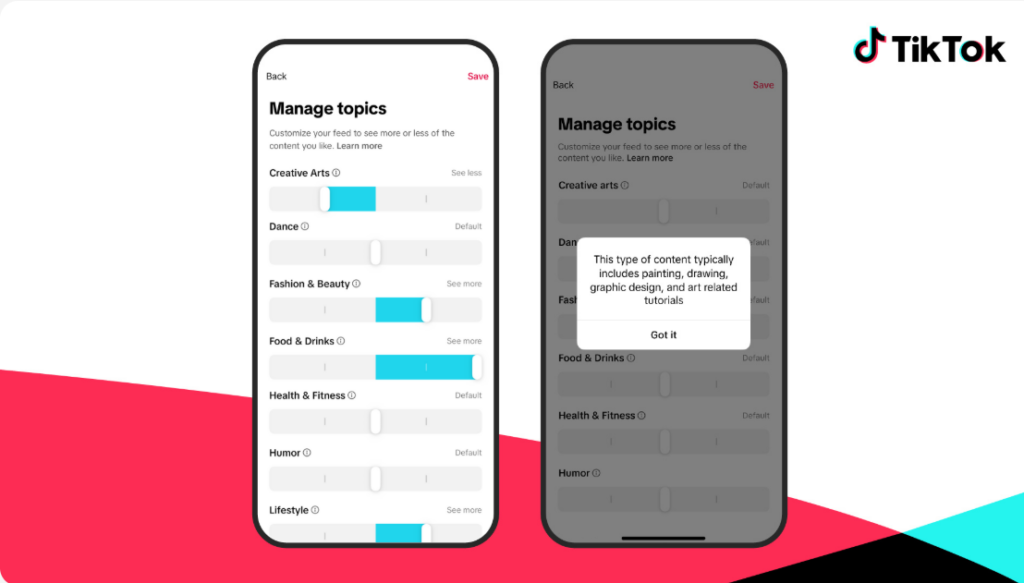
In the past two years, TikTok has also been introducing tools that allow users to adjust the recommended content, such as “Manage Topics” and “Control your scroll” released in 2025. These indicate the platform also acknowledges that the recommendation system will have a long-term impact on the content environment that users are exposed to, and users do not always have full control over this.
The above clearly shows how the platform defines relevance through interaction signals, organizes visibility through ranking, and gradually shapes users’ attention in this process.
The users thought they were just watching videos, but in fact, the content world they were exposed to had already been prearranged by the platform’s recommendation logic.
Why This Matters for Governance
What is even more worthy of questioning is this: When a platform keep decide what people see or ignore, is this a matter of product feature, or has it already become a form of governance power?
In the past, people tended to view social platforms as a neutral space where content could be posted and connect the users. However, cases like TikTok show that platforms do more than simply allow content distribute naturally. They also actively organize opportunities for information spread through setting ranking, relevance, and visibility. The platform is not a outsider of the content flow, but it continuously shapes the content environment that users come into contact with (Flew, 2021).
Recent developments also indicate that recommendation algorithms are no longer a product design issue. TikTok has introduced features such as “Manage Topics” and “Control your scroll” in an attempt to give users more control over their information flow. On the other hand, the UK Information Commissioner’s Office stated in 2025 that it is conducting an investigation into how TikTok uses the personal information of teenagers to drive content recommendations (TikTok, 2025; Information Commissioner’s Office, 2025).
The user may think they are just watching videos, but behind the scenes, the platform is constantly choosing what content should be shown to users. Also, because this power is invisible and keeps existing, managing platforms has become increasingly important.
Conclusion
Recommendation algorithms are worth discussing seriously because they greatly affect how people get information, what they focus on, and how they understand the world. TikTok’s “For You” page is a typical example. It shows that recommendation systems not only match people’s interests but also keep shaping them.
Finally, this is no longer just about the accuracy of the algorithms. It is about who use these systems to decide what people can see. Until this issue is properly solved, recommendation algorithms are more than a technical problem. They will always be a matter of power, visibility, and governance.
References
Bucher, T. (2018). If…then: Algorithmic power and politics. Oxford University Press.
Crawford, K. (2021). The Atlas of AI: Power, politics, and the planetary costs of artificial intelligence. Yale University Press.
Flew, T. (2021). Regulating platforms. Polity Press.
Gillespie, T. (2014). The relevance of algorithms. In T. Gillespie, P. J. Boczkowski, & K. A. Foot (Eds.), Media technologies: Essays on communication, materiality, and society (pp. 167–194). The MIT Press. https://doi.org/10.7551/mitpress/9780262525374.003.0009
Information Commissioner’s Office. (2025, March 3). Investigations announced into how social media and video sharing platforms use UK children’s personal information. https://ico.org.uk/about-the-ico/media-centre/news-and-blogs/2025/02/investigati ons-announced-into-how-social-media-and-video-sharing-platforms-use-uk-child ren-s-personal-information/
Just, N., & Latzer, M. (2019). Governance by algorithms: Reality construction by algorithmic selection on the Internet. Media, Culture & Society, 39(2), 238–258.
Noble, Safiya U. (2018) A society, searching. In Algorithms of Oppression: How search engines reinforce racism. New York: New York University. pp. 15-63
Pasquale, Frank (2015). ‘The Need to Know’, in The Black Box Society: the secret algorithms that control money and information. Cambridge: Harvard University Press, pp.1-18.
TikTok. (2025, June 3). TikTok’s new features to help you “Control your scroll”. TikTok Newsroom. https://newsroom.tiktok.com/tiktoks-new-features-to-help-you-control-your-scroll?
TikTok. (n.d.). How TikTok recommends content. TikTok Support. https://support.tiktok.com/en/using-tiktok/exploring-videos/how-tiktok-recommends-content
Be the first to comment