A cutting-edge technology and ancient beliefs seem to go hand in hand
Introduction
I was shocked by a piece of news published by ABC: thousands of Chinese social media users changed their profile photos to Kris Jenner.
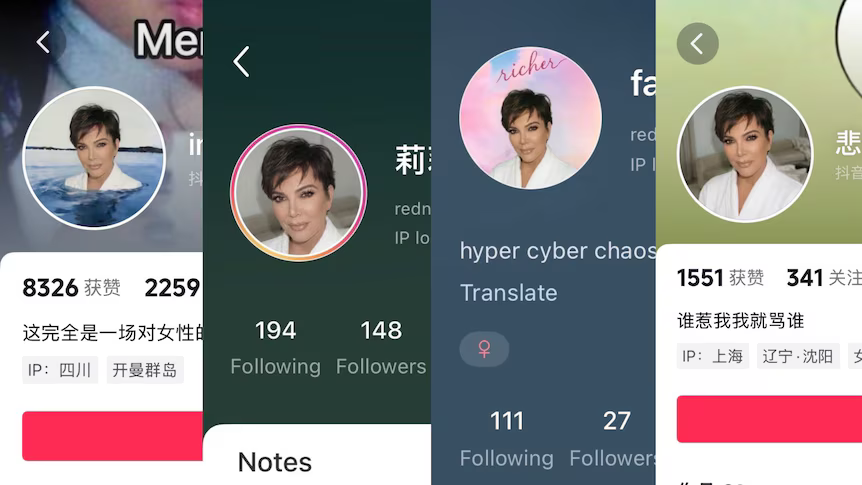
Chinese social media users have been changing their profile photo to Kris Jenner. (Supplied: RedNote/Douyin)
After laughing out loud for five minutes, I started looking more closely at these AI-generated images of Kris Jenner — this time with a sense of confusion.
Why Kris Jenner? In that campaign, many people said that they were “just looking for good luck”. We know that generative AI can generate images, but since when did it become capable of generating luck? Why do so many people believe that?
Why Do People Believe Predictions and AI Predictions?
In fact, Kris Jenner isn’t the first one to be associated with gen-AI and superstition. Have you ever asked your ChatGPT about your zodiac signs or your fortune? The development of AI is transforming into the mystical realm of fortune-telling. In recent years, people have begun to use AI to simulate traditional fortune-telling methods while leveraging big data to enhance the objectivity and accuracy of predictions. (Duan, et al., 2025)
Again, why do people believe that? Sushmitha Hegde explained that belief may originate from fear, and one major reason why people believe predictions—whether from fortune-telling or AI—is that the future is uncertain.
From astrology to zodiac signs, and from BaZi (Four Pillars) to palm reading. People have long tried to glimpse the future through symbolic systems. These practices promise something that modern life rarely offers: a sense that the uncertain can somehow be interpreted, if not controlled. Humans naturally feel fear when they cannot predict what will happen next. Superstition can offer an explanation for life’s unpredictability and uncontrollable events, providing an illusion of control when people feel anxious about these uncertainties. For instance, acts like knocking on wood become symbolic behavior against bad luck when people meet unpredictable situations.
There are two other reasons why people believe in superstition.
First, superstitions do not exist in isolation; they reflect our collective human experience and serve as a form of identity. People establish their sense of identity within a community, and superstition thrives on the soil of that identity.
Second, superstition acts as a psychological placebo, particularly for people in certain professions, such as athletes. This may well be one of the reasons why superstition has been believed throughout history.
AI predictions can therefore act like modern “superstitions.” If an algorithm claims it can predict behavior, success, or personality, people may trust it because it seems to give structure to an unpredictable world.
Why? Kahneman (2011) answers that people often make decisions using two different modes of thinking, called “System 1” and “System 2”. “System 1” is fast and intuitive, where we react quickly based on feelings or first impressions. “System 2” is slow and logical, where we carefully analyze information before deciding whether it is true.
In everyday life, people usually rely more on the fast way of thinking because it is easier and requires less effort. According to research about the co-existence of natural and supernatural explanations for illness and disease transmission, there is an “explanatory coexistence” in the human brain that leads scientific explanations and supernatural explanations to happily coexist.
As a result, people may not stop to question information very deeply. When an AI system gives a prediction using technical language or complex explanations, it can sound very scientific and convincing. Because of this, many people quickly assume the prediction must be accurate, even if they do not fully understand how the AI reached that conclusion.
There is another study that explores psychological factors underlying unwarranted belief in AI predictions, which concludes that “people’s belief in AI predictions was positively associated with paranormal beliefs, positive attitude towards AI, interest in the topic of prediction…” (Lee et al., 2024)
After understanding why people believe predictions and AI predictions, more and more questions come out:
- Why people are even looking for luck — an emotional support — from an AI-generated thing, as AI is usually presented as something rational and scientific?
- What role does AI play in this campaign and in modern superstition, and how does it work?
- Why can a cutting-edge technology and ancient beliefs seem to go hand in hand?
From “Clever Hans” to AI and Superstition
The connection between prediction and intelligence has a long history. In the late nineteenth century, the famous case of “clever Hans” seemed to demonstrate a remarkable form of “animal intelligence.” He can read human body language. When he noticed a slight change in the questioner’s posture or breathing, he would stop tapping —unintentional cues that signaled the horse had reached the correct answer. As Crawford (2021) notes, Hans was once described as “nothing less than a marvel.”
But we are living in the 21st century, and of course, we know Hans was not actually performing calculations; instead, he was responding to subtle cues from the humans around him. Hans was mimicking rather than thinking.
However, isn’t that similar to what prediction and AI do?
Basically, fortune-telling, or prediction, relies on algorithms. Take astrology as an example. Astrology requires the client’s exact time, place and date of birth; their name is also helpful for the analysis. Using this information, a birth chart can be drawn up for that specific time and place. A birth chart can be understood as a kind of algorithm. By interpreting the birth chart, an astrologer is able to make predictions about the future based on the positions and characteristics of the various planets. To conclude, prediction in superstition is driven by psychological suggestion and practices of divination, which are grounded in accumulated experience and numerous cases.
The working mechanism of AI is algorithms as well. It allows machines to learn, process information, and make decisions. Duan et al. (2025) noted that AI can learn traditional astrology knowledge and patterns to simulate the thinking process of human fortune-tellers in various systems of divination. The core technologies behind that are:
- natural language processing
- knowledge bases and expert systems
- machine learning and deep learning
- computer vision
- random algorithms and simulation
Although people may sometimes harbour doubts about prophecies, just as fortune-tellers often make vague predictions, AI also frames its answers in a way that is diplomatic or palatable, which makes people more inclined to believe it. This ambiguity is also one of the similarities between AI and fortune-telling.
Perhaps the connection between AI and superstition lies there. The blind worship of Hans by some people in the 19th century is much like the blind worship of AI and prediction by people today.
In this way, we seem to find out some insights into the questions above.
It is this shared ground between AI and predictive practices that may lead to people’s unconscious trust in them. Both seem capable of providing answers to uncertain situations, and both rely on patterns extracted from past cases. When they are presented persuasively, their outputs are easily mistaken for insight
Although generative AI is often regarded as a rational and scientific progress, it is still deeply shaped by human experiences and emotions. The systems themselves do not possess intention or belief, yet the information they generate is built upon patterns found in human communication, culture, and knowledge.
Because of this, AI predictions can sometimes feel strangely familiar to people. What people trust may not be the machine itself, but the reflection of human experience embedded within it. As superstition acts as a psychological placebo, AI is playing the role of creating such a placebo.
The Problems Behind AI Fortune-Telling
It is very common to see AI predictions in our daily lives. Many people use generative AI tools such as Doubao and DeepSeek for fortune-telling, and AI products specifically designed for this purpose have also emerged. However, the emergence of such fortune-telling products has also given rise to a series of problems
Firstly, data bias and discrimination have brought about harm. In the context of AI fortune-telling, such bias may be seen as gender discrimination, regional discrimination and so on.
AI fortune-telling usually generate fortune reading according to the information provided by users, like their gender and date of birth. These fortune readings are based on big data models and algorithms, which may inadvertently perpetuate underlying socio-cultural biases and discrimination. For example, for female users, AI may be more likely to generate predictions related to relationships, marriage or family; whereas for male users, it tends to emphasise aspects such as career development, wealth or power. Whilst this may appear to be the AI’s “customized predictions,” in fact, such differences are often not the result of genuine algorithmic analysis, but rather stem from the fact that the training data itself already contains long-standing gender stereotypes. In other words, what the AI does is merely rephrasing these social biases and then objectively and scientifically presenting them to users.
What’s worse, the issues of data bias and discrimination also touch upon the issue of the ethics of technology, especially the privacy issue. Many AI fortune-telling apps require personal information, such as users’ date of birth, time of birth, or even to upload photographs of their palms or faces. Then what if the platform does not adopt adequate data protection measures? What if my data is used for other purposes? Or what if it is even leaked? That could be a huge threat to users’ privacy and personal safety.
What Should We Do?
Just as Crawford(2021) noted, “in the case of AI, there is no singular black box to open, no secret to expose, but a multitude of interlaced systems of power.” If we want to make better use of AI fortune-telling, a double-edged sword, then the power system should engage in this warfield, more regulatory measures should be introduced.
One important step is to ensure algorithmic accountability. Blake(2024) suggests that in order to achieve algorithmic accountability, various stakeholders should make efforts. AI developers have responsibilities in building AI systems that are transparent, fair, and accountable. Policy makers should create regulations that ensure transparency, fairness, and responsibility in AI systems, while also allow individuals to challenge decisions made by algorithms. There is something that users can do, like actively seek information about the decision-making process. Users have the right to challenge decisions and are entitled to seek redress.
Besides, we can draw inspiration from the measures taken by some other AI applications. For example, when AI generates images or videos, a notice such as ‘Please note that this content has been generated by AI’ is displayed; similarly, AI fortune-telling programmes should also provide a warning when presenting their results.
But the most important thing is to keep a critical attitude toward AI fortune-telling. Of course, we can ask the AI what my weekly horoscope is, or what colour clothes I should wear to bring me good luck, rather than blindly believing in them.
Conclusion
In conclusion, when AI meets superstition, this is not only a technological event, but also about a reflection of how people think and behave. The similarity between AI and superstition makes people tend to trust the predictions of AI fortune-telling. But don’t take them too seriously, since they are still generated by a machine and still related to divination. Therefore, it is important to think critically about the role AI plays and the problems it may cause. The issues arising from the combination of AI and superstition are not isolated, and regulation in this area should continue to be improved.
Reference
Blake, H. (2024). Algorithmic accountability: Establishing frameworks for transparency and responsibility in AI-driven decisions.
Crawford, K. (2021). Atlas of AI: Power, politics, and the planetary costs of artificial intelligence. Yale University Press.
Duan, Y., Guo, Z., & Huang, S. (2025). AI fortune-telling: The imitation of traditional fortune-telling and big data analysis. https://doi.org/10.13140/RG.2.2.27253.69606
Kahneman, D. (2011). Thinking, fast and slow. Farrar, Straus and Giroux.
Lee, E., Pataranutaporn, P., Amores, J., & Maes, P. (2024). Super-intelligence or superstition? Exploring psychological factors underlying unwarranted belief in AI predictions. https://doi.org/10.48550/arXiv.2408.06602
Be the first to comment