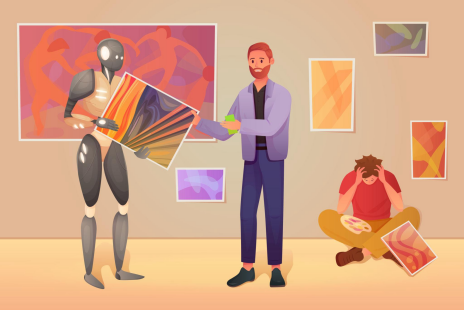
When audiences watch a new animation, they may hear a voice that sounds very familiar. But they may not see the voice actor’s name in the credits. Theproduction team may say that they had a limited budget. They may say theyused AI dubbing to save money, so they could spend more on visual effects.But does this harm the voice actor whose voice sounds similar?
The same issues with AI do not just exist in voice acting, but also in design and AI film creation. In these areas, AI can produce works that are very similar to people or other art styles. AI is capable of taking human actions and thought of people, and convert it to data. It will mix it up, and remixed data will produce a different product. It will be very similar to the person that was statted by AI, but also just slightly different. AI is turning people voices, faces, and also styles into data and it’s extracting that data. The problem is not only the copyright infringement, but the bigger problem is that they are being stripped of their digital identity and their creative work.
Since March 2026, well-known Chinese voice actors and major industry groups, including Ji Guanlin, Bian Jiang Studio, and 729 Voice Studio, have released public statements to defend their rights. They called for a ban on unauthorised AI collection of voices. They also opposed the commercial misuse of mixed or processed voice lines. They asked platforms to remove related content and hold the responsible people accountable.
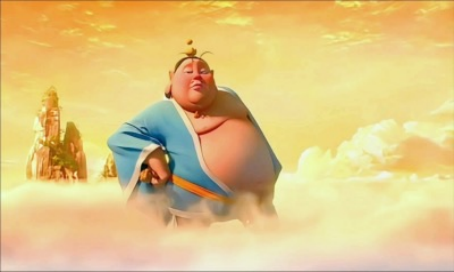
Among them, Zhang Jiaming, the voice actor of Taiyi Zhenren, said that his voice had been widely stolen. Some of his business partners told him that there were now many AI voices similar to his. Some of them could even be used for free. Because of this, they chose not to work with him anymore. To stop AI voice theft, he spent a lot of money collecting evidence and trying to protect his rights. However, because many infringers were minors, and because legal accountability was difficult, he has not successfully filed any lawsuit so far.
For voice actors, the voice is their professional identity. It is also the result of their labour.
Why are voice actors especially affected by AI voice theft?
First, the copyright of a voice is already difficult to protect. Videos, films, and podcasts on major websites can all become sources of data. Second, it is also hard to collect evidence and hold infringers accountable. AI can combine the voices of several voice actors to create a new voice. It can randomly match different tones, pronunciation styles, emotional expressions, and vocal qualities to produce a new voice. This voice may not be exactly the same as any one voice actor’s voice, but it may sound similar to several voice actors.
This makes audiences feel that the voice is “very familiar,” but they cannot match it to a specific name. Voice actors can only hear the final product after it is released. They may hear a voice that sounds similar to their own, but they cannot find evidence that their voice was collected.
Another reason is that voice actors usually work behind the scenes. Not many audiences know them or are willing to speak up for them. This makes it difficult for the issue to attract wide attention. At the same time, AI voice acting saves a huge amount of money. Production teams do not need to hire voice actors. They also do not need to spend time and energy polishing the voice acting script. Both production companies and platforms can benefit from this. Even if voice actors want to sue, the case will most likely end without a clear result.
Similar cases have occurred in the United States. “AI ‘stole’ our voices. Actors show CNN comparison of their voices and alleged ‘illegal’ AI versions.” is about two actors who show and compare their own voice and AI voice, which is convicted for copying.
This case is very straightforward because the audience can hear the controversy of the problem. Voice theft is not just a problem that can only be found in contracts; it is also a similarity that can be heard. Reuters also reported that actors Paul Skye Lehrman and Linnea Sage are suing Lovo, an AI voice company, for allegedly demanding AI copies of voice samples without their consent and profit margins. They reported that when they first provided voice samples, they were told that the data would be used for tests of a particular script, or research, not for developing commercialized AI voices.
This case lets us know why it’s hard to regulate AI stealing voice These problems not only ask whether a voice sample is copied or not, but the more deeper and difficult issue is where the voice samples given by the actors finally go. They do not know who can obtain voice sample and model it. They do not even know how to repackage their voice with some other names. Once the voice is renamed or packaged, it is like no longer your own, you don’t know how it can spread onto many platforms.
Digital identity, AI, and privacy
When a voice actor’s voice is used without their permission, it is basically a form of “voice theft.” Nissenbaum’s idea of “contextual integrity” can help us understand AI voice theft. Privacy is not only about whether information is public or private. It is also about whether information is used in the right context (Nissenbaum, 2018).
When a person provides information in one context, it does not mean that this information can be freely used in another context. The voices left by voice actors in their work are for their professional careers. But this does not mean they agree to let their voices be used to train AI models.
What voice actors lose is not only a voice file. They also lose control over how they are used, recognised, and commercialised in digital systems. Digital rights are important because digital technologies have already influenced how people participate in social, cultural, and economic life (Goggin et al., 2017).
AI short dramas: when the “face” becomes a copyable template
AI short dramas are also a good example. Production companies do not need real scenes, actors, or staff. They may not even need to prepare a storyline or script. This is clearly a huge temptation for producers.
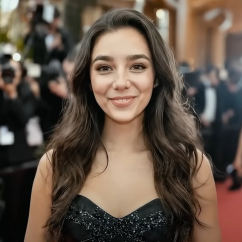
AI can combine the facial features and performance styles of several real celebrities. It can also combine their strengths to create a “perfect” actor. In this way, it creates a virtual character who “looks like many people, but is not any one person.” This seriously invades the portrait rights of real actors.
Significantly, the problem is not just plain infringement. AI commodifies human beings as data and then objectifies human beings as analyzable, tractable, cuttable, and recombinable. This appears as “survance capitalism.” Zuboff explains “survance capitalism” as “the extraction of human experience as raw material, its subsequent conversion into behavioral data, its calculation-driven packaging into prediction products, and its sale” (Zuboff, 2019). If expressions and behaviors are reducible to data then do humans have human rights?
Real consequences
Creation becomes cheaper, and creators are cheapened. The great thing about AI-generated content for businesses is the very low price they have to pay for creation. This is a kind of ‘evolution’ for production companies. Voice acting can be auto-generated without a need for fine-tuning. Actors don’t need to be given a real video to shoot. Posters can be mass-produced. It used to be difficult to create them.
Now, it can be compressed into a few minutes of output through a few lines of code. A short drama that originally needed one month to film can now be “produced” several times in one day with the help of AI.But the problem is that cheaper creation does not mean fairer creation. These practices directly ignore human labour. AI-generated content looks easy because the labour behind it has been absorbed by the model and hidden from view.
Creators may spend years, or even decades, building their skills and experience. But AI can collect, learn, and break down this work into parts within a few minutes. It can then use these parts to create new products. In this process, creators may lose their whole market. If one AI system can replace hundreds of jobs, why would production companies still hire real people?
Behind all of this, human civilisation may also be harmed. No matter how fast and efficient AI is, it can only use existing databases. Only human beings can create truly new things. If many creators no longer want to carefully polish their work under the influence of AI, then future human culture may be replaced by a large amount of AI-made content that is only copied, pasted, and recombined.
Data protection and regulation
Based on the analysis above, one issue has been constantly ignored: platforms’ silent permission and the inaction of regulatory authorities. AI’s endless collection of human information is not only the responsibility of AI technology companies. It is also the responsibility of platforms and regulators.
First, platforms need to be transparent and responsible. Platforms should stand on the side of creators. If creators’ work is stolen or plagiarised, creators should have the right to know, control, refuse, and withdraw this content.Cooperation between creators and platforms, or other companies, should follow the principle of purpose limitation. Creators’ works, materials, and information should only be used for the clearly stated purpose of the original cooperation. The meaning of the agreement should not be secretly changed. Most importantly, relevant regulatory authorities should limit AI companies’ free access to data templates as much as possible. They should also require AI companies to disclose data samples and training model processes in certain situations.
Conclusion
When human beings themselves can be turned into data, are current copyright laws, portrait rights, and platform governance rules still enough?
The biggest controversy around AI-generated content is not whether AI can create. The main problem is not that AI can create. The problem is that AI materializes human beings into a cheap mass. Voices of voice actors, faces of actors, and idea of designers are materialized by being converted into readable data. They are all combined and resold as a new product.
The “cheap” content has a high price. Loosing control of your own self. Cheaper creation is what AI allows to have, but it is just passing on the expenses. It is not that creation becomes free. It is that expenses are moved to other place. Creator faces hidden cost. Production companies save money. Platforms gain more content. AI companies collect more data. Audiences may also enjoy cheaper content without paying high fees. But creators pay the price. They lose control over themselves.
Couldry and Mejias(2019) conceptualize the peculiarity of data colonialism as converting a million different aspects of human existence into the raw material of capitalism. Today’s data enablers are turning the lived experience into a resource that can be appropriated by capital. It is more of the AI‘s data colonialism over the creators(Couldry &Mejias,2019).Being visible to the public is not the same as being usable. The harshest side of digital colonialism is the fact that it extracts from the whole thing and makes it usable.
References
Goggin, G., Vromen, A., Weatherall, K., Martin, F., Webb, A., Sunman, L., Bailo, F. (2017) Executive Summary and Digital Rights: What are they and why do they matter now?
Hutiri, W., Papakyriakopoulos, O., & Xiang, A. (2024). Not my voice! A taxonomy of ethical and safety harms of speech generators.In Digital Rights in Australia. Sydney: University of Sydney.
Nissenbaum, H. (2018). Respecting context to protect privacy: Why meaning matters. Science and Engineering Ethics, 24(3), 831-852.
Zuboff, S. (2019). The age of surveillance capitalism: The fight for a human future at the new frontiers of power. PublicAffairs.
Be the first to comment