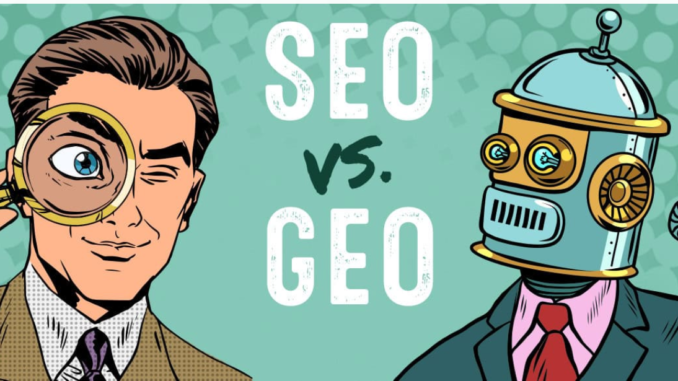

Why Search Visibility Has Always Mattered
In the web era, visibility has always been more important than rankings. If a company or website appear near the top of search results usually meant more attention, more clicks, and more profit. In that case, search engines did not simply help users find information. They also shaped commercial success and public visibility. Search engine optimisation(short as SEO) was a very efficient online strategy because usually being found then you can being heard .
From Search Results to AI Answers
But search is changing. As the development of AI tools , customers are more used to reply on AI when facing questions. The traditional competition of getting users to search on a website has eliminated. In traditional search, uses would get a list of answers that they can compare. However, In AI search, information is often summarised and compared on behalf of the uses.
This is why the move from SEO to Generative Engine Optimization(short as GEO)is so significant. GEO refers to making content better summarised and appeared in AI responses, not just a search result list (Aggarwal et al., 2023). That difference may sound subtle, but actually quite big. SEO tried to gain visibility by influencing where a source appeared in the result list. While GEO tries to win visibility by influencing whether a source cited in the AI answer. Once that happens, optimisation is no longer only about getting more traffic. It shows how authority is spread in digital environments. A source that cited in an AI answer can gain legitimacy, credibility, and influence over users(Aggarwal et al., 2023).
Search Has Never Been Neutral
This does not mean that search was ever indifferent before. Search engines have always shaping what is visible and trustworthy online. Search engines raise political and technical questions because the order of results affects relevancy and value of information (Introna and Nissenbaum,2000). Mager (2012) likewise shows that search systems are shaped by commercial interests and social power rather than by fully natural. Even how users respond to search results reflect this. Pan et al. (2007) found that users often treat higher-ranked results as more relevant and more trustworthy, even when they know rarely about how ranking systems work. In other words, trust can be shaped by position. GEO strengthen that dynamic because AI answers do not just rank sources. They narrate them.

Why GEO Is Also a Governance Issue
That shift from ranking to narration is what makes GEO especially important from a digital policy and governance perspective. Crawford (2021) argues that AI is not just a neutral tool.It is also part of larger systems of infrastructure, industry, and power. It also show AI systems do not float above society. They are built out of labour, data extraction, resource consumption and institutional priorities. The same is true of AI search. It is a new way that decides how information is selected, condensed, and made meaningful to users.
Just and Latzer (2017) coined this term: algorithmic selection. They describe it as a process that define relevance and shape how people understand the world. When AI choose what to retrieve, what to ignore, what to summarise, and what to cite, they are definitely not reflecting reality naturally. They are actively creating a coherent, effective and authoritative version of reality . Van Dijck (2014) similarly shows that datafication transforms social life into measurable and actionable data. In AI search, the web becomes a large database, and answer engines reorganise that content into answers. Given that, GEO is not just a content tactic. It actually relevant to how digital reality is sorted, interpreted, and presented.
When AI Becomes an Interpreter
This matters because users nowadays getting used to consider AI as an interpreter than a search tool. They ask them to explain, compare, simplify, and judge. Many people now use AI not just to find sources, but to save time. It can be convenient but also risky. Once users rely on AI to interpret the information, AI’s answer can be more controversial than search engine’s ranked list. That is due to a ranked list still preserves some uncertainty. It still allow some spaces for the user to navigate and make decision. However, AI generated answer can diminished complexity and possibility. It can turn a controversial knowledge field into a settled and singular response.

Whose Content Gets Included
This is why GEO should concern more than marketers, developers, or content creators. It actually reshaped everyday users’ ideas,trust and choices towards multiple conditions . People may assume that the answer they receive is the optimal solution by AI’s neutrally calculating and analysing. But that assumption can hardly be true once optimisation moves to the answer layer. In fact, Aggarwal et al. (2023) suggest that some forms of content are more likely to be selected by AI. Especially content with citations, credible quotations, statistics, and fluent writing (Aggarwal et al,2023). Thus, if content producers learn how to phrase, structure, and format information in that way, AI would more likely to include their content(Aggarwal et al,2023). Consequently, More and more creators are applying strategies that prompt their visibility rather than improve informational quality. The issue is not that all optimisation is inherently malicious. The issue is that optimisation begins to affect what content users sees and consider as knowledge. A governance perspective also makes clear that GEO is a fairness issue. The actors most able to influence AI answers are likely to be those with more money, more labour, greater technical expertise, and stronger incentives to optimise. Large platforms, major brands, professional agencies, and commercial publishers are better placed to experiment with answer-oriented strategies than small websites, public-interest knowledge projects, or independent writers. In the SEO era, smaller sites could still potentially appear in results and be discovered by attentive users. In the age of AI answers, many sources are compressed into one output, while others disappear entirely from view. This means that the struggle for inclusion may become even more unequal.
Noble’s (2018) work on search engines is useful here because it shows that search does not just reflect social inequalities. It can also reproduce and strengthen them. When some representations are made more visible while others are pushed aside, search systems can make unequal or biased patterns of visibility seem normal. This idea is still very relevant to GEO. If answer engines keep citing some kinds of sources while leaving others out, they may strengthen existing hierarchies of credibility. This is not only a commercial issue. It is also a cultural and political one, because visibility affects whose knowledge is taken seriously, whose perspective is amplified, and whose voice is ignored. GEO therefore raises questions not only about efficiency or discoverability, but also about whose version of reality gets to appear authoritative in the first place.
Opacity, Accountability, and Influence
GEO also needs to be understood through the issues of opacity and accountability. Pasquale (2015) argues that powerful algorithmic systems often work like black boxes. They shape outcomes, but they do not clearly show the public how they work. This is especially important in AI search. Users usually do not know why one source was chosen instead of another, how credibility was judged, or what signals were used to create the final answer. This lack of transparency becomes even more worrying when strategic optimisation is involved. If a system gives a distorted or misleading answer, who should take responsibility? Is it the content creator who made the material easier for AI to use, the platform that designed the retrieval and generation process, the company behind the model, or no one at all? These questions show that GEO is not just about better content strategy. It is also about governance, responsibility, and public accountability.
Optimisation, Manipulation, and Security
The The line between optimisation and manipulation becomes even less clear when we look at security research on large language models. Greshake et al. (2023) show that indirect prompt injection can happen when when harmful instructions are hidden in outside content that is later retrieved by an LLM-based system. Their point is not that every optimisation practice is an attack. Instead, they show that retrieval-based AI systems are vulnerable because outside content can shape later outputs. This is highly relevant to GEO because both rely on the same basic condition: outside content is no longer just passive material. Once it is retrieved, it can affect what the system says, how it presents information, and what it seems to trust.
Meanwhile, there is still an important difference between normal optimisation and harmful interference. A company making its webpage clearer, better organised, and easier to read is not the same as a negative actor hiding manipulative instructions in content. But even so, the line between them is not always clear. Once answer engines become sensitive to wording, formatting, and source structure, the web starts to become a space where different creators compete to shape AI outputs. In that space, optimisation, persuasion, and manipulation start to mix together. This is what makes GEO politically and ethically important. It is not just about visibility. It is also about the growing risk that AI-based knowledge can be shaped by outside influence in ways that users may not easily notice or question.
Fluency, Trust, and Platform Power
Bender et al. (2021) make this danger even clearer by showing that large language models can produce smooth and convincing language without really understanding what they are saying. In other words, a system can be clear and confident even when its reasoning is weak or unreliable. This matters in search because users often expect not just a fluent answer, but also a trustworthy one. They may think the system has already compared different ideas and chosen the best answer. But if that answer comes from an online environment already shaped by optimisation, then smooth language can hide outside influence. So the problem is not only that AI answers can be wrong. It is also that they can be shaped in strategic ways that ordinary users may not easily notice or question.
Given that, GEO is not as a niche issue or the next stage of SEO.It reflects a deeper shift in how public knowledge is organised online. Flew (2021) argues that platform regulation is fundamentally about the power of intermediaries to shape public communication. That idea is especially relevant here. AI systems do not just host or distribute information. They also reorganise and package it in ways that shape access, relevance, and trust. So the politics of search have not disappeared in the age of AI. Instead, they have moved deeper into the infrastructure of information itself.
So digital policy debates must go beyond narrow questions of technical accuracy. Governance also needs to ask who gets optimised into visibility, whose sources are repeatedly cited, what kinds of knowledge are systematically prioritised, and who bears responsibility when commercial or strategic influence distorts public understanding. A stronger governance response would include clearer source transparency, more visible citation practices, stronger distinctions between legitimate optimisation and manipulative interference, and more meaningful accountability for systems that repeatedly privilege some actors over others. Users should not be asked to place trust in systems whose processes remain largely invisible while their outputs increasingly shape public understanding.
Conclusion
GEO is not just a new version of SEO. Search is changing. Before, people got a list of links and choices. Now, AI can give one contention answer. This gives some websites and companies more chances to be seen, but it also gives them more power. Once optimisation starts shaping the answer itself, being visible become more and more important to all creators. That is why GEO is not only important for companies. It also matters for ordinary people who use AI to understand things online. So the big question is not only whether AI can find information. It is whether people still know who is shaping the answers they get, and why.
AI Acknowledgement
I acknowledged the use of ChatGPT and Grammarly for checking grammar and deepl for translating some sentences.
References
Aggarwal, P., Murahari, V., Rajpurohit, T., Kalyan, A., Narasimhan, K., & Deshpande, A. (2023). GEO: Generative engine optimization. arXiv. https://doi.org/10.48550/arXiv.2311.09735
Barraza, S. (2025, August 22). SEO vs. GEO: How businesses can improve visibility in AI search. Aker Ink. https://akerink.com/blog/seo-vs-geo-how-businesses-can-improve-visibility-in-ai-search/
Bender, E. M., Gebru, T., McMillan-Major, A., & Shmitchell, S. (2021). On the dangers of stochastic parrots: Can language models be too big? In Proceedings of the 2021 ACM Conference on Fairness, Accountability, and Transparency (pp. 610–623). Association for Computing Machinery. https://doi.org/10.1145/3442188.3445922
Crawford, K. (2021). Atlas of AI: Power, politics, and the planetary costs of artificial intelligence. Yale University Press.
Flew, T. (2021). Regulating platforms. Polity Press.
Greshake, K., Abdelnabi, S., Mishra, S., Endres, C., Holz, T., & Fritz, M. (2023). Not what you’ve signed up for: Compromising real-world LLM-integrated applications with indirect prompt injection. arXiv. https://doi.org/10.48550/arXiv.2302.12173
How the algorithm knows you better than you know yourself. (n.d.). [Video]. YouTube. https://www.youtube.com/watch?v=OWXEGo0TQQc
Introna, L. D., & Nissenbaum, H. (2000). Shaping the web: Why the politics of search engines matters. The Information Society, 16(3), 169–185. https://doi.org/10.1080/01972240050133634
Just, N., & Latzer, M. (2017). Governance by algorithms: Reality construction by algorithmic selection on the internet. Media, Culture & Society, 39(2), 238–258. https://doi.org/10.1177/0163443716643157
Mager, A. (2012). Algorithmic ideology: How capitalist society shapes search engines. Information, Communication & Society, 15(5), 769–787. https://doi.org/10.1080/1369118X.2012.676056
Noble, S. U. (2018). Algorithms of oppression: How search engines reinforce racism. New York University Press.
Pan, B., Hembrooke, H., Joachims, T., Lorigo, L., Gay, G., & Granka, L. (2007). In Google we trust: Users’ decisions on rank, position, and relevance. Journal of Computer-Mediated Communication, 12(3), 801–823. https://doi.org/10.1111/j.1083-6101.2007.00351.x
Pasquale, F. (2015). The black box society: The secret algorithms that control money and information. Harvard University Press.
van Dijck, J. (2014). Datafication, dataism and dataveillance: Big data between scientific paradigm and ideology. Surveillance & Society, 12(2), 197–208. https://doi.org/10.24908/ss.v12i2.4776
Be the first to comment