If you’ve been browsing Chinese social media recently, you’ve probably heard the story of that “pink-haired girl”. In July 2023, a 24-year-old girl from Zhejiang, Xiao Zheng (a pseudonym), posted a photo of herself holding a graduate admission letter on social media. In the photo, she had her hair dyed in a striking pink color and was smiling brightly. What was supposed to be an ordinary sharing to record the highlights of her life turned out to be the beginning of a devastating cyber violence.

In just a few days, her photos were maliciously screenshot, tampered with and spread, and a large number of netizens used “pink hair” as an attack point to insult her personality, humiliate her appearance, spread professional rumors, and labels such as “undignified”, “hostess”, “goblin” were everywhere, and even death threats like “Why not die?” appeared. Despite her repeated deletion of comments, account closure and seeking help from the platform, hate speech followed her like a shadow, and months of mental torture eventually crushed her – in November 2023, she committed suicide due to severe depression. The incident shocked many people, but more thought-provoking: Is this really just an isolated case?

What is more alarming is the frequent occurrence of such incidents in China’s cyberspace. From the death of Liu Xuezhou, a boy seeking his family, to the suicide of the Internet celebrity Luo Xiaomaomiaozi due to public opinion attacks, and to the collective bullying of college students because of their special hair color, online hatred has spread from “public opinion judgment” against public figures to “everyday violence” against ordinary individuals. Guan & Chen (2025) confirmed in their latest study that hate speech in China’s cyberspace has distinct local characteristics – often using “upholding traditional morality” and “criticizing bad customs” as justifies, constructing hatred by “heerizing” non-mainstream individuals eventually evolves into indiscriminate attacks (p. 3).
This article, with the pink-haired girl incident as the core case and in combination with three academic literature, wants to talk to you about a not-so-easy topic – hate speech on the Internet and the harm mechanism in the digital age.
Ⅰ. The nature of hate speech on the Internet and its triple harms: from verbal violence to life-threatening harm
1. The core definition of online hate speech
There are differences in academic definitions of online hate speech, but the core consensus is clear. Flew (2021) defines it as “online speech that discriminates, belittled, threatens, or incites hatred against individuals or groups based on characteristics such as race, gender, appearance, sexual orientation, or identity, with the core being the denial of the basic dignity and equal rights of others” (p. 92). This definition breaks through the surface controversy of “freedom of speech” and points directly to the essence of hate speech – discriminatory expressions aimed at causing harm.
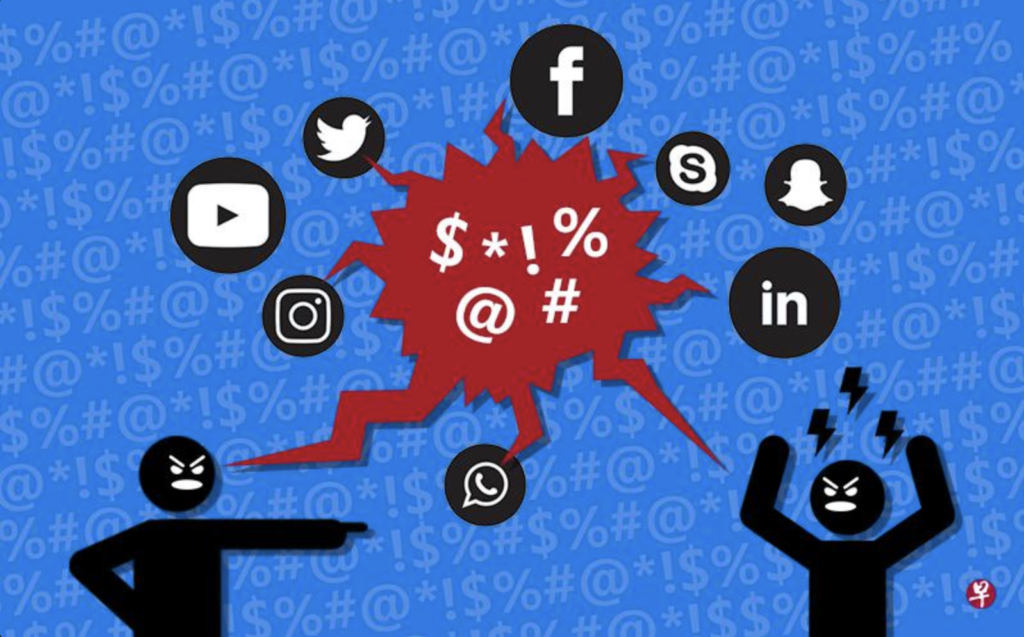
Sinpeng et al. (2021) further classified hate speech on social media in the Asia-Pacific region into three actionable specific forms that precisely correspond to all types of harm suffered by girls with pink hair (p. 12) :
1.1 Discriminatory speech: Categorizing victims as “outliers” through labeling, denying their social value and legitimacy of identity, such as associating pink hair with “moral corruption”;
1.2 Derogatory remarks: Using insulting words, false rumors, malicious photo editing, etc. to trample on the dignity of the victim, such as abuse like “hostess”, “slug”, etc.
1.3 Deprivation of rights: Direct denial of the victim’s rights to life, expression and development, such as threats like “Die quickly” or “drop out of school and don’t pollute the school”.
The image is from online sources.
2.The triple deadly hazards of online hate
2.1 At the individual level: Irreversible psychological trauma and destruction of life
The direct victims of cyber hate are subjected to prolonged, intense, all-round mental violence. Flew (2021) points out that “because of the anonymity of the Internet, the abuser is at liberty with no moral constraint, extreme speech diffuses easily, and the victim, unaware of the origin of the attack, lives in a constant state of fear, anxiety, and self-doubt” (p. 94). Relatives and friends of Xiao Zheng said that “during the period of online harassment, she had no sleep all night, checked negative comments repeatedly, was afraid to go out to socialize with others. Her previously optimistic personality changed to silent and introverted, eventually diagnosed with major depressive disorder. This is the entire process of ‘verbal harm’ leading to ‘mental illness’ and then to ‘the end of life’.”Studies have shown that individuals who have been subjected to cyber violence for a long time are 4.3 times more likely to suffer from depression and anxiety than the general population, and have a sixfold higher risk of suicide.
2.2 At the social level: Tearing public Spaces and dissolving inclusive cultures
Online hatred is not a conflict between individuals, but rather an erosion of the culture of trust and inclusiveness in society. Guan & Chen (2025) pointed out that hate speech in China’s cyberspace often spreads through a “group polarization” mechanism: a few extreme remarks trigger herd herd, creating a situation where the “silent majority” stands by and the “radical minority” acts violence, ultimately transforming cyberspace into a “moral judgment ground” (p. 5). When pink hair, niche aesthetics, and individual expressions can all be grounds for being attacked, the entire society will fall into the fear of “self-censorship”, multiple values will be suppressed, and rational dialogue in the public space will completely disappear.
2.3 Governance level: Challenging legal authority and the boundaries of platform responsibility
The cross-regional, anonymous, and fast-spreading nature of online hate poses a disruptive challenge to the traditional governance system. Flew (2021) pointed out that there is a natural contradiction between the borderlessness of cyberspace and the territoality of national laws, making it difficult for a single country to fully regulate cross-border hate speech (p. 96). At the same time, the platform’s algorithmic logic centered on “traffic supremacy” conflicts with its social responsibility of “preventing cyber harm” – hate speech, due to its high controversy and high interactivity, gains more algorithmic recommendations and becomes a “grey source” of platform traffic (p. 95). This governance failure has turned online hate from an “individual incident” into a “systemic risk”.
Ⅱ. Why has “online swearing” become so serious?
A lot of people would think: “Getting scolded online is not that bad, is it?” But the problem is that the Internet has magnified “a couple of sentences” into “thousands of sentences”. According to Flew (2021, pp. 91-92), hate speech is not just “uncomfortable words”, and it often has the following characteristics: targeting specific groups (such as gender, appearance, cultural identity); It has a sense of humiliation, dehumanization or threat; May cause psychological or even social harm in reality; In the case of the pink-haired girl, almost all of these traits were present: she was labeled (” abnormal “, “undignified”); Being collectively judged by strangers; Being constantly attacked for personality and even family. More importantly, the attacks are persistent, intense, and hard to escape — that is precisely the key difference between the digital environment and the real world.
Ⅲ. Why is the online environment more prone to hate?
1. Anonymity reduces the “cost of speaking”
In real life, most people don’t humiliate someone to their face. But on the Internet, an anonymous account can do it. As Flew (2021, p. 93) points out, the online environment weakens the mechanism of responsibility in social interaction, making it easier for people to make extreme remarks. Meanwhile, Sinpeng et al. (2021, pp. 15-17) also pointed out that the structural design of platforms (such as anonymity and forwarding mechanisms) would invisibly reduce users’ sense of responsibility, thereby amplifying aggressive behavior. To put it simply: no responsibility → easier to say harsh words.
2.The algorithm is “pushing the fire” rather than “putting it out”
Have we noticed that the more extreme and controversial the content is when using social media software, the more likely it is to be seen?
This is no coincidence. Platform algorithms tend to give priority to content with a lot of comments, intense emotions, and controversial content. Hate speech fits precisely these characteristics. As Sinpeng et al. (2021, pp. 15-17) emphasized, this mechanism may unintentionally amplify the spread of hate speech. And so the cycle continues: hate speech → creates controversy → viewed by more people → leads to more hate speech. It is like an “emotional amplifier.”
3. “Group psychology” makes people more extreme
When one sees a lot of people attacking a certain object, it is easy to develop a mentality: “So many people are saying it, it should be fine, right?”
Guan and Chen (2025, pp. 5-7), who researched the online environment in China, emphasized the fact that hate speech is often related to “othering,” i.e., “treating certain people as outliers.”
The pink-haired girl has become a target because she is “not conforming to mainstream aesthetics” and “deviating from social norms.” Once she is labeled as “the other,” the hate speech is more likely to be rationalized.

Ⅳ. It’s not just China
You may ask yourself: is this phenomenon unique to China? The answer is: no, it is not unique to China. There are similar phenomena occurring everywhere in the world: females being abused because of their physical appearance or opinions, minorities being abused on social media on a systematic level, and teenagers suffering from mental illnesses due to cyberbullying. The above-mentioned phenomena show that the cause of the problem is not the person themselves but the interplay between the platform, social bias, and technology.
V. Is the platform really “unmanageable”?
Many platforms would say, ‘We’re already working hard.’ In fact, some platforms have already taken measures such as content moderation (AI + human), implementing a system of whistleblowing, and limiting hate speech. The problem is that these actions are very obvious.
1. The review criteria are ambiguous
What is hate speech? The definition of hate speech varies from culture to culture. Sinpeng et al. (2021, pp. 23-25) found that in Asian countries such as Asia Pacific, it is hard to identify hate speech due to linguistic differences as well as cultural backgrounds. In fact, a lot of hate speech remains unaddressed.
2.The “business logic” of the platform
This is a real but crucial question: hate speech generates traffic, which generates revenues. Flew (2021, pp. 95-96) reminds us that there is a structural contradiction for these platforms with regards to hate speech: “managing risks and maintaining user engagement.”
3.Limitations of the user reporting mechanism
Theoretically, it is possible to report inappropriate content; however, the response is slow, and the feedback is not transparent.Sinpeng et al. (2021, pp. 30-32) noted that this mechanism undermines the effectiveness of platform governance.
Ⅵ. What does the Pink-haired girl incident tell us?
The most alarming thing about this incident is that online hate has become “everyday”. Many people don’t think they are hurting others, but are just joking, following the trend to comment or expressing their opinions. But as Flew (2021, p. 92) emphasizes, the harm of hate speech lies in its cumulative effect. One sentence is not serious, but ten thousand can be fatal.
Ⅶ. What should we do?
1. Platform: From “traffic first” to “security first”, fulfilling primary responsibility
The platform must reverse its business model and incorporate “preventing cyber hazards” into its core objective, which is the key to governance.
1.1 Optimize algorithm design: Reduce the weight of recommendations for hate speech and controversial content, and limit the flow of high-risk content such as attacks on appearance and identity; Establish a “contextualized review model” and collaborate with linguists and sociologists to build a database of Chinese hate words to enhance the ability to identify latent hate (Sinpeng et al., 2021, p. 42);
1.2 Improve the review and reporting mechanism: Increase the manpower for non-English content review to achieve 24-hour rapid response; Set up a “one-click reporting of cyberbullying” function, simplify the process, and impose permanent bans and IP restrictions on malicious accounts;
1.3 Establish a victim protection system: Provide functions such as temporary account hiding, keyword blocking, and one-click comment clearing; Joint psychological institutions provide free psychological intervention for victims (Flew, 2021, p. 95).
2. Law: Improving the regulatory system from “post-event accountability” to “pre-event prevention”
2.1 Introduce specific regulations: Formulate the Law on the Prevention and Control of Online Hate Speech, clearly defining three types of hate speech and detailing the penalty standards – regardless of whether it causes serious consequences or not, discriminatory, derogatory and threatening speech shall bear civil and administrative liability, and criminal liability shall be pursued in serious cases (Guan & Chen, 2025, p. 12);
2.2 Lower the threshold for accountability: Simplify the process of obtaining evidence in cases of online hate, and recognize electronic screenshots, platform data, etc. as valid evidence; Establish a public interest litigation mechanism where procuratorial organs and public interest organizations represent victims in safeguarding their rights to address the difficulty of individual rights protection;
2.3 Strengthening cross-border cooperation: Establishing information sharing and joint law enforcement mechanisms for hate speech with countries in the Asia-Pacific region to combat transnational cyber violence (Flew, 2021, p. 96).
3.Society: From “moral revelry” to “rational inclusion” to enhance civic literacy
3.1 Eliminating cognitive misconceptions: Through public service advertisements, case-based legal education, campus education, etc., popularize the idea that “online speech has boundaries” and “cyber violence is illegal”, and make it clear that cyberspace is not beyond the reach of the law.
3.2 Foster an inclusive culture: Advocate values that respect differences and embrace individuality, and let the public understand that pink hair and niche aesthetics are personal choices and have nothing to do with moral right or wrong, and oppose suppressing diversity in the name of “tradition”.
3.3 Enhance media literacy: Educate the public to rationally distinguish online information, not to create, believe or spread rumors; Actively report hate speech and support the victims instead of attacking them (Guan & Chen, 2025, p. 13).
Ⅷ. Conclusion
Many people think the Internet will automatically become more civilized, but the reality is: technology won’t change society, people will.
The story of the pink-haired girl reminds us that the Internet is not virtual, and every word can have real consequences.
If we don’t reflect, such a tragedy won’t be the last.
References
1.Flew, T. (2021). Hate speech and online abuse. In Regulating platforms (pp. 91–96). Cambridge: Polity Press.
2.Guan, T., & Chen, X. (2025). Threat perception, otherness and hate speech in China’s cyberspace. Journal of Contemporary China, 1–16.
3.Sinpeng, A., Martin, F., Gelber, K., & Shields, K. (2021, July 5). Facebook: Regulating hate speech in the Asia Pacific. University of Sydney & University of Queensland.
Be the first to comment