Have you used any menstrual cycle tracking apps (CTAs)?
Homepage interface of the Flo period-tracking app (Flo Health, 2026). Screenshot captured by author from Flo official website.
The menstrual cycle app not only can accurately predict your menstrual cycle, but also, centered on the menstrual period records, provides professional content such as information on conception and gynecological diseases (Hammond & Burdon, 2024).
As mentioned by Kemp (2023), the main functions of the menstrual cycle app are:
- Track one’s menstrual cycle, sometimes to prevent pregnancy during sexual activity, and/or to record symptoms of menopause;
- Determine the “fertile period” for conception by tracking sexual activity, menstrual cycle, and other symptoms, in an attempt to conceive;
- Track and manage their pregnancy stages, including preparation for childbirth, delivery, and parenting.
While enjoying these conveniences, have you ever wondered how the 99% of similar apps available on the market are free to use? How do they make profits then?
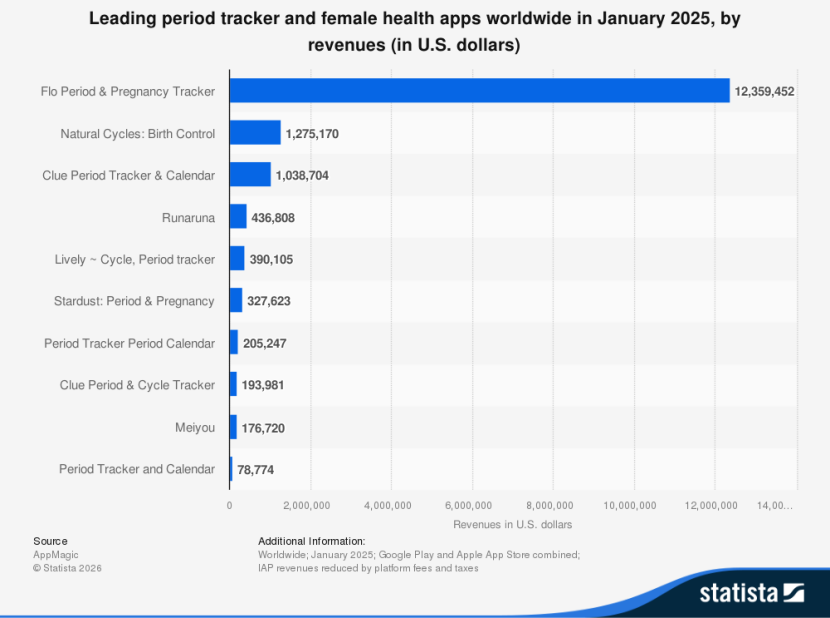
Leading period tracker and female health apps worldwide in January 2025, by revenues. Source: Statista Research Department (2025).
According to the research conducted by Statista Research Department (2025), it was discovered that within just one year in 2025, Flo’s total revenue skyrocketed to an astonishing 12 million US dollars. Meanwhile, although the other apps did not match Flo in terms of revenue, they still achieved an average income of 450,000 US dollars each.
However, according to a report by the US news aggregation website BuzzFeed News in 2019 (Rajagopalan, 2019), CTA such as Maya and Flo directly sent information about the contraceptive methods used by women, their menstrual cycles, as well as symptoms such as swelling and abdominal cramps to Facebook.
On October 12, 2021, the US Federal Trade Commission (FTC) filed a lawsuit, sharing the personal health data of millions of American women to Meta, Google and other third parties. This lawsuit was part of a consolidated lawsuit involving multiple lawsuits against companies including Flo Health Inc. (a developer of women’s health applications) and major tech companies Meta Platforms Inc. (Meta) and Google. (Flo Health, Inc., 2020)
Shortly after that, in March 2024, Canada brought the same charges against Flo Health Inc.
And in August of last year, Flo agreed to a settlement and changed their approach to data sharing. (Flo Reaches Settlement in Class Action Lawsuit after Judge Said He Would Toss Plantiffs’ Claim, 2025)

California jury finds Meta breached period-tracking app users’ privacy (Business & Human Rights Resource Centre, 2025).
Imagine that you have recorded your menstrual cycle, ovulation, emotions, and medication usage in the app. These most private and confidential personal details are being sold to third parties without your knowledge, yet you have no idea what they are using this data for. At that point, how would you think about “My privacy, my digital rights?”
Flo’s case is not merely a simple legal case; rather, it is more like a magnifying glass that has magnified the issue of the hidden data flow in the entire field of women’s health applications. Reproductive health data is highly sensitive personal information, and the consequences resulting from this include but are not limited to privacy infringement, discrimination, moral issues, and serious legal and social consequences. Moreover, the menstrual cycle information of women may exceed the boundaries of these applications and be abused without their consent, potentially leading to significant and disastrous economic consequences (Hammond & Burdon, 2024).
More importantly, many users, while worried about their data, also feel helpless about the platform’s use of their data. everyone that does anything online […] It kind of accepts the fact that your data may potentially be accessed and used by third parties. That’s just the current situation. (Friedlander et al., 2025)
The grey area: How to Make a Profit
Most CTA platforms, such as Flo and Glow, offer free downloads and basic functionality access. The ownership structure and business models of these platform companies vary, but the “free” model (where users exchange their personal information for the right to easily access content and services) is a very common one (Flew, 2021, p. 72).
This “free” operation model makes most CTA users believe that the software is highly secure and of a charitable nature as a health app. But as we mentioned earlier, the CTA software on the market all achieve high revenues.
So where do these revenues come from?
Are they only from advertisers and subscription services?
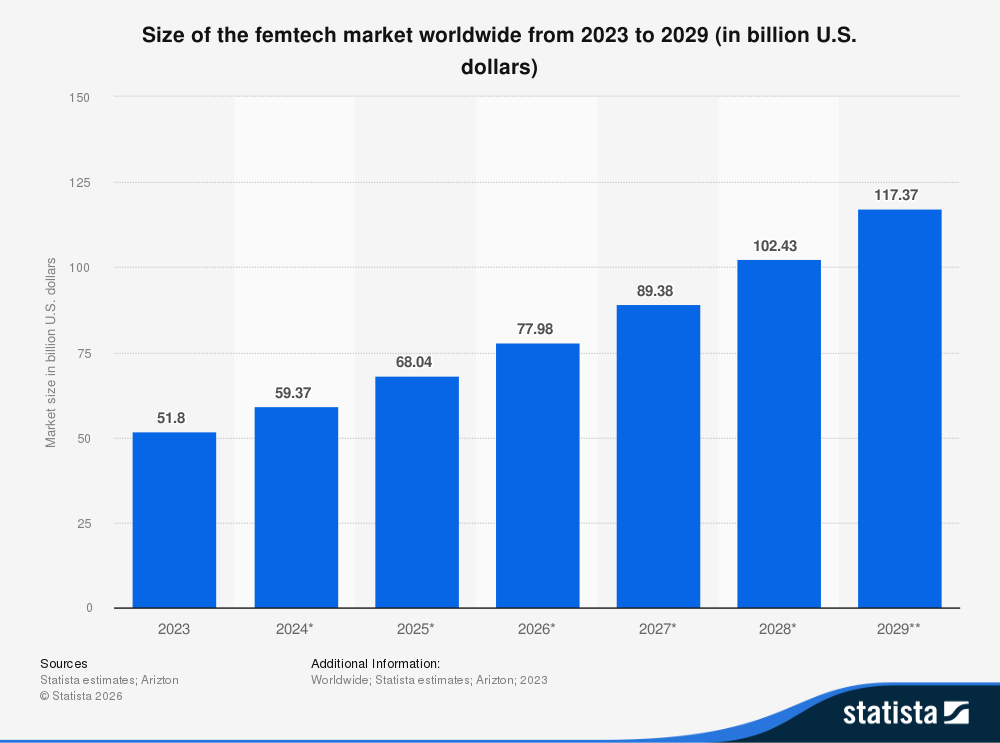
Femtech market size worldwide from 2023 to 2029. Adapted from Statista Research Department (2025).
In 2023, the global value of the female technology market was nearly 52 billion US dollars. With continuous growth, it is projected that this market will exceed 117 billion US dollars by 2029 (Stewart, 2025).
Behind the seemingly harmless aspects of “free use” and “health care”, the profit models of these applications are actually hidden in a complex and ambiguous grey area.
Trust becomes a part of the profit mechanism – Feminism
The success of CTA is largely based on a special emotional connection – trust.
Dr Stefanie Felsberger (2025) said:
For the majority of people in the Global North, understanding one’s menstruation is an unhappy and unattractive process. Instead, it is frustrating and lonely. Access to menstrual health or reproductive health care is at best frustrating.
Female physiological health has long been an area that has received insufficient research in the medical field (Bobel, 2020).
In 2016, the Danish internet entrepreneur Tin proposed the term “femtech“, referring to a rapidly developing technology designed to serve people with female reproductive systems. According to Tin (2016), menstrual cycle tracking applications play a fundamental role in the female technology movement. Mishra and Suresh (1998) believe that female technology originated from the claims of liberal feminists, namely, “women have always been excluded from the health field”. They argue that most health data is centered around men, so female technology can “fill the key gaps in female health research”.
Therefore, after the CTA entered the market, it rapidly achieved market expansion under this circumstance.
Meanwhile, CTA usually employs persuasive language that is easy for women to trust, such as
“A health space tailored for women”
“A utopia exclusively for women”
“The fluctuations of hormones lead to mood swings.
This is a natural rhythm that is unique to women.”
to encourage users to actively record information about their menstrual periods, emotional changes, sexual activity frequency, etc., in order to confirm their physical conditions and obtain precise health advice. However, these data have also become important commercial assets for the platform.
When the platform is regarded as a reliable partner, users are more likely to share sensitive information and are less likely to question how the data is used. In the platform capitalism system, this emotional interaction becomes a part of the data extraction process, in which personal experiences are transformed into commercial value (Andrejevic, 2013; Van Dijck, 2014).
In other words, trust is not merely an experience, but a resource that can be monetized.
Data Sharing: Participation of Third-Party Institutions & Advertising
According to the concept proposed by Flew (2021, p. 72), data collection is the core of the platform’s business model, as the use of the platform brings detailed information about users – such as menstrual cycles, ovulation periods, etc. These data can then be provided to third parties through application programming interfaces (APIs), which offer detailed information about user behaviors and metrics, thereby facilitating the further development of applications and services on the platform.
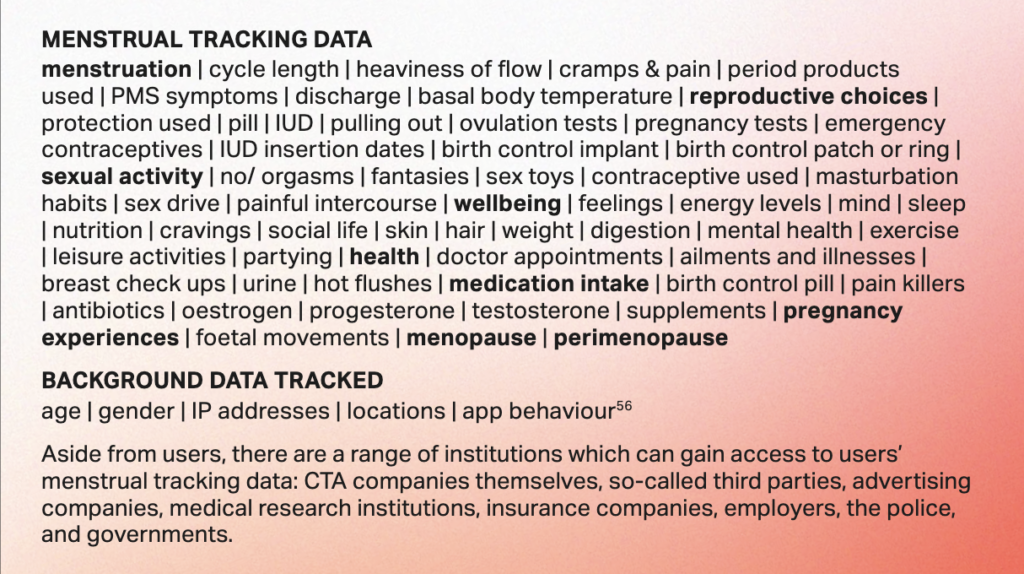
Data flows in menstrual tracking ecosystems. Adapted from Felsberger (2025).
Most users believe that CTA is private, or after trusting CTA to handle their data without any precautions, users think that their data is not important and that such leaked data cannot cause harm to themselves or others.
Firstly, a survey by Privacy International revealed that CTA had shared and continued to share user data with third parties and advertisers (Privacy International, 2025). Each user’s active record is valuable to advertisers. By combining data such as consumers’ social media behavior, it is possible to analyze a user’s political stance, potential psychological barriers, fertility intentions, etc. And these data are of significant commercial value to advertisers (Felsberger, 2025).
Dr Stefanie Felsberger referred to CTA’s data as a huge consumer profile gold mine. For a long time, medical data has been a valuable resource both on the black market and in the legal market. On the black market, medical data can even be sold at more than five times the price (Lori, 2018, pp. 421–478). Among them, data related to “pregnancy” is the most influential data and is the factor most likely to change a user’s consumption habits. The Financial Times (2018) found that information about a person’s gender, age, or location is worth $0.0005 per person, but information about someone being in the late stages of pregnancy can increase the value of the record by 220 times, reaching $0.11.
The next aspect is the personalized recommendations of advertisements. According to Felsberger’s (2025) research, when the platform uses big data to predict your menstrual cycle and combines it with medical knowledge, it will provide you with personalized advertisements based on the cycle. During the first half of the cycle, the female body is dominated by estrogen, and at this time, the platform will recommend cosmetics or clothing; during the second half of the cycle, the advertisements will tend to be related to home products and green plants.
Therefore, we can see that the functions of the platform are not merely what is presented on the surface, representing a specific business model based on data, algorithms and machine learning (Van Dijck, 2014).
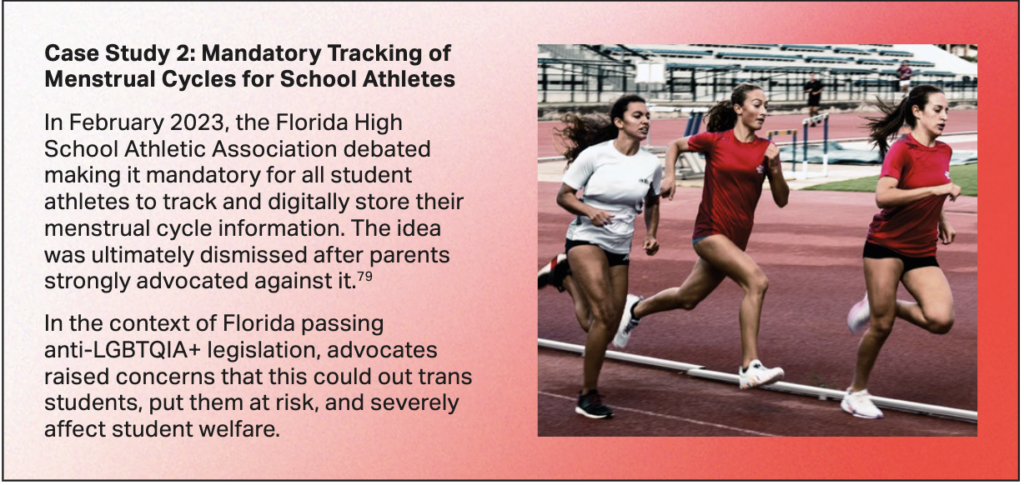
Case Study – Mandatory Tracking of Menstrual Cycles for School Athletes
Data flows in menstrual tracking ecosystems. Adapted from Felsberger (2025).
This case (Guardian staff reporter, 2023) demonstrates how women’s physical data can go beyond medical purposes and become part of the institutional screening mechanism. Although the national sports physical examination guidelines do suggest that doctors should be aware of the menstrual conditions of female athletes to identify potential health risks, the core of the controversy lies not in whether such information can be asked for, but in who can access this information and for what purposes it will be used.
Therefore, this case reminds us that the controversy over women’s health data is not limited to commercial platforms, but also exists in educational institutions and policy systems. Whether it is a women’s health app or a school medical form, they all reflect the same core issue:
When women’s health data is collected, is it serving health or management?
Conclusion
However, it is undeniable that even after the scandal involving the leakage of data and infringement of customer privacy caused by CTA, this type of software still retains a certain market share. CTA meets the health needs of users and is also an important health channel. Therefore, in this situation, I believe that users have little control over their own data and the use of the platform, and their situation is rather helpless.
Therefore, the aforementioned various unsafe, privacy-infringing and digital rights-violating behaviors have further highlighted the urgent need to strengthen laws and regulations, regulatory agencies, and the “Privacy Law”. Both users and platforms should conduct transactions based on absolute transparency and fairness.
The unfair and unsafe privacy practices in fertility apps illustrate to what extent modern data practices have disregarded the value and importance of privacy (Kemp, 2023). Therefore, the absence of dignity, privacy, and digital rights is also a fundamental issue that addresses the deep lack of respect for women, their bodies, reproductive privacy, and intimate relationships.
Finally, in the future digital environment, whether women (or members of other genders) can truly protect their personal privacy and exercise control over the interpretation and management of their own bodies is a topic that requires special attention from the legal, social and individual perspectives.
Reference List
Andrejevic, M. (2013). Infoglut: How Too Much Information Is Changing the Way We Think and Know. Routledge. https://doi.org/10.4324/9780203075319
Bobel, C. (2020). The Palgrave Handbook of Critical Menstruation Studies (C. Bobel, I. T. Winkler, B. Fahs, K. A. Hasson, E. A. Kissling, & T.-A. Roberts, Eds.). Springer Singapore. https://doi.org/10.1007/978-981-15-0614-7
Business. (2026). USA: California jury finds Meta breached period-tracking app users’ privacy – Business and Human Rights Centre. Business and Human Rights Centre. https://www.business-humanrights.org/en/latest-news/usa-california-jury-finds-meta-breached-period-tracking-app-users-privacy/
Felsberger, S. (2025, June 11). The High Stakes of Tracking Menstruation. Mctd.ac.uk. https://www.mctd.ac.uk/femtech-high-stakes-tracking-menstruation/
Financial Times. (2018). @FinancialTimes. https://www.ft.com/content/3cb056c6-d343-11e2-b3ff-00144feab7de
Flew, T. (2021). Regulating Platforms (p. 72). John Wiley & Sons.
Flo Health, Inc. (2020, October 15). Federal Trade Commission. https://www.ftc.gov/legal-library/browse/cases-proceedings/192-3133-flo-health-inc
Flo Reaches Settlement in Class Action Lawsuit After Judge Said He Would Toss Plantiffs’ Claim. (2025). Flo.health – #1 Mobile Product for Women’s Health. https://flo.health/newsroom/flo-reaches-settlement-in-class-action-lawsuit-after-judge-said-he-would-toss-plantiffs-claim
Friedlander, A., Greenhalgh, C., Thorpe, H., & Schmidt, J. (2025, June 19). Popular period-tracking apps can hold years of personal data – new NZ research finds mixed awareness of risk. The Conversation. https://theconversation.com/popular-period-tracking-apps-can-hold-years-of-personal-data-new-nz-research-finds-mixed-awareness-of-risk-258920
Guardian staff reporter. (2023, February 9). Florida cuts “humiliating” questions about school athletes’ menstrual histories. The Guardian; The Guardian. https://www.theguardian.com/sport/2023/feb/09/florida-cuts-humiliating-questions-about-school-athletes-menstrual-histories#img-1
Hammond, E., & Burdon, M. (2024). Intimate harms and menstrual cycle tracking apps. Computer Law & Security Review, 55, 106038. https://doi.org/10.1016/j.clsr.2024.106038
Kemp, K. (2023). Your Body, Our Data: Unfair and Unsafe Privacy Practices of Popular Fertility Apps. https://allenshub.unsw.edu.au/sites/default/files/2023-03/KKemp%20Your%20Body%20Our%20Data%2022.03.23.pdf
Lori, A. (2018). A New Privacy Paradigm in the Age of Apps (pp. 421–478). Wake Forest Law Review Association, Etc.
Merkatz, R. B. (1998). Inclusion of Women in Clinical Trials: A Historical Overview of Scientific Ethical and Legal Issues. Journal of Obstetric, Gynecologic & Neonatal Nursing, 27(1), 78–84. https://doi.org/10.1111/j.1552-6909.1998.tb02594.x
Privacy International. (2025, May). NO BODY’S BUSINESS BUT MINE. Privacy International. https://privacyinternational.org/sites/default/files/2025-05/period%20tracking%20with%20recs.pdf
Rajagopalan, M. (2019, September 9). Period Tracker Apps: Maya And MIA Fem Are Sharing Deeply Personal Data With Facebook. BuzzFeed News. https://www.buzzfeednews.com/article/meghara/period-tracker-apps-facebook-maya-mia-fem
Statista Research Department. (2025, March). Top grossing global period tracker apps 2023. Statista. https://www.statista.com/statistics/1307733/top-period-tracker-apps-worldwide-by-revenues/
Stewart, C. (2025, November). Size of the femtech market worldwide from 2023 to 2029. Statista. https://www.statista.com/statistics/1483460/femtech-market-size-worldwide/
Tin, I. (2016). The rise of a new category: Femtech. Helloclue.com. https://helloclue.com/articles/culture/rise-new-category-femtech
Van Dijck, J. (2014). Datafication, dataism and dataveillance: Big Data between scientific paradigm and ideology. Surveillance & Society, 12(2), 197–208. https://doi.org/10.24908/ss.v12i2.4776
Be the first to comment